Showing posts with label quotes - words to the wise?. Show all posts

Apr 22, 2025

Mike Adams on the coming collapse of the Trump administration (2025)

Prediction: We're going to start seeing resignations from the Trump administration.  It will start with people being FORCED out, possibly with Hegseth.  And then it will escalate as people FLEE the chaos and try to get far from the (political) blast damage radius.  The Trump administration is on the path of total self-destruction, and he's going to inflict trillions of dollars of irreversible damage on the U.S. economy and small businesses as he goes down with the Titanic.  This isn't 4D chess.  It's 2D cartoonish stupidity.  It takes a real idiot to do worse than the Democrats, but Trump is somehow managing it, not even 100 days into his new administration.  If he doesn't turn this ship around, it's over, and it won't be long before Trump is impeached and marched out of the White House as the U.S. economy collapses.  And no, I didn't vote for him.

~ Mike Adams, founder of Natural News, Twitter/X post, April 21, 2025


Jan 18, 2023

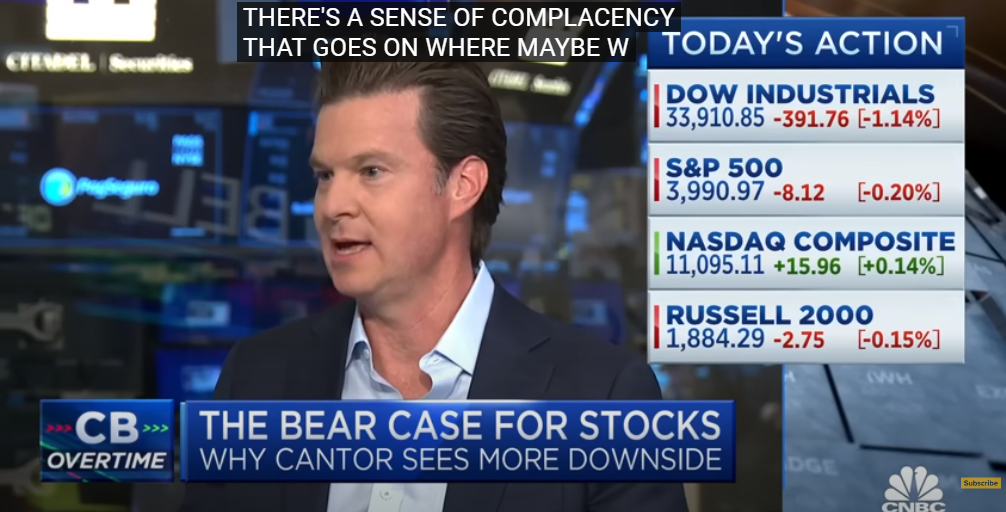
Eric Johnston on using the unemployment rate as a contrary indicator

If you look at the past selloffs in the market, they've all started with a very low unemployment rate.  So February of 2020?  That was a 50-year low unemployment rate.  2007?  That was a 6-year low unemployment rate.  In the bubble of 2000, everything felt great in February of 2000.  We were at a 30-year low unemployment rate.  Things felt great and then... things completely fell apart.  So in the beginning of these things, there's a sense of complacency that goes where "maybe we can get through this."  But the reality is, is that it always feels this way in the beginning.  We go in cycles and I think over time, if you sold a 3 1/2% to 4 1/2% unemployment rate and you bought a 10% unemployment rate, you would do very well.  And right now we are towards the end of the cycle, and whether the cycle ends in 2023 or '24, it's probably on its last legs.

~ Eric Johnston, Cantor Fitzgerald, CNBC interview with Scott Wapner, 2:20 mark, January 18, 2023


Sep 4, 2021

Jim O'Sullivan on the stimulus drug wearing off

People will be surprised at how much the economy decelerates over the next year as the stimulus boost fades.

~ Jim O'Sullivan, chief U.S. macrostrategist, TD Securities

(As quoted in "Biden's Challenge: A Wobbly Economy," The New York Times, September 1, 2021)


Dec 29, 2020

Marc Faber: "The Chinese economy will be the size of Europe and America combined"

If I were an American, I would hold some assets outside America and I would not only listen to the "China bashers," but also try to understand that the Chinese economy will be the size of Europe and America combined...  And whether you like the Chinese or not, and whether you're racist or not, I think that portfolios will have to own some assets in China, whether it's real estate or stocks or bonds.  In all the global indices, China is way underweight.  I have many friends - they invest in China - and they find world class companies.  Nobody can deny that Netease or Alibaba or Tencent are not world class companies.  There are also industrial companies.  There are also beverage companies that are world class. When Grant [Williams] asked the question, "How do you protect yourself?", I think you need an international diversification.  I think China is an option. 

~ Marc Faber, "The End Game Ep. 8 - Dr. Marc Faber," The Grant Williams Podcast, 1:03:50 mark, October 7, 2020


Jan 25, 2018

Jim Coulter on Davos 2018: "My biggest concern is how little concern there is"

My biggest concern is how little concern there is...  There's a risk that we've gone from the Goldilocks economy to the Pollyanna economy.

~ Jim Coulter, co-founder and CEO, TPG Capital, CNBC interview from Davos, 2018 World Economic Forum, January 25, 2018

Mar 25, 2011

Jeremy Siegel signals concern about Fed-caused price inflation

These inflation numbers are a bit troublesome. Oil continues to be strong, and it was strong even before we had the Mid East situation. Food, as we know, the biggest rise in 25 years on the Consumer Price Index, they can not ignore this forever and that's why my feeling is, you know Trichet has already said with the ECB, 'Maybe we'll raise in April,' that's certainly too soon for the Fed but I think by autumn, Bernanke's got to put out some words that he is thinking and looking at exiting from this enormously accomodative policy they've been following.

~Jeremy Siegel, professor of finance, Wharton School of Business, Bloomberg News interview, March 24, 2011

Mar 10, 2011

"Bond King" Jeff Gundlach says the muni market is the new subprime

You’ve got a history of low defaults, which is comforting. But that kind of sounds like what subprime sounded like back in 2006. You had a triple-A market that had never traded below par, the fundamentals were getting worse and it was owned for a technical reason. In the case of subprime, it was that triple-A rating that had such good treatment from the bank regulators, and the funds with their prospectuses could buy the triple-A rating and all of that.

And the muni market has never really had defaults and it's always had good recovery rates but the fundamentals are bad and its own for a technical reason, which is the tax benefit! People own it for the tax benefit.

I don't think you need to know what the default rates will be or how low 'low' is, munis are going to go down. There are going to be other shoes to drop. There might be so many that it looks like Imelda Marcos's closet when all of those shoes drop because all the states have to deal with this stuff.

Between here and the end game, lies the valley. And the valley is full of fear. I think the muni market is going to go down by at least, on the long end, something like 15 and 20 percent.

~Jeffrey Gundlach, CEO and "Bond King", DoubleLine Capital, CNBC interview, March 9, 2011 

Sep 25, 2010

Alan Abelson builds the skeptic's case against economic recovery

That the market is on a roll is undeniable (and who but a cockeyed grizzly would want to deny it). But what's providing the biggest lift is the prevailing investor tendency to respond like gangbusters to even a glimmer of good news and to ignore bad news no matter how telling. Take the response to the latest data on housing.

First came the disclosure that existing home sales were up 7.6% in August—immediately seized upon as evidence that housing was on the mend, supposedly a harbinger of an accelerated recovery and reason enough to take the plunge into equities. But it ain't necessarily so.

As Mark Hanson, of Hanson Advisors, is quick to point out, while last month's sales were better than economists' forecasts (most of whom never saw the housing crash coming), they were down 19% from sales in August '09, and inventory edged up to 11.6 months. That awesome pile of unsold homes all by itself is going to be exceedingly tough to unload.

Moreover, Mark warns that you better be prepared from here on for the full impact of the end of government stimulus, including some pretty irresistible tax breaks, which helped goose demand this year. The absence of such artificial resuscitation is likely to translate into extremely disappointing year-to-year comparisons, including more than a few months of double-digit declines in existing home sales. He also sees the heavy mass of foreclosures and so-called short sales "pushing median and average prices lower, quickly."

As for new home sales in August, they were flat at a pitiable annual rate of 0.288 million units, just a sneeze above May's all-time low of 0.282 million. As a matter of fact, Mark says August sales were the smallest for the month ever. And he notes that foreclosure starts and actual foreclosures were close to 300% of overall new home sales, which stacks up as "a huge obstacle to builder sales" as we head into the slow season for housing.

Again, maybe we're missing something, but a decent recovery without a revival in housing strikes us as a BLT on toast without bacon. It just isn't going to happen. But investors at the moment apparently couldn't care less.

~Alan Abelson, Barron's magazine, "The Bad News Bulls", September 25th, 2010

Jan 3, 2009

Alan Abelson on "widespread stealth bullishness"

We'll happily abandon our nagging negativism on the stock market when everyone stops saying it's time to buy because everyone's bearish. As was nicely enunciated last week by an options maven in this space, the professed ubiquitous bearishness doesn't square with unmistakable evidence of widespread stealth bullishness. We'll pay more heed to the optimism of the most luminous pundits, including those few who properly urged caution in advance of the debacle, when they stop offering projections five and seven years out in urging one and all to invest now.

~ Alan Abelson, "A Plague of Prophecy," Barron's, January 5, 2009

Jan 2, 2009

Bob Rodriguez on the futility of economic stimulus

[President-elect Barack Obama] will try to stimulate spending with one foot on the gas, while consumers are pushing on the brake [by saving.] We're in for a very discontinuous environment.

~ Bob Rodriguez, "The Doomsayers Who Got It Right," The Wall Street Journal, January 2, 2009, by Jeff Opdyke

(Thus, he says, the economy will sputter in fits and starts. The recession will deepen over the next six to 18 months.)

Jul 31, 2008

Marc Faber on the coming global bust

The Fed has created a bubble in everything - stocks in emerging market, real estate everywhere in the world, commodities, art. The only asset class that is down is the U.S. dollar.

It is quite likely that the current synchronized global economic boom and the universal, all-encompassing asset bubble will lead to a colossal bust. [With commodity prices so inflated, I expect an] increase in international tensions [over resources].

~ Marc Faber, "Even the pros may be stuffing the mattresses," ChicagoTribune.com, July 29, 2008, by Gail Marks Jarvis

Apr 26, 2008

Gary Shilling on biofuel schemes

With global recession, demand for industrial commodities and oil will fade. It will become clear that much of China's demand for commodities was not primarily to supply its citizens but to supply its export market.

No one will be talking anymore about how oil production is peaking. Look at Petrobras' huge oilfield discovery off Brazil and consider the gigantic energy supplies that will come from tar sands, nuclear, coal liquefaction and maybe shale. More supply equals lower prices.

Good weather and weak ethanol prices may knock down ag prices. A recent report in Science magazine has discredited many biofuel schemes as environmental salvations. We're going to stop fueling our cars with taco ingredients.

~ A. Gary Shilling, "Sell Commodities," Forbes, March 10, 2008

Feb 17, 2008

Jon Markman will eat his column if Citigroup or JPMorgan Chase turn around by the end of the year

If Citigroup or JPMorgan Chase beat any of the above-mentioned defensive stocks this year (JNJ, MO, MRK, MCD, HON, UTX, MMM) in a freakish turnaround, I will eat this column on a live webcast at noon Wednesday, Dec. 31, 2008.

~ Jon Markman, "10 market predictions for a glum '08," MSN.Money, January 4, 2008

Jan 31, 2008

Jacob G. Hornberger on the financial iceberg dead ahead

My advice? Given that the American people and their federal officials are not yet ready to give up on either their welfare state or the warfare state – and the massive expenditures that are needed to fund them, my advice would be the same I’d give to people on a ship heading directly toward an iceberg: Brace yourselves.

~ Jacob G. Hornberger, "Brace Yourselves," LewRockwell.com, January 30, 2008

Nov 1, 2007

Dennis Gartman on the dollar

Everybody, everywhere is short the dollar in any sort of manifestation they can get their hands on... In 35 years of watching markets, I cannot recall a single trade that has been this one-sided. And when the public gets that one-sided, it usually ends in tears.

~ Dennis Gartman, The Gartman Letter, as interviewed on Bloomberg Video, November 1, 2007

John Bennett: Bearish on China and the Baltic states

It's gone daft. Chinese stocks are in a bubble and the Baltic economies are overheating. They'll end up collapsing under their own weight.

The Fed keeps going back to easy money as a solution,'' Bennett said. ``It's indicative of what's going on around the world. The Fed sets the tone and the last thing these countries need is a looser monetary policy.

~ John Bennett, 44, oversees GAM's $1.1 billion European Equity Hedge Fund, "'Overheating' Emerging Markets Change Bennett Into Baltic Bear," Bloomberg.com, October 30, 2007

Oct 26, 2007

Hitwise: Searches for "housing bubble" hit 2-year low


As of the week ending February 17th 2007, searches for "housing bubble" have reached a two year low, only 4.4% of the searches on the same subject that occurred during the second week of June 2005. A media frenzy around a pending correction occurred that very same week, which demonstrates just how suggestible we are, as well as how short our attention spans can be.

But while the bubble seems not to be a major concern, there is a growing game of chicken between buyers and sellers. In the past, searches for "homes for sale" have outnumbered "homes for rent" by nearly 3 to 1. As of last week that margin was cut nearly in half as online domicile searchers indicated their willingness to at least explore renting pending a drop in home prices.

~ Bill Tancer, general manager of global research, Hitwise, "Will The Housing Bubble Burst in 2007?," Time, February 22, 2007

Thomas Donlan on the business of Wall Street

The work of Wall Street often is to introduce people who should not borrow to people who should not lend.

~ Thomas G. Donlan, Barron’s editor

Image result for thomas g donlan barron's

Oct 25, 2007

Jon Markman: Avoid bank and brokerage stocks

Somehow, the big banks have to find a way to retain investors' confidence despite a January that is likely to feature many of the same problems we witnessed earlier this month. In early October, you may recall, institutions such as Wachovia (WB, news), Bank of America (BAC, news) and Merrill Lynch (MER, news) did an about-face from assertions that their businesses were not harmed by the credit crunch when they announced massive write-downs on asset-backed paper.

Investors will let them get away with that sort of rudeness only once. If the banks do it again -- after potentially being forced to take a lot of debt onto their balance sheets from failed "structured investment vehicles" -- shareholders are likely to slaughter the bank stocks, pushing them down at least another 20%.

[Banking analyst Richard] Bove contends that for every $1 in uncollected debts that they have written off so far, the banks have uncovered another $2.50 from failed mortgages, auto loans and commercial lending. "Bad loans are going onto their balance sheet faster than they can write them off," he said.

Once investors determine that the banks' bad loans are out of control and that the risk cannot be adequately measured, they will sell first and ask questions later. So, we are about to enter even more interesting times. A debt-led recession punctuated with joblessness and foreclosure is almost certainly en route. The only questions are whether it comes early next year or in 2009, and how deep a hole we'll need to dig for the burial. Whatever the timing or depth, continue to avoid the bank and brokerage stocks.

~ Jon Markman, "Why we need a recession -- soon," MSN Money, October 25, 2007

Jon Markman: Bankers are like heroin dealers

Just as heroin dealers are in business to sell drugs, banks are in business to make loans. Their financial engineers will do everything in their power to force debt down consumers' throats -- and then find ways to keep them on the hook for it as long as possible. Although they talk a big story about encouraging responsibility in borrowing, they actually want consumers to max out their credit cards and to take large home-equity lines of credit, small-business loans and car loans, with the goal of having customers pay interest as long as humanly possible.

~ Jon Markman, "Why we need a recession -- soon," MSN Money, October 25, 2007