Within a week’s time, protectionists claim that tariffs will generate more tax revenue (including the absurd claim that the tax revenue will be paid by foreign exporters), protect and/or repatriate manufacturing jobs to American shores, punish trading partners who don’t “play by the rules”, make America more self-sufficient in key industries, and not cause prices to rise. Whew! That’s quite a lot of promises, and they conflict with one another. For example, will tariffs generate tax revenue or cause production to be repatriated to America? You can’t have it both ways.
Showing posts with label protectionism. Show all posts
Jun 5, 2025
Patrick Barron on Trump's protectionist promises
Probably the most galling claim is that the protectionists want to force the rest of the population to buy only American products in order to benefit stockholders and workers in key industries. There is no recognition that this claim cannot be fulfilled unless whatever benefit accrues to key industries must come at the expense of everyone else. In other words, protectionists tout the concentration of benefits and keep quiet about the diffusion of cost. But the costs are there, even if widely diffused. Protectionism really isn’t a theory of betterment for all but a claim that certain people in certain occupations are special. They must be paid more handsomely than the market, meaning you and me, wishes to pay.
~ Patrick Barron, "The Protectionists Have No Theory," Going Postal, June 5, 2025
May 14, 2025
Murray Rothbard on the protectionist scheme
As we unravel the tangled web of protectionist argument, we should keep our eye on two essential points: (1) protectionism means force in restraint of trade; and (2) the key is what happens to the consumer. Invariably, we will find that the protectionists are out to cripple, exploit, and impose severe losses not only on foreign consumers but especially Americans. And since each and every one of us is a consumer, this means that protectionism is out to mulct all of us for the benefit of a specially privileged, subsidized few – and an inefficient few at that: people who cannot make it in a free and unhampered market.
~ Murray Rothbard, “Protectionism and the Destruction of Prosperity,” 1986
Apr 2, 2025
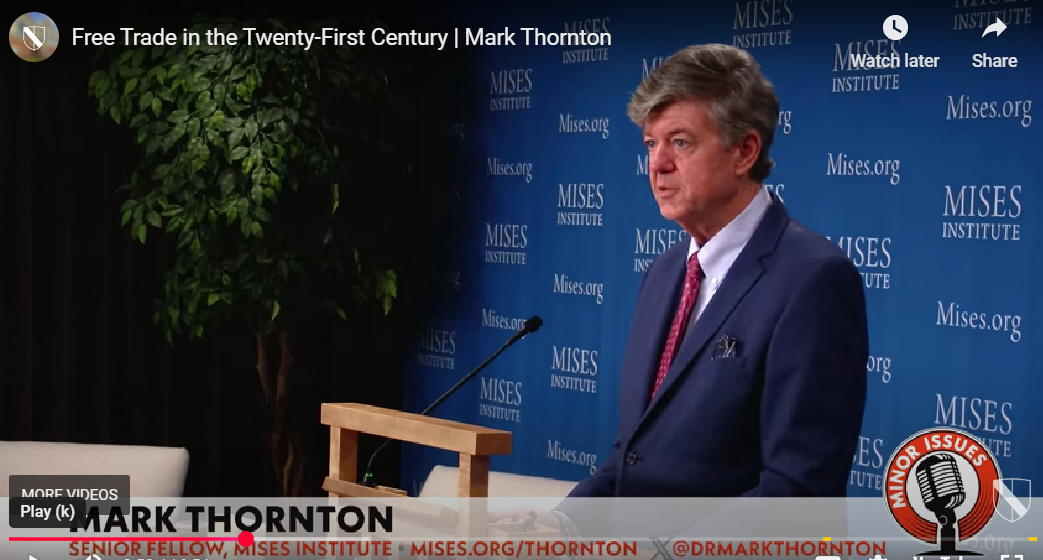
Mark Thornton on protectionism
It's important that Austrians and friends of the Austrian School realize that protectionism is just a step forward to war. It's a step forward to human impoverishment and it's a step towards human division, hate and devolution. Protectionism is the health of the state.
~ Mark Thornton, "Free Trade in the Twenty-First Century," Minor Issues, 3:40 mark, March 29, 2025
Mar 17, 2025
JD Vance: "If you want to be rewarded, build in America"
We started a great American comeback. [We will] make it easier and more affordable to make things in the United States... This is not always easy and it doesn't happen overnight... I have to be honest with you. The road ahead is long, but we are ready - in just seven weeks - starting to see early indications of the president's vision becoming our shared American reality.
[...]
If you want to be rewarded, build in America. If you want to be penalized, build outside of America. [prompting chants of "USA! USA!"] It's as simple as that.
[...]
If we do not protect our nation's manufacturers, we lose a fundamental part of who we are as a people. Making things, building things, working with our hands is America's heritage. When we lose the ability to make our own stuff, we abandon a way of life.
~ Vice President JD Vance, speech given to plastics manufacturing facility in Michigan, March 14, 2025
(Source: "Vance says U.S. manufacturing can rebound despite tariff jitters, falling markets," The Philadelphia Enquirer, March 15, 2025)
Labels:
manufacturing,
mercantilism,
people - Vance; JD,
protectionism
Mar 16, 2025
Ray Dalio: trade wars lead to conflict
Sara Eisen: Is a trade war healthy? [...] Where does the trade tensions and tariffs ratcheting it up fit, whether it's the external order of what do you think will ultimately happen as a result of all of this?
Ray Dalio: It's just an extension of the patterns of history. So for example, if you looked at European countries in the '30s, like Germany in the '30s and taking economic policy, there was write down the debts, create tariff revenue because you can get a lot of money from tariff revenue, then build up your domestic [industry] - be nationalist, be protectionistic, be militaristic. That is the way these things operate.
So I would say lessons from the past of what that looks like. And the issue is really the confrontation of all of this, the fighting of all of this. So tariffs are going to cause fighting between countries. What kind of fighting? Maybe military, I'm not necessarily talking military, but think about U.S., Canada, Mexico, China and all of those types of fighting. There will be fighting and that will have consequences. And I think that's the main thing to pay attention to.
Sara Eisen: Do you worry about what it will do to the global economy... as a result of all the trade barriers?
Ray Dalio: Of course. I worry about the global economy and the global well being... but I also should emphasize that in history you can see that there are the major countries [involved in the conflict] and then there are the neutral countries. And the neutral countries do extremely well during these periods of time. They get people and capital that go to them, they are able to navigate in a certain way. The making of great prosperity, it doesn't effect the whole world; there are beneficiaries of this, too. Like Singapore, if it remains a neutral country - and that's a very difficult thing to do - and it operates this way, it becomes great opportunities.
~ Ray Dalio, "Ray Dalio and Salesforce’s Benioff on AI, trade wars and new world order," CNBC International Live, 18:40 mark, March 14, 2025
Labels:
1930s,
militarism,
nationalism,
people - Dalio; Ray,
protectionism,
trade war
Jan 31, 2025
Tom DiLorenzo on Donald Trump's admiration for William McKinley
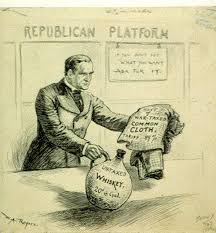
Lo and behold, President Trump has discovered a new political hero to idolize: President (1897-1901) William McKinley of Ohio whose election was orchestrated by the wealthiest man in Ohio (and the U.S.), John D. Rockefeller, who ran the Standard Oil Company out of his Cleveland home. McKinley is President Trump’s new hero because he was known as a congressman as the most rabid Republican party protectionist in a party that was founded on the principle of protectionism (and of corporate welfare and a national bank) in the mid 1850s. The 1890 McKinley tariff was named after Representative William McKinley because of his notoriety as a tool of the Northern manufacturing plutocracy. It created the highest average tariff rate in U.S. history up to that point and targeted such items as wool and tin with especially high tariff taxes, some exceeding 100 percent. It caused such a spike in the prices of such items that in the next election the Republican party was wiped out, losing both houses of Congress and the White House, with the Democrat party having a 2-1 advantage in the House. Free trader Grover Cleveland became president. McKinley himself was defeated and was installed by the Rockefeller machine as the governor of Ohio.
The Rockefeller machine got McKinley elected president in 1896. One of his first “accomplishments” in 1897 was to repeat the political disaster of the McKinley Tariff Tax by signing the Dingley Tariff Tax which created another highest average tariff rate in history. The people be damned; by that point the Republican party had created a government by the Northern corporate plutocracy, for the corporate plutocracy, of the corporate plutocracy. President Trump’s kind of people.
McKinley was also a notorious imperialist, waging an imperialistic war against Spain (the Spanish-American War) during which the U.S. government conquered Cuba, Puerto Rico, and the Philippines, leading the great Yale University libertarian scholar William Graham Sumner to author his famous article, “The Conquest of the United States by Spain.” The Spanish-American War, Sumner wrote, turned the U.S. into an imperialist power, just like the thoroughly corrupt and bankrupted Spanish empire. (All empires, by the way, view their populations as good for two things: as taxpayers and cannon fodder in the empire’s wars. Fast forward to today’s world and the incoming president is proposing a takeover of Greenland, part of Panama, and Canada “for national security reasons.”
~ Thomas DiLorenzo, "How the McKinley Tariff Almost Destroyed the Republican Party," LewRockwell.com, December 31, 2024
Jan 30, 2025
Tom DiLorenzo on Donald Trump's "populism"
President Trump’s election is said to be a “populist” victory against the deep state establishment, but there is nothing more anti-populist than protectionist tariff taxes. Protectionist tariff taxes are nothing more than a price-fixing conspiracy orchestrated by the state that enriches a relatively small group of politically connected corporations (and their unions) by plundering their consumers with higher prices. After all, if it is possible to use tariffs to force foreigners to pay a county’s taxes, every government on earth would be doing it. Yet President Trump apparently believes that he has discovered some kind of holy grail of economics that proves you can get something for nothing after all.
~ Thomas J. DiLorenzo, William McKinley: Prostitute of Protectionism, Mises Wire, January 29, 2025
Dec 30, 2024
Kevin Duffy on Trump, trade and tariffs
Outside of Trump’s inner circle, nearly everyone seems to understand the destructive nature of tariffs, even Keynesian economists and Trump voters. After the election, the stocks of dollar stores immediately sold off on concerns the industry would face higher costs in a trade war with China, no doubt passed on to their lower- and middle-income customers. Investors, at least for now, are downplaying these risks.
The problem is that the very essence of Trump is that of a pragmatic, businesslike interventionist who thinks trade is “negotiable” and “reciprocal.” In a sense, he
is right: trade is mutually beneficial, but to the parties involved, its terms are negotiated by the parties involved and each gives up something to get something in return. However, when a third party, in this case the government, interferes, it can only interject its own wants and needs. It does so through violence, i.e. it gives up nothing and benefits at the expense of those who would otherwise trade with each other. While the state gains power, both parties to the trade are made poorer.
Protectionism prevents a nation’s consumers from securing the best products at the lowest prices around the world. It also denies producers and distributors the cheapest inputs and best deals. Trade and peace go hand in hand. A healthy global economy and rising living standards require expanding trade, specialization and the division of labor. Protectionism moves in the opposite direction, towards self-sufficiency, nationalism and ultimately impoverishment.
When Trump threatens 100% tariffs on anyone who refuses to trade in U.S. dollars, he is playing with fire. In response to the Smoot-Hawley tariff of 1930, global trade plummeted 65%, plunging the world into depression and laying the groundwork for nationalism, authoritarianism and world war.
~ Kevin Duffy, "Great Expectations: Handicapping Trump 2.0," The Coffee Can Portfolio, December 20, 2024
Sep 23, 2024
Office of the Historian on the Smoot-Hawley tariff
Scholars disagree over the extent of protection actually afforded by the Smoot-Hawley tariff; they also differ over the issue of whether the tariff provoked a wave of foreign retaliation that plunged the world deeper into the Great Depression. What is certain, however, is that Smoot-Hawley did nothing to foster cooperation among nations in either the economic or political realm during a perilous era in international relations. It quickly became a symbol of the “beggar-thy-neighbor” policies of the 1930s. Such policies, which were adopted by many countries during this time, contributed to a drastic contraction of international trade. For example, U.S. imports from Europe declined from a 1929 high of $1,334 million to just $390 million in 1932, while U.S. exports to Europe fell from $2,341 million in 1929 to $784 million in 1932. Overall, world trade declined by some 66% between 1929 and 1934.
Smoot-Hawley marked the end of the line for high tariffs in 20th century American trade policy. Thereafter, beginning with the 1934 Reciprocal Trade Agreements Act, the United States generally sought trade liberalization through bilateral or multilateral tariff reductions. To this day, the phrase “Smoot-Hawley” remains a watchword for the perils of protectionism.
~ Office of the Historian, "Protectionism in the Interwar Period"
Labels:
Great Depression,
protectionism,
Smoot-Hawley tariff
Dec 1, 2023
Ludwig von Mises on protectionism
The philosophy of protectionism is a philosophy of war. The wars of our age are not at variance with popular economic doctrines; they are, on the contrary, the inescapable result of consistent application of these doctrines.
~ Ludwig von Mises, Human Action, p. 683
Labels:
people - Mises; Ludwig von,
protectionism,
war
Jul 17, 2023
Walter Block on protectionism
Protectionism is a misnomer. The only people protected by tariffs, quotas and trade restrictions are those engaged in uneconomic and wasteful activity. Free trade is the only philosophy compatible with international peace and prosperity.
~ Walter Block
Labels:
free trade,
people - Block; Walter,
protectionism
Jun 22, 2023
David Laband on "unfair competition"
Every effort by small businessmen to forestall the building of a Wal-Mart is an attempt to shoot the messenger rather than pay heed to the message. Local economies do not go to pot when Wal-Marts are built. Quite the opposite: Sam Walton once said, "There was a lot more business in those towns than people ever thought."
(Article was reprinted in The Spirit of Freedom: Essays in American History, edited by Burton W. Folsom, Jr. This quote appears on pp. 197-198.
Without question, each Wal-Mart and Sam's store alters the structure of local unemployment. The sons and daughters of local businessmen and women no longer follow in their parents' proprietary footsteps. Now they, as well as many other local workers, go to work for Uncle Sam (Walton). Thus, the overall rate of local employment is generally not adversely affected. While we may feel sorry for the personal losses suffered by the owners of these no-longer competitive small firms, the aggregate benefits reaped by (all-too-often- forgotten) consumers, including those same small businessmen, outweigh their losses...
The pleas to local zoning boards and planning commissions for protection from "unfair competition" by small businesses faced with the prospect of having to compete with a new Wal-Mart store sound identical to the rhetoric employed by mouthpieces for the Big Three automobile companies, the textile and steel industries, sugar producers, and every other domestric industry seeking to restrict foreign sales of these products in America. To kick Japanese and other foreign producers out of American markets is to deny the benefits of Sam Walton-esque competition.
[...]
By invoking the rhetoric of "unfair competition," domestic firms seek deliberately to mislead consumers into thinking that protection of competitors is the same thing as protection of competition. Nothing could be further from the truth. Protection of the existing firms in an industry against more efficient competitors, be they American or foreign, insulates those firms from the forces of competition. American consumers are the worse for it: they pay higher prices for shoddier products than would be available in a more competitive environment.
Japan-bashing is equivalent to Sam Walton-bashing. The principles of competition are universal, whether the competitors are domestic or foreign. The fact that sellers are foreign does not diminish the potential gains to American consumers from competition between sellers. If we're going to lionize Sam Walton, consistency demands that we lionize every successful producer in the global economy.
~ David N. Laband, "Lessons from an Entrepreneur," The Freeman, September 1992
Dec 12, 2022
Donald Boudreaux on protectionism
It’s easy to understand, and excuse, intellectually unengaged people falling for protectionist fables. And there’s certainly no mystery as to why business executives and politicians often endorse protectionist policies: protective tariffs and subsidies swell the wallets and purses of the executives, and enhance the electoral prospects of the politicians. But it’s always baffled me that protectionism is championed by so many learned and intellectually active people who have nothing personally to gain from protectionism.
After all, the argument against protectionism is, as they say, not rocket science. Indeed, it can be grasped by a reasonably alert eighth grader: because the very essence of protectionist policies is to forcibly reduce the supplies of goods and services available in the home country, protectionism reduces the quantity of goods and services available, on average, for each citizen of the home country to consume. Protectionism makes people in the home country poorer than they would be otherwise.
Although the argument against protectionism is simple, some intellectual effort is required to understand the fact that imports do not increase overall unemployment in the home country. A few moments of cogitation are necessary to grasp the reality that imports are not gifts, but instead represent foreigners’ demands for our exports or to invest in our country. Some thought deeper than the surface must be made to understand that when we import more, we either export more, or we witness the capital stock of our country growing larger than otherwise, and both of these outcomes create jobs to offset the jobs that are “destroyed” by imports.
~ Donald J. Boudreaux, "The Libido for the Superficial," American Institute for Economic Research, December 8, 2022
Oct 18, 2021
Kevin Duffy on the national defense case for free trade
Life is about tradeoffs. Yes, we can protect this or that industry, but there is a cost: lower living standards. With that comes fewer resources for things like defense.
Second, where does it end? Once you start protecting one industry under the national defense excuse, they'll all scream for protection.
Third, and perhaps most important, the interdependence gained through trade is our best defense! As Bastiat pointed out nearly two centuries ago, countries that trade with each other have an economic deterrent to fight each other (war is an extremely costly endeavor).
Fourth, protectionism invites a bigger role for government (which it gladly accepts). That means less individual freedom and more dependence on government.
Fifth, the United States has the most defendable position on earth. We are surrounded by two oceans and two friendly neighbors, account for 40% of global military expenditures, and have an arsenal of nuclear weapons that can wipe out mankind many times over. We also have one of the highest gun ownership rates in the world, a second line of defense.
Imho, neutrality (which the founders advised) and free trade would make us far more prosperous AND secure.
~ Kevin Duffy, Facebook post, October 18, 2021
Oct 27, 2020
Murray Rothbard on protectionism
In the host of special interests using the political process to repress and loot the rest of us, the protectionists are among the most venerable. It is high time that we get them, once and for all, off our backs, and treat them with the righteous indignation they so richly deserve.
~ Murray Rothbard, Making Economic Sense (1995), "Smashing Economic 'Theory' (Again)"
Aug 9, 2020
Donald Trump on reimposing 10% aluminum tariffs on Canada
Canada was taking advantage of us, as usual. The aluminum business was being decimated by Canada, very unfair to our jobs and our great aluminum workers.
~ President Donald Trump, August 7, 2020
Labels:
aluminum,
Canada,
import tariffs,
people - Trump; Donald,
protectionism
Mar 2, 2020
Frédéric Bastiat on the three economic "isms"
Protectionism, socialism, and communism are basically the same plant in three different stages of its growth.
~ Frédéric Bastiat
~ Frédéric Bastiat
Jan 18, 2020
Tom DiLorenzo on Lincoln's economic ignorance regarding protectionist tariffs (in his own words)
LINCOLN WAS ECONOMICALLY IGNORANT OF THE BIG ECONOMIC ISSUE OF HIS DAY: PROTECTIONIST TARIFFS
“[A] tariff of duties on imported goods . . . is indispensably necessary to the prosperity of the American people.” (The Collected Works of Abraham Lincoln, Vol. I, p. 307.)
“[B]y the tariff system . . . the man who contents himself to live upon the products of his own country, pays nothing at all.” (CW, Vol. I, p. 311).
“All carrying . . . of articles from the place of their production to a distant place for their consumption . . . is useless labor.” (CW, Vol. I, p. 409).
“I was an old Henry Clay tariff whig. In old times I made more speeches on that subject, than on any other. I have not changed my views.” (CW, Vol, III, p. 487).
“The tariff is to the government what a meal is to a family . . .” (CW, Vol., IV, p. 211).
“I must confess that I do not understand the subject [the economics of tariffs].” (CW, Vol. IV, p. 211).
~ Tom DiLorenzo, "The Real Lincoln in His Own Words," LewRockwell.com, June 5, 2013
“[A] tariff of duties on imported goods . . . is indispensably necessary to the prosperity of the American people.” (The Collected Works of Abraham Lincoln, Vol. I, p. 307.)
“[B]y the tariff system . . . the man who contents himself to live upon the products of his own country, pays nothing at all.” (CW, Vol. I, p. 311).
“All carrying . . . of articles from the place of their production to a distant place for their consumption . . . is useless labor.” (CW, Vol. I, p. 409).
“I was an old Henry Clay tariff whig. In old times I made more speeches on that subject, than on any other. I have not changed my views.” (CW, Vol, III, p. 487).
“The tariff is to the government what a meal is to a family . . .” (CW, Vol., IV, p. 211).
“I must confess that I do not understand the subject [the economics of tariffs].” (CW, Vol. IV, p. 211).
~ Tom DiLorenzo, "The Real Lincoln in His Own Words," LewRockwell.com, June 5, 2013
Jan 10, 2020
Q&A with Tom DiLorenzo about the Civil War
Q: Were Confederate soldiers fighting to defend slavery even though the vast majority were not slaveholders?
DiLorenzo: There was no need to go to war to "defend slavery." Lincoln guaranteed it in his first inaugural address by endorsing the Corwin Amendment.
Q: South Carolina gave 17 reasons after the 1860 election for seceding, including the protection of slavery. How big a factor was slavery?
A: Why states seceded and why there was a war are two totally different questions. There is no question that Lincoln invaded the South over tax collection, as he promised/threatened in his first inaugural address, his "slavery forever" speech. Tariffs were constitutional, so to justify secession on a constitutional basis some of the southern states cited non-enforcement of the fugitive slave clause of the constitution. In the words of Lincoln and the U.S.Congress (read the Crittenden Compromise), slavery had nothing whatsoever to do with why they invaded the southern states.
Q: How much did the prevalence of economic fallacies, especially the uncertainty of what freed blacks would have on the economy, contribute to the war on both sides?
A: Economic fallacy is the ideological bedrock of mercantilism, and mercantilism is what the Republican Party always stood for.
Q: You’ve written about how Lincoln trotted out practically every economic fallacy in the book. Did he actually believe in these fallacies or was he simply a selfish politician pushing a corrupt policy and using any means at his disposal?
A: Lincoln had a long career as a trial lawyer and as you know, most trial lawyers are in the business of throwing rhetorical mud against the wall to see if it sticks to promote their clients' interests, so I suspect he just adopted any economic fallacy that he could find to justify protectionism, corporate welfare, and a national bank run by politicians. He had spent a quarter of a century doing just that before becoming president.
Q: Did Lincoln’s attitude toward Southerners mellow at all during the war and after? It seems he greatly underestimated the cost and time it would take. Did he have any regrets? Had he not been assassinated, would he have handled Reconstruction any differently than the Andrew Johnson administration?
A: Lincoln celebrated Sherman and Sheridan's war crimes up to the very end, he promoted them, and the Republican Party made national heroes out of them. His speech writers like Seward made him sound magnanimous, but look at what he did-- orchestrating total war on Southern CIVILIANS to the very end. The party of Lincoln did what their namesake would have done during Reconstruction -- continue to plunder the South for the benefit of party hacks and the Northern plutocracy while doing next to nothing for the ex slaves.
Duffy: Thank you!
~ Tom DiLorenzo, author of The Real Lincoln and Lincoln Unmasked, answers to questions from Kevin Duffy, January 9, 2020
DiLorenzo: There was no need to go to war to "defend slavery." Lincoln guaranteed it in his first inaugural address by endorsing the Corwin Amendment.
Q: South Carolina gave 17 reasons after the 1860 election for seceding, including the protection of slavery. How big a factor was slavery?
A: Why states seceded and why there was a war are two totally different questions. There is no question that Lincoln invaded the South over tax collection, as he promised/threatened in his first inaugural address, his "slavery forever" speech. Tariffs were constitutional, so to justify secession on a constitutional basis some of the southern states cited non-enforcement of the fugitive slave clause of the constitution. In the words of Lincoln and the U.S.Congress (read the Crittenden Compromise), slavery had nothing whatsoever to do with why they invaded the southern states.
Q: How much did the prevalence of economic fallacies, especially the uncertainty of what freed blacks would have on the economy, contribute to the war on both sides?
A: Economic fallacy is the ideological bedrock of mercantilism, and mercantilism is what the Republican Party always stood for.
Q: You’ve written about how Lincoln trotted out practically every economic fallacy in the book. Did he actually believe in these fallacies or was he simply a selfish politician pushing a corrupt policy and using any means at his disposal?
A: Lincoln had a long career as a trial lawyer and as you know, most trial lawyers are in the business of throwing rhetorical mud against the wall to see if it sticks to promote their clients' interests, so I suspect he just adopted any economic fallacy that he could find to justify protectionism, corporate welfare, and a national bank run by politicians. He had spent a quarter of a century doing just that before becoming president.
Q: Did Lincoln’s attitude toward Southerners mellow at all during the war and after? It seems he greatly underestimated the cost and time it would take. Did he have any regrets? Had he not been assassinated, would he have handled Reconstruction any differently than the Andrew Johnson administration?
A: Lincoln celebrated Sherman and Sheridan's war crimes up to the very end, he promoted them, and the Republican Party made national heroes out of them. His speech writers like Seward made him sound magnanimous, but look at what he did-- orchestrating total war on Southern CIVILIANS to the very end. The party of Lincoln did what their namesake would have done during Reconstruction -- continue to plunder the South for the benefit of party hacks and the Northern plutocracy while doing next to nothing for the ex slaves.
Duffy: Thank you!
~ Tom DiLorenzo, author of The Real Lincoln and Lincoln Unmasked, answers to questions from Kevin Duffy, January 9, 2020
Jan 5, 2020
Abraham Lincoln on his political agenda
I presume you all know who I am. I am humble Abraham Lincoln. I have been solicited by many friends to become a candidate for the legislature. My politics are short and sweet, like the old woman's dance. I am in favor of a national bank... in favor of the internal improvements system and a high protective tariff.
~ Abraham Lincoln, upon first running for public office, 1832
(as quoted by Tom DiLorenzo in The Real Lincoln, p. 54)
~ Abraham Lincoln, upon first running for public office, 1832
(as quoted by Tom DiLorenzo in The Real Lincoln, p. 54)
Subscribe to:
Posts (Atom)