Showing posts with label war. Show all posts

Apr 21, 2026

Bob Dylan on war and religion

Oh, my name, it ain't nothin', my age, it means less 
The country I come from is called the Midwest
I's taught and brought up there, the laws to abide 
And that the land that I live in has God on its side
 
Oh, the history books tell it, they tell it so well 
The cavalries charged, the Indians fell 
The cavalries charged, the Indians died 
Oh, the country was young with God on its side 
 
The Spanish-American War had its day
And the Civil War too was soon laid away 
And the names of the heroes I was made to memorize 
With guns in their hands and God on their side
 
The First World War, boys, it came and it went 
The reason for fightin' I never did get 
But I learned to accept it, accept it with pride 
For you don't count the dead when God's on your side
 
The Second World War came to an end 
We forgave the Germans, and then we were friends 
Though they murdered six million, in the ovens they fried 
The Germans now too have God on their side 
 
I learned to hate the Russians all through my whole life 
If another war comes, it's them we must fight 
To hate them and fear them, to run and to hide 
And accept it all bravely with God on my side 
 
But now we've got weapons of chemical dust
If fire them we're forced to, then fire them we must 
One push of the button and they shot the world wide 
And you never ask questions when God's on your side 
 
Through many dark hour I been thinkin' about this 
That Jesus Christ was betrayed by a kiss 
But I can't think for you, you'll have to decide 
Whether Judas Iscariot had God on his side 
 
So now as I'm leavin', I'm weary as hell 
The confusion I'm feelin' ain't no tongue can tell 
The words fill my head, and they fall to the floor 
That if God's on our side, he'll stop the next war
 
~ Bob Dylan, "With God With God on Our Side," 1964
 
song and lyrics by Bob Dylan | Spotify 

Mar 13, 2026

Doug Casey on international law

Here’s an analogy. Look at the world of international law as a sleazy nightclub with 200 customers. Some are going to be raucous, some will be quiet; some are friendly, some are aggressive; some smart, some stupid. 

There will always be a few gangbangers who don’t like each other, some townies who hate the preppies, some junkies, a couple of ex-cons, and a few psychos. And there’s no cop to keep order. The world is just like that bar. No written rules, just some vague understandings. And lots of misunderstandings. Like in any bar, customers size each other up, deciding who to drink with, who’s looking for trouble, or, if you’re a bad actor, who you can beat up and roll.

The US used to be the toughest customer in the saloon of international law, buying friends with free drinks. But he’s turned into a mean drunk who’s overdrawn his tab. The other customers who used to tolerate his eccentricities have started to dislike, disrespect, and resent him. It will probably end up like an altercation in Deadwood’s Gem Saloon.

~ Doug Casey, "Cost of the Iran War—and Why It Will Fuel Inflation," International Man, March 13, 2026

Al Swearengen & the Gem Saloon 

Mar 8, 2026

Napoleon Bonaparte on war blunders

Never interrupt an enemy when he is making a mistake.

~ Napoleon Bonaparte

Napoleon I | Biography, Achievements ... 

Sun Tzu on avoiding conflicts

If you sit by the river long enough, you will see the body of your enemy float by.

~ Sun Tzu

There is a profound wisdom hidden in ... 

Sep 5, 2025

Kevin Duffy on wars in the Middle East

Wars are the embodiment of collective delusions.  The same laws that govern bubbles apply: the madness of crowds, intolerance for dissent, promotion of false and simple narratives and a rush of euphoria that brings about an orgy of poor decisions.  The good news is that all bubbles eventually burst, reversing a long, ruinous trend and exposing the false belief that supports them.  

In the Middle East there are multiple delusions taking place.  The first is that Israel has a history of acting in self-defense.  The second is that the U.S. has long been a “global force for good.”  The third is that Donald Trump is opposed to “forever wars” and a threat to the military industrial complex.

~ Kevin Duffy, "The End of the Innocence: American Foreign Policy in the Middle East," The Coffee Can Portfolio, August 27, 2025


Jun 18, 2025

Bertrand Russell on war

War does not determine who is right, only who is left.

~ Bertrand Russell


Jun 12, 2025

Kevin Duffy on modern warfare

Warfare today is all about pinning the “aggressor” label on the opposing side and claiming victim status.  This allows the self-proclaimed victim to act with impunity – civilians be damned – all in the name of “self-defense.”  Thus modern warfare is filled with an endless litany of false flag operations, baiting the other side into firing the first shot, preemptive strikes and sensationalized propaganda (usually involving “killing babies”) all meant to gain the moral high ground and justify cutting the dogs of war loose.

~ Kevin Duffy, "Gaza: What Would Rothbard Think?," The Libertarian Alliance, June 8, 2025


Oct 10, 2024

Kevin Duffy on the Left and Right

Both sides engage in different forms of tribalism.  The Left is at war with the rich.  The Right is at war with various boogeymen around the world.  Left and Right are at war with each other. 

The state absolutely THRIVES on tribalism.  It's like oxygen.  "War is the health of the state." 

~ Kevin Duffy, tweet, October 9, 2024


Sep 27, 2024

Jim Grant on inflation and war

If there's one sure, history-validated cause of inflation, it's war.  It's the activity, which, if carried on at scale, activates the money-printing presses, propels government spending and up-ends public expectations, all to the end of destroying life, property and, not infrequently, currencies.  Abstracting from a particular casus belli, war is malinvestment on a GDP-level scale, an economic calamity for the loser and no certain boon for the winner.  Yet war is what humanity wages.  We the people (through the agency of our tribes and governments) have fought since time immemorial, and the United Nations won't stop us now.

~ Jim Grant, "Where inflation comes from," Grant's Interest Rate Observer, September 27, 2024


May 24, 2024

Murray Rothbard on determining the aggressor in war

Just because all sides share in the ultimate State-guilt, does not mean that all sides are equally guilty. On the contrary, in virtually every war, one side is far more guilty than the other, and on one side must be pinned the basic responsibility for aggression, for a drive for conquest, etc. But in order to find out which side to any war is the more guilty, we have to inform ourselves in depth about the history of that conflict, and that takes time and thought--and it also takes the ultimate willingness to become relevant by taking sides through pinning a greater degree of guilt on one side or the other. 

~ Murray Rothbard, "War Guilt in the Middle East," 1967


May 22, 2024

Lew Rockwell on Hitler's modest plans before 1939

The neocon efforts to demonize the enemy are nothing new, and in what follows, I’m going to discuss a number of examples to show how pervasive this pattern has been in involving America in unnecessary, destructive, and costly wars. 

Let’s begin with the most salient case of all.  For the neocons, it’s always Hitler.  The Munich Conference of 1938 shows what happens when we fail to stand up against evil.  The facts don’t bear out what they say.  Hitler was indeed an evil dictator, but America had no valid reason to go to war against him.  Hitler did not aim to attack the United States, and fighting against him helped Stalin, who killed more people than Hitler did, in taking control of Eastern Europe. 

Furthermore, Hitler’s policies during the 1930s aimed at the peaceful revision of the punitive and unjust Treaty of Versailles.  A European War resulted only after the unwise and unenforceable British and French guarantee of the Western boundary of Poland.  The eastern boundary against Russia was not guaranteed, and Poland lost territory to Russia after the Russians invaded Poland on September 17, 1939. 

The great Murray Rothbard notes that Hitler’s policy before 1939 was improvised, responding to particular circumstances.  He did not have a plan for “world conquest” as the neocons continue to allege today.  “Hitler was not bent on world conquest, for which he had armed Germany to the teeth and constructed a ‘timetable.’  Hitler, in brief, (in foreign affairs) was not a uniquely evil monster or daimon, who would continue to gobble up countries diabolically until stopped by superior force.  Hitler was a rational German statesman, pursuing — with considerable intuitive insight — a traditional, post-Versailles German policy (to which we might add intimations of desires to expand eastward in an attack on Bolshevism).  But basically, Hitler has no ‘master plan’; he was a German intent, like all Germans, on revising the intolerable and stupid Versailles-diktat, and on doing so by peaceful means, and in collaboration with the British and French.  One thing is sure: Hitler had no designs, no plans, not even vague intimations, to expand westward against Britain and France (let alone the United States).”

~ Lew Rockwell, "Good vs. Bad Nations," LewRockwell.com, May 22, 2024

Jan 15, 2024

George Orwell on the pretense for war

Every war, when it comes, or before it comes, is represented not as a war but as an act of self-defense against a homicidal maniac.

~ George Orwell


Dec 12, 2023

Aleksandr Solzhenitsyn on war and the blessing of defeat

There is a simple truth which one can learn only through suffering: in war not victories are blessed but defeats.  Governments need victories and the people need defeats.  Victory gives rise to the desire for more victories.  But after a defeat it is freedom that men desire - and usually attain.  A people needs defeat just as an individual needs suffering and misfortune: they compel the deepening of the inner life and generate a spiritual upsurge.

~ Aleksandr Solzhenitsyn, The Gulag Archipelago, p. 272


Dec 1, 2023

Ludwig von Mises on protectionism

The philosophy of protectionism is a philosophy of war.  The wars of our age are not at variance with popular economic doctrines; they are, on the contrary, the inescapable result of consistent application of these doctrines.

~ Ludwig von Mises, Human Action, p. 683

1949


Nov 22, 2023

Murray Rothbard on why libertarians should oppose war

Many libertarians are uncomfortable with foreign policy and prefer to spend their energies either on fundamental questions of libertarian theory or on such "domestic" concerns as the free market or privatizing postal service or garbage disposal.  Yet an attack on war or a warlike foreign policy is of crucial importance to libertarians.  There are two important reasons.  One has become a cliché, but is all too true nevertheless: the overriding importance of preventing a nuclear holocaust.  To all the long-standing reasons, moral and economic, against an interventionist foreign policy has now been added the imminent, ever-present threat of world destruction...

The other reason is that, apart from the nuclear menace, war, in the words of the libertarian Randolph Bourne, "is the health of the State."  War has always been the occasion of a great - and usually permanent - acceleration and intensification of State power over society.  War is the great excuse for mobilizing all the energies and resources of the nation, in the name of patriotic rhetoric, under the aegis and dictation of the State apparatus.  It is in war that the State really comes into its own: swelling in power, in number, in pride, in absolute dominion over the economy and the society.  Society becomes a herd, seeking to kill its alleged enemies, rooting out and suppressing all dissent from the official war effort, happily betraying truth for the supposed public interest.  Society becomes an armed camp, with the values and the morals - as the libertarian Albert Jay Nock once phrased it - of an "army on the march."

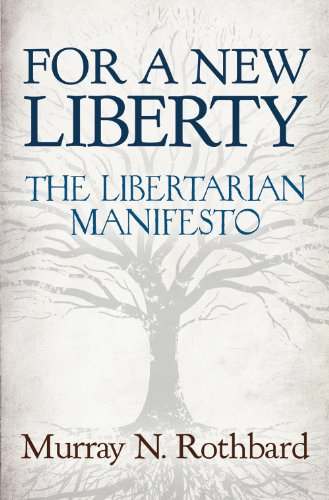
~ Murry Rothbard, For A New Liberty, "War and Foreign Policy," pp. 347-348

1973


Nov 4, 2023

Murray Rothbard on the libertarian case against war

Let us assume for the moment, a world of two hypothetical countries: Graustark and Belgravia.  Each is ruled by its own State.  What happens if the government of Graustark invades the territory of Belgravia?  From the libertarian point of view two evils immediately occur.  First, the Graustark Army begins to slaughter innocent Belgravian civilians, persons who are not implicated in whatever crimes the Belgravian government might have committed.  War, then, is mass murder, and this massive invasion of the right to life, of self-ownership, of numbers of people is not only a crime but, for the libertarian, the ultimate crime.  Second, since all governments obtain their revenue from the thievery of coercive taxation, any mobilization and launching of troops inevitably involve an increase in tax-coercion in Graustark.  For both reasons - because inter-State wars inevitably involve both mass murder and an increase in tax-coercion, the libertarian opposes war.  Period.

~ Murray Rothbard, For a New Liberty, "War and Foreign Policy," p. 332


Oct 11, 2023

Connor O'Keefe on war, revenge and killing civilians

War is no trivial subject.  It’s violence on the widest scale.  At their best, wars can throw off the worst tyrannies and liberate the oppressed.  But they can also bring about the worst atrocities. 

That’s why it is so important to have a firm and precise understanding of when violence is justified.  History shows that without this it is far too easy for our healthy human reactions and emotions to be funneled into support for further crimes—trapping us in indiscriminate revenge cycles.

~ Connor O'Keefe, "Is It Just War or Unjustified Slaughter of Innocents?," Mises Wire, October 11, 2023


Sep 25, 2022

Lao Tzu on those who glorify war

How could a decent person ever rejoice in victory and delight in the slaughter of men?

~ Lao Tzu


Sep 11, 2022

Hans Hermann-Hoppe on the myth of the "noble savage"

In the literature, primitive man has been frequently described as peaceful and living in harmony with nature.  Most popular in this regard is Rousseau's portrayal of the "noble savage."  Aggression and war, it has been frequently held, were the result of civilization built upon the institution of private property.  In fact, matters are almost exactly the reverse.  True, the savagery of modern wars has produced unparelled carnage.  Both World War I and World War II, for instance, resulted in tens of millions of deaths and left entire countries in ruins.  And yet, as anthropological evidence has in the meantime made abundantly clear, primitive man has been considerably more warlike than contemporary man.  It has been estimated that on the average some 30 percent of all males in primitive, hunter-gatherer societies died from unnatural - violent - causes, far exceeding anything experienced in this regard in modern societies...  Of course, primitive warfare was very different from modern warfare.  It was not conducted by regular troops on battlefields, but by raids, ambushes, and surprise attacks.  However, every attack was characterized by utmost brutalilty, carried out without mercy and always with deadly results; and while the number of people killed in each attack might have been small, the incessant nature of these aggressive encounters made violent death an ever-present danger for  every man (and abduction and rape for every woman).

~ Hans Hermann-Hoppe, A Short History of Man: Progress and Decline, pp. 27-28


Mar 19, 2022

Aeschylus on war and truth

In war, truth is the first casualty.

~ Aeschylus