Showing posts with label slavery. Show all posts

Oct 23, 2020

Frederick Douglass on critical thinking and slavery

To make a contented slave it is necessary to make a thoughtless one.

~ Frederick Douglass


Jul 15, 2020

Samuel Mitcham on when "all about slavery" became the official narrative of the Civil War

From the 1870s to the late 1950s, there was an unofficial truce between the North and South.  Each side recognized and saluted the courage of the other; it was conceded that the North fought to preserve the Union and because Old Glory had been fired on, and the Southerner fought for liberty and to defend his home; the two great heroes of the war were Abraham Lincoln and Robert E. Lee; and the South admitted that slavery was wrong but never conceded that it was cruel.

Around 1960, the Democratic Party—led by Lyndon B. Johnson—advanced the modern incarnation of identity politics.  It worked very well for them.  In the election of 1956, 75% of African-Americans voted Republican.  By 1964, more than 90% of them voted Democrat, and they have been doing so until 2020.  As part of their effort to control and manipulate the black vote, the Leftists and their myrmidons advanced the myth that the Civil War was all about slavery.  It wasn’t.  It was, in my opinion, about money, more than anything else.

~ Samuel W. Mitcham, Jr., "Why the Civil War Wasn't About Slavery," LewRockwell.com, July 15, 2020

LBJ and MLK – Pieces of History

Jul 9, 2020

Vasko Kohlmayer on today's anti-racism crusaders

Until relatively recently, nearly every society or historical figure was – by the logic of today’s crusaders –“tainted” by slavery in one way or another. In Europe, for instance, serfdom, which was essentially a soft form of slavery, lasted in many places well into the 18th century. In the rest of the world such practices lasted well beyond that time. In fact, slavery exists in a number of places in the world to this day. Most of those places are in Africa and most of the enslavers as well as the enslaved are black. One wonders why today’s racism crusaders do not focus their attention where the real problem is.

~ Vasko Kohlmayer, "Love of Ancestors and American History," LewRockwell.com, July 9, 2020

Vasko Kohlmayer on slavery and great civilizations of the past

In nearly all great civilizations of the past – Egypt, Sumeria, Babylon, Phoenicia, Greece, Rome, etc. – slavery was commonly practiced. In fact, these civilizations were to a great extent built on slave labor.

Are we going to blanketly condemn them all? Are we going to say there was nothing good in them and discard their great contributions to the development of mankind? Are we going to tear down statues of Plato, Aristotle, Pericles, Julius Caesar, Augustus, Cicero, Marcus Aurelius because all of them either owned slaves or directly benefited from their labor?  Are we going to condemn Jesus who lived at a time when slavery was a widespread practice and yet chose not to launch a crusade against it? When asked how people should behave toward their Roman overlords, he stated, “Render unto Caesar what is Caesar’s.” He said this even though slavery was endemic in Roman society.

~ Vasko Kohlmayer, "Love of Ancestors and American History," LewRockwell.com, July 9, 2020

Pin en ROMAN LIFESTYLE

Jun 22, 2020

John Martin on the Irish slave trade

King James II and Charles I also led a continued effort to enslave the Irish. Britain’s famed Oliver Cromwell furthered this practice of dehumanizing one’s next door neighbor.

The Irish slave trade began when James II sold 30,000 Irish prisoners as slaves to the New World. His Proclamation of 1625 required Irish political prisoners be sent overseas and sold to English settlers in the West Indies. By the mid 1600s, the Irish were the main slaves sold to Antigua and Montserrat. At that time, 70% of the total population of Montserrat were Irish slaves.

Ireland quickly became the biggest source of human livestock for English merchants. The majority of the early slaves to the New World were actually white.

From 1641 to 1652, over 500,000 Irish were killed by the English and another 300,000 were sold as slaves. Ireland’s population fell from about 1,500,000 to 600,000 in one single decade. Families were ripped apart as the British did not allow Irish dads to take their wives and children with them across the Atlantic. This led to a helpless population of homeless women and children. Britain’s solution was to auction them off as well.

~ John Martin, "The Irish Slave Trade - The Forgotten "White" Slaves," Global Research, April 14, 2008

Amazon.com: White Cargo: The Forgotten History of Britain's White ...

Jan 19, 2020

Tom DiLorenzo on how Henry Clay thought ending slavery could harm the cause of liberty

In the eulogy Lincoln claimed that [Henry] Clay, like himself, had a "deep devotion to the cause of human liberty," even though Clay was a slaveowner.  Clay was opposed to slavery "on principle"; however, he not only owned slaves but also was opposed to eliminating slavery.  In Lincoln's words, "[Clay] did not perceive, as I think no wise man has perceived, how [slavery] could be at once eradicated, without producing a greater evil, even to the cause of human liberty itself."

It's hard to imagine a clearer example of circular reasoning: Slavery is an affront to human liberty, but ending slavery would supposedly be even worse.

~ Tom DiLorenzo, The Real Lincoln, pp. 14-15

Henry Clay
1890-1893

Jan 17, 2020

Tom DiLorenzo on the myth of the morally superior Yankee

The idea of Yankee moral superiority was carefully crafted almost from the time of the Pilgrims. By 1861, New England Yankees and their Midwestern cousins had concocted the myth of a free, white, and virtuous New England that, by virtue of its moral superiority, had a right to remake all other sections of the U.S. in its own image, creating a Heaven on Earth (i.e., the New England-ization of North America). A corollary of this myth was the notion of the morally corrupt, slave-owning South.

But the notion of a morally superior New England Yankee nation is all a myth, as is explained in great detail by Joanne Pope Melish in her book, Disowning Slavery: Gradual Emancipation and Race in New England, 1780—1860 (Cornell University Press, 1998). Professor Melish, who teaches at the University of Kentucky, documents how New England propagandists rewrote their own history, not unlike how the Soviets rewrote Russian history, to say that slavery in that part of the country was only very brief and very benevolent.

The truth of the matter is that slavery existed in New England for more than 200 years (beginning in 1638) and it was every bit as degrading and dehumanizing as slavery anywhere.

~ Tom DiLorenzo, "The Myth of the Morally Superior Yankee," LewRockwell.com, February 10, 2004

Jan 10, 2020

Q&A with Tom DiLorenzo about the Civil War

Q: Were Confederate soldiers fighting to defend slavery even though the vast majority were not slaveholders?

DiLorenzo: There was no need to go to war to "defend slavery." Lincoln guaranteed it in his first inaugural address by endorsing the Corwin Amendment.

Q: South Carolina gave 17 reasons after the 1860 election for seceding, including the protection of slavery. How big a factor was slavery?

A: Why states seceded and why there was a war are two totally different questions. There is no question that Lincoln invaded the South over tax collection, as he promised/threatened in his first inaugural address, his "slavery forever" speech. Tariffs were constitutional, so to justify secession on a constitutional basis some of the southern states cited non-enforcement of the fugitive slave clause of the constitution. In the words of Lincoln and the U.S.Congress (read the Crittenden Compromise), slavery had nothing whatsoever to do with why they invaded the southern states.

Q: How much did the prevalence of economic fallacies, especially the uncertainty of what freed blacks would have on the economy, contribute to the war on both sides?

A: Economic fallacy is the ideological bedrock of mercantilism, and mercantilism is what the Republican Party always stood for.

Q: You’ve written about how Lincoln trotted out practically every economic fallacy in the book. Did he actually believe in these fallacies or was he simply a selfish politician pushing a corrupt policy and using any means at his disposal?

A: Lincoln had a long career as a trial lawyer and as you know, most trial lawyers are in the business of throwing rhetorical mud against the wall to see if it sticks to promote their clients' interests, so I suspect he just adopted any economic fallacy that he could find to justify protectionism, corporate welfare, and a national bank run by politicians. He had spent a quarter of a century doing just that before becoming president.

Q: Did Lincoln’s attitude toward Southerners mellow at all during the war and after?  It seems he greatly underestimated the cost and time it would take.  Did he have any regrets?  Had he not been assassinated, would he have handled Reconstruction any differently than the Andrew Johnson administration?

A: Lincoln celebrated Sherman and Sheridan's war crimes up to the very end, he promoted them, and the Republican Party made national heroes out of them.  His speech writers like Seward made him sound magnanimous, but look at what he did-- orchestrating total war on Southern CIVILIANS to the very end. The party of Lincoln did what their namesake would have done during Reconstruction -- continue to plunder the South for the benefit of party hacks and the Northern plutocracy while doing next to nothing for the ex slaves.

Duffy: Thank you!

~ Tom DiLorenzo, author of The Real Lincoln and Lincoln Unmasked, answers to questions from Kevin Duffy, January 9, 2020

Image result for tom dilorenzo

Jan 5, 2020

Abraham Lincoln on the reason for war against Southern secession

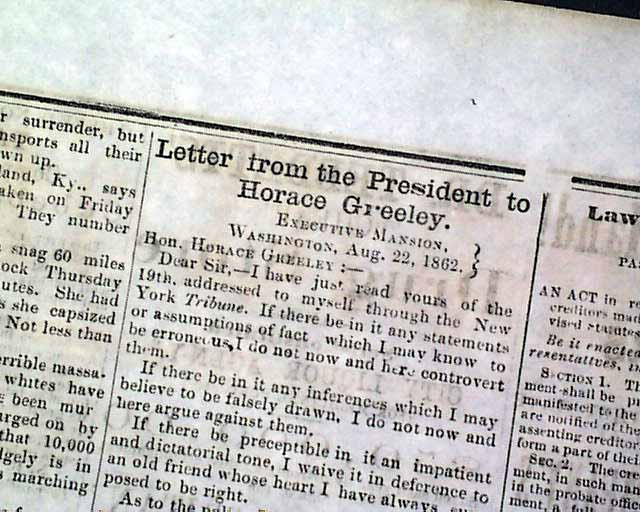
My paramount object in this struggle is to save the Union, and is not either to save or to destroy slavery.  If I could save the Union without freeing any slave I would do it;  and if I could save it by freeing some and leaving others alone I would also do that.  What I do about slavery, and the colored race, I do because I believe it helps save the Union...

~ Abraham Lincoln, public letter to New York Tribune editor Horace Greeley, August 22, 1862

Image result for lincoln letter to horace greeley

Jan 4, 2020

Private letter from Abraham Lincoln to Alexander Stephens

Do the people of the South really entertain fears that a Republican administration would, directly, or indirectly, interfere with their slaves, or with them, about their slaves?  If they do, I wish to assure you, as once a friend, and still, I hope, not an enemy, that there is no cause for such fears.

The South would be in no more danger in this respect, than it was in the days of Washington.  I suppose, however, this does not meet the case.  You think slavery is right and ought to be extended; while we think it is wrong and ought to be restricted.  That I suppose is the rub.  It certainly is the only substantial difference between us. 

~ Abraham Lincoln, private letter to Alexander H. Stephens (friend and future vice president of the Confederacy), December 22, 1860

Abraham Lincoln
1873

Robert Morgan on Lincoln's views on slavery and race adjustment

Many Americans think of Abraham Lincoln, above all, as the president who freed the slaves. Immortalized as the "Great Emancipator," he is widely regarded as a champion of black freedom who supported social equality of the races, and who fought the American Civil War (1861-1865) to free the slaves.

While it is true that Lincoln regarded slavery as an evil and harmful institution, it is also true, as this paper will show, that he shared the conviction of most Americans of his time, and of many prominent statesmen before and after him, that blacks could not be assimilated into white society. He rejected the notion of social equality of the races, and held to the view that blacks should be resettled abroad. As President, he supported projects to remove blacks from the United States.

~ Robert Morgan, "Abraham Lincoln's Program of Black Resettlement," The Journal of Historical Review, Sept.-Oct. 1993 (Vol. 13, No. 5), pages 4-25

Related image
Abraham Lincoln
1867

Jan 3, 2020

William Seward on Lincoln's Emancipation Proclamation

We show our sympathy with slavery by emancipating slaves where we cannot reach them and holding them in bondage where we can set them free.

~ William Seward, U.S. Secretary of State, 1861-1869

William Seward
1873

Abraham Lincoln on interfering with slavery in the South

I have no purpose, directly or indirectly, to interfere with the institution of slavery in the states where it exists. I believe I have no lawful right to do so, and I have no inclination to do so.

~ Abraham Lincoln, inaugural address, March 4, 1861

Abraham Lincoln
1869


Jefferson Davis on trying to avoid the Civil War

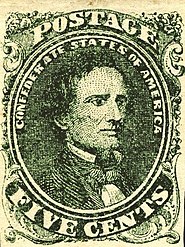
I tried all in my power to avert this war.  I saw it coming, for twelve years I worked night and day to prevent it, but I could not.  The North was mad and blind; it would not let us govern ourselves, and so the war came, and now it must go on unless you acknowledge our right to self government.  We are not fighting for slavery.  We are fighting for Independence.

~ Jefferson Davis, President of the Confederate States, 1862-1865

Image result for confederate states stamps

Aug 21, 2017

Alexis de Tocqueville on how slavery was already dying an economic death in the 1830s

A century had already passed since the founding of the colonies and an extraordinary fact began to strike the attention of everyone.  The population of those provinces which had virtually no slaves increased in numbers, wealth, and prosperity more rapidly than those which did have them.

In the former, however, then inhabitants were forced to cultivate the ground themselves or to hire someone else to do it; in the latter, they had laborers at their disposal whom they did not need to pay.  With labor and expense on one side and leisure and savings on the other, nevertheless the advantage lay with the former.

This outcome seemed all the more difficult to explain since the immigrants all belonged to the same European race with the same habits, the same civilization, the same laws, and there were only barely perceptible shades of differences between them.

As time went on, the Anglo-Americans left the shores of the Atlantic Ocean to plunge day by day ever further into abandoned spaces of the West, where they encountered new land and climates and had to overcome various obstacles.  Races mingled; men from the South moved North; men from the North moved South.  Amid all these circumstances, the same fact repeated itself at every step and, in general, the colony without slaves became more populous and prosperous than the one in which slavery flourished.

As further advances were made, people began, therefore to perceive that slavery, as cruel as it was for the slave, was fatal to the master.

But the truth of this provided its final proof when civilization reached the banks of the Ohio.

The stream named by the Indians as the Ohio, or the Beautiful River, irrigates one of the most magnificent valleys in which man has ever made his home.  On both banks of the Ohio stretches undulating land whose soil lavishes upon the plowman inexhaustible riches.  On both banks, the air is equally healthy and the climate temperate; each bank forms the frontier of a vast state: the one to the left tracing the many windings of the Ohio is called Kentucky, the other takes its name from the river itself.  The two states differ in only one respect: Kentucky has accepted slaves but Ohio has rejected them from its lands.

The traveler who, positioned at the center of the Ohio River, drifts downstream to its junction with the Mississippi is, therefore, steering a path between freedom and slavery, so to speak, and he only has to look about him to judge immediately which is the more beneficial for mankind.

On the left bank of the river the population is sparse; occasionally a troop of slaves can be seen loitering in half-deserted fields; the primeval forest grows back again everywhere; society seems to be asleep; man looks idle while nature looks active and alive.

On the right bank, by contrast, a confused hum announces from a long way off the presence of industrial activity; the fields are covered by abundant harvests; elegant dwellings proclaim the taste and industry of the workers; in every direction there is evidence of comfort; men appear wealthy and content: they are at work.

The state of Kentucky was founded in 1775, Ohio just twelve years later: twelve years in America is more than half a century in Europe.  Today the population of Ohio is already more than 250,000 greater than that of Kentucky.

The contrasting effects of slavery and freedom are easily understood and are enough to explain many of the differences between ancient and contemporary civilization.

On the left bank of the Ohio, work is connected with the idea of slavery, on the right bank with the idea of prosperity and progress; on the one side, it is a source of humiliation, on the other, of honor; on the left bank of the river no white laborers are to be found as they would dread to like like slaves; they have to look to Negroes for such work.  On the right bank it would be a waste of time to look for an idle man, as the whites extend their energy and intelligence to every sort of work.

Thus, the men in Kentucky who are responsible for exploiting the natural abundance of the soil lack both enthusiasm and knowledge, whereas those who might possess these qualities either do nothing or cross over into Ohio in order to be able to profit by their efforts and do so without dishonor.

[...]

On both banks of the Ohio, nature has endowed man with an enterprising and energetic character but on each side of the river men use this shared quality in different ways.

The white man on the right bank, being forced to live by his own efforts, has made material prosperity his life's main aim.  Since he lives in a country offering inexhaustible resources to his hard work and continuous inducements to his activity, his enthusiasm for possessing things has passed the normal bounds of human greed.  Driven on by his longing for wealth, he boldly embarks upon all the paths which fortune opens before him.  He does not mind whether he becomes a sailor, a pioneer, a factory worker, a farmer, enduring with an even constancy the labors or dangers associated with these various professions.  There is something wonderful in the ingenuity of his talent and a kind of heroism in his desire for profit.

The American on the left bank not only looks down upon work but also upon those undertakings which succeed through work.  Living in a relaxed indleness, he has the tastes of idle men; money has lost a part of its value in his eyes; he is less interested in wealth than excitement and pleasure and he deploys in this direction all the energy his neighbor devotes to other things; he is passionately fond of hunting and war; he enjoys the most vigorous of physical exercise; he is well versed in the use of weapons and from childhood he has learned to risk his life in single combat.  Slavery, therefore, not merely prevents the whites from making money but even diverts them from any desire to do so.

The same reasons which have for two centuries worked in opposition to each other in the English colonies of the northern part of America have in the end created an amazing difference between the commercial capabilities of men from the South and those from the North.  Today, only the North has ships, factories, railroads, and canals.

[...]

Gradually, as the truth of this became evident in the United States, slavery retreated little by little in the face of the knowledge gained by experience.

Slavery had begun in the South and had then spread toward the North; at the present time, it is receding.  Freedom, starting from the North, is moving without interruption toward the South.

~ Alexis de Tocqueville, Democracy in America (1840), pp. 404-409


May 29, 2017

Ulysses S. Grant on the Civil War and slavery

If I thought this war was to abolish slavery, I would resign my commission and offer my sword to the other side.

~ Ulysses S. Grant, Union general

(The veracity of this quote is in question.)

Outstanding Genuine Scott #303 F-Vf Mint OG NH 1902-03 Brown 4¢ Ulysses Grant
Ulysses S. Grant
1902-1903

Mar 3, 2017

Kevin Duffy on the difference between slavery and government

200 years ago slavery was rationalized on the basis chaos would ensue without it. Today government is rationalized on the same basis. How will we be judged in 200 years?

~ Kevin Duffy

Dec 29, 2014

Jeff Berwick on anarchy vs. slavery

All the word "anarchy" means is no rulers.  So, if you say you are not an anarchist it means you want a ruler.  If you want a ruler you are a slave.  I'm surprised how many people are comfortable publicly identifying themselves as slaves.

~ Jeff Berwick

Image result for jeff berwick

Sep 4, 2008

Governeur Morris on aristocracy and government

The rich will strive to establish their dominion and enslave the rest. They always did. They always will. ... They will have the same effect here as elsewhere, if we do not, by such a government, keep them within their proper spheres. We should remember that the people never act from reason alone. The rich will take advantage of their passions, and make these the instruments for oppressing them. The result of the contest will be a violent aristocracy, or a more violent despotism.

~ Governeur Morris, New York delegate to the Constitutional Convention and drafter of the Constitution, reflecting on the new federal government

(Quoted by G. Edward Griffen, The Creature from Jekyll Island, page 335.)

Aug 29, 2008

Thomas DiLorenzo on slavery in New York

Last Friday I toured the New York Historical Society's exhibit on "Slavery in New York," accompanied by Butler Shaffer and his daughter Bretigne. We were quite surprised at the high ratio of historical truth to political correctness. I purchased the book on the subject published by the Society, which says this in the introductory chapter:
"For nearly three hundred years, slavery was an intimate part of the lives of all New Yorkers, black and white, insinuating itself into every nook and cranny of New York history. For portions of the seventeenth and eighteenth centuries, New York City housed the largest urban slave population in mainland North America, with more slaves than any other city on the continent. During those years, slaves composed more than one quarter of the labor force in the city and perhaps as much as one half of the workers in many of its outlying districts. Slavery died with glacial slowness; slaves could be found in New York into the fifth decade of the nineteenth century."
There were still slaves in New York in the 1850s and, according to the Society's publication, New Jersey did not end slavery until 1865.

Bet you didn't learn that in school.

~ Thomas DiLorenzo, "The Myth of the Morally Superior Yankee," LewRockwell.com Blog, January 8, 2006

Image result for 13th amendment stamp
13th Amendment - 75th Anniversary
1865-1940