Showing posts with label books - The March of Folly. Show all posts

Aug 19, 2022

Barbara Tuchman on the U.S. military's first involvement in Vietnam

A week after the Japanese surrender in August 1945, a Viet-Minh congress in Hanoi proclaimed the Democratic Republic of Vietnam and after taking control in Saigon declared its independence, quoting the opening phrases of the American Declaration of Independence of 1776.  In a message to the UN transmitted by the OSS, Ho Chi Minh warned that if the UN failed to fulfill the promise of its charter and failed to grant independence to Indochina, "we will keep on fighting until we get it."

[...]

Self-declared independence lasted less than a month.  Ferried from Ceylon [Sri Lanka] by American C-47s, a British general and British troops with a scattering of French units entered Saigon on 12 September, supplemented by 1500 French troops who arrived on French warships two days later.  Meanwhile, the bulk of two French divisions had sailed from Marseilles and Madasgar on board two American troopships in the first significant act of American aid...  Afterward, the State Department, closing the stable door, advised the War Department that it was contrary to United States policy "to employ American flag vessels or aircraft to transport troops of any nationality to or from the Netherlands East Indies or French Indochina, or to permit the use of such craft to carry arms, ammunition or military equipment to those areas."

~ Barbara Tuchman, The March of Folly, pp. 240-241


Apr 7, 2021

Barbara Tuchman on the pursuit of policies contrary to self interest

A phenomenon noticeable throughout history regardless of place or period is the pursuit by governments of policies contrary to their own interests. 

~ Barbara W. Tuchman, The March of Folly


Aug 9, 2020

Barbara Tuchman on "wooden-headedness"

It may be asked why, since folly or perversity is inherent in individuals, should we expect anything else of government?  The reason for concern is that folly in government has more impact on more people than individual follies, and therefore governments have a greater duty to act according to reason.  Just so, and since this has been known for a very long time, why has not our species taken precautions and erected safeguards against it?...

Wooden-headedness, the source of self-deception, is a factor that plays a remarkably large role in government.  It consists in assessing a situation in terms of preconceived fixed notions while ignoring or rejecting any contrary signs.  It is acting according to wish while not allowing oneself to be deflected by the facts...

Wooden-headedness is also the refusal to benefit from experience, a characteristic in which medieval rulers of the 14th century were supreme.  No matter how often and obviously devaluation of the currency disrupted the economy and angered the people, the Valois monarchs of France resorted to it whenever they were desperate for cash until they provoked insurrection by the bourgeoisie.  In warfare, the métier of the governing class, wooden-headedness was conspicuous.  No matter how often a campaign that depended on living off a hostile country ran into want and even starvation, as in the English invasions of France in the Hundred Years' War, campaigns for which this fate was inevitable were regularly undertaken.

~ Barbara Tuchman, The March of Folly, pp. 6-8

Barbara W. Tuchman (Author of The Guns of August)


Jul 26, 2020

Barbara Tuchman on the Cold War

In the late 20th century it begins to appear as if mankind may be approaching a similar stage of suicidal folly.  Cases come so thick and fast that one can select only the overriding one: why do the superpowers not begin mutual divestment of the means of human suicide?  Why do we invest all our skills and resources in a contest for armed superiority which can never be attained for long enough to make it worth having, rather than in an effort to find a modus vivendi with our antagonist - that is to say, a way of living, not dying?

~ Barbara Tuchman, The March of Folly (1984), p. 8

9780349106748: The March of Folly - AbeBooks - Tuchman, Barbara ...

Oct 3, 2008

Barbara Tuchman on folly in government

Personal self-interest belongs to every time and becomes folly when it dominates government.

~ Barbara W. Tuchman, The March of Folly, Page 126.

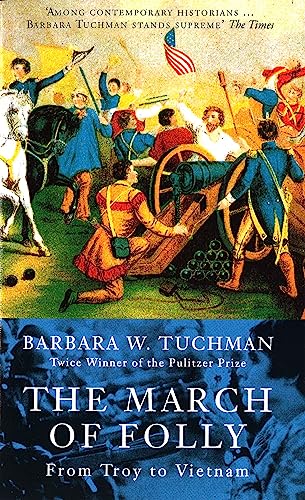
(Barbara Tuchman was a distinguished American historian of the 20th Century. The March of Folly's theme is the pursuit of policy contrary to self-interest using examples from the Battle of Troy, the Renaissance popes, the British loss of North America and ultimately America betraying herself in Vietnam.)

Tuchman-portrait.jpg

Nov 29, 2007

Barbara Tuchman on cognitive dissonance

Psychologists call the process of screening out discordant information ‘cognitive dissonance,” an academic disguise for “Don’t confuse me with the facts.” Cognitive dissonance is the tendency “to suppress, gloss over, water down or ‘waffle’ issues which would produce conflict or ‘psychological pain’ within an organization.” It causes alternatives to be “deselected since even thinking about them entails conflicts.” In the relationships of subordinate with superior within the government, its object is the development of policies that upset no one. It assists the ruler in wishful thinking, defined as “an unconscious alteration in the estimate of probabilities.”

~ Barbara W. Tuchman, The March of Folly, Page 303

Image result for the march of folly