Showing posts with label SVB Financial. Show all posts

Jul 11, 2023

Michael Lewitt on handling of SVB failure: "the government avoided a fire sale and created the time for these and other assets to recover"

While there is a great deal of handwringing about moral hazard with regard to the extension of unlimited deposit insurance at SIVB and Signature Bank (SBNY), that ship sailed a long time ago.  I think there are other lessons to be gleaned from how failing financial institutions were handled in 2008 that were applied (either knowingly or not) in this case that produced a better result.  And I think the FDIC did a reasonably good job managing a relatively orderly resolution of SIVB while minimizing any immediate systemic damage. 

The extension of unlimited deposit insurance will be debated for years but based on how the government handled the 2008 crisis, I believe it did the prudent thing here.  Had it extended a blanket guarantee on AIG’s obligations back then instead of selectively backstopping certain obligations, and also had it done the same with Lehman Brothers’ obligations rather than let the firm collapse, the losses in both cases would have been much lower and short-term and long-term damage to the financial system would have been much less.  Such a guarantee would have created the time required for these firms’ temporarily distressed assets to recover in value.  When financial institutions become distressed, the primary enemy is time.  Panic creates illiquidity which forces down prices to artificially low levels that almost invariably recover (sometimes rather quickly) once the situation stabilizes.  Today, even more than 15 years ago, time moves dangerously fast as a result of social media which accelerated the panic surrounding SIVB.  By guaranteeing the deposits at SIVB and SBNY, the government avoided a fire sale and created the time for these and other assets to recover (or begin to recover) their value, thereby avoiding unnecessary losses... 

In choosing between moral hazard and a bank run that could have caused unrepairable systemic damage, the government made the correct choice. It can address moral hazard later with measures designed to improve how banks manage their assets (including improved bank regulation), but the goal should be to live to fight another day. I would also add that the fact that depositors with more than $250,000 are almost exclusively “wealthy” as defined by the terms of our current political debates is a red herring.

~ Michael Lewitt, "Chasing Our Tails," The Credit Strategist, March 27, 2023


Michael Lewitt on the FDIC sale of Silicon Valley Bank's assets

First Citizens Bank stepped up and bought Silicon Valley Bank’s deposits and loans over the weekend, taking advantage of another bank’s mismanagement and the government’s need to support the banking system.  The deal involves the purchase of ~$72 million of assets at a $16.5 billion discount while another $90 billion of securities remain in receivership for sale by the FDIC.  What this means is that First Citizens is buying SVIB’s loans and leaving long-dated Treasuries and other investments behind for the FDIC to work out over time.  The FDIC also received equity appreciation rights in First Citizens’ holding company First Citizens Bancshares (FCNCA) with a potential value of $500 million to defray some of the potential losses on the transaction.  The 17 former branches of SIVB reopened this morning as First Citizens branches. FCNCA is rallying 40% on the news.  This should turn out to be a good move by FCNCA for which its management deserves credit.

~ Michael Lewitt, "Chasing Our Tails," The Credit Strategist, March 27, 2023


May 11, 2023

Michael Milken on what landed banks in trouble

You shouldn't have borrowed short and lent long.  Finance 101.  How many times, how many decades are we going to learn this lesson of borrowing overnight and lending long?  Whether it was 1970s, the 1980s, the '90s and again here.  The banks have enough credit.  They had enough equity.  The had enough ability to absorb credit losses that are coming.  

However, what they did was doubled, tripled, quadrupled their size by borrowing overnight at artificially low rates and buying intermediate securities.  There's $30 trillion of them out there and let's say they're worth 85 cents on the dollar.  Who has an unrealized loss of  three trillion dollars?  What we know, number one, is the Fed has the largest share of that loss, $800 billion or $900 billion, but they can print money so that isn't an issue...  What we saw here is organizations - great companies - like Silicon Valley Bank, like First Republic, what they turned themselves into was adding to income by borrowing short and lending long.  In the case of Silicon Valley, really government agencies, municipals, in the case of First Republic, fixed-rate mortgages with floating rate liabilities.

So this is Finance 101.  People are so focused on credit risk, etc., but one of the great risks is interest rate risk. 

~ Michael Milken, CNBC interview, 1:15 mark, May 2, 2023


Apr 28, 2023

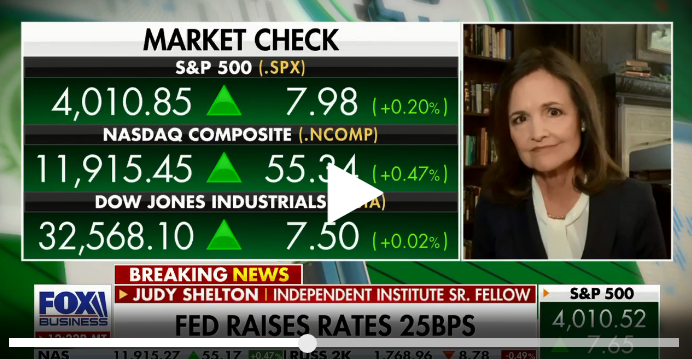
Judy Shelton on how the Fed's stress tests missed the Silicon Valley Bank failure

A: I will say the call for more stress tests overlooks the fact that the stress tests that became a part of the post-2008 regime were really oriented toward what will the bank do to survive if the Fed drops rates to zero again.  And it's uncanny, given that the Fed has over a trillion [dollars] in unrealized losses on its own portfolio that wasn't alert to this sort of dilemna in the valuation of bank assets.

Q: Yeah, theoretically the Federal Reserve is broke.

~ Judy Shelton, senior fellow, Independent Institute, "How Did Silicon Valley Bank Miss Its Ticking Time Bomb?," Fox Business, 1:30 mark, March 27, 2023


Apr 8, 2023

Jim Grant on SVB's $73 billion loan portfolio

What zero percent interest rates do is bring on the phenomenon of zero gravity finance.  Imagination displaces analysis.  And if you are in the business of projecting technology out into the wonderful 10 or 20 year realm, there's nothing like zero percent rates to facilitate that exercise of imagination.  And that's what Silicon Valley Bank had going for it.  So this portfolio - $73 billion loan portfolio - I think might also have been problematic.

~ Jim Grant, CNBC interview, 1:25 mark, March 16, 2023


Apr 3, 2023

Kevin Duffy on the Trump rollback of Dodd-Frank in 2018

As fate would have it, Silicon Valley Bank CEO Greg Becker lobbied in 2018 to raise the asset bar on the annual Dodd-Frank stress tests from $50 billion to $250 billion.  On May 24, 2018, when President Donald Trump signed “the biggest rollback of bank rules since the financial crisis,” SVB’s assets footed to $54 billion.  By the end of last year, they had mushroomed to $212 billion. 

Never mind that the rollback bill was signed by 33 Democrats in the House and 17 in the Senate.  The Left had its perfect scapegoat.  “Back-to-back collapses came after deregulatory push,” claimed The New York Times, shortly after the FDIC took control of SVB and Signature Bank, the second and third largest U.S. bank failures in history. 

Would it have made any difference?  The architects of the 2010 Dodd-Frank Act put in place a set of rules to prevent another mortgage crisis, never imagining that the next crisis would change its spots.  Truth be told, subjecting SVB to a rash of annual stress tests would not have saved the day.  Bank regulators have been looking for trouble in all the wrong places. 


Mar 31, 2023

Michael Hiltzik blames SVB failure on "skittish depositors" and "paper losses" in bond portfolios

SVB's fundamental problem was that it had a huge number of skittish depositors, most of whose money was uninsured by the FDIC and could be withdrawn on demand, and had invested those deposits in treasuries and bonds that were generally safe, but wouldn't mature in less than 10 years.  After a series of interest rate hikes, the bonds were showing immense losses on paper.  When the depositors pulled their money — to the tune of $42 billion on March 9 — the bank couldn't liquidate its bond portfolio in a way that wouldn't convert its paper losses to real losses, so it ran out of money to pay the depositors.

~ Michael Hiltzik, "How Trump's frenzy of deregulation killed Silicon Valley Bank," Los Angeles Times, March 30, 2023


Mar 28, 2023

Sam Goldfarb on how bank stock investors are buying the dip

A growing number of investors are betting on a rebound in the banking sector, wagering that regional lenders are in much better condition than many initially feared after the collapse of Silicon Valley Bank.

[...]

One of SVB’s problems was that it faced large unrealized losses on its portfolio of government-backed bonds thanks to last year’s jump in interest rates.  But no other major bank currently faces nearly the same amount of losses relative to its size, these investors point out.  In addition, such bonds are still essentially guaranteed to be paid in full when they mature, and banks can now borrow against them from the Fed at their face value—making them worlds apart from the toxic mortgage assets that sank lenders in the late 2000s.


Mar 24, 2023

Bill Ackman on the need to guarantee uninsured deposits at Silicon Valley Bank

 I woke up Saturday morning after the events of the week pretty convinced that if the government didn't, at a minimum, guarantee deposits at Silicon Valley Bank, we'd have a massive run on pretty much every regional bank on Monday.  And my advice was "we need to guarantee all deposits, not just those."  Unfortunately, I think the run is continuing.  If you look at the deposit inflows at the big banks, if you talk to anyone at JPMorgan who works at opening accounts, they're working literally around the clock to take in all the capital that's flowing in.  That's not good for our banking system and our country and that's what I was afraid of over the weekend, which is why I was so public, if you will.

~ Bill Ackman, interview with Harry Stebbings, 20VC, 27:00 mark, March 20, 2023


Mar 20, 2023

Sheila Bair on the SVB bank run

This bank seemed to have a reasonable plan to stabilize itself, but its depositors panicked and almost all of its deposits were uninsured.  Insured deposits generally do not run.  People have confidence in the FDIC.  They're not worried about their insured money, but uninsured deposits can run and most of this was from pretty sophisticated institutional investors: venture capitalists, startups, as you mentioned.  That's what I find so astonishing, that there was this herd mentality by sophisticated individuals to take this money out.  

You mentioned my books.  I also write children's books and I'm thinking maybe I should write one about banking for venture capitalists because their behavior suggests maybe they didn't understand the mechanics about banks where it's a classic Jimmie Stewart problem: you come in and take out all the money at once, you're going to force the bank to close even if it may otherwise be solvent.

~ Sheila Bair, MSNBC interview, 0:45 mark, March 11, 2023


Mar 12, 2023

Stephanie Pomboy on SVB failure: "this is all totally predictable"

This is all totally predictable.  When you force the banks to hold nothing but Treasuries and agencies and you ratchet up interest rates at the fastest pace in history, and drive sharp losses in those same "risk-free" assets, you're going to create some dislocations.  And I think probably what happened is that the fact that nothing untoward had occurred over the last 12 months imbued their confidence that "hey, maybe everything's going to be just fine."

~ Stephanie Pomboy, interview on Fox Business, 5:25 mark, March 11, 2023


Mar 11, 2023

Jim Cramer pumps SVB Financial (2023)

The ninth best performer year-to-date is SVB Financial.  This company's a merchant bank with a deposit base that Wall Street has been mistakenly concerned about...  I think the fears were not justified and it's a very compelling situation.  Hey, by the way, private equity and venture capital, they're not going away.  Being a banker to these immense pools of capital has always been a very good business.  Stock's still cheap.

~ Jim Cramer, CNBC's Mad Money, February 8, 2023