~ Alex J. Pollock, "How do you gt interventions withdrawn when the crisis is over?," The Austrian, May-June 2023
Showing posts with label interest rate risk. Show all posts
Jun 30, 2023
Alex Pollock on the Fed's holdings of mortgage securities
As of April 2023, the Fed owns $2.6 trillion of mortgage securities. That is larger than what the total assets of the Fed were at the end of 2008. That number and the interest rate risk it represents would have astonished previous generations of Federal Reserve governors. The Fed also experienced a massive mark to market loss on these mortgage securities: a loss of $408 billion as of the end of 2022, or almost ten times the Fed' total capital of $42 billion.
May 11, 2023
Michael Milken on what landed banks in trouble
You shouldn't have borrowed short and lent long. Finance 101. How many times, how many decades are we going to learn this lesson of borrowing overnight and lending long? Whether it was 1970s, the 1980s, the '90s and again here. The banks have enough credit. They had enough equity. The had enough ability to absorb credit losses that are coming.
However, what they did was doubled, tripled, quadrupled their size by borrowing overnight at artificially low rates and buying intermediate securities. There's $30 trillion of them out there and let's say they're worth 85 cents on the dollar. Who has an unrealized loss of three trillion dollars? What we know, number one, is the Fed has the largest share of that loss, $800 billion or $900 billion, but they can print money so that isn't an issue... What we saw here is organizations - great companies - like Silicon Valley Bank, like First Republic, what they turned themselves into was adding to income by borrowing short and lending long. In the case of Silicon Valley, really government agencies, municipals, in the case of First Republic, fixed-rate mortgages with floating rate liabilities.
So this is Finance 101. People are so focused on credit risk, etc., but one of the great risks is interest rate risk.
~ Michael Milken, CNBC interview, 1:15 mark, May 2, 2023
Apr 5, 2023
Nouriel Roubini: rising interest rates wiped out over 80% of bank capital
Bank managers, regulators and investors forgot duration risk and market risk. When yields are higher, the price of the bonds is lower. Investors lost 20% last year on 10-year Treasuries... For the overall banks, you have about $620 billion of unrealized losses on the securities out of a capital of $2.2 trillion. And for some of the regional banks the numbers are much higher.
But it's not just the securities that have lower value. Many of the banks had issued loans, like mortgages at fixed rates at 30 years when interest rates were 1% while right now they're at 3 1/2% for 10-year Treasuries. So the market value of those assets is also down. People have estimated, therefore, the overall losses for the U.S. banking system from the rise in interest rates, both on securities and loans, are equivalent to $1.8 trillion out of a capital of $2.2 trillion. Hundreds of the smaller banks are literally insolvent.
So that's a fundamental problem: When interest rates go higher, the value of securities and loans is lower and then we have mass liquidity and solvency problems.
~ Nouriel Roubini, Bloomberg TV interview, 0:30 mark, March 31, 2023
Mar 23, 2023
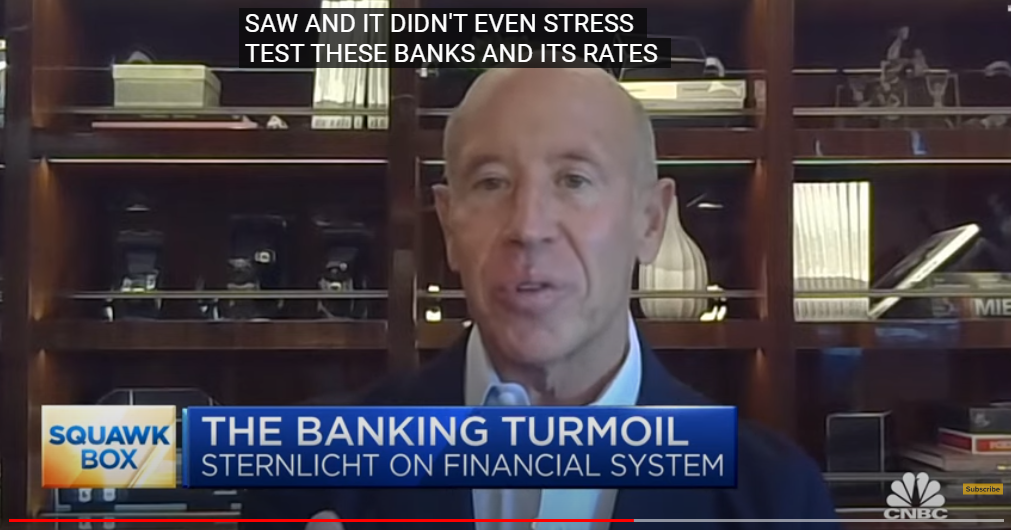
Barry Sternlicht on how the Fed encouraged banks to take on interest rate risk
There are 400 PhDs at the Federal Reserve. Four hundred. This weekend, me and two of my colleagues went through six regional banks and if you had to mark them to market, they're all insolvent. Now why are they insolvent? Actually it was the rule book set up by the government. The government said that if you own 10-year fixed agencies and mortgage-backs or if you own Treasuries, it's one-fifth the capital requirement than if you bought floating rate notes, senior secured floating rate notes.
So you wound up with a situation, the banks were following the rules. They were following the rules and they did not have to mark those securities to market. We run the nation's largest mortgage REIT. We have 2 billion dollars in securities, and 90 percent rate-hedged. It couldn't have happened to us. But because the banks face no consequences with the held-to-maturity category, they decide to save some money and not put any hedges in place. That's irresponsible, but it is the rule book that the OCC [Office of the Comptroller of the Currency] and the government, the Treasury and the Fed oversaw, and they didn't even stress test these banks if rates rose.
~ Barry Sternlicht, CNBC interview, 1:25 mark, March 23, 2023
Mar 20, 2023
Sheila Bair on risk of rising interest rates to the financial system
When interest rates rise, it creates instability. My friend and dear mentor, Paul Volcker, was very critical of inflation targeting because the protracted period of accomodative monetary policy would inflate financial assets, inflate the value of stocks and bonds, and then when interest rates have to go up to fight inflation, the value of those assets go down... There's this correction mechanism that can have instability ramifications on the financial system so I think and hope the regulators are on top it. There's a lot more capital now in the banking system, but I'm still a little wary. I think we need to learn more.
Sheila Bair, MSNBC interview, 5:40 mark, March 11, 2023
Subscribe to:
Posts (Atom)