Showing posts with label people - Cantillon; Richard. Show all posts

Apr 3, 2024

Kevin Duffy on Phil Duffy's new book 'A Tale of Four Cities'

To economic historians, the “hockey stick of human prosperity” is that irresistible bright shiny object. Up until 1800, the human population and living standards grew at a snail’s pace, but then a strange thing happened: both took off.


[...] 

In A Tale of Four Cities, Phil Duffy asks an intriguing question: “What if the real inflection point took place 100 years or so earlier?”  Have economic archeologists been unearthing evidence in all the wrong places?  Have they drawn false conclusions?

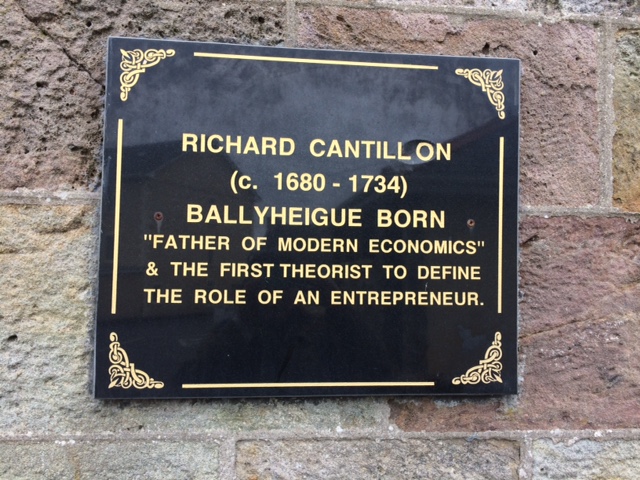
Challenging simple narratives often leads to valuable, contrarian insights.  By shifting the timeline of the starting gun on human progress back a century, Duffy unlocks a treasure trove.  First, he asserts that the actual dawning was the Agricultural Revolution, which laid the foundation for the Industrial Revolution.  Second, he discovers Richard Cantillon, the first economist to recognize the critical role of the entrepreneur in creating wealth.  Cantillon’s Essay on the Nature of Trade in General was written in 1730, long before Adam Smith’s seminal work, The Wealth of Nations.  Third, he makes a compelling case that Smith suppressed Cantillon’s work and removed the role of the entrepreneur, paving the way for misguided theories which treated entrepreneurship as vulgar and exploitative.

This would largely explain why many people in America, far from appreciating their good fortune, are openly hostile towards ultra-rich entrepreneurs like Amazon’s Jeff Bezos.  It also explains why those same billionaires give openly to anti-capitalistic charities.  It explains why so many countries have destroyed themselves by ingesting toxic theories on wealth creation, from sub-Saharan Africa, to the former Soviet Union, to Cuba and Venezuela.  It explains why governments in the West have grown to oppressive levels, threatening to strangle their productive hosts. 

If Duffy is correct, much of the world today enjoys a level of wealth unimagined by our ancestors despite worshipping false idols like Adam Smith, paper money and democracy.  Future economic progress is not a guarantee.  In fact, the human experiment appears to be at a crossroads.  Choosing the right path may just require getting the timeline right on that bright shiny object.

~ Kevin Duffy, Forward to A Tale of Four Cities, April 8, 2023


Jul 22, 2022

Phil Duffy on Adam Smith vs. Richard Cantillon

[Adam] Smith’s Wealth of Nations had the advantage of a half century more of observation over Cantillon’s Essay, and yet it was the latter’s insights into the agricultural revolution and the guiding role of the entrepreneur in achieving economic progress that separated the two economists. It is high time Richard Cantillon and the British Agricultural Revolution got their due respect.

~ Phil Duffy, "The British Agricultural Revolution Gets No Respect," Mises Wire, July 22, 2022


Jul 29, 2019

Murray Rothbard on Richard Cantillon and methodology

[Richard] Cantillon was one of the first to use such unique tools of economic abstraction as what Ludwig von Mises would later identify as the indispensable method of economic reasoning: the Gedanken-experiment (or thought-experiment).

~ Murray Rothbard, An Austrian Perspective on the History of Economic Thought, Vol. I, Chapter 12, "The founding father of modern economics: Richard Cantillon," p. 348

Image result for richard cantillon

Jul 28, 2019

Murray Rothbard on Adam Smith's omission of entrepreneurship

[T]he greatest of the many defects in [Adam] Smith's theory was his totally discarding Cantillon's and Turgot's brilliant analysis of the entrepreneur.  It was as if these great eighteenth century Frenchmen had never written.  Smith's analysis rested solely on the capitalist investing 'stock' and on his labour of management and inspection; the very idea of the entrepreneur as a risk-bearer and forecaster was thrown away and, again, classical economics was launched into another lengthy blind alley.  If, of course, one persists in fixing one's vision on the never-never land of long-run equilibrium, where all profits are low and equal and there are no losses, there is no point in talking about entrepreneurship at all.

The political implications of this omission were also not lost on nineteenth century socialists.  For if there is no role for entrepreneurial profits in a market economy, then any existing profits must be 'exploitative,' far more so than the low, uniform rate existing in long-run equilibrium.

~ Murray Rothbard, An Austrian Perspective on the History of Economic Thought, Vol. I, Chapter 16, "The celebrated Adam Smith," pp. 459-460, 1995

Image result for ballyheigue ireland richard cantillon plaque

Murray Rothbard explodes the Adam Smith myth

Adam Smith (1723–90) is a mystery in a puzzle wrapped in an enigma. The mystery is the enormous and unprecedented gap between Smith’s exalted reputation and the reality of his dubious contribution to economic thought.

Smith’s reputation almost blinds the sun. From shortly after his own day until very recently, he was thought to have created the science of economics virtually de novo. He was universally hailed as the Founding Father. Books on the history of economic thought, after a few well-deserved sneers at the mercantilists and a nod to the physiocrats, would invariably start with Smith as the creator of the discipline of economics. Any errors he made were understandably excused as the inevitable flaws of any great pioneer...

[B]usinessmen and free market advocates have long hailed Adam Smith as their patron saint...  On the other hand, Marxists, with somewhat more justice, hail Smith as the ultimate inspiration of their own Founding Father, Karl Marx...

As we have already seen, Smith was scarcely the founder of economic science, a science which existed since the medieval scholastics and, in its modern form, since Richard Cantillon. But what the German economists used to call, in a narrower connection, Das AdamSmithProblem, is much more severe than that. For the problem is not simply that Smith was not the founder of economics.

The problem is that he originated nothing that was true, and that whatever he originated was wrong; that, even in an age that had fewer citations or footnotes than our own, Adam Smith was a shameless plagiarist, acknowledging little or nothing and stealing large chunks, for example, from Cantillon. Far worse was Smith’s complete failure to cite or acknowledge his beloved mentor Francis Hutcheson, from whom he derived most of his ideas as well as the organization of his economic and moral philosophy lectures...

Smith not only contributed nothing of value to economic thought; his economics was a grave deterioration from his predecessors: from Cantillon, from Turgot, from his teacher Hutcheson, from the Spanish scholastics, even oddly enough from his own previous works, such as the Lectures on Jurisprudence (unpublished, 1762–63, 1766) and the Theory of Moral Sentiments (1759).

The mystery of Adam Smith, then, is the immense gap between a monstrously overinflated reputation and the dismal reality. But the problem is worse than that; for it is not just that Smith’s Wealth of Nations has had a terribly overblown reputation from his day to ours. The problem is that the Wealth of Nations was somehow able to blind all men, economists and laymen alike, to the very knowledge that other economists, let alone better ones, had existed and written before 1776. The Wealth of Nations exerted such a colossal impact on the world that all knowledge of previous economists was blotted out, hence Smith’s reputation as Founding Father.

~ Murray Rothbard, An Austrian Perspective on the History of Economic Thought, Vol. I, Chapter 16, "The celebrated Adam Smith," 1995

Image result for exploding myths dynamite