Showing posts with label people - Hamilton; Alexander. Show all posts

Oct 18, 2024

David Gordon on the Hamiltonian and Jeffersonian visions of America

Most readers of the Mises Wire will be familiar with the account of American history developed in many books by Mises Institute President Thomas J. DiLorenzo.  According to him, American history since our founding as a nation has been shaped by two conflicting traditions: one, begun by Alexander Hamilton, favoring a centralized government and the other, best personified in Thomas Jefferson, supporting decentralized government and the rights of the states and local communities.  Hamilton favored building up American industry artificially through high tariffs, as well as a national bank and a system of costly “national improvements.”  He also supported high government debt to stimulate industry.  Jefferson opposed all of these measures.  Henry Clay’s “American System” continued the Hamiltonian plan, as did Clay’s follower Abraham Lincoln.  In the twentieth century, Franklin Roosevelt’s “New Deal” fits into this paradigm. 

~ David Gordon, "Alexander Hamilton's poisoned legacy," Mises Wire, July 19, 2024


Nov 13, 2020

Jared Miller on how Hamilton the musical glorifies fatherlessness in the black community

Another problem with Hamilton the musical is that it glorifies fatherlessness instead of pointing to the obvious detriments it has had on society and the black community. Alexander Hamilton’s father abandoned him and his family at a young age as the man was a bigamist and fled to escape prosecution.

‘Hamilton’, through the statistically unlikely success of its muse, seems to portray fatherlessness (something exceeding 77 percent in black communities) as an advantage or an inspiration that can lead to a revolution rather than a negative cultural trend that has caused significant suffering for communities it affects the greatest. 

BLM and Antifa members clearly believe in this kind of revolution as members often have ‘Hamilton’ songs and quotes plastered across their social media pages as they tear down statues of our founders and vandalize crosses in graveyards and church buildings.

~ Jared Miller, "'The Masses Are Asses': Hamilton Sucks," American Watchmen, July 7, 2020


Jared Miller on Alexander Hamilton and the First Bank of the United States

Upon George Washington becoming President of the United States, he appointed Alexander Hamilton as the first Treasury Secretary. As the Secretary of Treasury, his first order of business was to establish a central monetary system and currency. 

The underwriter of what would become the First Bank of the United States was the Bank of New York which Alexander Hamilton conveniently co-owned. The underwriters of the Bank of New York were members of the Bank of England which operated under the auspices of the Crown. Once established in this position, he also supported the creation of a national debt: “A national debt, if it is not excessive, will be to us a national blessing.” 

His reasoning, briefly summarized, is that in order for an emerging nation to foster trade with its neighbors and European powers, a line of credit would have to be established. A line of credit would not be possible without a national debt and a consistent history towards paying off that debt (the interest be damned). 

The same elites today (Rothchilds, Rockefellers) own and operate the private Federal Reserve Bank to which our government now owes trillions in un-backed currency, courtesy of the Federal Reserve Act of 1913 (an amount far beyond “excessive” as Hamilton originally claimed).

~ Jared Miller, "'The Masses Are Asses': Hamilton Sucks," American Watchmen, July 7, 2020

Alexander Hamilton
1879


Oct 31, 2020

Kevin Duffy exposes the quasi-statist Liberty Series of 1954-1968

I was just going through my old stamp collection and stumbled on the “Liberty Series” of 1954-1959. Denominations went from ½ cent to $5.00. You’ll never guess who was on the $5.00 stamp - Alexander Hamilton. In fact, John Marshall was on the 40 cent stamp as well. Other noteworthies in the series: Lincoln (4 cent, standard postage at the time), Teddy Roosevelt (6 cent), and Wilson (7 cent). 

Of course, mixed in were many who belonged, probably to give the series some legitimacy: Franklin (½ cent), Washington (1 cent), Jefferson (2 cent), Revere (25 cent), Robert E. Lee (30 cent) and Patrick Henry ($1.00).

~ Kevin Duffy, email to Tom DiLorenzo, January 31, 2009

(DiLorenzo responded, "How politically incorrect to put Robert  E. Lee on a stamp!  It would never happen today.")


Jan 7, 2020

Alexander Hamilton on the Constitution

Ah, this is the Constitution.  Now, mark my words.  So long as we are a young and virtuous people, this instrument will bind us together in mutual interests, mutual welfare, and mutual happiness.  But when we become old and corrupt, it will bind no longer.

~ Alexander Hamilton

Alexander Hamilton
1870-1871


Jan 5, 2020

Tom DiLorenzo on the political agenda of Henry Clay

When Henry Clay entered national politics in 1811 as a member of Congress, on the eve of the War of 1812 one of his first acts was to try to convince his colleagues to invade Canada, which they did, three times.  He waged a thirty-year political battle with the likes of James Madison, James Monroe, John C. Calhoun, John Randolph, Andrew Jackson, and the other defenders of the Jeffersonian philosophy of limited, decentralized, constitutional government.  Clay was the political heir to Alexander Hamilton and so championed centralized government power driven by political patronage for the benefit of what U.S. Senator John Taylor of Virginia called the "monied aristocracy."

~ Tom DiLorenzo, The Real Lincoln, p. 62

Henry Clay
1873

Jan 3, 2020

Edgar Lee Masters on the crony capitalism of Henry Clay

[Henry] Clay was the champion of that political system which doles favors to the strong in order to win and to keep their adherence to the government.  His system offered shelter to devious schemes and corrupt enterprises...  He was the beloved son of Alexander Hamilton with his corrupt funding schemes, his superstitions concerning the advantage of a public debt, and a people taxed to make profits for enterprise that cannot stand alone...  The Whigs adopted the tricks of the pickpocket who dresses himself like a farmer in order to move through a rural crowd unidentified while he gathers purses and watches.

~ Edgar Lee Masters, Lincoln the Man (1997), p. 27

(as quoted by Tom DiLorenzo in Hamilton's Curse, pp. 120-121 and The Real Lincoln, pp. 58-59)

Henry Clay
1873

Alexander Hamilton on limited government

It's not tyranny we desire; it's a just, limited, federal government.

~ Alexander Hamilton

Alexander Hamilton
1873

Tom DiLorenzo on the Jeffersonian and Hamiltonian visions for America

Two of the most influential figures in American history. Two opposing political philosophies. Two radically different visions for America.

Thomas Jefferson and Alexander Hamilton were without question two of the most important Founding Fathers. They were also the fiercest of rivals. Of these two political titans, it is Jefferson—–the revered author of the Declaration of Independence and our third president—–who is better remembered today. But in fact it is Hamilton’s political legacy that has triumphed—–a legacy that has subverted the Constitution and transformed the federal government into the very leviathan state that our forefathers fought against in the American Revolution.

~ Tom DiLorenzo, Hamilton's Curse

Alexander Hamilton
1873

Jan 2, 2020

Tom DiLorenzo on the men who destroyed the Constitution

After a lucid explanation of each section of the Constitution [Judge Napolitano, in his book The Constitution in Exile] discusses how the nationalist/mercantilist coalition, led by Alexander Hamilton and his accomplice Judge John Marshall, conspired to effectively rewrite (and undermine) the Constitution almost as soon as the ink was dry on the original copy. The "Federalists" (who would eventually morph into the Whigs, and then the Republicans) never accepted their defeat in the Constitutional convention (which created a federal, not a national government). Nor did they accept Jefferson’s election as president. Thus, two days before his term ended the Federalist President John Adams appointed dozens of "midnight federal judges" and appointed John Marshall to the Supreme Court on March 3, 1801, one day before he would leave office. Marshall "spent the remainder of his career finding clearly disingenuous, historically inaccurate, and highly questionable justifications for ruling that federal power is not limited," writes Judge Napolitano.

~ Tom DiLorenzo, "The Men Who Destroyed the Constitution," LewRockwell.com, August 26, 2006

Sep 21, 2017

Ron Paul on Alexander Hamilton

Hamilton is the architect of big government in America.

~ Ron Paul, from the forward to How Alexander Hamilton Screwed Up America, by Brion McClanahan

Image result for how hamilton screwed up america

Nov 25, 2008

Alexander Hamilton on Fiat Money

To emit an unfunded paper as the sign of value ought not to continue a formal part of the constitution, nor ever hereafter to be employed; being, in its nature, repugnant with abuses and libel to be made the engine of imposition and fraud.

~ Alexander Hamilton, as quoted in G. Edward Griffin, The Creature from Jekyll Island, page 316

Related image
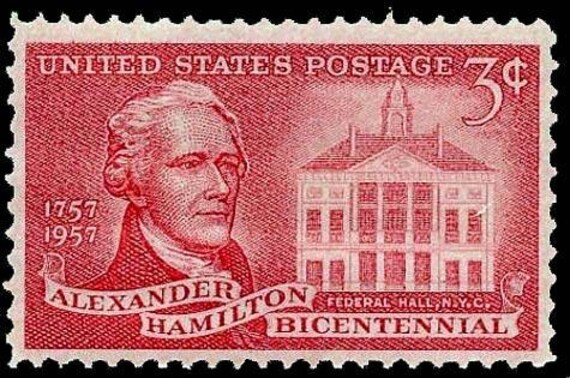
Alexander Hamilton Bicentennial
1757-1957

Nov 15, 2007

Alexander Hamilton on principle

Those who stand for nothing fall for anything.

~ Alexander Hamilton

Nov 14, 2007

Alexander Hamilton on public debt

A national debt, if it is not excessive, will be to us a national blessing.

~ Alexander Hamilton

Alexander Hamilton
1954-1968