Showing posts with label Iraq War. Show all posts

Jul 17, 2025

Jeremy Hammond on ideology and the post-9/11 WMD lie

When I first started on the path that led me to doing journalism, it was after 9/11, and I was speaking out against the coming Iraq war, warning people how the government was lying about WMD.  My own parents and older brother refused to listen to me and supported the war effort, even though I was providing them with all the information I had so they could see the truth that there was no evidence Iraq still had WMD.  My brother at one point at least conceded that I’d refuted all the claims and that no credible evidence was publicly available, but then his argument became: "well, I’m sure the government has classified intelligence that Iraq really is a threat and just can’t publicly release it." 

For a long time, I just couldn’t understand it.  I just assumed that facts and logic matter to people.  But the truth is that beliefs often matter more, so that reason is suspended if necessary to maintain a belief system.  The idea that the government would lie to start a war was just so incompatible with their view of the government as “the greatest on Earth”, and even though there are bad actors within it, the system itself is fundamentally benevolent, a beacon of light shining democracy and freedom on the world.  It’s a belief system, a matter of faith.  The state religion.

~ Jeremy Hammond

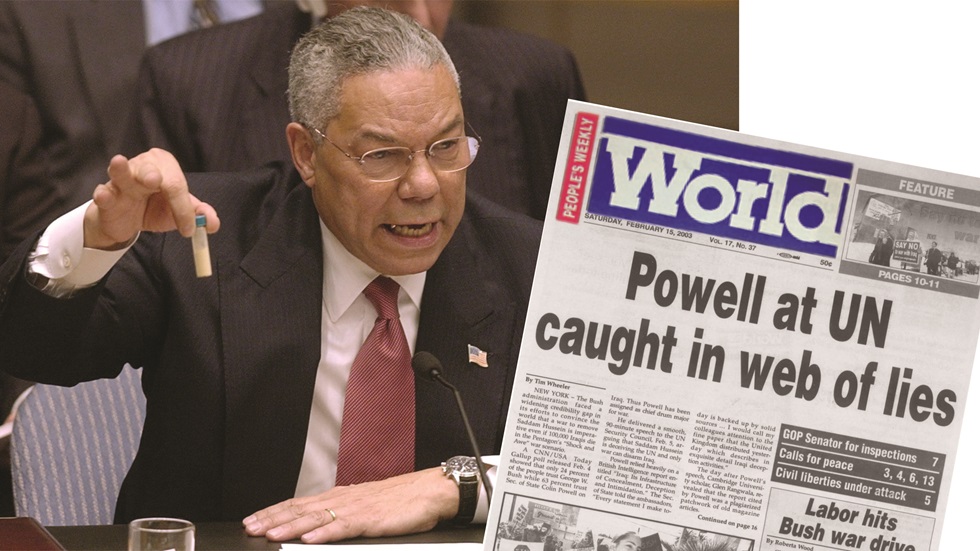
Iraq 'weapons of mass destruction': Remembering the lies of wars past –  People's World 

Mar 20, 2024

Saifedean Ammous on the appreciation of the Iraqi dinar in 2003

Should a currency credibly demonstrate its supply cannot be expanded, it would immediately gain value significantly.  In 2003, when the United States invaded Iraq, aerial bombardment destroyed the Iraqi central bank and with it the capability of the Iraqi government to print new Iraqi dinars.  This led to the dinar drastically appreciating overnight as Iraqis became more confident in the currency given that no central bank could print it anymore.  A similar story happened to Somali shillings after their central bank was destroyed.  Money is more desirable when demonstrably scarce than when liable to being debased.

~ Saifedean Ammous, The Bitcoin Standard, p. 68


Nov 18, 2023

Ben Shapiro calls for legislation to prosecute critics of the Iraq War for sedition (2006)

It is now considered bad form to criticize those who commit seditious acts against the United States.  Challenging the patriotism of a traitor draws more ire than engaging in treasonable activities.  Calling out those who undermine our nation creates more of a backlash than actually undermining our nation.

[...]


At some point, opposition must be considered disloyal.  At some point, the American people must say "enough."  At some point, Republicans in Congress must stop delicately tiptoeing with regard to sedition and must pass legislation to prosecute such sedition. 

"Freedom of speech!" the American Civil Liberties Union will protest.  Before we buy into the slogan, we must remember our history. President Abraham Lincoln suspended the writ of habeas corpus and allowed governmental officials to arrest Rep. Clement Vallandigham after Vallandigham called the Civil War "cruel" and "wicked," shut down hundreds of opposition newspapers, and had members of the Maryland legislature placed in prison to prevent Maryland's secession.  The Union won the Civil War.

Under the Espionage Act of 1917, opponents of World War I were routinely prosecuted, and the Supreme Court routinely upheld their convictions.  Justice Oliver Wendell Holmes rightly wrote, "When a nation is at war, many things that might be said in time of peace are such a hindrance to its effort that their utterance will not be endured so long as men fight and that no Court could regard them as protected by any constitutional right."  The Allies won World War I.

During World War II, President Franklin D. Roosevelt authorized the internment of hundreds of thousands of Japanese-Americans, as well as allowing the prosecution and/or deportation of those who opposed the war.  The Allies won World War II.

During the Vietnam War, the Supreme Court repeatedly upheld the free speech rights of war opponents, whether those opponents distributed leaflets depicting the rape of the Statue of Liberty or wore jackets emblazoned with the slogan "F--- the Draft."  America lost the Vietnam War.

This is not to argue that every measure taken by the government to prosecute opponents of American wars is just or right or Constitutional.  Some restrictions, however, are just and right and Constitutional -- and necessary.  No war can be won when members of a disloyal opposition are given free reign to undermine it.

~ Ben Shapiro, "Should We Prosecute Sedition?," February 15, 2006

Oct 3, 2023

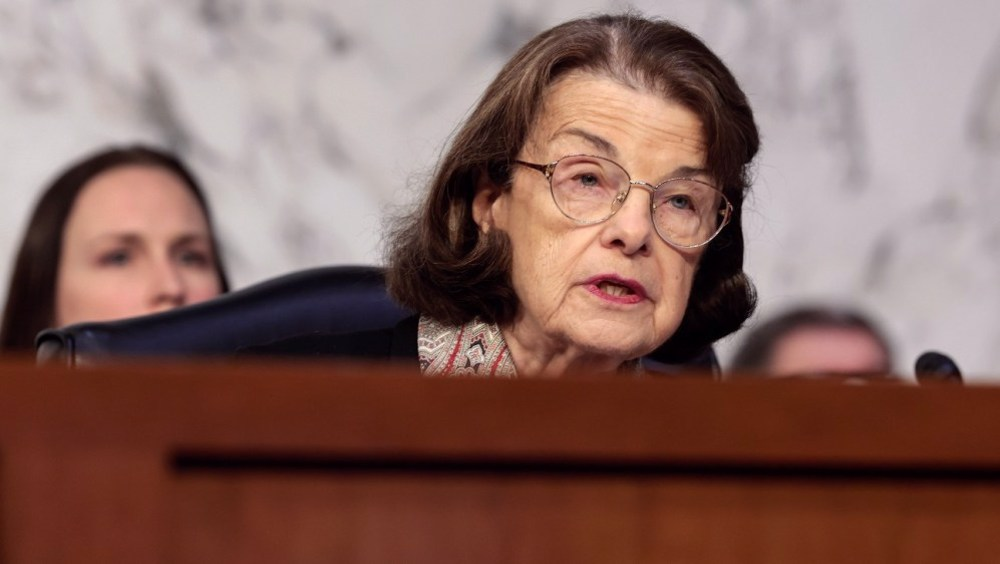
Scott Ritter on how Senator Diane Feinstein went along with the WMD lie to justify Iraq War

I met Senator Diane Feinstein once, in the lead up to the 2003 invasion of Iraq.  She had just recently been assigned to the Senate Select Committee on Intelligence (in 2001), and it was in that capacity that she had a senior staffer from the committee ask me to come to Washington DC to brief her on Iraqi WMD and the allegations being made by the Bush administration that Iraq continued to possess them.  We met in a secure conference room in the Capital building—me, the Senator, and a half dozen staffers and aides.  It was a polite, professional affair, with the Senator asking questions and taking notes.  Eventually she confronted me—“Your position is causing us some difficulty. You are making the US look bad in the eyes of the world.”  I replied that my analysis and the underlying facts were rock solid, something she agreed with. I said that while I knew she couldn’t reveal sensitive intelligence, if she could look me in the eye and say she has seen unequivocal proof that Iraq retained WMD, I’d shut up and go away.  She looked at her retinue, and then me.  “I have seen no such intelligence,” she replied.  She thanked me for the briefing, and said it provided her with “food for thought.” 

[On October 11, 2002, Senator Feinstein voted in favor of the resolution authorizing war with Iraq. Later, she said she had been misled by the Bush administration and bad intelligence.]

I will forever know Senator Feinstein as someone who had been empowered by the truth, and lacked the moral courage to act on it.  The blood of thousands of Americans and hundreds of thousands of Iraqis stains her soul.  I hope when she stands in judgment before her maker, she is punished accordingly.

~ Scott Ritter, former UN weapons inspector and US intelligence officer, "Blood of thousands of Americans, Iraqis stains Senator Feinstein’s soul: Former US official," PressTV, September 30, 2023


Dec 8, 2010

George W. Bush on the Iraq War (2003)

Mission accomplished!

~ President George W. Bush regarding the Iraq War, May 1, 2003


Jan 19, 2009

Paul Johnson at the onset of the Iraq War (2003)

The U.S. must not merely possess the means to act alone if necessary; it must alsocultivate the will. Fate, or Divine Providence, has placed America at this time in the position of sole superpower, with the consequent duty to uphold global order and to punish, or prevent, the great crimes of the world. That is what America did in Afghanistan, is in the process of doing in Iraq and will have to do elsewhere. It must continue to engage the task imposed upon it, not in any spirit of hubris but in the full and certain knowledge that it is serving the best and widest interests of humanity.

~ Paul Johnson, historian, "Five Vital Lessons From Iraq," Forbes, March 17, 2003

Sep 3, 2008

Sara Palin on the Iraq War

Pray for our military men and women who are striving to do what is right. Also, for this country, that our leaders, our national leaders, are sending [U.S. soldiers] out on a task that is from God. That's what we have to make sure that we're praying for, that there is a plan and that that plan is God's plan.

~ Sarah Palin , Governor of Alaska, June 8, 2008, speech before her congregation at Wasilla Assembly of God

(Source: "Palin's Church May Have Shaped Worldview," The Huffington Post, September 2, 2008)

Apr 19, 2008

Dick Cheney on the eve of the Iraq War (2003)

My belief is we will, in fact, be greeted as liberators... I think it will go relatively quickly... weeks rather than months.

~ Vice President Dick Cheney, March 16, 2003

Christopher Manion on the HMS Cornwall incident (seizure of British sailors by Iran in Iraqi supposedly waters)

Remember when those poor Brits were captured in Iraqi waters last year, bringing Bush to the brink of war with Iran?

Well, it turns out they weren't Iraqi waters. The U.S. occupation force had changed the border between Iraq and Iran! Only -- and this exemplifies their crafty, twenty-first century strategic brilliance -- they didn't bother to tell Iran!

Of course, this blunder was kept secret for a year, and hats off to the London Times for its persistence -- the documents were released only after the Times lodged a Freedom of Information suit. The documents included this gem from Tony Blair's Defence Secretary -- who knew the whole thing was bogus a year ago! From April 13, 2007:

"[Top Secret] The exact coordinates to the Op Line have not been published to Iran."

"History will vindicate us," blurted Blair on one of his visits to Bush early in the war.

Tony, history is not vindicating you, it's convicting you.

~ Christopher Manion, LewRockwell.com blog, "What? More Lies? I'm Shocked, Shocked!," April 19, 2008

Mar 29, 2008

Lily Hamourtziadou on civilian casualties in the Iraq War

We, who have lost very little, who have sacrificed very little, who have paid very little,... we continue to speak of ‘our’ war, of ‘our’ fight against the terrorists, ‘our’ ideals, ‘our’ kindness, ‘our’ courage; things that we value far more than the lives of millions of others, people whose deaths do not hurt us, whose loss does not affect us, and whose sacrifice we do not see bloodying our own hands.

~ Lily Hamourtziadou, "The Price of Loss: How the West Values Civilian Lives in Iraq," IraqBodyCount.org, November 12, 2007

Mar 24, 2008

Charley Reese on the 5-year anniversary of the Iraq War

We have passed the five-year anniversary of George W. Bush's bungled war in Iraq. What has it gained the American people? I'm afraid the answer is nothing. Let's look at the accomplishments.
We delivered a new ally to Iran. We lost nearly 4,000 American lives and suffered another 29,000 wounded. We spent $400 billion, by Pentagon accounting. We increased the federal deficit to $9 trillion. We've made the Middle East more, not less, unstable. American prestige is in the trash can. Oil is more than $100 a barrel. The military is strained to the breaking point, so we are now recruiting high-school dropouts and people with criminal records. The American economy is on the tipping point of disaster. Bush's disapproval rating is at 65 percent.

~ Charley Reese, "The Bungled War," LewRockwell.com, March 24, 2008

Mar 22, 2008

John McCain: Invasion of Iraq "will not be very difficult" (2002)

I am very certain that this military engagement will not be very difficult. It may entail the risk of American lives and treasure, but Saddam Hussein is vastly weaker than he was in 1991. He does not have the support of his people.

And I'd ask one question: What member of the Iraqi army is willing to die for Saddam Hussein when they know he's going to be taken out? So I don't think it's going to be nearly as difficult as some assume.

~ Senator John McCain, as appeared on CNN, September 12, 2002

Mar 21, 2008

Bill Mahar on blowback and the war on terror

You know, we are one terrorist attack away from John McCain I'm sure rising in the polls by ten points because people think, oh, yeah, he is tougher. He is not tougher about the war. He's dumber about the war.

He's dumb about the war because he thinks by keeping troops in the heart of the Muslim world that's going to help the war on terror. That's exactly what started the war on terror. . .
That is why young Muslim men want to come here and blow themselves up and kill us. It is not about what happens in Iraq. We need to get out of Iraq not build bases there.

~ Bill Mahar, as appeared on Hardball with Chris Matthews, March 18, 2008

Glenn Greenwald on media bias in reporting John McCain's foreign policy credentials

The reality is that John McCain's understanding of foreign policy and his approach to national security has proven to be simplistic, destructive and idiotic. Nobody spewed more pre-invasion falsehoods and confused and misleading claims about Iraq than John McCain did. And he's been the Prime Cheerleader for one of the most destructive wars in U.S. history. The notion that he has expertise in foreign policy or sound judgment is a total myth, yet it's one that his press fans accept and enforce as orthodoxy.

McCain's simple-minded militarism, his ignorance about national security, and his moronic view that the U.S. should run the world through endless wars ought to be one of the most intensely debated issues in the campaign. But it won't be because... the media has already decided that McCain is a Serious Expert in these matters and that national security is his strength, and evidence to the contrary won't be reported.

~ Glenn Greenwald, "The media's special relationship with John McCain," Salon.com, March 20, 2008

Feb 16, 2008

Hillary Clinton: "I would not have started this war"

If I had been president in October of 2002, I would not have started this war.

If we in Congress don't end this war before January 2009, as president I will.

~ Senator Hillary Clinton, New York Democrat, who announced late last month she is seeking the 2008 Democratic presidential nomination, "Clinton: I will end Iraq war," CNN.com, February 2, 2007

Feb 15, 2008

John McCain on the Iraq War

In Iraq our national security interests and our national values converge. Iraq is truly the test of a generation, for America and for our role in the world. Faced with similar challenges, previous generations of Americans have passed such tests with honor. It is now our turn to demonstrate that our power, ennobled by our principles, is the greatest force for good on earth today. Iraq's transformation into a secure democracy and a force for freedom in the greater Middle East is the calling of our age. We can succeed.

~ Senator John McCain, JohnMcCain.com

Feb 5, 2008

Brink Lindsey on preventive war and the Iraq War (2003)

So on the general question of preventive war -- whether to make war now in order to avoid a worse war later -- my position is: It depends on the circumstances. The decision whether to go to war should turn on a pragmatic assessment of relative risks. Sometimes the balance will tilt in favor of action, sometimes not. In the particular case of Iraq in 2002, I believe the balance tilts strongly toward action.

Accordingly, it seems to me that a no-exceptions policy against preventive war rests ultimately on an untenable assumption: that unrousable passivity on the part of the greatest and most powerful country that ever existed will somehow yield the most favorable achievable conditions in the world -- that, in an intricately interconnected world, leaving everything outside our physical borders to the wolves will ensure that everything turns out for the best.

I don't buy it. Hostile regimes bent on relentless expansion and pursuing weapons of mass destruction are a threat to global security. Hostile regimes that could put weapons of mass destruction into the hands of terrorists are a direct threat to the lives of Americans. If regimes fitting either of these descriptions don't change their ways, military action against them should be an option.

Brink Lindsey, senior fellow at the Cato Institute, "Should We Invade Iraq?," Reason, January 2003

Image result for brink lindsey

Dec 31, 2007

Larry Kudlow on the proposed invasion of Iraq

The shock therapy of decisive war will elevate the stock market by a couple of thousand points.

~ Larry Kudlow, National Review Online, June 26, 2002

Dec 20, 2007

Neil Cavuto on the Iraq War and early victory (2003)

I want to talk to the French right now. And the Germans. And the Russians. I want to talk to all those who opposed the liberation of Iraq.

I want to show you all the joyous scene in downtown Baghdad today.

People oppressed. Now people free.

People once hopeless. Now hopeful.

People you forgot. But we remembered.

If you had things your way, they'd still be under the thumb of a dictator. And you were fine with that. We were not.

You had no problem telling them, live with it. We had a big problem telling them, get over it.

Look at their faces. See their smiles. Feel their joy. Their freedom. Their fervor. How do you feel now? Still sure going the extra mile for them wasn't worth it? I don't think they'd agree.

While you were debating, they were suffering.

~ Neil Cavuto, "Stomping on Saddam," FOX News, April 9, 2003

Dec 1, 2007

John McCain: Opposition to Iraq War = appeasement = Hitler's rise

If you oppose the war [in Iraq], says [John] McCain, you're – pro-Hitler. It was inevitable – the return of Hitler, that is. The third-rate painter and homicidal maniac always turns up when the War Party gets desperate. After five years of war, and nothing but a reinvigorated al Qaeda and thousands of dead and grievously wounded to show for it, there's just one way to stanch the loss of support for our Iraqi adventure, and that is the return of Hitler to the international scene. In John McCain's world, it doesn't matter that we were lied into war: it doesn't matter that there were no Iraqi links to al Qaeda; we only have to know that Saddam was a Middle Eastern Hitler, who has now been replaced by Mahmoud Ahmadinejad, and everything falls neatly into place.

It's all nonsense, to be sure. To compare the ramshackle fourth-rate Iraqi military – and bin Laden's ragged insurgents – with the military might of the German Army at the height of the Third Reich's power is worse than absurd: it involves a major misperception of what we are up against, and the very real threat posed by the worldwide Islamist insurgency whose spearhead is al Qaeda. Hitler had overrun most of Europe and a good chunk of the Russian, French, and British empires before hubris and the weight of his own evil brought him down: the rag-tag legions of Iraq's Sunni rebels and Shi'ite militias are not exactly the Wehrmacht. And yet the Iraq war has now gone on longer than World War II, and still dead-enders like McCain are telling us "victory" is right around the next corner.

The misuses of historical analogies in politics are legion, and this one in particular is extremely problematic for the War Party. To begin with, McCain has his facts wrong: Hitler came to power not due to any "appeasement" by the Western powers, but because of World War I. He was elected by the German people – isn't democracy wonderful? Isn't it really the solution to all the world's problems? – due to resentment of the Treaty of Versailles, and the heavy burden of reparations which unleashed inflation such as the world had never seen on the German economy. This created the conditions under which German national socialism flourished – and when Hitler was installed in the German Chancellory, it was long past the time when anyone in Europe's capitals or in Washington could do anything about it.

The rise of Hitler and the Nazi Party was "blowback" from the Great War – just as the wars of the future will be visited upon us and our children as a direct consequence of the Iraq war and the growing conflict in the Middle East.

~ Justin Raimondo, "McCain's Mangled Metaphor: Has the Third Reich reappeared in the Middle East?," Antiwar.com, November 30, 2007