Showing posts with label peace talks. Show all posts

Dec 19, 2023

Sheldon Richman on the 1973 Yom Kippur War

The Six-Day War left the Arabs humiliated and the Israelis vauntingly triumphant.  It was the Israeli sense of invincibility that left the country vulnerable in 1973.  On October 6, as Jews were preparing for their holiest day of the year, Yom Kippur, Egypt and Syria launched attacks intended to regain the territories lost in 1967.  The Egyptians crossed the Suez Canal and established positions it would not lose.  Two cease-fires were arranged, only to be violated by Israel.  Finally, 18 days after the war began, a third and final cease-fire went into effect. 


The war was launched to regain not only Arab territory but Arab pride as well.  That explanation, which is true as far as it goes, gives a distorted picture.  Often overlooked are the Arab leaders' efforts to make peace with Israel before 1973.  In November 1967 King Hussein offered to recognize Israel's right to exist in peace and security in return for the lands taken from Jordan in the Six-Day War.  (Israel had de facto annexed the old city of Jerusalem shortly after that war.)  In February 1970 Nasser said, "It will be possible to institute a durable peace between Israel and the Arab states, not excluding economic and diplomatic relations, if Israel evacuates the occupied territories and accepts a settlement of the problem of the Palestinian refugees."  (Israel had allowed only 14,000 of 200,000 refugees from the Six-Day War to return.)  Then, in February 1971, Anwar Sadat, who had succeeded to the Egyptian presidency on Nasser's death in 1970, proposed a full peace treaty, including security guarantees and a return to the pre-1967 borders.  That was not all.  Also in 1971 Jordan again proposed to recognize Israel if it would return to its prewar borders.  Egypt and Jordan accepted UN Resolution 242, passed in November 1967, that called for an Israeli withdrawal from the occupied territories in return for peace and security.  Both Arab states also accepted the land-for-peace plan of Secretary of State William Rogers and the efforts of UN representative Gunnar Jarring to find a solution. 

Israel turned a deaf ear to each proposal for peace, rejected the Rogers plan, snubbed Jarring, and equivocated on Resolution 242.  At that time Israel and Egypt were engaged in a war of attrition across the Suez Canal.  Israel flew air raids deep into Egypt and bombed civilians near Cairo.  Soviet pilots and missiles participated in the defense of Egypt. 

The Rogers plan represented only one side of the Middle East policy of the Nixon administration, which came into office in 1969, and it was the weak side at that.  The strong side was represented by national security adviser (and later secretary of state) Henry Kissinger.  Kissinger was busy with the Vietnam War and the diplomatic opening to Communist China during Nixon's initial years in office, so the Middle East was one of the few areas left to Rogers.  Yet Kissinger could not resist getting involved.  Thus, a battle occurred between two forms of intervention: Rogers's efforts to broker a solution and Kissinger's efforts to thwart one.  The State Department believed that the key problem was Israeli intransigence.  Kissinger, who saw the Middle East as another arena for the superpower rivalry, believed the Israeli victory in 1967 was a glorious defeat of the Soviets, and he actively opposed progress toward peace.  Referring to 1969 he explained in his memoirs: 
The bureaucracy wanted to embark on substantive talks as rapidly as possible because it feared that a deteriorating situation would increase Soviet influence.  I thought delay was on the whole in our interest because it enabled us to demonstrate even to radical Arabs that we were indispensable to any progress and that it could not be extorted from us by Soviet pressure. . . .  I wanted to frustrate the radicals-- who were hostile to us in any event--by demonstrating that in the Middle East friendship with the United States was the precondition to diplomatic progress.  When I told [Joseph] Sisco in mid-February that we did not want a quick success in the Four-- Power consultations at the United Nations in New York, I was speaking a language that ran counter to all the convictions of his Department. . . .  By the end of 1971, the divisions within our government . . . had produced the stalemate for which I had striven by design. 
That policy was consistent with the Nixon Doctrine, articulated by the president in July 1969.  Under that doctrine the United States would rely on local powers to keep internal regional order and furnish "military and economic assistance when requested and appropriate."  The United States would continue to provide a nuclear umbrella to deter Soviet intervention.  In other words, client states such as Israel and Iran would police their regions to prevent upheavals by forces inimical to U.S. interests.

As the 1972 election approached, Kissinger assumed more control over Middle Eastern policy.  He later recalled that Nixon "was afraid that the State Department's bent for abstract theories might lead it to propose plans that would arouse opposition from all sides.  My principal assignment was to make sure that no explosion occurred to complicate the 1972 election--which meant in effect that I was to stall." Since Kissinger was able to undermine Rogers's peace efforts, his was a "policy" the Israelis could embrace. 

Kissinger's obstructionism came at the worst possible time.  The 1967 Arab defeat and the ensuing bilateral peace offers persuaded many Palestinians that the Arab states were willing to sacrifice the Palestinians.  It was a period of heightened violence from Yasser Arafat's nonideological al-Fatah, a major element of the Palestine Liberation Organization; the Black September faction of al-Fatah; and George Habash's radical, Marxist-oriented Popular Front for the Liberation of Palestine.  The break between the Palestinians and the Arab states created problems for Jordan.  The PLO had become a virtual state within a state there, and in 1970 the PFLP hijacked several airliners to Jordan.  As a result, in September 1970 King Hussein gave the military the go-ahead to root out the guerrilla infrastructure.  Syria, in a show of support for the Palestinians, sent tanks into Jordan.  At Kissinger's urging, Israel mobilized in support of Jordan, but before it could enter the country, the Syrian force was repulsed.  The month known as "Black September" cost the Palestinians 5,000 to 20,000 lives.  Although Israeli troops did not see action, their mobilization helped cement Israel's image as a strategic asset of the United States in the region.  Any evenhandedness that had marked earlier Nixon administration policy was now gone. 

Less than a year later, Jordanian forces massacred Palestinians in several incidents before expelling the PLO from Jordan.  The PLO then moved to Lebanon, having previously won that country's formal recognition of the right to operate autonomously.  Harassment of the Palestinians by the Israeli-backed Lebanese Christians and guerrilla activity directed at Israel from Lebanon preceded massive Israeli raids and the deaths of hundreds of Lebanese and Palestinian civilians. 

U.S. military and economic aid to Israel took a major jump.  Just before the Jordanian crisis, Nixon approved a $500 million military aid package and sped up delivery of F-4 Phantom jets to Israel.  Israel had indicated that, before it could start talks with the Arabs, it would need arms to ensure its security.  Nixon had stalled, believing that Israel was already militarily superior.  But under pressure from 78 U.S. senators, Nixon initiated a major transfer of technology (including the sale of jet engines for an Israeli warplane) that would enable Israel to make many of its own weapons.  A second deal was struck for 42 Phantoms and 90 A-4 Skyhawk warplanes.  Soviet leader Leonid Brezhnev countered the U.S. action by promising to supply arms and bombers to the Arabs, although not in the quantities that the United States supplied them to Israel. 

In mid-1972 Sadat, whom Kissinger did not take seriously as a political leader, expelled the 15,000 Soviet advisers in his country.  Sadat's reasons included continued wrangling about military aid, the emigration of Soviet Jews to Israel, Soviet opposition to another war in the region, and general cultural differences.  Although the United States was taken by surprise, Kissinger took credit for the development and, after the election, began secret negotiations with Egypt and the Soviets.  However, his proposal for a settlement, which included Israeli military posts in the Sinai, was rejected by Sadat.  Meanwhile, Nixon agreed to provide Israel with 84 new warplanes.  Sadat summed up his reaction in a statement quoted in Newsweek: "Every door I have opened has been slammed in my face by Israel--with American blessings. . . . The Americans have left us no way out." 

Peace proposals by Jordan, communicated to Kissinger around that same time, were rejected by Israel, which was not interested in relinquishing the West Bank.  The Israeli rejection had at least tacit U.S. approval.  On September 25, 1973, two weeks before war broke out, Kissinger became secretary of state and, with Nixon mired in Watergate, had complete control over foreign policy. 

During the Yom Kippur War, Kissinger ordered four ships of the Sixth Fleet to within 500 miles of Israel and initiated a UN strategy aimed at tying up the Soviets and delaying a cease-fire resolution.  As he later put it, "We wanted to avoid this [cease-fire] while the attacking side was gaining territory, because it would reinforce the tendency to use the United Nations to ratify the gains of surprise attack."  The Israelis asked for arms, but Kissinger was reluctant to comply, believing that Israel was well armed already, that the war would be short, and therefore that a resupply would unnecessarily anger the Arabs.  But Kissinger did not want to appear to desert Israel, which he thought might harden its position, so he had arms sent secretly, a policy publicly ratified by Nixon on October 9.  While the airlift of equipment was still covert, U.S. planes flew directly to the Israeli troops in the occupied Sinai, a violation of Egypt's territory. 

Kissinger had another reason to accede to Israel's demand for an airlift.  Although no one believed that Israel's survival was at risk, the surprisingly strong Arab showing panicked some Israelis.  The Israeli ambassador to Washington warned that if the request for the airlift was denied, "we will have to draw very serious conclusions from all this."  According to a historian sympathetic to Israel, "Kissinger. . . had long known that Israel possessed a very short nuclear option which it held as a weapon of last resort. . . . Suddenly . . . the scenario of an Israel feeling on the verge of destruction resorting in despair to nuclear weapons. . . assumed a grim actuality."  Other reasons for the change in U.S. policy included domestic political considerations (the Israel lobby had become a powerful force) and a modest Soviet airlift to Syria.  The multi-billion-dollar U.S. airlift was approved. 

Kissinger was instrumental in having three cease-fire resolutions, all favorable to the Israeli army's position, passed in the UN Security Council.  The first was passed on October 22, after Kissinger went to Moscow.  His failure to consult them before working with the Soviets so outraged the Israelis that Kissinger felt he had to placate them by allowing some "slippage" in the deadline.  "Slippage" became a major six-day offensive in which Israeli troops crossed the Suez Canal, blocked the roads from Cairo, and completed the encircling of Egypt's Third Army in the Sinai.  When the offensive was over, Israel had reached the Gulf of Suez and occupied 1,600 square kilometers inside Egypt.  According to Kissinger, Israel told him, untruthfully, that Egypt had launched an attack first, but he never publicly criticized his ally. 

The second cease-fire, which weakly called for a return to the first cease-fire lines, passed the Security Council on October 24.  Sadat accepted it, but Israel refused to pull back, which left Egypt's beleaguered Third Army at its mercy.  Israel violated the cease-fire within hours and continued closing in on that army.  The Nixon administration again was silent.  Sadat appealed to the Security Council for help, asking for U.S. and Soviet troops to intervene.  The Soviets responded favorably to the idea, but Kissinger opposed it.  "We had not worked for years to reduce the Soviet military presence in Egypt only to cooperate in reintroducing it as a result of a United Nations Resolution,"  Kissinger later wrote. "Nor would we participate in a joint force with the Soviets, which would legitimize their role in the area and strengthen radical elements." 

The Soviets then said they might send troops unilaterally.  In response, late on October 24, the United States put its ground, sea, and air forces--conventional and nuclear--on worldwide alert.  That brush with nuclear war demonstrated once again the grave danger posed by U.S. intervention in Middle Eastern affairs. 

Meanwhile, Kissinger assured Israel that it would not be asked to return to the first cease-fire lines, and the airlift continued.  Sadat ended the crisis by asking that a multinational force, without U.S. or Soviet troops, be sent to oversee the cease-fire.  On October 25 the third UN resolution was passed, creating a peace-keeping force and again merely requesting a return to the October 22 lines. 

Israel continued attacking Egyptian forces and forbidding the passage of food, water, or medicine to the trapped Third Army.  Private pleas from Kissinger to Israel were rejected.  The crisis ended with Sadat's offer of direct talks between the two nations' military officers about carrying out the UN resolutions.  He asked for one delivery of nonmilitary supplies to the Third Army under UN and Red Cross supervision.  Israel accepted, although it was bitter that the United States did not allow it to capture the Third Army and humiliate Egypt. 

One consequence of the mammoth U.S. arms shipments to Israel, and particularly the U.S. deliveries in the Sinai, was the OPEC oil embargo.  The dollar price of oil had been rising since 1971, when Nixon stopped redeeming foreign governments' dollars for gold.  Even before the war, Saudi Arabia had talked about linking oil to an Israeli-Palestinian settlement. 

On October 20 Saudi Arabia announced that it would sell no oil to the United States because of U.S. support for Israel.  Saudi Arabia's average provision of oil to the United States came to 4 percent of American daily consumption.  Iraq, Abu Dhabi, Algeria, Bahrain, Kuwait, and Qatar followed the Saudi example.  Nixon's price control program turned an inconvenience into a crisis, with long lines at gas stations and other disruptions of the economy.  After the war, despite Kissinger's appeal, King Faisal of Saudi Arabia stood by his demand that Israel withdraw from all the occupied territories (including those taken in 1967) before the oil tap was turned on again.  Kissinger threatened to retaliate while also promising that the United States would support the land-for-peace UN resolutions (Resolution 338, passed during the war, reiterated Resolution 242 of 1967).  In December OPEC, at the bidding not of Arab countries but of Iran and Venezuela, quadrupled the price of oil to $11.65 a barrel.  But shipments to Europe, which became more critical of Israel, were increased.  Finally, on March 18, 1974, after Israel, Egypt, and Syria concluded disengagement agreements, and after prodding by Sadat, the Arab states ended the oil embargo.  The Arabs placed no conditions on their action; the last export restrictions were removed on July 11.  After the embargo, Saudi Arabia and Kuwait ended the concession system and ostensibly nationalized their oil industries.  In fact, they entered into long-term contracts with the former concession owners. 

The costs to the United States of the Yom Kippur War were significant.  As Kissinger calculated it, the war "cost us about $3 billion directly, about $10-15 billion indirectly.  It increased our unemployment and contributed to the deepest recession we had in the postwar period."  The war was another demonstration of the bankruptcy of U.S. policy in the Middle East.  Total support of Israel did not create stability; on the contrary, it further alienated the Arabs, pushed several Arab states closer to the Soviet Union, upset the U.S.-Soviet detente (indeed, came close to igniting a nuclear confrontation), and loaded the OPEC oil weapon. 

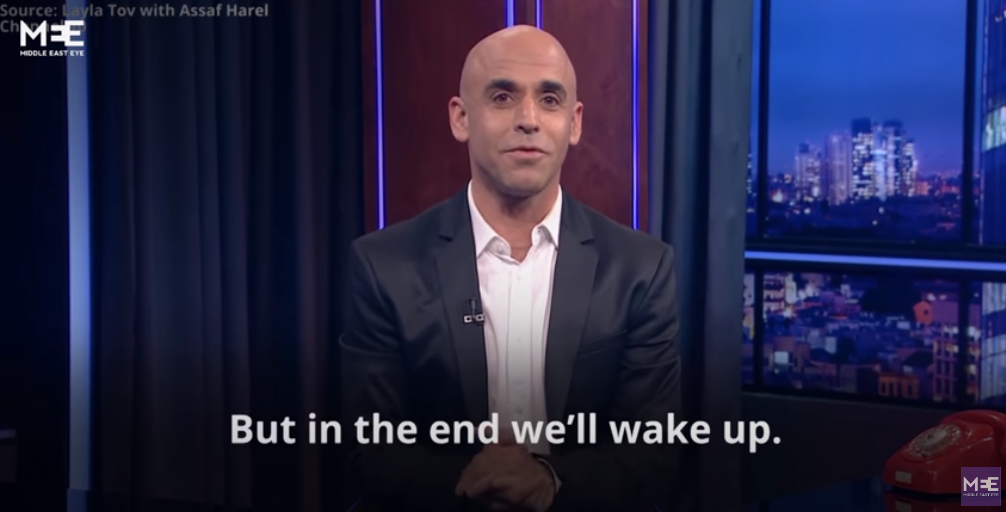
Assaf Harel on the importance of human rights organizations in Israel

The human rights organizations are the most legitimate and healthy thing today in Israeli society.  They are trying to wake a dormant society, a blocked society...  And the reason [prime ministers Naftali] Bennett and Bibi [Netanyahu] are spending so much time saying they're illegitimate is because they're saying the truth about the occupation and of what's happening.  And Bibi and Bennett know that on the day Israeli citizens wake up and discover what's happening beyong the Green Line, what it does to our solidiers, to the children who are raised there, to the elderly, to the families, to the millions of innocent people, what it does to our budget, our society, our economy?  On that day, the people will ask themselves if the occupied territories are really worth it.

[...]

If for once we could wake up before the war.  Because before now we only wake up after.  We had to have the Yom Kippur War to have peace with Egypt.  We had to have the intifada to have the Oslo Accords.  If only for once we could be smart enough to reach a peace agreement before the war.  Worse case, after it or another one after that, but in the end we'll wake up.

~ Assaf Harel, "Israeli comedian slams Israel for apartheid," Middle East Eye, 3:45 mark, March 2, 2017


Nov 28, 2023

Avi Shlaim on the Israel-Palestine peace process under Benjamin Netanyahu

The peace process is a charade.  It's all process and no peace.  It's worse than a charade because it gives Israel just the cover that it needs to pursue its aggressive colonial project on the West Bank.  The present government is hellbent on settlement expansion and settlement expansion is theft.  Land grabbing and peace making don't go together.  It's one or the other.  And by its actions, if not by its words, this government has opted for land grabbing.

This government has accelerated Jewish settlement in and around occupied Arab East Jerusalem in defiance of international law.  This government continues to build the wall on the West Bank.  It calls it a security barrier and it claims that its purpose security.  But a much more important purpose of the wall is land grabbing.  The wall is illegal.  Maybe good fences make good neighbors, but not when the fence is built in the middle of the neighbor's garden.

So Netanyahu is like the man who pretends to be negotiating the division of the pizza while he keeps eating it.  There is no Palestinian leader, however moderate, who is prepared to make peace on these ludicrous terms.

~ Professor Avi Shlaim, "Prof. Avi Shlaim - Hamas is Not a Greater Obstacle to Peace Than Israel," OxfordUnion, 3:30 mark, April 29, 2015


Nov 18, 2023

Ian Bremmer on recent peace and trade talks with Israel and the Middle East breaking down after October 7 Hamas attack

Israel had benefited from being seen as an economic juggernaut, a security juggernaut, a technological juggernaut.  And a lot of the countries in the region wanted to work more closely with Israel as a consequence of that.  That's why you had the UAE and Bahrain and Morocco signing the Abraham Accords, not just normalize diplomatic relations, but also to dramatically expand trade and investment with Israel.  That's why the Saudis were improving their informal relations and were moving towards normalization.  Even though the Saudi populatio is going to be quite cautious and conservative on the Palestinian issue, they say, "No, the priority is we gotta find a to work with Israel."

But once you have Israel, in response to there terrorist acts, going after Hamas, and as they're doing so killing all of these Palestinian civilians, well then there's a freeze on everthing.  Then if you're Jordan, you say, "We can't work with, we can't engage with Israel."  If you're Turkey, Turkish President Eedogan, who has said that Hamas is not a terrorist organization, he has said that Hamas is a liberation movement...  So they've thrown out the Israeli diplomats on the ground as well.  And when that's happening across the region and the Arab Street is demonstrating in solidarity with the Palestinians, then even if you have a number of wealthier Arab countries that want to continue to work with Israel, they can't because of the domestic pressure. 

~ Ian Bremmer, "Political scientist Ian Bremmer on the Israeli-Palestinian conflict," Big Think, 15:10 mark, November 9, 2023

Oct 24, 2023

Clyde Prestowitz on the history of Israel, Palestinians and America's involvement

I know this is probably a foolish piece for me to write as it will not change any dynamics while probably stirring disenchantment with me among readers on all sides. But having been there before, I simply cannot remain silent in the face of the renewal of the long running Israel-Palestine war. 

My 2003 book, ROGUE NATION - American Unilateralism and the Failure of Good Intentions, was written in the wake of 9/11 in an attempt to show the American public that despite its very good intentions America’s perceptions of itself and its international role were (are) greatly at odds with reality and with the perceptions of much of the rest of the world, and especially of the Arab world. 

What I am seeing on the TV screen as I write now is proof positive that despite mine and the efforts of many others, nothing has changed. Indeed, the misperceptions, false assumptions, half truths, and outright lies have only gotten worse. The reporting admits of no history, of no possible causes other than sheer barbarism, and of no solutions other than completely wiping the “barbarians” and the people of their lineage out. 

A LITTLE HISTORY 

Let me take you back to the beginning of the Arab/Palestinian-Jewish/Israeli conflict. Some may say, with justification, that it goes all the way back to Abraham and his two sons - Ishmael (father of the Arabs) and Isaac (father of the Jews). But today’s conflict really began in the late 19th century when Jewish leaders in Europe like Theodore Herzl, Leo Pinker, and Moses Hess began promoting the idea of enabling Jews to escape the discrimination they often suffered in Europe by emigrating to Palestine, the ancient homeland of the Jews around Jerusalem which was then part of the Turkish Ottoman Empire. In reading their early writings, it is fascinating to observe that they seemed completely unaware that the area had long been and was then occupied by Arabs. Indeed, they ventured to speak of “ a land without people for a people without land.” 

Consider that for just a moment. Either they just did not know that in fact there were a lot of people there or they did not consider the then present inhabitants to be people. 

As the project proceeded, friction between immigrant Jews and resident Arabs quickly arose as it became ever clearer that the newcomers had no intention of becoming part of the local life, but aimed rather to build their own separate and very different society. Indeed, Chaim Margalit Kalvarisky, a one time Jewish Colonization Association manager, once noted that he felt “compassion” for the Arabs and that twenty five years of dispossessing them had been hard, but he had had no choice because the Jewish public demanded it. The Jewish philosopher and writer Ahad Ha’am noted prophetically, “We have to treat local populations with love and respect… and What do our brethren in the Land of Israel do (note that even at this early date when there were virtually no Jews there, it was being called the Land of Israel)? Exactly the opposite. Should the time come when the life of our people in Palestine imposes on the natives, they will not easily step aside.” 

World War I brought a pregnant moment when, in an effort to marshal Jewish support for the allied cause in Europe and the U.S., British Foreign Minister Lord Balfour issued the “Balfour Declaration” which called for eventual “establishment in Palestine of a national home for the Jewish People.” He added that “Zionism, good or bad, is of far profounder import than the desires and prejudices of the 700,000 Arabs who now inhabit the ancient land.” 

Of course, this happened to be at odds with the views of Henry McMahon, Britain’s High Commissioner for Egypt who was trying to incite an Arab revolt against Germany’s allies, the Ottoman Turks. He went so far as to send a letter to Arab leader Sharif Hussein promising independence to the Arabs in the Ottoman-ruled provinces if they would rise up against the Turks. Indeed, he even sent the letter along with a person charged with assisting such an uprising - one T.E. Lawrence (of Arabia). 

These promises collided at the Versailles Peace Conference where President Woodrow Wilson allowed his prejudices to overcome his devotion to national self-determination noting that “undeveloped peoples” would need “guidance” from administering powers under mandates from the League of Nations. London, having long forgotten Lawrence and the Arab revolt pushed hard to be awarded the Mandate for Palestine. Wilson’s King-Crane Commission was sent to investigate local sentiment and found strong opposition to the Zionist program among the area’s Christian-Muslim majority as well as a desire for an American Mandate. The Zionists, who surmised that America would insist on majority rule that would put Arabs in control, strongly opposed any American presence. ( the Zionists did not “stand with America” ). Rather, they strongly preferred Britain and the Balfour Declaration. Wilson went along, and the Brits wound up in charge of Palestine. (France got Lebanon).

The Mandate turned out to be unhappy and nothing but trouble for Britain. As immigrants poured in from Europe with financing from the Colonization Association, tensions with the Arab population led to frequent riots. But when the Brits tried to restrict immigration, they wound up with serious conflicts with the Zionist groups who had significant political influence in London. 

This all got lost in the tumult of WWII, but with the end of the war, millions of Holocaust survivors turned their steps toward Palestine. Fearful of massive displacement, the Arabs resisted further Jewish immigration, and the Brits again imposed restrictions. But now a new player named the Irgun entered the game. A Jewish underground army (the father of today’s Prime Minister Binjamin Netanyahu was a key Irgun leader) that had been fighting Arabs, it now turned its guns and bombs on the British, blowing up, among other things, the King David hotel which served as the British army’s headquarters in Palestine. Deciding that the game was no longer worth the candle, the Brits gave their Mandate back to the United Nations and left Palestine in 1948. 

The UN proposed a two state solution with Jerusalem internationalized. This was rejected by the Arabs who declared war on the newly form Israel and promptly lost the fight, leaving Palestine and Jerusalem along an armistice line that now constitutes the internationally recognized Israeli border. About 750,000 Palestinian refugees from the area that was now Israel were left stranded in camps in the West Bank, Gaza, and other countries like Jordan and Lebanon. Nothing fundamental changed until 1967 when the Six Day War left Israel in charge of the West Bank and Gaza and gave rise to the Israeli settler movement setting the stage for decades of struggle, terrorist attacks, war in Lebanon, UN resolutions calling for peace negotiations and various more or less aimless “peace talks.” 

The first “Intifada” of 1987-89 and the Gulf War of 1990-91 began to create movement. U.S. President George H.W. Bush called for a peace conference in Madrid and also for a halt to Israeli settlement construction, which U.S. aid was inevitably underwriting. Indeed, Bush suspended certain aid flows to Israel. At the same time, the election of Yitzhak Rabin as Israeli Prime Minister led to an agreement between the two sides in Oslo under which Israel would gradually withdraw its army from some occupied areas and transfer responsibilities for such things as education, health, and police to Palestinian governance. The deal also committed the Palestinians to recognition of Israel’s right to exist and to renunciation of all acts of violence. 

As long as Rabin was in charge, things moved steadily, if slowly, in a good direction. But his assassination in late 1995 by an Israeli, I repeat, an Israeli shooter resulted in what the shooter and his backers obviously wanted which was an unwinding of the whole peace process. 

ARAFAT AND DESPERATE EFFORTS 

Yasir Arafat, for many years a major thorn in the Israeli side and even caused by Israel to be exiled from Lebanon to Tunis at one point, had been resurrected by Rabin to be his (Rabin’s) key interlocuter for peace negotiations. Rabin’s untimely death was a huge loss to both the Palestinians and the Israelis, but Arafat managed to stay in the game for quite a while longer and during his period of leading the Palestinians there occurred perhaps the best opportunity for a long term, peaceful resolution of the Israeli-Palestinian conflict.

I met him in the summer of 2002 at his then headquarters in Ramallah just outside of Jerusalem. I had requested the meeting a couple of weeks in advance and at 3 p.m. on August 10, I received a call telling me that “Chairman Arafat can see you, but you must be at the Ramallah checkpoint at 5 p.m. Since Ramallah is essentially a suburb of Jerusalem, under normal circumstances it should not take more than a half hour to get there and to see Arafat. But nothing about the West Bank is normal. About 400 kilometers of special roads are reserved for Israeli settlers while Palestinians must stop at endless checkpoints to have their vehicles and whatever they are carrying inspected. It can take hours to go a couple of miles. 

Once through the checkpoint, my car headed with difficulty to the Muqata, Arafat’s headquarters. The roads had been rutted and crushed by Israeli army tanks that were now surrounding the Muqata with guns leveled at Arafat by order of the new Israeli Prime Minister and former Israeli army general Ariel Sharon who succeeded Rabin. Unlike Rabin, Sharon had no use for Palestinians and certainly not for Arafat. 

When I finally reached his presence at the sandbagged entrance of the Muqata, I was quite surprised to see a very small man whose hand almost disappeared in my own more or less average male hand as we greeted each other with a handshake. 

In his small, simply furnished and telegram/memo laden office he had gathered the top leadership of his Palestinian Authority team. He was at pains to explain that he was not directing or instigating terror attacks on Israel. Noting that the Israeli army had more or less destroyed all the Palestinian Authority’s police stations and public offices, including closing Palestinian universities and taking computer hard drives, he argued that he had little capability to direct anything. “Bush” he said, “calls for reform and elections, but how can we hold elections when we can’t even make a telephone call?” He attributed recent suicide bombing extremist Hamas and Islamic Jihad organizations that were competing for the support of Palestinians with his Palestine Liberation Organization (PLO) for the support of the Palestinian people and noted that the more Israel attacks him and undermines the Palestine Authority, the stronger Hamas becomes. 

We particularly discussed the relatively recent negotiations at Camp David in July, 2000, and at Taba in January of 2001. In March 2000, then Israeli Prime Minister Ehud Barak (who had immediately succeeded Rabin) had called President Clinton to proposed leapfrogging the tedious Oslo negotiation process by calling an all-or-nothing negotiation session at Camp David. Clinton saw an historic opportunity for an agreement and perhaps a legacy for himself and bit. It had been the ultimate failure of these talks and succeeding talks at Tabah on the Red Sea that had resulted in suicide bombings, the election of Big Israel proponent Ariel Sharon as Israeli Prime Minister and brutal Israeli reprisals. Moreover, the inevitable attribution of blame had led to a broad acceptance among Israeli and American leaders of an orthodox view that the Palestinians had rejected generous Israeli offers because they truly hate Israel and prefer to seek its violent destruction rather than peace. 

Indeed, Barak had explained exactly this to me over breakfast in Washington DC a few months earlier. He insisted that he had offered Arafat the deal of a lifetime: a demilitarized Palestinian state on 92 percent of the West Bank and 100 percent of the Gaza Strip: the dismantling of most of the Israeli settlements and relocation of settlers to an 8 percent portion of the West Bank to be annexed by Israel; creation of a Palestinian capital in East Jerusalem; custody (not sovereignty) of the Temple Mount; a return of refugees to the Palestinian state (but not to Israel proper), and a massive international aid program. Nevertheless, he (Barak) insisted that Arafat had said “no” and was just performing and seeking maximum Israeli concessions without negotiating in good faith. He insisted to me that there is no “truth” in Arab culture and that they have no qualms about lying. 

Very significantly, he argued that Palestinians don’t believe Israel has a right to exist and that they see demographics (Israeli birth rate is far below Palestinian rate) as their main weapon. He insisted to me that the Palestinians would take advantage of Israeli democracy to turn Israel into “a state for all its citizens” and then push for a bi-national state until demographics gives them a majority and thereby an end to the “Jewish state.” 

In another conversation I had with President Clinton’s lead Camp David negotiator Dennis Ross, I heard essentially the same argument. Ross didn’t say it the same way as Barak, but he put most of the blame for the failure of the talks on Arafat. He called Arafat a “surfer” who missed the “big wave” because he was more interested in surfing than in riding into shore. Clinton also pointed the finger at Arafat. 

But Arafat said it was Barak, not Arafat, who rejected the Clinton-Taba peace plan ideas. He said Barak had admitted that he could not sell the plan to the Israeli public - with his recent electoral defeat at the hands of the Israeli hawk Sharon. Arafat added that he would welcome a settlement imposed by the United States. I took this seriously because several leading Israelis had told me the only real hope was a U.S. imposed settlement. Not a “we stand with Israel” deal, but a sincere American sculpted deal aimed at delivering fairness for both sides. 

Saab Erekat was Arafat’s chief negotiator. A University of California graduate with a PhD in economics, he pointed to another factor virtually never mentioned in the normal discussions. I asked him why the suicide bombings and terrorist attacks could not be stopped and noted that as one who knew America he surely recognized how devastating each of these attacks is to any American support for the Palestinians. 

His response was deeply troubling. “Of course, I know that”, he replied. “But listen to me. I am supposed to have some authority here in Jericho, but I am being made more irrelevant day by day. The real head of Jericho is Lieutenant Allon down at the checkpoint. It is he who decides who gets into the city and who gets out, whether an old woman gets to the hospital or not, whether fuel comes in or not. And just as he is undermining me, the guys over here,” pointing to the local Mosque, “are also undermining me by telling the people that Erekat can do nothing for you and only God can help. Life on the West Bank is hell. Unemployment is near 80 percent. Half the people are living on only $2 per day in hovels and must wait at checkpoints so that Israeli settlers can have priority. The Israelis complain about suicide bombings and they are correct to do so, but more Palestinians are being killed by Israelis than the reverse. Every time Sharon orders reprisals and assassinations, he creates more support for Hamas." 

Re Camp David, Erekat said that he and Arafat had begged Clinton for more time but to no avail. He further noted that it was the Palestinians who had made some of the imaginative proposals such as swapping land in Israel with the Palestinians in exchange for incorporating some of the major West Bank settlements into Israel proper. The real problem, he said, had been the rapidly approaching end of Clinton’s term and the ever weakening political position of Barak which made it impossible for him to commit to anything in the least politically risky.

Of great significance is that this view was essentially shared by Rob Malley, one of the key players on the U.S. side. He agreed that preparation time was dangerously short and driven mostly by the political weakness of Barak and the rapidly approaching end of Clinton’s term. In addition, Barak had not kept his commitment to some interim steps like withdrawal of troops from the West Bank and transfer of control of several villages to the Palestinian side. To Barak, this may have seemed inconsequential because a final deal would incorporate all of it in any case. But to the Palestinians it seemed like the same old game all over again. 

Clearly there was enough blame to go around. But it was not presented that way in the U.S. media or by the U.S. government. 

MEANING FOR TODAY

So here we are twenty years down the road and from where I sit, not much seems to have changed. Yes, the attack, murder, and terror conducted by Hamas was and is despicable and deserves to be severely punished, with Hamas completely eliminated as a player in the future. But is killing half or a fourth or even five percent of the 2.2 million people locked in Gaza with severely limited supplies of water, food, medicine, and electric power going to achieve that? 

Is it really wise for the United States to be “standing with Israel” in supporting the conduct of massive destruction and the inevitable murder of thousands of innocent people? Indeed, isn’t that exactly what Hamas wants? Think of the propaganda win it will have in the rest of the Middle East, Africa, Asia, and Latin America if by standing with Israel we effectively condone atrocities as bad as or worse than those of Hamas. Think of the support this will give to China and its drive to create alternatives to the G-20, the G-7, and the UN. 

There has to be a better way. 

~ Clyde Prestowitz, "Israel, Palestinians, and America," October 15, 2023