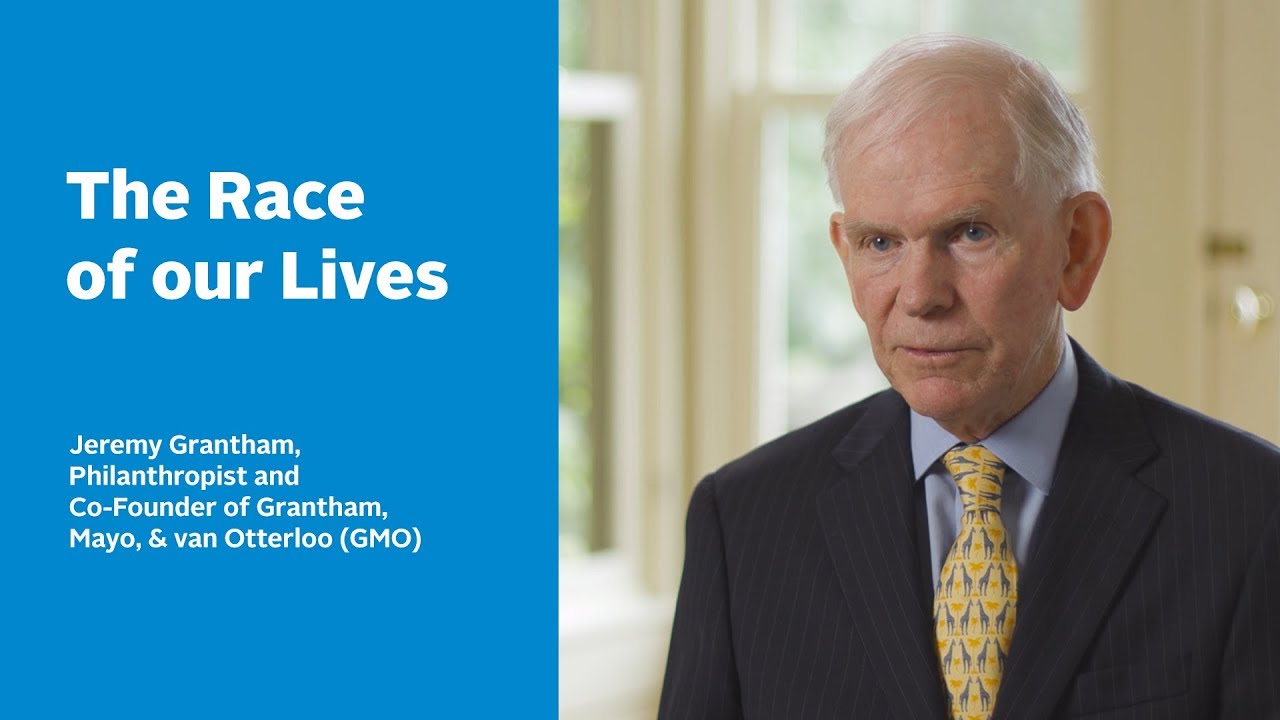
Showing posts with label people - Grantham; Jeremy. Show all posts

May 14, 2021

Jeremy Grantham on the everything bubble

This is pretty bad on a very broad front [stocks, bonds, commodities and real estate]. We will have to live potentially, possibly, with the biggest loss of perceived value from assets that we have ever seen.

~ Jeremy Grantham, recent Business Insider article

(As cited by Dan Ferris in his Quote of the Week on his Stansberry Investor Hour podcast, May 13, 2021.)


Jan 28, 2021

Jeremy Grantham on the everything bubble and "burst of euphoria"

It's the burst of euphoria that typically brings these things end and we are seeing it all around us today.

[...]

When you have reached this level of obvious super enthusiasm, the bubble has always, without exception, broken in the next few months, not a few years.  It's always.  You can't maintain this level of near ecstasy.  It can't be done because you've put in your last dollar.  You are all in.  What are you supposed to do at that point?  You can't borrow any more money.  You can't take any more risk.

~ Jeremy Grantham, "Why Grantham Says the Next Crash Will Rival 1929, 2000," Bloomberg interview, January 22, 2021, 8:00 and 10:00 mark


Nov 19, 2017

Jeremy Grantham on climate change

Carbon dioxide is going up at an increasing rate, with the three biggest increases occurring in the last three years; the climate is warming at an increasing rate; and the water is warming at an increasing rate; and therefore, the level at which oceans are rising is increasing at an accelerating rate. It’s one thing for the world to be deteriorating, but deteriorating at an increasingly fast rate is particularly dangerous and scary.

~ Jeremy Grantham, "Jeremy Grantham Combats Climate Change, Barron's, October 7, 2017

Image result for jeremy grantham"

Mar 16, 2014

Jeremy Grantham: "There’s probably quite a bit left in this rally"

Bubbles don’t usually stop until sensible investors, value investors, and prudent investors have been hung out to dry.  That hasn’t happened yet, so there’s probably quite a bit left in this rally.
 
~ Jeremy Grantham, Barron's, March 17, 2014

Jan 5, 2009

Jeremy Grantham turns cautiously bullish at 900 on the S&P 500

Finally! On October 10th we can say that, with the S&P at 900, stocks are cheap in the U.S. and cheaper still overseas. We will therefore be steady buyers at these prices. Not necessarily
rapid buyers, in fact probably not, but steady buyers. But we have no illusions. Timing is difficult and is apparently not usually our skill set, although we got desperately and atypically lucky moving rapidly to underweight in emerging equities three months ago. That aside, we play the numbers. And we recognize the real possibilities of severe and typical overruns. We also recognize that the current crisis comes with possibly unique dangers of a global meltdown. We recognize, in short, that we are very probably buying too soon. Caveat emptor.

~ Jeremy Grantham, "Reaping the Whirlwind," GMO Quarterly Letter, October, 2008

Jeremy Grantham on bubbles as outlier events

Just as all bubbles have broken, these bubbles did. Far from being a surprise, the bubbles breaking were absolutely not outlier events, contrary to protestations. The bubbles forming in 1998 and 1999 and in 2003 through 2007 were the outlier events. The U.S. housing market, which was a clear bubble with prices at least 30% above a previous very stable trend, is well on its way back to normal, and equities and risktaking may well have made it all the way back.

~ Jeremy Grantham, "Reaping the Whirlwind," GMO Quarterly Letter, October, 2008

Jeremy Grantham on the bubble in risk taking

The combination of favorable conditions and irrationally exuberant encouragement from the authorities produced an even more poisonous bubble – that in risk-taking itself. Everybody, and I mean everybody, got the point that risk-taking was asymmetrical and reached to take more risk. The asymmetry here was that if things worked out badly they would help you out (this sounds very familiar!), but if all went well you were on your own, poor thing. Ah, the joys of pure capitalism!

~ Jeremy Grantham, "Reaping the Whirlwind," GMO Quarterly Letter, October, 2008

Jul 31, 2008

Jeremy Grantham: "I am officially scared"

I am officially scared. In 2000, we had a technology bubble. But this is massive, a massive credit crisis and a bubble in global housing, global equity and global land.

~ Jeremy Grantham, GMO investment manager, "Even the pros may be stuffing the mattresses," ChicagoTribune.com, July 29, 2008, by Gail Marks Jarvis

Apr 28, 2008

Jeremy Grantham on Fed bailouts and $300,000 speaking engagements for former Fed chairmen

Even Fed chairmen get bullied and have their faces slapped if they stick to their guns, which will, not surprisingly, be rare since everyone values his career or does not want to be replaced à la Volcker. So, be as optimistic as possible, be nice to everyone, bail everyone out, and hope for the best. If all goes well after all, you will have a lot of grateful bailees who will happily hire you for $300,000 a pop. By the way, that such payments to prior Fed officials are in themselves a moral hazard and an obvious conflict of interest that could moderate their prior behavior, is apparently too crude an accusation even to have surfaced yet. Well it should surface. Selling services to financial interests whose fates have been in your hands should simply not be tolerated as acceptable or ethical behavior by a former Fed Chairman.

~ Jeremy Grantham, "Immoral Hazard," GMO Quarterly Letter, April 2008

Image result for jeremy grantham

Jeremy Grantham on 20 years of moral hazard

At the time that Paul Volcker broke the back of inflation in early 1980s, the recognition that risk and leverage had consequences was baked into the pie: if you were to take excessive risk you had better win the bet. If you missed the target, the expected result would be more or less total failure, and that seemed then and for decades earlier a reasonable law of nature. Now in contrast we get ready to celebrate the 20th anniversary of the era of the Great Moral Hazard. Slowly at first, but with steadily growing traction, the idea was planted that asset bubbles would be tolerated, but consequences of their bursting would be moderated or avoided entirely by increasingly vigorous actions sometimes, like now, bordering on the hysterical. This is to say that if all went well, enormous profits could be made by speculators – largely the great financial firms, including some formerly conservative blue chip banks – by riding and leveraging the bubbles. If all went badly, then the costs would be passed on to others.

~ Jeremy Grantham, "Immoral Hazard," GMO Quarterly Letter, April 2008

Jeremy Grantham on Alan Greenspan

Greenspan came onto my radar screen in the late sixties as a seller of economic and financial advice to the investment industry. To be brutally honest, he was considered run of the mill by anyone I knew then or have met later who knew his service then. His high point in most memories, certainly mine, was a famous call in January 1973 that, “it is rare that you can be as unqualifiedly bullish as you now can,” a few days before a market decline of over 60% in real terms, second only to the Great Crash in a century, accompanied also by a bitter recession. This was one of the first of a long line of terrible prognostications for which he has remarkably not been remembered, except by a handful of us amateur historians. Then in the mid seventies he disappeared into some government job, of which I was barely aware, until he re-emerged with a bang in 1987, without as far as I can find having done anything documentably very well.

~ Jeremy Grantham, "Immoral Hazard," GMO Quarterly Letter, April 2008

Mar 25, 2008

Jeremy Grantham on private equity

Q: I understand you are most concerned with further fallout in the private-equity arena?

A: Yes. I have yet to meet a private-equity firm that put into its spreadsheet the assumption that system-wide profit margins could decline by 20% to 30%. They have taken the current, abnormally high profit margins as a given and then determined to improve them by, let's say, 15% and assume everything works out pretty well.

But if the base declines by 20%, even if they end up improving margins by 15%, they are going backwards. And if they pay the 25% premium up front, which was normal, and if they leverage 4-to-1, which was normal, then they almost precisely wipe out all of the clients' money, all of the 20% in equity and if, perish the thought, they don't add 15%, but add perhaps zero to 5%, then they do more than wipe out the equity, they leave the underlying debt in ragged disarray. That is the next shoe to drop on the credit side.

~ Jeremy Grantham, "This Credit Crisis Has a Long Way to Run," Barron's, February 11, 2008

Jeremy Grantham on the twin Greenspan/Bernanke bubbles

Greenspan and Bernanke have taken a hands-off approach for two consecutive great bubbles, first in TMT -- telecommunications, media and technology -- and second, in housing. A hands-off approach is a polite way of saying they facilitated this. And what is the point of a 125-basis-point rate reduction, other than to provide reinforcement for the people who borrow short and lend long? From bankers who have committed every crime you could possibly accuse a banker of, to hedge funds who borrow short, leverage, and invest long in the stock market -- that's who really benefits from the interest-rate reduction. The economy, broadly defined, does not.

~ Jeremy Grantham, "This Credit Crisis Has a Long Way to Run," Barron's, February 11, 2008

Jeremy Grantham on housing prices being tied to median incomes

A: The other near certainty is that house prices will go back to a normal multiple of family income. In the end, we, the people, have to be able to afford the houses and they are affordable at something around 2.8 times family income. When they peak in Boston at 6 times and nationally at 3.9 times, you know you are in for tough times.

Incidentally, it was late in '06 when [Fed Chairman Benjamin] Bernanke said he thought the high prices of homes in the U.S. merely reflected a strong U.S. economy. Was he not looking at the data? Did he not measure long-term house prices? Had he not seen how they ebbed and flowed as a multiple of family income, which they do here and in the U.K. and everywhere else? And with it being so obviously a bubble, how could he have said that?

Q: Where else does this housing crisis lead us?

A: It has a lot to go. It still has to drop 20% to 25% to reach more normal levels, or if you prefer, it could wait five years for income to catch up, barring no big recessions.

~ Jeremy Grantham, "This Credit Crisis Has a Long Way to Run," Barron's, February 11, 2008

Jan 24, 2008

Jeremy Grantham on the credit crunch

Markets are well into a massive repricing of both risk and asset prices but it has far to go outside the original subprime area, where repricing may have already run its course.... This of course will be a painful process and will be a considerable drag on economic activity. Unfortunately, it is likely to take several years. To house clean completely by the end of 2010 would be a reasonable target... By the end of this credit crisis, perhaps better defined as a sloppy-debt-issuing crisis, we will be lucky if the amount of write-downs does not start with a “T.”

~ Jeremy Grantham, Managing Director, Grantham, Mayo Van Otterloo, "The Minsky meltdown and the problem with quantery," Seeking Alpha, January 24, 2008

(Quote came from Grantham's quarterly letter to shareholders, January 12, 2008.)

Dec 4, 2007

John W. Rogers Jr.on the role of private equity in the credit bubble

Jeremy Grantham, head of the well-respected investment firm GMO, projected in his last quarterly letter that in just five years, half of today's hedge funds and a significant number of private equity firms will tank.

Private equity funds bear some responsibility for the enormous leverage that our entire financial system has taken on. The supersize deals they make involve scary debt loads. The multiples are rich, as much as 16 times operating income (Ebitda). Not long ago a fair price for a solid business was 10 to 12 times. The higher prices are worrisome given the large fraction of the purchase price that is borrowed. And until very recently many lenders have been blasé about excess leverage. With the huge fees to be earned, debt providers were only too pleased to oblige. Now they aren't so happy with $350 billion in buyout debt sitting on their books and no takers.

In my view we are only in the early innings of a significant market correction led by the finance sector. When financial firms struggle, they have a big effect on the broader economy, from consumer loans to initial offerings to mergers and acquisitions. A real recovery is going to take a while.

~ John W. Rogers Jr., chairman and CEO, Ariel Capital Management, "Defensive Moves," Forbes, October 29, 2007