Showing posts with label IPOs. Show all posts

Jan 24, 2022

Philip Grant on the 2021 IPO class

They sell, you buy.  In a typical initial public offering, management and large shareholders commit to stand pat on their holdings for 180 trading days.  But that informal industry norm has eroded significantly during the recent bull run.  A quarter of last year’s record haul of U.S. IPOs featured expedited lock-up periods, data from Renaissance Capital show.  That’s the highest on record since data collection began in 2011 and compares to just 9% for the 2020 IPO class. 

Shareholders attempting to vote their displeasure may find limited success, as 32% of last year’s IPO class debuted with a dual class share structure, University of Florida Professor Jay R. Ritter finds.  That’s both the highest gross tally and highest proportion of total IPOs since at least 1980.  For context, about 90% of existing public companies in the U.S. are organized under a one-share, one-vote system, according to the Council of Institutional Investors. 

The Renaissance IPO Index, comprised of the largest, most liquid new U.S. listings and rebalanced on a quarterly basis, has suffered a 41% drawdown over the past 11 months, retracing a substantial junk of its 255% jaunt from the March 2020 nadir.

~ Philip Grant, Almost Daily Grant's, January 24, 2022


Dec 29, 2021

Jim Grant on 2021: a record year of issuance

So far in 2021, a record $156 billion's worth of IPOs have come to market in the United States alone, not counting SPACs, which easily tops the prior, $97 billion record set in the bubbly year 2000.  Year-to-date issuance of leveraged loans and junk bonds ($613 billion and $461 billion, respectively) have similarly roared to records.

~ Jim Grant, "All except for the human beings," Grant's Interest Rate Observer, December 24, 2021


Sep 8, 2021

Corrie Driebusch on the IPO boom

Traditional IPOs alone have raised a whopping $105 billion through Monday, just shy of record full-year totals set during the tech boom...  Overall IPO performance remains robust.  On average, traditional IPOs jumped more than 37% in their first day of trading, the biggest one-day pop for IPOs since 2000, Dealogic data show.

~ Corrie Driebusch, "For Chobani, Allbirds, Other Coming IPOs, Greed Is Out. Do-Gooding Is In.," The Wall Street Journal, September 8, 2021


Aug 26, 2021

Kevin Duffy on the Robinhood IPO

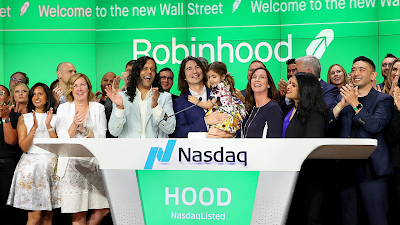
The Robinhood IPO gives us a unique look at the market’s youngest and most aggressive retail investors.  Their actions, as any seasoned observer of investor behavior would expect, tend to be emotional and self-defeating.  Robinhood’s customers have gone from extreme caution at the March, 2020 stock market low to uber-aggressive, a period in which the S&P 500 doubled.

~ Kevin Duffy, "Robinhood IPO," The Coffee Can Portfolio, August 26, 2021


Aug 18, 2021

Jim Cramer on the DiDi Global IPO

You've got my blessing to bet on DiDi.  I would try to get as many shares as you can.

~ Jim Cramer, before the June 30, 2021 IPO


May 19, 2021

Ben Inker on the bubble in speculative stocks unwinding

If the whole of the market is dominated by speculators with outsized expectations, it seems likely that deflation in the obviously speculative tier will take the overall market with it.

It is not a coincidence that value today is close to as cheap as it has ever been relative to the market, but it is convenient nevertheless. You can protect your equity portfolios by choosing to bias them toward value and away from the most expensive end of growth.

~ Ben Inker, head of asset allocation at GMO, "This signal is telling investors that highflying stocks are ready to fall back to Earth, says fund manager," MarketWatch, May 19, 2021


Apr 24, 2021

Barron's: "SPAC IPOs fall out of favor after hot streak"

If April could be distilled in a sound, it would be that of brakes screeching on market enthusiasm for special purpose acquisition companies. 

There have been only six new SPAC initial public offerings so far in the second quarter, according to Goldman Sachs data.  That’s a rounding error compared with the 55 SPAC IPOs in the first few weeks of the first quarter, which ended with 277 new SPACs raising combined proceeds of $91 billion.

~ Carleton English, "SPAC IPOs Fall Out of Favor After Hot Streak," Barron's, April 24, 2021


Dec 11, 2020

MarketWatch.com on the Airbnb IPO

The San Francisco company, which was founded in 2008 and has become a platform for people to rent out their homes all over the world, started the day having raised at least $3.5 billion at a valuation of more than $40 billion. By the end of trading, Airbnb’s market capitalization was roughly $86.5 billion, slightly higher than the market cap of Booking Holdings Inc., a larger and more established online-travel company. Other valuation methods put the company’s worth at more than $100 billion, which would be roughly the same as the combined market caps of Booking plus another rival, Expedia Group Inc.


Sep 13, 2019

Almost Daily Grant's weighs in on the upcoming WeWork IPO and melting valuation

It’s full speed ahead for WeWork Cos., Inc. parent The We Company.  In an updated S-1 filing today, We Co. announced a handful of governance changes to placate investors, including trimming the super-voting rights in the Class-C shares and removing family members of CEO Adam Neumann from the board of directors.

Nevertheless, things are trending in the wrong direction, as Reuters reports today that We’s updated projected valuation has fallen to as low as $10 billion. That’s down from a $47 billion valuation in a private funding round in January and a the $20 billion to $30 billion range reported just last week by Bloomberg. With $14.2 billion in total capital raised, We Co.’s private investors are, on balance, now well underwater.

The largest outside investor is facing particularly acute pain.  At that reported $10 billion valuation, SoftBank’s Vision Fund, which has itself invested $10.7 billion for a 29% stake, would be sitting on mark-to-market losses of approximately $7.8 billion.  Yet, SoftBank CEO Masa Son is apparently undaunted, as The Journal reports this afternoon that SoftBank will buy “at least $750 worth” of We Co. shares in the IPO.

Perhaps Masa might be fit for a cameo in the upcoming Joker movie? 

~ Almost Daily Grant's, September 13, 2019

Sep 12, 2019

David Kostin on IPO performance over the past 25 years

Most IPOs underperform, but some new offerings outperform dramatically.  [A]n investor that purchased $100 of every US IPO completed during the past 25 years would have generated a 0.6 percentage point annualized excess return versus the Russell 3000 index. In contrast, the typical IPO completed during the same period has lagged the market during the first 12, 24, and 36 months as a public company.

~ David Kostin, Goldman Sachs analyst, "Investors beware: The typical IPO stock is a dud, says Goldman Sachs" MarketWatch.com, September 5, 2019

Aug 22, 2019

Scott Galloway on the cult of personality at WeWork

WeWork's prospectus has a dedication (no joke): "We dedicate this to the power of We — greater than any one of us, but inside each of us." Pretty sure Jim Jones had t-shirts printed up with this inspiring missive. Speaking of idolatry, "Adam" (as in Neumann) is mentioned 169 times, vs. an average of 25 mentions for founder/CEOs in other unicorn prospectuses. Uber’s CEO, Dara Khosrowshahi, is mentioned 29 times in their prospectus. Granted, "Adam" is super dreamy, in sort of an Argentinian polo player way (he's Israeli). But he's not 6x dreamier than Dara, who has a whole “Omar Sharif, if he went to Brown” thing going on. But I digress. We's mission is "to elevate the world's consciousness." Maybe, but it's clear the mission of the prospectus is to dampen our consciousness ahead of the sh*tshow that is "The Story of Us: We."

~ Scott Galloway, "WeWTF," No Mercy / No Malice blog, August 16, 2019

Aug 19, 2019

Grant's tees up WeWork IPO

The public debut of The We Company, parent of co-working outfit WeWork Cos., Inc. draws closer.  Over the weekend, Reuters reported that J.P. Morgan Chase & Co. has secured “the pole position” to lead the offering. That follows a July 23 report from The Wall Street Journal that the IPO could come as soon as September, earlier than had been widely expected. Per The Journal, that expedited timeline accompanies a sense of urgency: “One reason for the September launch target is executives at WeWork are worried that the good times won’t last, with the U.S. stock market trading near records.”

The stakes are high. According to a Bloomberg dispatch today, WeWork is set to raise up to $6 billion in a two-part debt offering, but that deal comes with a caveat: “banks will have to make good on their commitments only if at least $3 billion is raised” in the IPO.  The company was most recently valued at $47 billion in a private fundraising round led by SoftBank Group Corp.

With that backdrop in mind, let’s take a stroll through WeWork’s most recently published audited financial results (Ernst & Young LLP did the honors) recently obtained by Grant’s. Despite the company’s imminent public debut, accessing the data is not easy.  The documents are only available online, and printing is disabled.

Each page is stamped “confidential,” with the recipient’s name, along with the date and time of publication.  Unlike most web-based financial statements such as those domiciled on sec.gov, searching for specific terms is disabled. Now, to the figures. In the quarter ended March 31, revenues footed to $728 million, more than doubling year-over-year from $342 million in first quarter 2018.  Similarly, total WeWork memberships rose to 371,000 in the fourth quarter, compared to 174,000 at year-end 2017.

Unfortunately, increased scale has yet to provide any relief to the torrent of red ink. So-called community operating expenses (“exclusive of depreciation and amortization”) rose at a similar clip, doubling to $581.5 million in the first quarter from $288 million, while WeWork’s operating loss jumped to $637 million from $296 million year-over-year.  Sales and marketing expense rose to $151 million, or 21% of revenues, from $63 million (19% of revenues) in the year ago period.

Meanwhile, community-adjusted Ebitda (or, adjusted adjusted adjusted Ebitda), WeWork’s signature  metric, rose to $169.5 million in the first quarter from $95 million year-over-year.  That gain failed to keep pace with the jump in revenues, as the “margin” declined to 27% from 29.2%.

While the financials provide little fodder for optimism, the company looks for other ways to impress investors. On July 30, CNBC reported WeWork was in talks to acquire startup SpaceIQ, which sells software to aid the efficient use of office space, a move which “could help WeWork convince Wall Street that it’s at least somewhat of a technology company.”

The bond market seems to need some persuasion. Single-B-plus-rated WeWork’s senior unsecured 7 7/8 notes due 2025 last changed hands at 96.5 cents, for a 8.66% yield-to-worst and 712 basis point spread to Treasurys. That’s well above the 491 basis points at issuance.  By comparison, the Bloomberg Barclays High Yield Index has seen its option-adjusted spread widen by just 63 basis points over that period, to 397 basis points at Friday’s close.

Meanwhile, CEO Adam Neumann is ringing the register. On Thursday, The Real Deal reported that Neumann “is putting a property that he owns as a personal investment in Greenwich Village up for sale on the open market... The 11-story building at 88 University is place is almost fully leased to WeWork and is about to come to market with an asking price north of $110 million.”  That follows the July 18 bulletin from The Wall Street Journal that the WeWork boss has already cashed out more than $700 million from the company, news that Neumann’s associates downplayed by noting that “Neumann’s borrowings against some of his WeWork shares indicate that he is bullish on the company’s long-term prospects.”

~ Almost Daily Grant's , August 5, 2019

Image result for grant's cartoon wework

Jun 30, 2019

Barron's on how the current IPO boom is "no signal of a bubble" (2019)

This is not your father's IPO market.  The resurgence of IPOs is no flash in the pan, no signal of a bubble reinflated.  Instead, it reflects a shift in the way that investors and entrepreneurs approach company creation, the rich supply of mature companies that have yet to come public, and investors's insatiable hunger for growth stories.

~ Barron's, "The New - and Improved - IPO Boom," June 29, 2019

Image result for barron's cover piping hot ipos

Dec 7, 2013

Fred Hickey: "Fear has left the building"

We all know the markets are driven by two sentiments: fear and greed.  Currently, investors show no fear but plenty of greed as they pile into stocks as if it were 1999 all over again.  The much-watched Investors Intelligence survey of investment newsletter writers last week reported that the percentage of bears was down to 14.4% - a level not seen in 26 years - 1987, before the crash.

The Consensus Bullish Sentiment Index is currently at 77% - putting it firmly in the "market is overbought" territory.  After four consecutive years of withdrawals (2009-2012) investors are now pouring money into stock mutual funds at the fastest pace in thirteen years (since the 2000 top).  Barron's estimates that equity mutual funds and ETFs are on pace to receive more than $450 billion in inflows this year, more than the previous four years combined.  Investors are chasing "story" stocks again.  Anything related to the "cloud," "Big-Data," social media and 3-D printing is fair game to drive into the stratosphere of infinite P/Es.  The Shiller cyclically adjusted price-to-earnings (P/E) ratio is now over 25, a level only exceeded three times before - prior to the 1929, 2000, and 2007 crashes.  According to Credit Suisse, U.S. nonfinancial stocks are 45% more expensive on a price-to-book basis than their global peers, an excess not seen since the 2000 crash period.

The Dow Jones Industrials and S&P 500 indices have risen for eight consecutive weeks, the S&P 500 has leapt 26.6% year to date and the Nasdaq Composite index has soared 34.5%.  There hasn't been a 10% correction since the fall of 2011.  Initial public offerings (IPOs) this year-to-date are more than at any time since 2000, with more than 60% of the IPOs funding money-losing companies.  Secondary stock offerings (over $160 billion) are at the heaviest pace ever (since Dealogic began keeping records in 1995).  Fear has left the building.

~ Fred Hickey, editor, The High-Tech Strategist, "Fear Will Make a Comeback," December 1, 2013

May 18, 2011

Jim Chanos on the hot Chinese IPO market

It is interesting that as the party elites and others are trying to get their money out, via circumventing the banking regs or through Macau or whatever, that the American public is being asked to buy right in through the IPO market.

~Jim Chanos, founder, Kynikos Associates, CNBC "Squawk Masters", May 18, 2011

May 13, 2011

Ben Graham on IPOs in bull markets

Somewhere in the middle of the Bull market the first common-stock flotations make their appearance. These are priced not unattractively, and some large profits are made by the buyers of the early issues. As the market rise continues, this brand of financing grows more frequent; the quality of the companies becomes steadily poorer; the prices asked and obtained verge on exorbitant. One fairly dependable sign of the approaching end of a bull swing is the fact that new common stocks of small and nondescript companies are offered at prices somewhat higher than the current level for many medium-sized companies with a long market history. The heedlessness of the public and the willingness of the selling organization to sell whatever may be profitably sold can have only one result - price collapse.

~ Benjamin Graham, dean of the value school

Western Cattle in Storm
1898