Showing posts with label people - Fisher; Irving. Show all posts

Aug 2, 2019

Irving Fisher on the role of the elites and need for scientific management

The world consists of two classes - the educated and the ignorant - and it is essential for progress that the former should be allowed to dominate the latter.  But once we admit that it is proper for the instructed classes to give tuition to the uninstructed, we begin to see an almost boundless vista for possible human betterment.

~ Irving Fisher, "Why has the Doctrine of Laissez Faire been Abandoned?," Science, 1907, p. 20

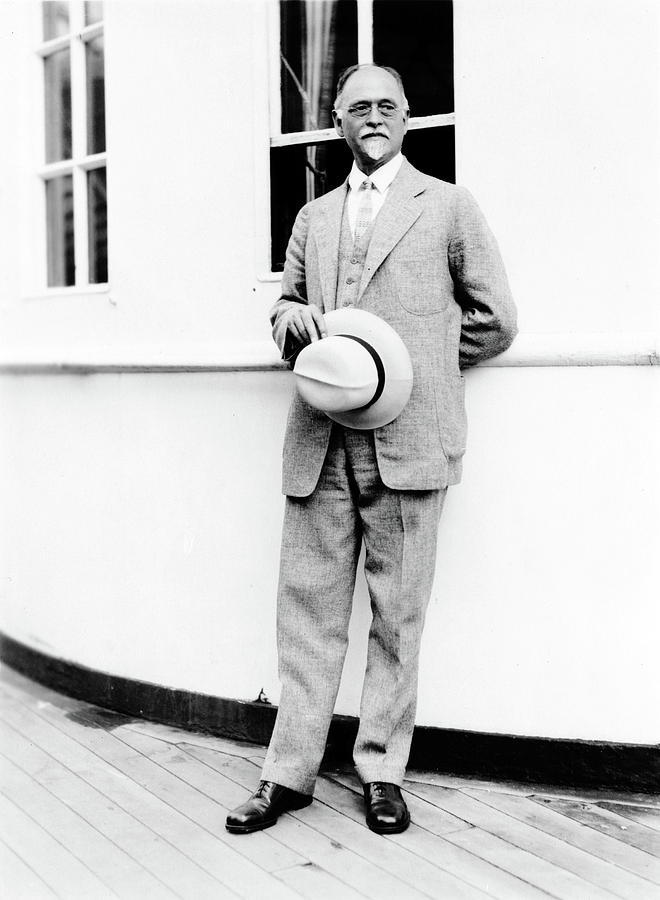
Image result for young irving fisher

(Cited in "The Great Depression: Mises vs. Fisher" by Mark Thornton, Quarterly Journal of Austrian Economics, p. 239, November 25, 2008

Jul 31, 2019

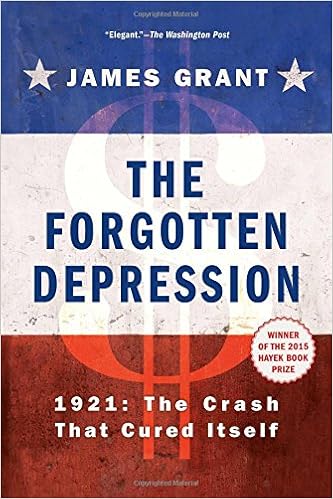
Jim Grant on Irving Fisher and his desire to smooth out the boom-and-bust cycle

[Irving] Fisher was a man of few doubts and boundless energy.  He advocated for public health (with all the authority of the tuberculosis survivor that he was), prohibition, common stocks, eugenics, longevity through vegetarianism, Indian meditation - and government economic management.  An enlightened central bank could neutralize booms and busts alike by controlling the stock of money, or so he proposed.

Fisher rejected the Bryanite campaign for lots of silver dollars.  But he did not reject the notion that the quantity of money was of the utmost importance in determining prices and wages.  Neither did he share his contemporaries' fatalism with respect to the cycles of credit and business.

Stability was the ticket, he said.  The price level should neither rise nor fall but should remain the same.  Justice to debtors and creditors demanded it.  And enlightened central bankers might achieve it.  The age of laissez-faire was over, declared Fisher in 1906.

~ James Grant, The Forgotten Depression: 1921: The Crash That Cured Itself (2014), p. 28

Image result for the forgotten depression grant

Jul 30, 2019

Irving Fisher on easy money

Easy money is the great cause of overborrowing.

~ Irving Fisher, "The Debt-Deflation Theory of Great Depressions," September 1933

Irving Fisher on the causes of over-indebtedness

44. The over-indebtedness hitherto presupposed must have had its starters. It may be started by many causes, of which the most common appears to be new opportunities to invest at a big prospective profit, as compared with ordinary profits and interest, such as through new inventions, new industries, development of new resources, opening of new lands or new markets. Easy money is the great cause of overborrowing. When an investor thinks he can make over 100 per cent per annum by borrowing at 6 per cent, he will be tempted to borrow, and to invest or speculate with borrowed money. This was a prime cause leading to the over-indebtedness of 1929. Inventions and technological improvements created wonderful investment opportunities, and so caused big debts. Other causes were the left-over war debts, domestic and foreign, public and private, the reconstruction loans to foreigners, and the low interest policy adopted to help England get back on the gold standard in 1925.

~ Irving Fisher, "The Debt-Deflation Theory of Great Depressions," September 1933

Irving Fisher anticipates the modern day Fed

42. If the debt-deflation theory of great depressions is essentially correct, the question of controlling the price level assumes a new importance; and those in the drivers' seats—the Federal Reserve Board and the Secretary of the Treasury, or, let us hope, a special stabilization commission—will in future be held to a new accountability.

~ Irving Fisher, "The Debt-Deflation Theory of Great Depressions," September 1933

Irving Fisher: laissez-faire approach to Depression would have led to a political revolution

39. If even then our rulers should still have insisted on "leaving recovery to nature" and should still have refused to inflate in any way, should vainly have tried to balance the budget and discharge more government employees, to raise taxes, to float, or try to float, more loans, they would soon have ceased to be our rulers. For we would have insolvency of our national government itself, and probably some form of political revolution without waiting for the next legal election.

~ Irving Fisher, "The Debt-Deflation Theory of Great Depressions," September 1933

Irving Fisher on reflation as preventing depression

38. [I]t is always economically possible to stop or prevent such a depression simply by reflating the price level up to the average level at which outstanding debts were contracted by existing debtors and assumed by existing creditors, and then maintaining that level unchanged.

~ Irving Fisher, "The Debt-Deflation Theory of Great Depressions," September 1933

Irving Fisher on alternative explanations of the boom-bust cycle

15. While any deviation from equilibrium of any economic variable theoretically may, and doubtless in practice does, set up some sort of oscillations, the important question is: Which of them have been sufficiently great disturbers to afford any substantial explanation of the great booms and depressions of history?

16. I am not sufficiently familiar with the long detailed history of these disturbances, nor with the colossal literature concerning their alleged explanations, to have reached any definitive conclusions as to the relative importance of all the influences at work. I am eager to learn from others.

17. According to my present opinion, which is purely tentative, there is some grain of truth in most of the alleged explanations commonly offered, but this grain is often small. Any of them may suffice to explain small disturbances, but all of them put together have probably been inadequate to explain big disturbances.

~ Irving Fisher, "The Debt-Deflation Theory of Great Depressions," September 1933

Irving Fisher on the business cycle

6. There are two sorts of cyclical tendencies. One is "forced" or imposed on the economic mechanism from outside. Such is the yearly rhythm; also the daily rhythm. Both the yearly and the daily rhythm are imposed on us by astronomical forces from outside the economic organization; and there may be others such as from sun spots or transits of Venus. Other examples of "forced" cycles are the monthly and weekly rhythms imposed on us by custom and religion. The second sort of cyclical tendency is the "free" cycle, not forced from outside, but self-generating, operating analogously to a pendulum or wave motion.

7. It is the "free" type of cycle which is apparently uppermost in the minds of most people when they talk of "the" business cycle.

~ Irving Fisher, "The Debt-Deflation Theory of Great Depressions," September 1933

Irving Fisher on main causes of boom and bust: over-indebtedness and deflation

19. I venture the opinion, subject to future evidence, that, in the great booms and depressions, each of the above-named factors has played a subordinate role as compared with two dominant factors, namely over-indebtedness to start with and deflation following soon after; also that where any of the other factors do become conspicuous, they are often merely effects or symptoms of these two. In short, the big bad actors are debt disturbances and price level disturbances.

While quite ready to change my opinion, I have, at present, a strong conviction that these two economic maladies, the debt disease and the price-level disease (or dollar disease), are, in the great booms and depressions, more important causes than all others put together.

Irving Fisher on the liquidation cure for busts

40. [I]t would be as silly and immoral to "let nature take her course" as for a physician to neglect a case of pneumonia. It would also be a libel on economic science, which has its therapeutics as truly as medical science.

~ Irving Fisher, "The Debt-Deflation Theory of Great Depressions," September 1933


Irving Fisher on debt, deflation and the business cycle

29. When over-indebtedness stands alone, that is, does not lead to a fall of prices, in other words, when its tendency to do so is counteracted by inflationary forces (whether by accident or design), the resulting "cycle" will be far milder and far more regular.

30. Likewise, when a deflation occurs from other than debt causes and without any great volume of debt, the resulting evils are much less. It is the combination of both—the debt disease coming first, then precipitating the dollar disease—which works the greatest havoc.

~ Irving Fisher, "The Debt-Deflation Theory of Great Depressions," September 1933

Jul 28, 2019

Jim Grant on negative interest rates and the ghost of Irving Fisher

It's tempting to try to imagine how [Irving] Fisher would react to the negative interest rates of 2019.  He certainly had nothing against innovation.  One can imagine him falling in with the new thinking, or even, perhaps, leading it.  He was an inveterate tinkerer and an ardent reflationist.

If his analysis was correct, Fisher wrote in 1933, "it is always economically possible to stop of prevent such a depression simply by reflating the price level up to the average level at which outstanding debts were contracted by existing debtors and assumed by existing creditors, and then maintaining that [price] level unchanged."

The mind - at least our mind - boggles at the otherworldliness of this casual prescription.  "Simply by reflating?"  The dubious record of so-called quantitative easing suggests there would be nothing simple about it.  As to the unintended consequences of this prospective intervention, Fisher is silent.

~ Jim Grant, "The best economist on the lowest rates," Grant's Interest Rate Observer, July 26, 2019

Image result for irving fisher

Mar 29, 2017

Irving Fisher endorses presidential candidate Herbert Hoover (1928)

Mr. Hoover is a practical economist and one to whom is due more largely than to any other one man improvement in our prosperity...  Mr. Hoover knows as few men do the terrible evils of inflation and deflation, and the need of avoiding both if business and agriculture are to be stabilized.

~ Irving Fisher, July 29, 1928

Image result for irving fisher 1929

Nov 16, 2013

Time's Justin Fox on Irving Fisher, "the country's first great economist"

[Irving] Fisher was the country's first great economist, a pioneer of the mathematical approach that came to dominate the discipline after his death. Fisher saw the behavior of the market in rational, mathematical terms. He wasn't completely doctrinaire about this--earlier in his career, he had allowed that investors sometimes behaved like sheep. But in the 1920s, convinced that skilled monetary management at the Federal Reserve and the rise of new, professionally run investment trusts had reduced the riskiness of markets, he lulled himself into believing that the prices prevailing on Wall Street were a reflection of economic reality and not of investor mania or a credit bubble.

~ Justin Fox, Time, "The Myth of the Rational Market," June 22, 2009

Nov 10, 2013

Time reporter Justin Fox on Irving Fisher's prescription for the 1930s bust

For all its flaws, [Irving] Fisher's economic approach delivered genuinely important insights. He proposed in 1911 that the government issue inflation-linked bonds; in 1997, the Treasury Department finally got around to doing so. If anybody in power in Washington had been willing to follow his advice in 1930 or '31 (which essentially amounted to "Print more money"), the Great Depression might not have been so great. For the past two years, the Federal Reserve has been working right out of the Fisher playbook, and while the results haven't been perfect, they've been a lot better than those of the early 1930s.

~ Justin Fox, Time, "The Myth of the Rational Market," June 22, 2009

Irving Fisher sees no crash in stock prices (1929)

There may be a recession in stock prices, but not anything in the nature of a crash.  Dividend returns on stocks are moving higher.  This is not due to receding prices for stocks, and will not be hastened by any anticipated crash, the possibility of which I fail to see.

A few years ago people were as much afraid of common stocks as they were of a red-hot poker. In the popular mind there was a tremendous risk in common stocks. Why? Mainly because the average investor could afford to invest in only one common stock. Today he obtains wide and well managed diversification of stock holding by purchasing shares in good investment trusts.

~ Irving Fisher, September 5, 1929 (two days after the peak of the bull market according to Robert Murphy, author of The Politically Incorrect Guide to the Great Depression and the New Deal)

Image result for irving fisher 1929

Dec 19, 2010

Mark Thornton on the tech bubble (2000)

Dear Investors Business Daily:

In "Are Boom- Bust Cycles Gone Forever?" (08-23-00, p. A10) a strong case is made that the business cycle is dying, if not dead. Once again the "new economy" mantra of technology, globalization and government management of the economy has raised its ugly head.

The same mantra was common in the U.S. during the 1960s when Keynesian "counter- cyclical fiscal policy" was in charge of the business cycle while American high tech companies expanded around the globe. Then came the stagflation of the 1970s. The Japanese boom of the 1980s was said to be due to its "managed economy" that allowed Japanese industry to dominate world markets. The Japanese bust of the 1990s followed. And who can forget the "Roaring 20s" when America's new technology (radios, cars, planes, refrigerators, motion pictures, etc.) had the world in awe. Economist Irving Fisher declared a "permanent prosperity" right before the stock market crash of 1929 and the Great Depression.

Technology cannot kill the business cycle. In fact, technology is the mechanism that traps capital in unsustainable and premature investment projects. Entrepreneurs are lured by artificially low or stable interest rates during the "boom" phase of the business cycle only to see their plans go bust as interest rates and inflation increase.

Clearly FED chief Alan Greenspan understands that monetary instability is the key to the cycle and he has recently stated his knowledge of the Austrian business cycle theory to Congress. But knowing the problem and solving it are two different things. Knowledge of economic theory does not allow bureaucrats to solve the problems of government inefficiency, taxation, business regulation and price controls.

The business cycle will not die until money and credit are purely market-based institutions, rather than government bureaucracies that supply, control, and regulate. While such a radical change of institutions is an unlikely event in the near future, requiems for the death of the business cycle might serve as a good forecast for what is.

~ Mark Thornton, letter-to-the-editor sent to IBD, never published, August, 2010

Image result for mark thornton 2010

Sep 7, 2010

Irving Fisher admits socialist sympathies to Yale Socialist Club, 1941

I believe [William Graham Sumner] was one of the greatest professors we ever had at Yale, but I have drawn far away from his point of view, that of the old laissez faire doctrine.

I remember he said in his classroom: "Gentlemen, the time is coming when there will be two great classes, Socialists, and Anarchists. The Anarchists want the government to be nothing, and the Socialists want government to be everything. There can be no greater contrast. Well, the time will come when there will be only these two great parties, the Anarchists representing the laissez faire doctrine and the Socialists representing the extreme view on the other side, and when that time comes I am an Anarchist."

That amused his class very much, for he was as far from a revolutionary as you could expect. But I would like to say that if that time comes when there are two great parties, Anarchists and Socialists, then I am a Socialist.

~ Irving Fisher, in a speech to the Yale Socialist Club in 1941, as quoted in the biography My Father, Irving Fisher, p. 44

Image result for the socialist party 1941

Jan 15, 2008

Christopher Mayer: All the ingredients of a bubble exist (2000)

Looking back, future financial historians will likely relate the Glassman-Hassett thesis to Irving Fisher's famous proclamation in 1929 that "stock prices have reached a permanent and high plateau." James Grant likes to say that there are three common features of a bubble: one part fundamental (i.e., a technological revolution), one part financial (i.e., a surge in money and credit), and one part psychological (i.e., a suspension of belief in traditional value measures.) All the ingredients would appear to exist in the current bull market.

As is often said, only time will tell. Unfortunately, no theory of cycles or bubbles can tell us precisely when it will end. Maybe twenty years from now, we will be able to definitively state whether these prices were reasonable or whether the boom time of the 1990s ended in a bust. From where I sit, heeding the teachings of the Austrians, I'll place my bet on the latter.

~ Christopher Mayer, 2000

Related image