~ Joel Tillinghast, Big Money Thinks Small, p. 60
Showing posts with label indexation. Show all posts
Feb 21, 2023
Joel Tillinghast: avoid investing in the single largest stock in the S&P 500
Familiarity can work against investors. If you continuously invested in the single largest S&P 500 stock by market value between 1972 and 2016, your compound returns would have been less than 4 percent, while the index earned over 10 percent. A smiliar but smaller effect was seen with the ten largest S&P 500 stocks.
Jan 5, 2023
Horizon Kinetics: indexation and asset allocation models are broken
Investors now face questions they haven’t had to consider for decades. Until this past year, the entrenched basketof-securities approach to investing meant one didn’t have to think, one just bought the recommended asset classes. That approach is now in disarray. It depended on a simplistic presumption that the prior 20 or 40 years of daily price data represented normality. It couldn’t contemplate a change in those presumptions. History is a lot messier. That data, it turns out, described an anomalous period, not a normative one.
It should now be clear that indexation and asset allocation models – at least as practiced – can no longer be relied upon as having predictive value. Bonds, for instance. Over the past 20 years, after taxes, they returned only about 2%, annualized. Even accepting the government’s CPI calculation that inflation averaged only 2.5%, that means bonds had a negative real return, a two-decade loss of purchasing power. That was not supposed to happen (on the reasoning that it hadn’t happened before). And that was during a period of relatively benign inflation. ‘Benign’ is not the likely caption for the next 20 years. Rationally, one must rethink one’s approach to bond investing. One must rethink other presumptions about the standardized approach to investing.
~ Horizon Kinetics 2023 investor letter, January 4, 2023
Jun 22, 2022
Dan Ferris on index funds
Psychologically, you've gotten used to buying every dip for the last 13 years going back to 2009. Psychologically, you've gotten used to the fact that your bonds protect you from the drawdowns in your stocks. And it's really hard to shake these. We still have people saying, "Oh, the best thing you can do is just buy an index fund and hold it for the long-term, and Warren Buffett says to do it, so you know it's really good." But Warren Buffett is a beneficiary of this status quo... He's worth tens of billions of dollars because of this financialization... So it's sort of weird to listen to somebody like that at this moment. Nobody's right all the time and nobody's right forever. And what looks like long-term wisdom of the ages can sometimes look really bad for awhile and I think right now we're learning that just buying an index fund and hanging onto it might not be the greatest thing in the world. This might not be a great moment to double down.
~ Dan Ferris, Stansberry Investor Hour, 8:45 mark, June 21, 2022
Labels:
buy and hold,
index funds,
indexation,
people - Ferris; Dan
Jan 18, 2020
Mark Hulbert on market sentiment, index funds, and market timers
One indication that we’re a lot closer to the greed end of the spectrum comes from the widespread popularity today of buying and holding index funds. Judging by the 200 newsletters I monitor, market timers are struggling. It’s a good bet that just the opposite will be true at the bottom of the next bear market.
~ Mark Hulbert, "How the 1% at Davos make the same mistakes as we do about stocks and the economy," MarketWatch.com, January 10, 2020
Labels:
greed,
indexation,
market timing,
people - Hulbert; Mark,
sentiment
Jan 15, 2020
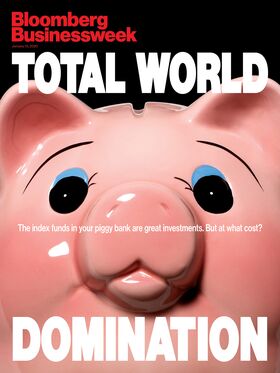
Bloomberg Businessweek on index funds
The index fund is one of a handful of unambiguously beneficial financial innovations. Before it caught on, investors routinely paid sky-high fees to active stockpickers who often delivered subpar returns. The near-universal popularity of index funds puts them up there with Social Security, Stevie Wonder, and streaming TV.
~ Bloomberg Businessweek, "The Great Index Fund Takeover," January 13, 2020
Labels:
indexation,
magazine covers,
passive bubble,
passive investing
Nov 26, 2018
Michael Santoli on $6.6 bil flowing into Fidelity's zero fee index funds (excluding ETFs)
Low-fee exposure to the equity market is the new performance chasing.
~ Michael Santoli, as appeared on CNBC, November 26, 2018
Labels:
indexation,
mutual fund flows,
passive investing
Apr 11, 2017
Kevin Duffy on the Fiduciary Rule
If we’re going to pass a law against conflicts of interest,
shouldn’t there be a law against lobbying the government when such a conflict
exists? (Which is always, of course.) How can John Bogle not admit
that he and his friends benefit from the Fiduciary Rule?
The irony, of course, is that indexation needs discovery
agents, and this legislation will put more obstacles in their path.
Without price discovery (e.g., interest rates set by the market) and discovery
agents (active investors, short sellers, upstart entrepreneurs), there is no
vibrant economy that generates the returns Mr. Bogle’s customers covet.
It can’t be a coincidence that the government only recently
discovered the merits of high-liquidity low-fee investing after a tripling of
the S&P 500 in 8 years and a 35 year bull market in bonds. Should we
be thanking them for ringing the bell yet again?
~ Kevin Duffy, April 11, 2017
Subscribe to:
Posts (Atom)