Showing posts with label liquidity. Show all posts

Nov 18, 2022

Charles Hugh Smith on counterparty risk and the dominos from the FTX collapse

The full exposure to the risks inherent in extreme leverage and illiquidity can be cloaked, buried in off-balance sheet assets and liabilities, etc., while pages of mind-numbing disclosures were duly signed by blinded-by-greed marks. 

These quasi-legal versions are just as prone to unraveling and collapse as the blatantly fraudulent varieties. Properly disclosed leverage and illiquidity are just as prone to unraveling as undisclosed leverage and illiquidity. 

Mismatches of duration, liquidity and risk are just as toxic to full-disclosure firms as they are to fraudulent firms. 

This is why we can predict the dominoes of FTX's financial fraud have yet to fall.  When there are mismatches in counterparty asset durations and liquidity, assets that theoretically cover loans that are called can't be sold or can only be sold at ruinous discounts.

~ Charles Hugh Smith, "FTX: The Dominoes of Financial Fraud Have Yet to Fall," OfTwoMinds.com, November 16, 2022



Mar 16, 2021

Will McGough on the rise of SPACs and cryptocurrencies

There is so much $$ sloshing around now which will have its own impact.  You could argue the rise of crypto and SPACs are just vehicles to absorb all the new money.

~ Will McGough, Stadion Money Management, "One year ago stocks dropped 12% in a single day. What investors have learned since then," CNBC.com, March 16, 2021


Sep 27, 2020

Nathan Anderson on tech bubble 2.0: "I view it as a state-sponsored mess of stupidity of sorts"

We’re in a market where there’s so much liquidity sloshing around, and so much of the retail investment is in hype-fueled industries, that it has attracted and enriched just about every stock promoter capable of telling a basic story. 

A lot of this is fueled by never-ending Federal Reserve liquidity. So the Fed has come in and largely put a bid under everything. Whenever you print trillions of dollars of new money, at any given point there’s a finite number of Treasury bills and high-quality instruments, whether corporate bonds or stocks, and you can bid up multiples to a certain point. But it seems that eventually that money flows into highly speculative names, and what that’s led to is the Nasdaq ripping past new highs, behind a lot of money that’s really going into just about any speculative tech stock with potential. I view it as a state-sponsored mess of stupidity of sorts.


Sep 6, 2020

Dick Fuld on the Fed's support of the investment banking industry

[The Fed's creation of a liquidity facility for primary dealers] from my perspective, takes the liquidity issue for the entire industry off the table.

~ Dick Fuld, Chairman, Lehman Brothers, e-mailed statement, March 17, 2008

(Reuters, March 28, 2008: Since Bear was forced to announce plans to sell itself to JPMorgan Chase & Co on March 16, the Federal Reserve has allowed investment banks to borrow directly from the central bank, in a move designed to shore up the financial system.)

Feb 12, 2020

Jim Grant on liquidity

Liquidity is a psychological construct, perhaps as much as an arithmetic one.  Without a minimum quotient of speculative hope, even objectively liquid markets can malfunction.  It's confidence - in the future, in the dollar, in "the authorities," in the earning power of a business, in something or other - that makes the waters run...  In the dollar world, the fount of liquidity is the Federal Reserve...  Of course, the Fed merely proposes.  It's the "markets" - people changing their minds about price and value and buying and selling, lending and borrowing, accordingly - that dispose.

~ Jim Grant, "Gale-force liquidity," Grant's Interest Rate Observer, February 7, 2020


Oct 13, 2009

Business Week on a new "era of nonexistent inflation and rapid economic growth" (2006)

Nevertheless, despite all the twists, hedges, and cautious asides, a much bigger theme emerged from [Fed chairman] Bernanke's speech. He believes that real bond yields have taken a fundamental step down. If he's right, and I think he is, the significance of lower real rates is a seismic event for everyone from a young, first-time homebuyer to a grizzled venture capitalist. Put it this way: The world economy is on the cusp of an era of nonexistent inflation and rapid economic growth -- a long boom of historic proportions.

~ Business Week, "Let the Good Times Roll," March 27, 2006, by Chris Farrell

Dec 30, 2008

Alan Schwartz on Bear Stearns: No liquidity crisis (2008)

We don't see any pressure on our liquidity, let alone a liquidity crisis.

~ Alan Schwartz, CEO of Bear Stearns, March 12, 2008

Nov 10, 2008

Ken Fisher on solving the credit crunch (he failed to see coming)

The Fed has several powerful tools that it hasn't used. When banks fail, by definition they had inadequate reserves. So when you have a bunch of banks failing, you drop reserve requirements.

The other thing you do [is] manipulate, planfully, the spread between the discount rate, the Fed funds rate, and the T-bill rate…The way to end the liquidity crisis is to drop the discount rate relative to the Fed fund rate, which then motivates banks which are troubled to go to the discount window, plead baby shoes, get cheap money at the discount window, and then turn their rear ends around and lend it out at the Fed fund market rate because it’s free money. You borrow at the discount window cheap, you lend it to the safest bank you know, and now that bank has excess reserves, and they lend it out. The way the Fed has always unlocked liquidity freezes is to increase the spread between the discount rate and the fund rate. If you want to get more extreme, drop the discount rate below the T-bill rate, and now you have a riskless transaction.

~ Ken Fisher, "Catching Up With: Ken Fisher," Investment Adviser, November 1, 2008, by James J. Green

Nov 3, 2008

Laurence Fink: "We are trading liquidity for illiquidity" (2007)

Probably the greatest issue that's confronting the world's investors is we are trading liquidity for illiquidity.

~ Laurence D. Fink, CEO, BlackRock, FT.com, April 26, 2007

Image result for laurence fink bailouts

Sep 27, 2008

Alan Greenspan's response to the '87 Crash

The Federal Reserve, consistent with its responsibilities as the nation's central banker, affirmed today its readiness to serve as a source of liquidity to support the economic and financial system.

~ Alan Greenspan, Federal Reserve chairman, October 19, 1987

(On October 19, the Fed reversed their September 4 rate hike, lowering the Fed funds rate from 7.25% to 6.88% in an emergency inter-meeting move.)

Image result for alan greenspan 1987
June 15, 1987

Jan 13, 2008

Jim Paulsen on endless liquidity (2007)

This could be a prolonged cycle where the cost of capital is low [for] 10 or 20 years.

~ James W. Paulsen, chief investment strategist at Wells Capital Management, "It’s a Low, Low, Low, Low-Rate World," BusinessWeek, February 19, 2007 cover story

Image result for james paulsen wells capital management

Dec 15, 2007

Merrill Lynch analyst concerned about liquidity drying up for New Century

Finance companies that go out of business usually do so because of a lack of liquidity.

Investors and warehouse lenders could lose confidence in New Century. New Century's business model is highly reliant on liquidity, so if investor confidence deteriorates and credit facilities are constrained, a liquidity event could ensue.

New Century's accounting issues and deteriorating fundamentals at its lending operation could put it at a steep downward slope, in our view, and we are more concerned that liquidity issues and adverse market reactions could undermine its business model and financial stability even further.

~ Kenneth Bruce, Merrill Lynch analyst, from a note to clients on Feb. 8, "Big banks control fate of subprime lenders," MarketWatch, February 16, 2007

(Merrill Lynch downgraded the stock to a sell.)

Image result for new century financial

Dec 12, 2007

Alan Skrainka on latest Fed plan to add liquidity

This is a very bullish development for the markets. The main problem in credit markets has not been that rates are too high, but that financial institutions have been unwilling to lend. This added liquidity should relieve some of that pressure.

~ Alan Skrainka, chief market strategist, Edward Jones, "U.S. stocks recover gains after late-session slide; Coordinated actions by central banks designed to add $40 billion in liquidity," MarketWatch, December 12, 2007

(The Fed unveiled a plan Wednesday to add $40 billion in liquidity to the markets, with help from the European Central Bank, the Bank of England, the Bank of Canada and the Swiss National Bank. See full story.)

Dec 6, 2007

Chip Mason on credit markets

(Chip Mason, chief executive and founder of Legg Mason, one of the world's biggest money managers, said yesterday that the credit markets are in the worst state he has seen in his 47 years in the business.)

It is a very unusual situation. I have not seen anything like this, where nothing is traded.

~Chip Mason, CEO, Legg Mason, Financial Times, December 5, 2007

Nov 3, 2007

Chuck Prince on playing the game of musical chairs

When the music stops, in terms of liquidity, things will get complicated. But as long as the music is playing, you've got to get up and dance. We're still dancing.

The depth of the pools of liquidity is so much larger than it used to be that a disruptive event now needs to be much more disruptive than it used to be.

At some point, the disruptive event will be so significant that instead of liquidity filling in, the liquidity will go the other way. I don’t think we’re at that point.

~ Chuck Prince, Citigroup CEO, "Citigroup chief stays bullish on buy-outs," Financial Times, July 9, 2007


Oct 26, 2007

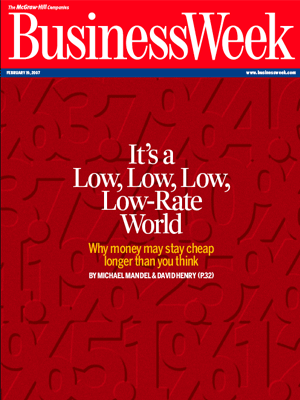
BusinessWeek cover: It’s a Low, Low, Low, Low-Rate World

Borrowers, of course, are deliriously happy. Even the shakiest companies are seeing their debt costs plunge… Most remarkably, the craziness isn’t likely to stop anytime soon.

~ "It’s a Low, Low, Low, Low-Rate World," BusinessWeek, February 19, 2007 cover story

Image result for businessweek it's a low low low low rate world