Showing posts with label Smoot-Hawley tariff. Show all posts

Jul 29, 2025

Fred Hickey on the risk of tariffs to investors

Tariff hikes are a major risk [for investors].  The average effective U.S. tariff rate is currently around 15%.  The last time U.S. tariffs were this high was in the mid-1930s, during the Great Depression.  Many believe that the Smoot-Hawley tariffs (signed into law on June 17, 1930) were a major contributing factor for that extended depression.

~ Fred Hickey 

Image 

Dec 30, 2024

Kevin Duffy on Trump, trade and tariffs

Outside of Trump’s inner circle, nearly everyone seems to understand the destructive nature of tariffs, even Keynesian economists and Trump voters.  After the election, the stocks of dollar stores immediately sold off on concerns the industry would face higher costs in a trade war with China, no doubt passed on to their lower- and middle-income customers.  Investors, at least for now, are downplaying these risks.

The problem is that the very essence of Trump is that of a pragmatic, businesslike interventionist who thinks trade is “negotiable” and “reciprocal.”  In a sense, he is right: trade is mutually beneficial, but to the parties involved, its terms are negotiated by the parties involved and each gives up something to get something in return.  However, when a third party, in this case the government, interferes, it can only interject its own wants and needs.  It does so through violence, i.e. it gives up nothing and benefits at the expense of those who would otherwise trade with each other.  While the state gains power, both parties to the trade are made poorer. 

Protectionism prevents a nation’s consumers from securing the best products at the lowest prices around the world.  It also denies producers and distributors the cheapest inputs and best deals.  Trade and peace go hand in hand.  A healthy global economy and rising living standards require expanding trade, specialization and the division of labor.  Protectionism moves in the opposite direction, towards self-sufficiency, nationalism and ultimately impoverishment. 

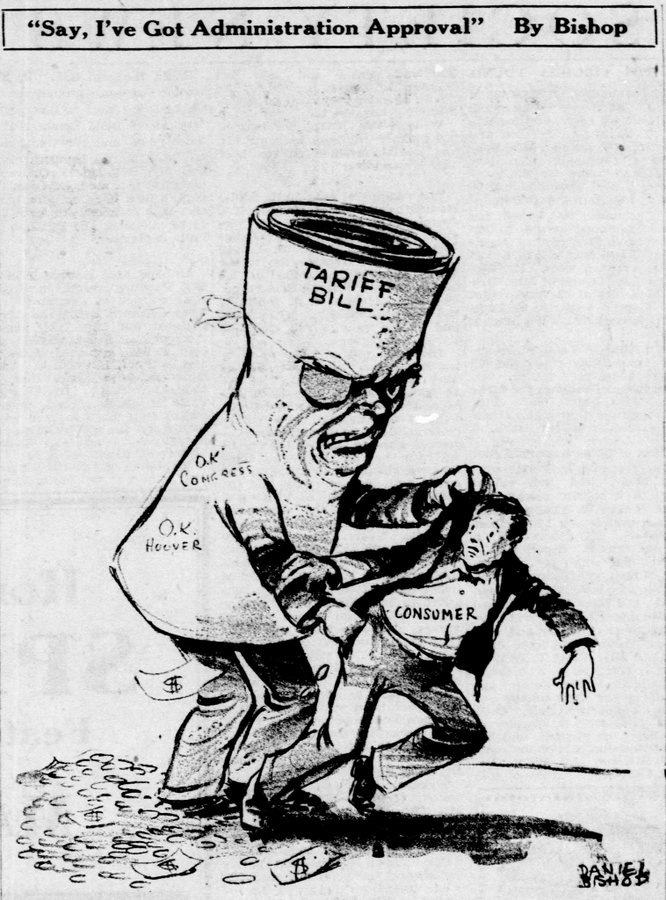
When Trump threatens 100% tariffs on anyone who refuses to trade in U.S. dollars, he is playing with fire.  In response to the Smoot-Hawley tariff of 1930, global trade plummeted 65%, plunging the world into depression and laying the groundwork for nationalism, authoritarianism and world war.


Sep 23, 2024

Office of the Historian on the Smoot-Hawley tariff

Scholars disagree over the extent of protection actually afforded by the Smoot-Hawley tariff; they also differ over the issue of whether the tariff provoked a wave of foreign retaliation that plunged the world deeper into the Great Depression.  What is certain, however, is that Smoot-Hawley did nothing to foster cooperation among nations in either the economic or political realm during a perilous era in international relations.  It quickly became a symbol of the “beggar-thy-neighbor” policies of the 1930s.  Such policies, which were adopted by many countries during this time, contributed to a drastic contraction of international trade.  For example, U.S. imports from Europe declined from a 1929 high of $1,334 million to just $390 million in 1932, while U.S. exports to Europe fell from $2,341 million in 1929 to $784 million in 1932.  Overall, world trade declined by some 66% between 1929 and 1934. 

Smoot-Hawley marked the end of the line for high tariffs in 20th century American trade policy.  Thereafter, beginning with the 1934 Reciprocal Trade Agreements Act, the United States generally sought trade liberalization through bilateral or multilateral tariff reductions.  To this day, the phrase “Smoot-Hawley” remains a watchword for the perils of protectionism. 

~ Office of the Historian, "Protectionism in the Interwar Period"