Showing posts with label Hamas. Show all posts

Jan 4, 2024

Uri Averny on the first Gaza War (2009)

WHAT WAS THE AIM?  Tzipi Livni [Minister of Foreign Affairs] announced it openly: to liquidate Hamas rule in Gaza.  The Qassams served only as a pretext. 

Liquidate Hamas rule?  That sounds like a chapter out of “The March of Folly”.  After all, it is no secret that it was the Israeli government which set up Hamas to start with.  When I once asked a former Shin-Bet chief, Yaakov Peri, about it, he answered enigmatically: “We did not create it, but we did not hinder its creation.” 

For years, the occupation authorities favored the Islamic movement in the occupied territories.  All other political activities were rigorously suppressed, but their activities in the mosques were permitted.  The calculation was simple and naive: at the time, the PLO was considered the main enemy, Yasser Arafat was the current Satan.  The Islamic movement was preaching against the PLO and Arafat, and was therefore viewed as an ally.

With the outbreak of the first intifada in 1987, the Islamic movement officially renamed itself Hamas (Arabic initials of “Islamic Resistance Movement”) and joined the fight.  Even then, the Shin-Bet took no action against them for almost a year, while Fatah members were executed or imprisoned in large numbers.  Only after a year, were Sheikh Ahmed Yassin and his colleagues also arrested.

Since then the wheel has turned.  Hamas has now become the current Satan, and the PLO is considered by many in Israel almost as a branch of the Zionist organization. The logical conclusion for an Israeli government seeking peace would have been to make wide-ranging concessions to the Fatah leadership: ending of the occupation, signing of a peace treaty, foundation of the State of Palestine, withdrawal to the 1967 borders, a reasonable solution of the refugee problem, release of all Palestinian prisoners.  That would have arrested the rise of Hamas for sure. 

But logic has little influence on politics.

~ Uri Averny, "Molten Lead," Gush Shalom, January 9, 2009


Dec 27, 2023

Brahma Chellaney on how Israel's policy of backing Hamas was influenced by U.S. support for mujahideen in Afghanistan

The international focus on the war in Gaza has helped obscure the fact that Israel in the 1980s aided the rise of the Islamist Hamas as a rival to the secular Palestinian Liberation Organization and its dominant faction, Yasser Arafat’s Fatah.  Israel’s policy was clearly influenced by the U.S. training and arming of mujahideen (or Islamic holy warriors) in Pakistan from multiple countries to wage jihad against Soviet forces in Afghanistan. 

The multibillion-dollar American program from 1980 to create anti-Soviet jihadis represented what still remains the largest covert operation in the Central Intelligence Agency’s history.  In 1985, at a White House ceremony attended by several mujahideen, then-U.S. President Ronald Reagan gestured toward his guests and declared, “These gentlemen are the moral equivalent of America’s Founding Fathers.”

Out of the mujahideen evolved the Taliban and al-Qaida.  As then-U.S. Secretary of State Hillary Clinton openly admitted in 2010, “We trained them, we equipped them, we funded them, including somebody named Osama bin Laden ... And it didn’t work out so well for us.”

~ Brahma Chellaney, "Israel's Historical Role in the Rise of Hamas," The Japan Times, November 21, 2023

President Reagan meeting with Afghan mujahideen
leaders in the Oval Office in 1983


Brahma Chellany on how Israel supported Hamas in order to thwart a two-state solution

Hamas, for its part, is alleged to have emerged out of the Israeli-financed Islamist movement in Gaza, with Israel’s then-military governor in that territory, Brig. Gen. Yitzhak Segev, disclosing in 1981 that he had been given a budget for funding Palestinian Islamists to counter the rising power of Palestinian secularists.  Hamas, a spin-off of the Palestinian branch of the Muslim Brotherhood, was formally established with Israel’s support soon after the first Intifada flared in 1987 as an uprising against the Israeli occupation of Palestinian lands. 

Israel’s objective was twofold: to split the nationalist Palestinian movement led by Arafat and, more fundamentally, to thwart the implementation of the two-state solution for resolving the protracted Israeli-Palestinian conflict.  By aiding the rise of an Islamist group whose charter rejected recognizing the Israeli state, Israel sought to undermine the idea of a two-state solution, including curbing Western support for an independent Palestinian homeland. 

Israel’s spy agency Mossad played a role in this divide-and-rule game in the occupied territories.  In a 1994 book, “The Other Side of Deception,” Mossad whistleblower Victor Ostrovsky contended that aiding Hamas meshed with “Mossad’s general plan” for an Arab world “run by fundamentalists” that would reject “any negotiations with the West,” thereby leaving Israel as “the only democratic, rational country in the region.”  Avner Cohen, a former Israeli religious affairs official involved in Gaza for over two decades, told a newspaper interviewer in 2009 that, “Hamas, to my great regret, is Israel’s creation.” 

~ Brahma Chellany, "Israel's historical role in the rise of Hamas," The Japan Times, November 21, 2023

Mehdi Hasan on how Israel helped finance Hamas

[D]id you also know that Hamas — which is an Arabic acronym for “Islamic Resistance Movement” — would probably not exist today were it not for the Jewish state?  That the Israelis helped turn a bunch of fringe Palestinian Islamists in the late 1970s into one of the world’s most notorious militant groups?  That Hamas is blowback?

This isn’t a conspiracy theory.  Listen to former Israeli officials such as Brig. Gen. Yitzhak Segev, who was the Israeli military governor in Gaza in the early 1980s.  Segev later told a New York Times reporter that he had helped finance the Palestinian Islamist movement as a “counterweight” to the secularists and leftists of the Palestine Liberation Organization and the Fatah party, led by Yasser Arafat (who himself referred to Hamas as “a creature of Israel.”)

“The Israeli government gave me a budget,” the retired brigadier general confessed, “and the military government gives to the mosques.”

~ Mehdi Hasan, "Blowback: How Israel Went From Helping Create Hamas to Bombing It," The Intercept, February 19, 2018


Dec 21, 2023

Sheikh Ahmed Yassin: "We don't hate Jews"

We don't hate Jews and fight Jews because they are Jewish.  They are a people of faith and we are a people of faith, and we love all people of faith.  If my brother, from my own mother and father and my own faith takes my homes and expels me from it, I will fight him.  I will fight my cousin if he takes my home and expels me from it.  So when a Jew takes my home and expels me from it, I will fight him.  I don't fight other countries because I want to be at peace with them, I love all people and wish peace for them, even the Jews.  The Jews lived with us all of our lives and we never assaulted them, and they held high positions in government and ministries.  But if they take my home and make me a refugee like 4 million Palestinians in exile?  Who has more right to this land?  The Russian immigrant who left this land 2000 years ago or the one who left 40 years ago?  We don't hate the Jews, we only ask for them to give us our rights.

~ Sheikh Ahmed Yassin, Hamas founder, 1988 interview


Dec 20, 2023

Bonnie Kristian on the plight of Palestinians in Gaza

As the Palestinian Christian writer mentioned above observed, "The poisonous plant of Hamas has been able to take root in our soil." And why? Significantly "because of conditions fostered by a flawed approach to Palestinians from the Israeli government." 

That phrase—a "flawed approach"—will almost certainly be an understatement about the Israeli military retaliation for Hamas's monstrous attack. Heading into this past weekend, 1 million civilian Palestinians in Gaza were warned to flee ahead of an Israeli ground incursion. But how can they flee? Where will they go? Borders are sealed. Gaza is small. Again, about half the population is children. People are moving, but their options are limited. 

A Reuters report published Thursday told the story of a 31-year-old Palestinian man named Ala al-Kafarneh. He fled his home "with his pregnant wife, his father, brothers, cousins, and in-laws," first to a coastal refugee camp, then elsewhere, after Israeli airstrikes hit around the camp. "On Tuesday night, an airstrike hit the building where Kafarneh and his family were sheltering, killing all of them except him." 

Kafarneh's position is unfathomable—a pregnant wife and unborn child, dead and recorded, nameless, in the list of family casualties. Would it surprise anyone if he turns to violence now?

That is not to say he would be justified in seeking a violent revenge. To say that is to take a step toward moral madness, toward a cycle of escalation and chaos, not justice, mercy, or any other good. But it is to say that violence, by its nature, tends to spread. Once loose, it overruns moral boundaries and bends our souls into grotesque shapes. We are each responsible for the violence we commit, each to blame for the wrong we do, each apt to respond to evil with evil. Blood is on the hands that shed it, but it tends to spill all over.


Dec 19, 2023

Murray Rothbard on rise of Hamas and decline of the P.L.O.

The P.L.O., child of the 1960s, was the last major organization born of the Old Islam: that is, led by secularists who were genuinely devoted to a unitary secular state in Palestine, with complete freedom to be enjoyed by all religions, Jewish and Christian, as well as Muslim.  At the same time that Israeli leaders were demonizing the P.L.O. as eager to hurl all Jews into the sea, the P.L.O. always insisted on distinctions between the aggressive "Zionist entity," which they hated, and the Jewish religion, which they had nothing against.

But that was Old Islam.  Within the last decade or so, as everyone knows, a militant New Islam has emerged, determined, "fundamentalist," and heaping only scorn on "Western" ideals such as religious freedom that had so influenced older groups like the P.L.O.  And so the upsurge of the New Islam, the "hard right" such as Hamas and Islamic Jihad, hard-core Muslims who have no use for secularism or religious freedom.  And never, ever are they in a spirit to compromise, to surrender, to the hated Zionist entity.  The Palestinians of the poor, wretched Gaza Strip are almost totally devoted to Hamas, as are much of the Palestinians on the West Bank and among the remainder of the Palestinians, the P.L.O.'s only trumpcard has been the person of Yassar Arafat, beloved by rank-and-file Palestinians as the George Washington of his people.  But even that devotion began to erode a few years ago when the Muslim Arafat displayed the temerity to marry a Christian wife.

~ Murray Rothbard, "The Israel-P.L.O. Accord," Rothbard-Rockwell Report, October 1993, p. 4

September 13, 1993


Dec 15, 2023

Zack Beauchamp on how Netanyahu propped up Hamas

Q: Tell us more about these payments that it sounds like Netanyahu continued to be in support of.  Tell us about what this money ostensibly being used for and why from teh Netanyahu perspective it was a good idea.

A: The basic idea behind these payments, facilitated via Qatar, sometimes very directly with Israeli support, was to prop up the Hamas government.  Netanyahu has said as much, not in public - he doesn't openly admit this, he in fact denies it - but in reports of comments he's made privately, that the basic idea here was you need to keep the Palestinians divided... between the Palestinian Authority, which governs the West Bank, and Hamas, which has governed Gaza since 2007.  Now why do you do that?  In his mind it's very simple: because Hamas is - or thought to be prior to October 7th - more responsible than other militant Palestinian factions in Gaza and second, and more importantly, because when the Palestinians are divided, there's very little pressure on Israel to make any final two-state agreement... because there's no one to agree with.  There's no unified Palestinian political structure.  And so from the hard-line Israeli point of view, Netanyahu's point of view, "This is perfect.  This is ideal.  We can keep doing whatever we want and we don't have to worry about the pesky international community as long as there are these violent fanatics in charge of Gaza."  

So it was sort of a win-win from his point of view prior to October 7th, which changed everything because it joked this entire conversation that Israel could buy a certain kind of quiet from Hamas by quietly supporting them on the security front just was wrong, entirely wrong.

~ Zack Beauchamp, senior correspondent, Vox, "Behind Bibi Netanyahu's FAILED PLAN To BUY PEACE By Propping Up HAMAS," The Hill, 1:00 mark, December 11, 2023


Dec 4, 2023

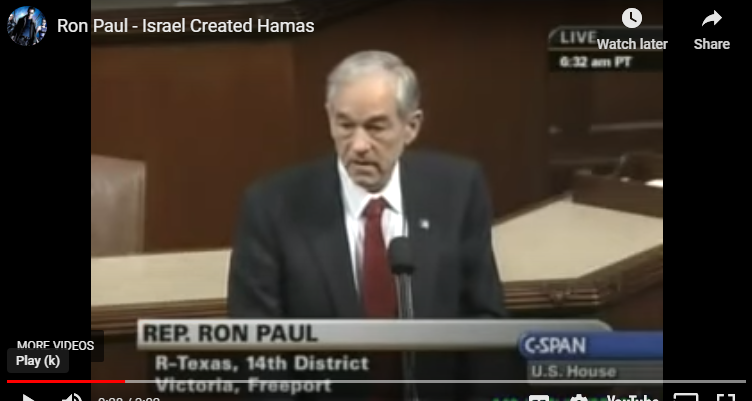
Ron Paul on Hamas and blowback (2009)

[Paul’s 2009 comments came as he rose in opposition to House Resolution 34, “Recognizing Israel’s right to defend itself against attacks from Gaza, reaffirming the United States’ strong support for Israel, and supporting the Israeli-Palestinian peace process.”]

I rise in opposition to this resolution, not because I am taking sides and picking who the bad guys are and who the good guys are, but I'm looking at this more from the angle of being a United States citizen, an American.  And I think resolutions like this really do us great harm.

In many ways, what’s happening in the Middle East, in particular with Gaza right now, we have some moral responsibility for both sides in a way because we provide help and funding for both Arab nations and Israel.  We have a moral responsibility, especially now today the weapons being used to kill so many Palestinians are American weapons and American funds are being used for this.

But there’s a political liability, which I think is something we fail to look at because too often there’s so much blowback from our intervention in areas that we shouldn’t be involved in.

You know Hamas, if you look at the history, you’ll find out that Hamas was encouraged and really started by Israel because they wanted Hamas to counteract Yasser Arafat.

You say, "Well, yeah, it was better then and served its purpose, but we didn’t want Hamas to do this." So then we, as Americans, say, "Well, we have such a good system; we’re going to impose this on the world.  We’re going to invade Iraq and teach people how to be democrats.  We want free elections."  So we encouraged the Palestinians to have a free election. They do, and they elect Hamas.

So we first, indirectly and directly through Israel, helped establish Hamas.  Then we have an election where Hamas becomes dominant, then we have to kill them.  It just doesn’t make sense.  During the 80s, we were allied with Osama bin Laden and we were contending with the Soviets.  It was at that time our CIA thought it was good if we radicalize the Muslim world.  So we finance the Madrassas school to radicalize the Muslims in order to compete with the Soviets.  There is too much blowback.

There are a lot of reasons why we should oppose this resolution.  It’s not in the interest of the United States, it is not in the interest of Israel either.

~ Rep. Ron Paul (R-TX), speech on House floor, 2009


Nov 28, 2023

Andrew Higgins on the roots of Hamas

Hamas traces its roots back to the Muslim Brotherhood, a group set up in Egypt in 1928.  The Brotherhood believed that the woes of the Arab world spring from a lack of Islamic devotion.  Its slogan: "Islam is the solution.  The Quran is our constitution."  Its philosophy today underpins modern, and often militantly intolerant, political Islam from Algeria to Indonesia. 

After the 1948 establishment of Israel, the Brotherhood recruited a few followers in Palestinian refugee camps in Gaza and elsewhere, but secular activists came to dominate the Palestinian nationalist movement. 

At the time, Gaza was ruled by Egypt.  The country's then-president, Gamal Abdel Nasser, was a secular nationalist who brutally repressed the Brotherhood.  In 1967, Nasser suffered a crushing defeat when Israel triumphed in the six-day war.  Israel took control of Gaza and also the West Bank.

"We were all stunned," says Palestinian writer and Hamas supporter Azzam Tamimi.  He was at school at the time in Kuwait and says he became close to a classmate named Khaled Mashaal, now Hamas's Damascus-based political chief.  "The Arab defeat provided the Brotherhood with a big opportunity," says Mr. Tamimi. 

In Gaza, Israel hunted down members of Fatah and other secular PLO factions, but it dropped harsh restrictions imposed on Islamic activists by the territory's previous Egyptian rulers.  Fatah, set up in 1964, was the backbone of the PLO, which was responsible for hijackings, bombings and other violence against Israel.  Arab states in 1974 declared the PLO the "sole legitimate representative" of the Palestinian people world-wide. 

The Muslim Brotherhood, led in Gaza by Sheikh Yassin, was free to spread its message openly.  In addition to launching various charity projects, Sheikh Yassin collected money to reprint the writings of Sayyid Qutb, an Egyptian member of the Brotherhood who, before his execution by President Nasser, advocated global jihad.  He is now seen as one of the founding ideologues of militant political Islam.

~ Andrew Higgins, "How Israel Helped Spawn Hamas," The Wall Street Journal, January 24, 2009

Sheikh Yassin


Jeremy Powell on the creation of Hamas

Between Israel and the broader Arab world after more than seventy years, nobody stands right.  Politics in the Middle East is complicated, but one word summarizes the situation perfectly: sectarianism.  I can’t do much justice to Arab-Israeli history here, so I’ll advance to recent events.  When Hamas launched its blitzkrieg into southern Israel and committed atrocities there, people didn’t think much about the organization other than merely another terrorist group dedicated to wiping the Jewish state off the map.  By any decent person’s definition, Hamas is a terrorist organization. 

But there’s a plot twist not many are aware of: Hamas is a creation of Tel Aviv intended to further Israeli interest in annexing the Gaza Strip by dividing the Palestinians into factions.  It wasn’t a conspiracy theory but a full-fledged project in the 1980s by Tel Aviv to destabilize Palestine by dividing the more secularist Palestine Liberation Organization with what would become Hamas through funding radical mosques.  It was a classic divide-and-conquer move, with the end goal being annexing the remainder of Palestinian territory.  Even though Israeli funding for the group ended years ago, Tel Aviv still lobbied Arab states to fund it until 2020. 

The initial divide-and-conquer campaign partially did what it intended to do.  The move split Palestinian territory and helped Israel to an extent in annexing territory.  But the price was paid by thousands of Israeli and Palestinian lives through the years as Hamas’s grip on Gaza continues, at least for the time being.


Nov 24, 2023

Dylan Saba on racist assumptions about Palestinians living in Gaza

It is precisely anti-Palestinian racism that allows people to say that there is no distinction between Palestinians living in Gaza and Hamas, which is exactly the messaging of the Israeli government.  They're saying it openly.  They're saying that they're not treating them differently and they're saying that Gaza is full of terrorists.  That distinction is based on racist assumptions about Palestinians.  It's based on the abiliy to paint Muslims and Arabs and Palestinians with a broad brush, that is to paint them as a threat to Israeli safety and Jewish safety.  So that is what is behind the smears and what allows the naked genocidal rhetoric on the Israeli side and on the U.S. side in supporting these actions.

~ Dylan Saba, "Zionist anti-Palestine censorship is surging," The Chris Hedges Report, 16:25 mark, November 24, 2023


Nov 18, 2023

Ian Bremmer on the emotional response of the Israeli people to the October 7 Hamas attack

It is very hard to say that Hamas actually expected the kind of success that they experienced on October 7th.  There were some 2,000 Hamas fighers, terrorists, that managed to get across one of the most well-defended borders with some of the best intelligence out there - human intelligence, signals intelligence - managed to get across the border, kill Israelis with reckless abandon and capture some 250 hostages and bring them back into Gaza.  I have a hard time believing that Hamas expected that they would have that kind of success, that they would be able to kill more Jews in one day than had happened anywhere in the world since the Holocaust.  I have a hard time with that.  

I think it turned out that Netanyahu and the Israeli government was dramatically weaker and less focused on defense than Hamas could have anticipated because the level of success that Hamas has had is a death sentence for those leaders and for those fighters.  There really is no choice.  There is no one in the Israeli political leadership - the entire spectrum from left to right that would say, "Oh, we can now leave Hamas intact.  We've hit 'em for a few weeks and that's enough."  The idea that Israel, after what they experienced on October 7th, would have a few weeks of attacks, but then could still live neighboring to Gaza, which is being run and controlled by Hamas, no country in the world would live with that.

And let's also remember that the people that were killed by Hamas, the people that are hostages, those that are Israeli, by the way, this is not a settler population, this is not a hard-right population, this was a progressive population!  These were the people in Israel that were most interested in making peace with the Palestinians.  And so you now have a situation where people that I know, friends of mine in Israel that I would consider to be very thoughtful, moderate politically, that are saying, "I wanna level this place.  I wanna make it a parking lot."  Not differentiating between Hamas fighters and Palestinian civilians and Palestinian women and children.  To you and I, that sounds insane, but on the back of what the Israelis have just experienced, that is the emotion that is coming out.

~ Ian Bremmer, 20:00 mark

Nov 12, 2023

Peter Zeihan on the Israeli invasion of Gaza

Dan Ferris: Where does this end up?

Peter Zeihan: What’s happening right now is the Israelis are on the verge of a massive invasion of the Gaza strip.  Now the Gaza strip is only [141 square miles].  It’s small, really small.  It’s like twice the size of the District of Columbia, but it’s got 2.3 million people.  So you’ve got people living in an inner city style compression when no enter lands, no power generation, no food production.  Everything comes from the outside.  And the Israelis, as they’ve proven that their intelligence gathering is not as good as we thought it was, want to go in and liquidate, at a minimum, the faction that carried out the attacks.  The problem is, if they knew where that faction was, the attacks would’ve never happened.  So they’re just going to go in and destroy all of Hamas.  And I don’t mean to suggest that these are nice people.  They are not.  But they are going to have to go house to house for 2.3 million people to destroy both the de facto government and any factions associated with it.  The human cost of that is going to be gargantuan.  I can see why some people are already starting to yell at the Israelis, but on the flipside, as per casualties per population, this is like 10 times what we went through with 9/11.  And I can tell you as an American who remembers this very very well, we didn’t give a flying f--- what anyone else in the world thought and we felt we needed to go down and hunt down those people [in Afghanistan]. 

So what this does to the political system in Israel, that’s actually the small story. What this does to the culture of Israel is something that is going to reverberate for decades. 

~ Peter Zeihan, "It's the End of Globalization as We Know It," interview with Dan Ferris, Stansberry Investor Hour, 37:20 mark, October 23, 2023


Nov 11, 2023

Elon Musk on the response to the October 7 Hamas attack most conducive to long-term peace

This is strictly my opinion: the goal of Hamas was to provoke an overreaction from Israel.  They obviously do not expect to have a military victory, but they really wanted to commit the worst attrocities that they could in order to provoke the most aggressive response possible from Israel, and then leverage that aggressive response to rally Muslims worldwide for the cause of Gaza and Palestine, which they have succeeded in doing.  So the counterintuitive thing here, I think the thing that should be done, even though it is very difficult, is that I recommend that Israel engage in the most conspicuous acts of kindness possible...  That is the actual thing that would thwart the goal of Hamas.

[...]

If you're not going to just outright commit genocide against an entire people, which obviously shouldn't be acceptable to anyone, then you're going to leave a lot of people alive who subsequently hate Israel.  So the question is "for every Hamas member that you kill, how many did you create?"  And if you create more than you kill, you've not succeeded...  And it's safe to say that if you kill somebody's child in Gaza, you've made at least a few Hamas members who will die just to kill an Israeli...  If the goal ultimately is some sort of long-term peace, one has to look at this from the standpoint of over time are there more or fewer terrorists being created?

~ Elon Musk, "Elon Musk on Israel-Hamas War," Lex Clips, 0:40 mark, November 9, 2023


Nov 1, 2023

Ryan Grim on how George W. Bush condemned Israel's killing of seven civilians in order to take out Hamas commander

Somebody pointed out that in 2002, or maybe 2003, very soon after 9/11, Israel struck the leader of Hamas and a founder of Hamas and killed him along with seven civilians.  George W. Bush put out one of the sternest statements condemning the action, condemning the loss of civilian life, saying that there's no justification, even if you're attacking the commander - the commander.  Not a battalion commander, but the head of Hamas.  "Killing seven civilians along the way is an unacceptable price to pay."  That's George W. Bush who later would have more blood on his hands than probably any president in a hundred years.  For him to say that "this is too much" and now to get very little reaction from the White House to who knows how many civilian casualties we're going to have, and it's kind of untoward to be quibbling over the numbers when you look at those images [of the Jabalia refugee camp being bombed in Gaza]...


~ Ryan Grim, "Israel Admits to Bombing Refugees Live on CNN," Breaking Points, 7:00 mark, November 1, 2023


Oct 26, 2023

Yuval Noah Harari on the Hamas attacks against Israeli civilians

The aim of the attack was really to sow seeds of hatred and violence for generations to come, to destroy all chance for peace.  What is, I think, very difficult for people in Europe to understand often is the mind frame behind this that there are people - and I know it because there are also people like that in my country [Israel] - there are people who just don't care about this world and about human suffering in this world because they are fixated on fantasies about another world.  In the Middle East this is politics.  This is the bedrock where everything starts.  And from the perspective of Hamas - not just slaughtering Israeli civilians - even the suffering of Palestinians does not count.  Because if a Palestinian is killed according to Hamas, they are martyrs, they immediately go to heaven, what's the problem?  We can not live, coexist, with such people holding immense military capabilities on our border.

~ Yuval Noah Harari, Zeit Online interview, 2:25 mark, October 19, 2023


Oct 20, 2023

Benjamin Netanyahu on why he supports Hamas

Anyone who wants to thwart the establishment of a Palestinian state has to support bolstering Hamas and transferring money to Hamas.  This is part of our strategy, to isolate the Palestinians in Gaza from the Palestinians in the West Bank.  It's impossible to reach an agreement with them.  Everyone knows this.  But we control the height of the flame.

~ Benjamin Netanyahu, addressing the Israeli cabinet, March 2019