Showing posts with label decentralization. Show all posts

Mar 24, 2024

Hans-Hermann Hoppe on decentralization

As indicated, the democratic system is on the verge of economic collapse and bankruptcy as in particular the developments since 2007, with the great and still ongoing financial and economic crisis, have revealed.  The EU and the euro are in fundamental trouble, and so are the US and the US dollar.  Indeed, there are ominous signs that the dollar is gradually losing its status as dominant international reserve currency.  In this situation, not quite unlike the situation after the collapse of the former Soviet Empire, countless decentralizing, separatist and secessionist movements and tendencies have gained momentum, and I would advocate that as much ideological support as possible be given to these movements.

For even if as a result of such decentralist tendencies new State governments should spring up, whether democratic or otherwise, territorially smaller States and increased political competition will tend to encourage moderation as regards a State's exploitation of productive people.  Just look at Liechtenstein, Monaco, Singapore, Hong Kong, and even Switzerland, with its still comparatively powerful small cantons vis-a-vis its central government.  Ideally, the decentralization should proceed all the way down to the level of individual communities, to free cities and villages as they once existed all over Europe.  Just think of the cities of the Hanseatic League, for instance.  In any case, even if new little States will emerge there, only in small regions, districts, and communities will the stupidity, arrogance, and corruption of politicians and local plutocrats become almost immediately visible to the public and can possibly be quickly corrected and rectified.  And only in very small political units will it also be possible for members of the natural elite, or whatever is left of such an elite, to regain the status of voluntarily acknowledged conflict arbitrators and judges of the peace.

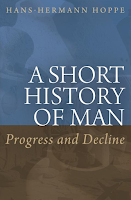
~ Hans-Hermann Hoppe, A Short History of Man: Progress and Decline, pp. 131-132
2015


Sep 19, 2020

James Altucher on the exodus from mega-cities and decentralization of opportunity

It's not like every city with 400,000 people are leaving.  Some cities, real estate is insane.  Real estate is going through the roof in some second and third tier cities.  People are buying houses sight unseen for 50% higher than listing price...  It's a scary trend, but the optimistic thing is that, for the first time ever, opportunity is now dispersed throughout the country.  It's decentralized.  It's no longer just in New York City, LA, San Francisco.  You could be a young person and find success anywhere now.  We all got comfortable communicating remotely and a lot of talented and skilled people are leaving the major cities, but particularly New York City, unfortunately.

~ James Altucher, "The Death Knell of the Urban Era," RealVision, 7:55 mark, September 17, 2020


Mar 28, 2020

Phil Duffy on the Covid-19 scare and telecommuting

The electronic cottage idea was at first opposed and mocked by the old order.  Today, during the COVID-19 scare, many organizations are requiring employees to telecommute and use the Internet from their electronic cottages.  At first we rushed to mob grocery stores to hoard staples such as toilet paper, then realized that we were compounding our exposure to this newly discovered risk.  Reacting, we started to return to a method of acquiring groceries abandoned in the 1950’s ordering on line for delivery...

Futurists, curiously, do not predict the future – they open our eyes to the possibilities.  But only if we allow our minds, which are certainly capable, to consider the deeper forces of progress and resistance that are in constant conflict.  We are in the middle of the newer force for decentralization against the old order of centralization.

~ Phil Duffy

Mar 23, 2020

Jeffrey Tucker on the knowledge of the marketplace

What is brought to bear in all of this is the knowledge, experience, informed judgments, and insightful hunches of all the individual participants of the entire global system of division of labor in the worldwide marketplace of goods and ideas. If, as the saying goes, two heads are better than one, then surely 7.7 billion heads are better than all of the best minds of the relative handful of those in government who would presume to know how to “get things done” in better and more balanced ways than when all those billions of minds are set to work through the motive of profit and the avoidance of loss in attempting to improve one’s own circumstances.

~ Jeffrey Tucker, "Leaving People Alone is the Best Way to Beat the Coronavirus," AIER.org, March 23, 2020

Image result for jeffrey tucker

Mar 14, 2020

Jeffrey Tucker on private vs. public decisions concerning the coronavirus

I don’t know what should and shouldn’t be shut down. But neither does the government have some special magical access to information on risk probabilities and the proper way forward. In fact, government is the last institution that should be making this judgment. Government acts out of self-interest; enterprise acts in the public interest. The obvious answer here is to leave the decision to private actors who are in the best position to make a good judgment on what should shut and what should open.

~ Jeffrey Tucker, "Celebrate the Heroes Who Stay Open," AIER.org, March 14, 2020

Per Bylund on the ability of open vs. control societies to handle crises

There are some very disturbing calls for quick-fix "solutions" following the reporting of how countries have and have not handled COVID19. It is not about how contagious or dangerous the virus actually is, which is not my expertise, but the typical and dangerous misunderstanding of the supposed efficiency of hierarchy and, therefore, the effectiveness of control societies, authoritarian rule, and dictatorial regimes.

To put it simply, the claim is that China "handled it right," was able to do something by acting fast and forcefully, and, by implication, that open societies are impotent to threats and fundamentally fragile. But this is exactly wrong. This misconception arises out of a common but fundamental misunderstanding of social organizing (such as society, markets, etc). And, interestingly, it is put forth by people who should definitely know better, including influential investors and entrepreneurs in Silicon Valley.

~ Per Bylund, "No, Authoritarian Governments Do Not Outperform 'Open Societies' in a Crisis," Mises.org, March 13, 2020

Mar 13, 2020

Kevin Duffy on the government-as-protector narrative

The narrative that really bothers me is that we’re all a bunch of dumbasses and without the government herding us around we’d die by the hundreds of thousands.  I think it’s helpful to consider how we could respond to something like a pandemic without our government masters bossing us around.  Most people are wired to believe chaos would ensue.  Well, when I look at Wall Street in free fall, my Facebook page showing people in long lines in grocery stores, or the local news interviewing small business owners in deep trouble and travelers who were stuck in Europe and had to pay thousands of dollars just to return home due to Trump’s travel ban, it appears that chaos already has ensued.

The evidence is pretty clear that if you’re under 50 or so and don’t have a compromised immune system, your risk to Covid-19 is minimal – probably not much greater than getting on an airplane.  Live your life and forget about it.  There’s probably a ton of spare capacity on cruise ships.  Fill them with young people on an extended spring break!  If you’re at risk, try to limit your exposure to those people who are living their lives without hesitation.  If you’re in the first group and come in contact with the second group, take precautions.  

Everyone’s situation is unique with its own set of tradeoffs.  Let people make those decisions on their own.  And guess what?  By taking responsibility and making those decisions, people will become more critical, independent thinkers better able to handle the next crisis… and not reflexively go crying to the authorities for protection.

~ Kevin Duffy, note to friend, March 13, 2020

Image result for young people on cruise ship

Mar 23, 2016

Jeff Tucker on building societies from the bottom up vs. "some great man"

Let’s just rule out right now that Trump’s hope of personally making America great is achievable. In fact, the illusion that it could happen is ridiculous. Societies become great only through the diffusion of action among millions and billions of people, one decision at a time. It is the absence of power, not its presence, that builds nations. It does not result from the authoritarian dictate from some great man.

~ Jeffrey A. Tucker, "Lance the Boil: How a Donald Trump Victory Might Be Good for Liberty," Liberty.me, March 10, 2016

Dec 19, 2007

Robert Taft on liberty and progress

We cannot overestimate the value of this liberty of ideas and liberty of action. It is not that you or I or some industrial genius is free; it is that millions of people are free to work out their own ideas and the country is free to choose between them and adopt those which offer the most progress. I have been through hundreds of industrial plants in the last two or three years, and in every plant I find that the people running that plant feel that they have something in the way of methods or ideas or machinery that no other plant has. I have met men said to be the best machinists in the industry who have built special machines for a particular purpose in which that company is interested.

Thousands of wholly free and independent thinkers are working out these ideas and have the right and ability to try them out without getting the approval of some government bureau. You can imagine the difference between the progress under such a system and one in which the government ran every plant in the country as it runs the post offices today. There would be one idea for a hundred that are now developed. If any plant employee had an idea for progress and wrote to Washington, he probably would get back a letter referring him to Regulation No. 5201 (c), which tells him exactly how this particular thing should be done, and has been done for the past fifty years.

It is clear to me that the great progress made in this country, the tremendous production of our people, the productivity per man of our workmen have grown out of this liberty and the freedom to develop ideas. We have the highest standard of living, because we produce more per person than any other country in the world.

~ Senator Robert Taft, A Foreign Policy for Americans (1951)

Dec 4, 2007

Hayek on the link between private property and freedom

What our generation has forgotten is that the system of private property is the most important guarantee of freedom, not only for those who own property, but scarcely less for those who do not. It is only because the control of the means of production is divided among many people acting independently that nobody has complete power over us, that we as individuals can decide what to do with ourselves. If all the means of production were vested in a single hand, whether it be nominally that of "society" as a whole or that of a dictator, whoever exercises this control has complete power over us.

~ Friedrich A. Hayek, The Road to Serfdom

Nov 16, 2007

Leonard Read's famous essay "I, Pencil"

There is a fact still more astounding: the absence of a master mind, of anyone dictating or forcibly directing these countless actions which bring me into being.  No trace of such a person can be found. Instead, we find the Invisible Hand at work.

Since only God can make a tree, I insist that only God could make me.  Man can no more direct these millions of know-hows to bring me into being than he can put molecules together to create a tree.

The lesson I have to teach is this: Leave all creative energies uninhibited.  Merely organize society to act in harmony with this lesson.  Let society's legal apparatus remove all obstacles the best it can.  Permit these creative know-hows freely to flow.  Have faith that free men and women will respond to the Invisible Hand.  This faith will be confirmed.

~ Leonard E. Read, founder, Foundation for Economic Education, "I, Pencil: My Family Tree as Told to Leonard E. Read," The Freeman, December 1958