Showing posts with label Europe. Show all posts

May 3, 2025

Jeffrey Sachs on the end of American exceptionalism and rise of Asia

Most of the world population lives in Asia, about 60%.  For most of history, that means that roughly 60% of the world economy, world output, was produced in Asia, as best as one can tell when historians look back and try to recreate economic estimates.  In recent centuries, that changed decisively with the rise of Europe and of the north Atlantic because in the 19th and 20th centuries, of course, the United States rose to become the largest economy in the world.  Asia was eclipsed in this.  Not only eclipsed, of course, it was dominated by European imperial powers.

If you look around 1820 or so, Asia was still more than half of the world economy, but by 1950, after 150 years of the industrial age, dominated by Europe and the United States, the whole Asian economy had declined to around 20% of world output from what had been roughly 60%.  This meant China completely being eclipsed and of course in fact attacked and losing many wars, first to the West in the first and second Opium Wars to chaos during the so-called Taiping Rebellion in the middle of the 19th century to the extraterritorial privileges or rights or dominance of European powers in China at the end of the 19th century and then to Japanese invasion in several episodes, starting with the Sino-Japanese War in 1894-95 and then several Japanese invasions, in fact, in the 20th century and the massive invasions of the 1930s.  Civil war in China in the 1940s.  And this meant that by the time of the establishment of the Peoples' Republic of China in 1949, China had gone through about 110 years of devastating defeats of what China calls the "century of humiliation."  China's share of the world economy was estimated to be maybe 2% of world output and roughly 20% world population as of the 1950s.  In other words, China was completely eclipsed from its long historical role in the world for at least a millennium, by the way, from 500 to 1500 AD.  Before the beginning of the European ascendancy, China clearly dominated the world across many technologies: gunpowder, steam engine, paper currency, the compass, large scale ocean navigation, and one could go on and on, in fact.

So, the story that we see today, taken from a very, very long-term perspective in history is the return of China to the front ranks of power in the world and economic productivity and technology.  In a sense, China has returned to its more traditional role in the world, which one could see for much of the last 2,000 years, in fact.  The rise of China, in this sense, should be understood as a rebalancing of what was absolutely unbalanced, and that is a European-dominated world.

Of course, it's very hard for Europeans and Americans to understand that the idea of European dominance in the world had become an absolute natural standby, and that's been true for several hundred years actually where as Europe rose in power, as European empires dominated the other parts of the world, full ideologies, belief systems, rewriting of history, a lot of racism one can add, even by the leading thinkers of world history in the West, came to say, "Well, Europe's dominance is natural.  European cultural superiority, maybe racial superiority," but whatever the argument was, "European superiority is natural."

Of course, now we're at the end of that phase of history.  And one should understand, it's not only the return of China.  It's also the rapid development of India, it's the rapid development of southeast Asia, the so-called ASEAN countries, it's the rapid development of parts of west Asia in the Gulf countries, for example.  All of this is rather fundamentally ending the Euro-centric view of the world or what in the late 19th century to the early 21st century became the north Atlantic, NATO-centered vision of the world, and by the end of the 20th century became the American-centered vision of the world.

And when you have these temporary imbalances of economy and power...  The tendency is to put a bulwark under them in ideological or religious or some other philosophical sense to say, "That imbalance is natural."  In the United States, the idea of American exceptionalism is very deep.  The idea that, "Yes, of course, America rules the world" is a deep part of the belief system, not a superficial item.  

So the rise of China is viewed with alarm, it's viewed with disdain, it's viewed with fear.  It's not viewed with equanimity.  I don't know any American leaders that say, "Well, of course China's a big power that's had a long history of civilizational greatness so it's natural that China's doing well."  What you hear is, "China's the great threat to the world.  China's rise must be stopped.  We must contain China.  We must prepare for war.  China cheated and stole its way to economic recovery...  It's artificial; China will collapse."  In other words, many erroneous, superficial, biased, sometimes blatantly racist views to undergird this sense of superiority in the U.S. that built up over two centuries.

~ Jeffrey Sach, "Jeffrey Sachs: Chinese Statecraft and a New World Order," Glenn Diesen, 1:10 mark, May 2, 2025


Dec 30, 2021

Ralph Raico on how the French Catholic liberals opposed the radical democratic movement in Europe

Henri-Dominique Lacordaire, along with Montalembert the outstanding leader of the French Catholic liberals (see below) delivered upon his election as Tocqueville’s successor at the Académie Française, he lashed out at the radical-democratic movement in Europe for aiding and abetting state centralization: 
The European democrat, idolater of what he calls the State, takes the human being from his cradle in order to offer him as a sacrificial victim to the public Omnipotence. He holds that the child, before belonging to the family, belongs to the City [i.e., the political organization], and that the City, that is, the people represented by those that govern them, has the right to form his mind on a uniform and legal model. He holds that the commune, the province, and every other association, even the most indifferent, depends on the State, and cannot act, nor speak, nor sell, nor buy, nor, finally, exist, without the intervention of the State and in the degree determined by it, in this way making the most absolute civil servitude the entrance way and the foundation of political liberty. 
~ Ralph Raico, Classical Liberalism and the Austrian School (p. 228)

(Raico's source is Henri-Dominique Lacordaire, Notices et Panégyriques (1886) (Paris: Poussielgue), p. 345)


Jul 28, 2020

Rodney Stark on the fall of the Roman empire and Western Civilization

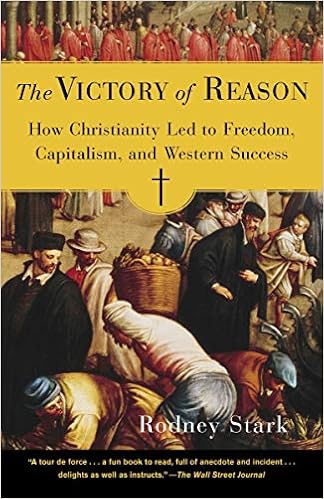
[T]he fall of Rome was not a tragic setback; had the empire prevailed, there would be nothing to call Western Civilization.  If Rome still ruled, Europe would be mired in a brutal command economy, there would've been very little innovation of any kind, and the rest of the world probably would be much as Europeans found it in the 15th and 16th centuries.  Empires are the enemies of progress!

~ Rodney Stark, The Victory of Reason: How Christianity led to freedom, capitalism and Western success, p. 75

The Victory of Reason: How Christianity Led to Freedom, Capitalism ...

Aug 4, 2011

Barton Biggs on saving the euro

It's clear that the Europeans didn't put together a big enough package to solve the problem and now, since they didn't do that, they're going to have to do a much bigger package and maybe even do fiscalization [sic]  of Europe to save the euro.

~Barton Biggs, founder, Traxis Partners, Bloomberg TV, August 4, 2011

May 26, 2010

Tim Geithner on sustaining the unsustainable

European leaders face the difficult challenge of trying to restore sustainability to an unsustainable system.

~ Timothy Geithner, US Secretary of the Treasury, remarks at the U.S.-China Strategic and Economic Dialogue, Beijing, China, May 25th, 2010

May 15, 2010

Jean-Claude Trichet on buying sovereign debt in the eurozone

Our measures are explicitly authorized by the (EU) treaty. We are not embarking on quantitative easing. We are helping some market segments to function more normally. And, as I said, we will take back all the additional liquidity that we will supply in our Securities Markets Program.

~Jean-Claude Trichet, president, European Central Bank, "A 'Quantum Leap' in Governance of the Euro Zone Is Needed", Der Spiegel, May 15th, 2010

Alan Skrainka on the European bailout of May 2010

One trillion dollars is a big number. This is enough to buy all of Greece's debt twice, with enough left over to buy all of Portugal's debt. It was meant to remove any potential for contagion. Problem solved.

~Alan Skrainka, Chief Market Strategist, Edward Jones, "They Said What? European Bailout", Barron's magazine, May 15th, 2010

Kevin Duffy on the European bailout of May 2010

If healthy economic systems require taxing the responsible and debasing the currency to bail out the profligate, the EU's rescue package should be a raging success.

~Kevin Duffy, principal, Bearing Asset Management, "They Said What? European Bailout", Barron's magazine, May 15th, 2010

May 8, 2010

Nicholas Sarkozy is serious about defending the euro

When the markets re-open Monday, we will have in place a mechanism to defend the euro. If you don’t think that’s significant, you haven’t been to many EU summits.

~Nicholas Sarkozy, president of France, Bloomberg, "EU to Set Up Fund to Prevent Spread of Greek Crisis", May 8, 2010

Feb 21, 2009

Peter Schiff on investing in Europe and in the euro

Europe certainly has its share of problems, but, unlike the United States, at least it lives within its diminished means. For all its socialism, at least the European Union enjoys a trade surplus and its people still manage to save. As a result the euro will likely be a principal beneficiary of the dollar's demise. That could give Europe a huge boost, helping to contain interest rates and consumer prices on the continent. As a result, the euro zone is definitely an area where we want to invest. Of course, we also want to invest money outside the euro zone, such as in Switzerland, the UK, and Scandinavia, which will also benefit from a strong Europe.

In the long run, the euro as a fiat currency may very well fail like the U.S. dollar. But being the largest nondollar currency issued by a major creditor, it appears certain to thrive in the short term.

~ Peter Schiff, Crash Proof, pp. 179-180

Image result for crash proof

Aug 11, 2008

George Washington on foreign policy

Why quit our own to stand upon foreign ground? Why, by interweaving our destiny with that of any part of Europe, entangle our peace and prosperity in the toils of European ambition, rivalship, interest, humor, or caprice?

~ George Washington, Farewell Address, September 17, 1796

Related image