Showing posts with label Austrian economics. Show all posts

Aug 26, 2023

Manuel García Gojon on Javier Milei's influence in Latin America

Tho Bishop: Javier Milei is a self-professed Rothbardian who has had some very strong polling in recent months.  Some pundits have compared his populist style with that of Donald Trump and Brazil's Jair Bolsonaro.  Given that Argentina has had recurring monetary and economic issues, including the current period of prolonged inflation, do you think Milei's political rise is real, and is it a model for other Latin American countries?

Manuel García Gojon: Even if Milei does not win the election, his attempt will have a deep and lasting effect.  I would speculate the campaign to be even more significant than the 2012 Ron Paul campaign.

The core of Milei's support can be found in young men, regardless of socioeconomic background.  Over 40 percent of men 18 to 30 years of age support Milei as their first choice among four competitive candidates.

Even people whose main occupation is food delivery are saving up to buy books on Austrian economics and are conversant in the arguments behind Milei's plans to reduce government spending, loosen labor laws, end protectionist measures, and abolish the central bank...

The youth is generally rebelling against the progressive status quo, as is also occurring in some parts of continental Europe.  It is possible that this phenomenon will spread across Latin America, especially in countries where economic conditions are dire, but a figure with the specific combination of characteristics that Milei has might be a once-in-a-generation phenomenon.

Milei does not like to be perceived as a populist because of the negative connotation it carries, saying that people confuse being a populist with being popular.  What makes him particularly interesting from an Austrian point of view is that he is a late convert.  He was as neoclassical as they come for over two decades, and when he came into contact with the Austrian school in 2014, he had the intellectual humility to recognize that a lot of what he been teaching was wrong...

It does feel to me as if the present is pregnant with a significant paradigm shift in Latin America.  That is a positive beginning.

~ Manuel García Gojon, Q&A, The Austrian, July-August 2023


Sep 24, 2021

Henry Hazlitt on how Austrian economics differs from orthodox economics

Perhaps something should be said about the chief differences today between Austrian economics and what we may call "orthodox" or "mainstream" economics.  The difficulty here is that "mainstream" economics itself would be hard to define.  Economists are still divided into a number of recognizable "schools": neoclassicists, Keynesians, the Chicago School, the Lausanne School, and so on.  The limits of space forbid me to go into the distinguishing doctrines of each of these schools.  But one outstanding difference of the Austrians from all of these lies in their method of reasoning.  The Austrians emphasize methodological individualism.  That is, they not only begin by emphasizing human actions, preferences, and decisions, but individual actions, preferences, and initiatives.  Mainstream economists are concerned with "macroeconomics," with averages and aggregates; and those of the Lausanne School, trying to reduce economics to an "exact" science, and therefore seeking to quantify everything, are obsessed with complicated mathematical equations that try to stipulate the conditions of "general equilibrium."

~ Henry Hazlitt, "Understanding 'Austrian' Economics," The Freeman, February 1981


Sep 23, 2021

Curt Howland on the basic principles of Austrian economics

What is the best way to disprove the Austrian School (Mises, Hayek, Friedman)? “What is the best way to disprove the Austrian School?” 

To disprove the Austrian method of economic analysis, first you would have to disprove the axioms upon which that analysis is based. 

Humans act. So, prove humans don’t act. 

People use scarce resources to achieve desired ends. Again, prove people don’t. 

Each additional unit of a homogeneous good will be used to satisfy the most urgent remaining use, and that use sets the price of all units of the homogeneous good. Surely the principle of “marginal utility” would be easy to disprove, I mean it was formulated in 1872 and signaled the foundation of the Austrian School itself: 

Principles of Economics | Carl Menger Easy to read, and free. Give it a try. 

People prefer the same good now compared to the same good some time in the future. Of course, if you can disprove this, then you disprove the existence of interest rates. 

Individual preferences are ordinal, not cardinal, and interpersonal comparisons don’t work. Can you prove you like chocolate 2 times as much as I do, but not 4 times as much? 

There are more such axioms, but all stem from the fundamental principle that people act, people choose. They are not merely atoms all responding the same way. 

So disprove that, and you’re set for the rest. 

You can start here: "Understanding 'Austrian' Economics," by Henry Hazlitt.

~ Curt Howland, Quora, September 16, 2021


Mar 25, 2021

Henry Hazlitt on economics

The whole of economics can be reduced to a single lesson, and that lesson can be reduced to a single sentence.  The art of economics consists in looking not merely at the immediate but at the longer effects of any act or policy; it consists in tracing the consequences of that policy not merely for one group but for all groups.

~ Henry Hazlitt, Economics in One Lesson, Chapter 1: "The Lesson," p. 17


Henry Hazlitt on the differences between the good and bad economist

The bad economist sees only what immediately strikes the eye; the good economist looks beyond.  The bad economist sees only the direct consequences of a proposed course; the good economist looks also at the longer and indirect consequences.  The bad economist sees only what the effect of a given policy has been or will be on one particular group; the good economist inquires also what the effect of the policy will be on all groups.

~ Henry Hazlitt, Economics in One Lesson, Chapter 1: "The Lesson," p. 16


Jan 16, 2021

Tom Woods on the beauty of economics

[Economics] really is something beautiful.  It reveals to you an order that can be hidden or obscured by your own eyes.  I think Mises or Rothbard put it this way in theory and history...  If you were just to look at Grand Central Terminal in New York and not think it through, all you would see is just a bunch of people running hither and yon, and that would be the end of it.  But when you think through what's actually going on, you realize that each one of those people has a goal and is pursuing that goal, and that that's not chaos, but it's actually order that you're observing.  Well likewise for the entire economy, to a Marxist it looks like "There's duplication of production," "It's not the way I would run it if I had a bullhorn."  But the more you understand it, the more you perceive the hidden order beneath it all.  And once you perceive that, you do want other people to understand it.  In my case not just because they'll derive intellectual pleasure from understanding it, but because they'll stop wrecking it 24 hours a day!

~ Tom Woods, "Ep. 1806 From Left to Libertarian: How He Did It," The Tom Woods Show, January 5, 2021


Oct 31, 2020

Ronald Stöferle et al. on Austrian School adherents who predicated the collapse of the 1920s boom

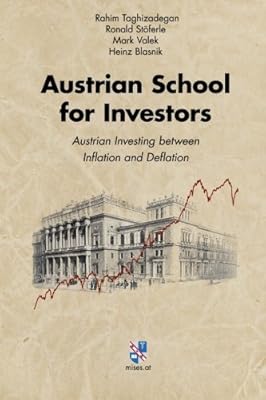
The Great Depression was predicted by several economists of the Austrian School: in Austria, Ludwig von Mises recognized the problem when it was still in an early stage of its development, and told his colleagues in 1924 that the then largest Austrian bank, Creditanstalt, would ultimately become insolvent. Friedrich August von Hayek published several articles in early 1929, in which he predicted the collapse of the US economic expansion. Felix Somary uttered numerous warnings in the late 1920s. In the US, the economists Benjamin Anderson and E.C. Harwood warned that the monetary policy of the Federal Reserve would lead to a crisis. However, as was Somary, they were widely ignored.

~ Rahim Taghnizadegan, Ronald Stöferle, Mark Valek and Heinz Blasnik, Austrian School for Investors (2015), p. 62


May 29, 2020

Kevin Duffy views the investment landscape through the lens of an Austrian economist and value investor

These are extraordinarily disorienting times. While the economist in me is terrified, my inner value investor feels like a mosquito in a nudist colony.

~ Kevin Duffy, The Coffee Can Portfolio, May 27, 2020, p. 12


Jul 29, 2019

Murray Rothbard on economic methodology

Human life is not a laboratory, where all variables can be kept fixed by the experimenter, who can then vary one in order to determine its effects.  In human life, all factors, including human action, are variable, and nothing remains constant.  But the theorist can analyse cause-and-effect relations by substituting mental abstractions for laboratory experiments.  He can hold variables fixed mentally (the method of assuming 'all other things equal') and then reason out the effects of allowing one variable to change.  By starting with simple 'models' and introducing successive complications as the simpler ones are analysed , the economist can at last discover the nature and operations of the market economy in the real world.  Thus the economist can validly conclude from his analysis that 'All other things equal (ceteris paribus), an increase in demand will raise price.'

~ Murray Rothbard, An Austrian Perspective on the History of Economic Thought, Vol. I, Chapter 12, "The founding father of modern economics: Richard Cantillon," p. 348

Image result for rats lab experiment


Jul 17, 2019

Jim Grant on the value of Austrian theory when peering into the future

What we do is look for extremes in markets: very undervalued or very overvalued.  Austrian theory has certainly given us an edge.  When you have a theory to work from, you avoid the problem that comes with stumbling around in the dark over chairs and night stands.  At least you can begin to visualize in the dark, which is where we all work.  The future is always unlit.  But with a body of theory, you can anticipate where the structures might lie.  It allows you to step out of the way every once in a while.

~ Jim Grant, "The Trouble with Prosperity: An Interview with James Grant," Austrian Economics Newsletter, Winter 1996

(Cited by Austrian School for Investors, p. 75.)

Image result for austrian school for investors

Jul 17, 2011

Ludwig Lachmann on the economic function of the entrepreneur

We are living in a world of unexpected change; hence capital combinations . . . will be ever changing, will be dissolved and reformed. In this activity, we find the real function of the entrepreneur.

~Ludwig Lachmann, German-born Austrian economist, 1956

Ludwig von Mises on entrepreneurs as visionaries

What distinguishes the successful entrepreneur and promoter from other people is precisely the fact that he does not let himself be guided by what was and is, but arranges his affairs on the ground of his opinion about the future.  He sees the past and the present as other people do; but he judges the future in a different way.

~ Ludwig von Mises, Austrian economist, Human Action, p. 585, 1949


Ludwig von Mises on how to tell an entrepreneur from a non-entrepreneur

There is a simple rule of thumb to tell entrepreneurs from non-entrepreneurs. The entrepreneurs are those on whom the incidence of losses on the capital employed falls.

~Ludwig von Mises, Austrian economist, 1951

Oct 1, 2008

Ron Paul on the financial meltdown

The financial meltdown the economists of the Austrian School predicted has arrived.

We are in this crisis because of an excess of artificially created credit at the hands of the Federal Reserve System. The solution being proposed? More artificial credit by the Federal Reserve. No liquidation of bad debt and malinvestment is to be allowed. By doing more of the same, we will only continue and intensify the distortions in our economy – all the capital misallocation, all the malinvestment – and prevent the market's attempt to re-establish rational pricing of houses and other assets.

~ Congressman Ron Paul, "The Austrian School and the Meltdown," LewRockwell.com, September 26, 2008

Nov 22, 2007

Kevin Duffy on inflation and the tech bubble

Much of the debate over New Economy vs. Old... comes down to a difference in how inflation is defined. Austrian economists tend to define inflation in terms of credit expansion and money supply growth. They recognize that inflation can show up in unpredictable areas. New Era economists tend to focus solely on consumer prices. Some, like Brian Wesbury, go even further, removing food, energy, tobacco, or whatever else causes the unintended effect.

Signs of inflation were obvious to readers of the latest issue of Barron’s:
  • Inflated stock prices – Cisco trades at 101 times estimated 1999 earnings, Oracle: 81x, Microsoft: 56x, Nortel Networks: 81x, Sun Microsystems: 83x, Lucent: 61x, and AOL: 304x. (p. MW4)
  • Inflated art prices – Recent auctions brought over $45 million each for a pair of Picassos and a record $129,000 for a 100 year old West African spoon. (p. 48)
  • Inflated earnings – In its latest quarter, Hewlett-Packard beat Street estimates by two cents (adding $17 billion in market value), by lowering its tax rate. (p. 6)
  • Inflated egos – Louis Rukeyser, apparently feeling viewers only need to hear his eternally optimistic message, ostracized his last dissenting Elf, Gail Dudack. (p. 6)
To this list we could easily add inflated real estate prices, inflated credit, inflated expectations, and inflated forecasts (e.g. “Dow 36,000”). Despite inflating its balance sheet 7.1% over the past year, the Fed assures us that last week’s rate hike should “markedly diminish the risk of inflation.”

This combination of credit expansion, asset inflation, and low or no consumer price inflation is a benign-looking, but potent mix. These conditions accurately described the bubble economies of the United States in the late 1920s and Japan in the late 1980s. This New Era will meet a similar fate. It’s a shame asset bubbles, according to our Fed Chairman, are “incontrovertibly evident only in retrospect.”

~ Kevin Duffy, "New Era or Old?," Barron's (letter to the editor), November 29, 1999

Nov 11, 2007

Gene Epstein on Friedman vs. Mises

I personally revered Milton Friedman, although not for his formal work in economics. While he deserves credit for his influence on mainstream theory, I attribute that more to the weakness of that theory than to any special contributions of his.

When most economists were focused on the wonders of Keynesian fiscal policy, he pointed out that money-supply matters. But Friedman's mechanistic view of money was thin gruel compared to the seminal contribution of Austrian economist Ludwig von Mises.

~ Gene Epstein, economics editor, Barron's, "Farewell, Dr. Friedman," November 20, 2006