Showing posts with label Facebook. Show all posts

Jan 22, 2026

Louis-Vincent Gave on how China will commoditize the AI business

Take a step back, what's the biggest price anomaly?...  I think a massive price anomaly is the share price of Nvidia and the share price of Facebook [Meta Platforms] and the share price of all these guys that are today incinerating cash on the hope and promise that this cash is going to lead to outsize returns, but it won’t.  It won’t because, unlike the smartphone revolution, unlike previous booms, this time around China is in the AI room.  And what I’ve learned out of 30 years of being in China is that when China enters the room, profits walk out.  And if you’re competing with China, you’ve taken a wrong turn in your life.

~ Louis-Vincent Gave, "China Just Ended 100 Years of American Dominance," RiskReversal Podcast, 42:45 mark, December 15, 2026

Jan 13, 2026

Barron's on Facebook: "Stay away from the stock"

Even with the sharp drop in its share price, Facebook remains a richly valued bet on the company's ability to wring a lot of revenue from a huge and potentially fickle user base.  Facebook's mobile woes aren't likely to go away.  Stay away from the stock.  It could be heading to the mid-teens.

~ Andrew Bary, "Still Too Pricey," Barron's, September 24, 2012

Facebook Is Worth $15 - Barron's 

Barron's is skeptical about Facebook's ability to monetize 900+ million users (2012)

Barron's has been skeptical about Facebook (see Feature, "Mad About Facebook!," May 12) because of the company's high absolute valuation, relative to earnings and revenues, and challenges to its evolving business model from the greater use of mobile devices by Facebook users.  Facebook hasn't found a way to generate meaningful ad revenue from mobile users. 

The problem for Facebook is that it amounted to a giant concept stock with a $100-billion-plus valuation.  Bulls said CEO Mark Zuckerberg was a genius and would find ways to monetize Facebook users.

However, without valuation support from ample earnings, it's tough to say where Facebook will settle.

~ Andrew Bary, "Facebook Loses Face - And How," Barron's, May 21, 2012

Dec 9, 2021

Dr. Robert Malone on natural immunity, WHO and the fact-checkers at Facebook

The official party line, as stated today by the World Health Organization, is that the vaccine-induced immunity is better and more prolonged than the protection afforded by natural infection.  Yet we have... multiple, multiple articles now, as one would expect, that the breadth of immune response after natural infection is greater and the durability is quite long and the levels of disease if you get reinfected are no worse than if you had been vaccinated, in many cases appear to be less.  So we've got the WHO posting on Facebook what is inconsistent with multiple peer reviewed publications - and common sense.  Facebook is not fact-checking the WHO.  By definition, they are the purveyors of truth.  So we're now in this Orwellian world where truth is whatever WHO says it is.

~ Dr. Robert Malone, COVID Revealed, Episode 9, 24:00 mark


Oct 26, 2021

Roger McNamee on Facebook furthering authoritarianism

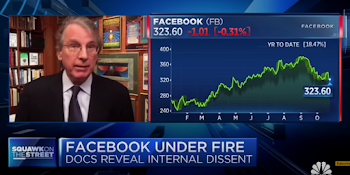
At some point we have to decide "Where do we want to live?" because the Facebook papers, among other things, have shown that Facebook in fact has - because of the design of its products - really furthered things like authoritarianism...  When you put 3 billion people on one network with no walls and then construct a business model that's designed to amplify the most extreme emotions of society, you're going to bring a lot of dangerous ideas from the fringes into the mainstream: white supremacy, anti-vax and the like.  And we're now seeing the cost of that.  And the question for investors is "Is it time to move on to something else?" because this company has shown that it is not going to take the public interest seriously.  And I think candidly that's a problem throughout Big Tech.

~ Roger McNamee, CNBC interview, 1:55 mark, October 25, 2021


Aug 6, 2021

George Gilder on Google, Facebook and the limits of their free model

Q: In your book Life After Google, you discuss some of the tech giants' flawed business models today may not allow them to survive.  Can you elaborate on that?

A: I think companies like Google and Facebook that collect almost all their revenues from advertising and don't have any real liabilities to their customers - no real responsibilities to their customers - they aggregate viewers and sell advertisements, ads that we all know are minuses; people don't want to see their ads, particularily on their smartphones where pop-up ads of various kinds comprise 36% of bandwidth costs for your smartphone and you only intentionally click on the ads 0.03% of the time.  It's a failing model and it's worth recognizing that all the Chinese companies that are really competing with our companies (with three times the population) get 10% or something of their revenues from advertising.  They really have figured out how to collect money from customers.  That's their advantage and we better be alert to this.

Q: It sounds like these companies are starting to become dated...

A: Their free model is debauching them.  Free is not capitalism.  They really don't know how to deal with customers and whenever they have to make a decision, they decide in the end, "ah, it's easier just to give it away for free and collect more data and sell it to advertisers."  This model is reaching the end of the line and we're moving into life after Google!

~ George Gilder, Stansberry Research interview, 5:20 mark, October 11, 2019


Apr 28, 2021

Kevin Duffy on how the 2000 tech bubble led to internet 2.0

The dot-com bubble of 2000 was never the internet itself, but the notion of “first mover advantage.” There was a gold rush mentality to stake claims, and it was the internet pioneers who largely took the arrows in the back. If anything, the optimists underestimated the transformative nature of the new technology. The early 2000s shakeout cleared the way for a powerful second wave that drove the economy and made vast fortunes for the settlers. 

In March 2000, when the NASDAQ Composite peaked at just above 5,000, Amazon.com hadn’t recorded its first $1 billion in sales, Google was in diapers generating $19 million in revenue, and Mark Zuckerberg had yet to reach his 16th birthday. Today the founders of Amazon, Google and Facebook are worth a combined $440 billion and their companies valued at $4.22 trillion, not quite 10% of the total U.S. stock market capitalization.

~ Kevin Duffy, "Bubble Lessons," The Coffee Can Portfolio, April 26, 2021


Feb 13, 2021

Alan Abelson: "Facebook is overpriced" (2012)

Assuming profit margins stay around the same as they are currently, and assuming, too, that the P/E will match that sported by Google last we checked, according to Mark Hulbert's calculations, Facebook's shares should be changing hands at $16.66 each...  Anyway he looks at it, Facebook is overpriced.

~ Alan Abelson, Up & Down Wall Street column, Barron's, May 28, 2012

(Facebook closed at $31.91 on May 25, 16% below its IPO price of $38 set on May 17.)


Aug 17, 2020

Dan Ferris on the mania for Big Tech

No one can imagine that Amazon isn't the greatest thing in the world.  No one can imagine that Facebook and Google and Apple... at a $2 trillion market cap.  People simply can't imagine that these aren't the greatest businesses now and forever.  I promise you, they will be disappointed.

~ Dan Ferris, "Kodak Crashes 85% from Recent Peak," Stansberry Investor Hour, 67:00 mark, August 13, 2020

Early Look (9/19/18): Why We Reiterate Our Short U.S. Growth Stocks Ca

Jun 30, 2020

Seraphim Hanisch on how Big Tech's attack on conservatism opened the door to competition

[T]he strategy of Big Tech appears to be to disrupt and isolate conservative activity by making it impossible for people to gather together and organize. Knowing of one another’s existence is powerful, and the Ministers of Propaganda at Castle Zuckerberg knew precisely where to strike.  However, they did not count on their actions spurring the explosive growth of a new network – one they cannot touch.

~ Seraphim Hanisch, "Social media earthquake as Parler welcomes 1,000,000 new users," The Duran, June 30, 2020

Jul 27, 2019

Barron's: DOJ goes after Big Tech even though "none of the companies have traditional monopoly positions"

The Justice Department announced late Tuesday that it has opened a review of “the practices of market-leading online platforms.” The agency didn’t name specific companies, but the wording suggests that it will look into Google parent Alphabet for search, Facebook for social media, and Amazon.com for e-commerce.

[...]

[P]roving consumer harm is a tough task when Facebook’s and Google’s services are mostly free, and Amazon’s e-commerce platform has arguably lowered prices and increased convenience through faster delivery.

In fact, none of the companies have traditional monopoly positions in various markets. EMarketer estimates that Amazon represented 37% of U.S. e-commerce sales in 2018 and 3.5% of total retail sales. The firm also said Google accounted for 50% of U.S. digital-ad spending that year, while Facebook had 22%. Apple’s iPhone had 45% of the U.S. smartphone market, according to eMarketer’s latest data.

~ Tae Kim, "Why Investors Shouldn’t Overreact to the DOJ’s Antitrust Review of Big Tech," Barron's, July 27, 2019

Feb 6, 2019

Roger McNamee criticizes Facebook's business model as "addictive"

I'm convinced that the business model is the problem.  It's the problem at Facebook.  It's the problem at Google.  They essentially have this advertising business model that depends on monopolizing the attention and manipulating the attention of the user, and in order to do that, the algorithms are tuned to focus on emotional things that trigger outrage, that trigger fear, or tickle people with rewards of some kind.  When you're doing that for long enough, people first develop a habit, then you develop an addiction.  And once they're in an addiction, they're vulnerable to manipulation by bad actors on the outside.  And until you change the business model, that's there.

~ Roger McNamee, "Former Zuckerberg Mentor McNamee Criticizes Facebook's Business Model," Bloomberg TV, February 5, 2017, 7:23 PM EST