If government wishes to see a depression ended as quickly as possible, and the economy returned to normal prosperity, what course should it adopt? The first and clearest injunction is: don’t interfere with the market’s adjustment process. The more the government intervenes to delay the market’s adjustment, the longer and more grueling the depression will be, and the more difficult will be the road to complete recovery.
~ Murray Rothbard, America's Great Depression (1963), p. 19
Showing posts with label liquidation. Show all posts
Showing posts with label liquidation. Show all posts

Jul 30, 2019
Irving Fisher on the liquidation cure for busts
40. [I]t would be as silly and immoral to "let nature take her course" as for a physician to neglect a case of pneumonia. It would also be a libel on economic science, which has its therapeutics as truly as medical science.
~ Irving Fisher, "The Debt-Deflation Theory of Great Depressions," September 1933
~ Irving Fisher, "The Debt-Deflation Theory of Great Depressions," September 1933
Jul 17, 2019
Jim Grant on the trouble with stability
Stability is a false ideal. Instability is a vital and necessary part of the capitalist drama. The purpose of the downside of the business cycle is to make the economy clean and honest again. To reduce the downside is to dampen the upside.
~ Jim Grant, "The Trouble with Prosperity: An Interview with James Grant," Austrian Economics Newsletter, Winter 1996
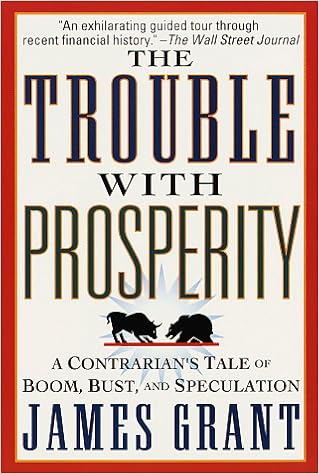
~ Jim Grant, "The Trouble with Prosperity: An Interview with James Grant," Austrian Economics Newsletter, Winter 1996
Dec 9, 2008
BusinessWeek on hedge fund dumping of leveraged loans
Perhaps nowhere has rapid-fire selling been more pronounced than in the $500 billion market for so-called leveraged loans. In recent years companies sold these securities to finance private equity buyouts, acquisitions, and other corporate deals. But hedge funds, which lined up to buy the loans during the boom, have been off-loading them in recent weeks to meet redemptions and margin calls.
Highland Capital Management, a $38 billion money-management shop that invested heavily in this arena, has been among the most aggressive sellers of leveraged loans. Highland declined to comment.
The sell-off by hedge funds and other investors is depressing loan prices. In recent weeks the value of the typical loan, according to research firm Standard & Poor's LCD, quickly dropped from 85¢ on the dollar to just 66¢, a deeply distressed price usually reserved for companies that are in bankruptcy. (Historically, investors have recovered 70¢ on the dollar when a company defaults.)
Yet few of the companies whose loans are trading near those prices, including utility TXU Energy and credit-card processor First Data, are in such dire straits. "The loan market is a very funny place right now," says David Ford, a founding member of Latigo Partners, a hedge fund that buys distressed investments. "It's not being driven by fundamental forces."
In essence, the market is suggesting that owners of such securities won't get their money back. That unlikely scenario has some market observers scratching their heads. In the event of bankruptcy, investors in leveraged loans are the first to be repaid, outranking other holders of corporate debt and stock. And many companies today have more than enough assets on hand to make their loan investors whole. For example, Tennessee-based Community Health Systems (CYH), whose loans are selling for roughly 75¢ on the dollar, has $9 billion in assets, far more than its $6 billion in loans.
~ BusinessWeek, "The Hedge Fund Contagion," October 22, 2008 (Nov 3. issue)
Highland Capital Management, a $38 billion money-management shop that invested heavily in this arena, has been among the most aggressive sellers of leveraged loans. Highland declined to comment.
The sell-off by hedge funds and other investors is depressing loan prices. In recent weeks the value of the typical loan, according to research firm Standard & Poor's LCD, quickly dropped from 85¢ on the dollar to just 66¢, a deeply distressed price usually reserved for companies that are in bankruptcy. (Historically, investors have recovered 70¢ on the dollar when a company defaults.)
Yet few of the companies whose loans are trading near those prices, including utility TXU Energy and credit-card processor First Data, are in such dire straits. "The loan market is a very funny place right now," says David Ford, a founding member of Latigo Partners, a hedge fund that buys distressed investments. "It's not being driven by fundamental forces."
In essence, the market is suggesting that owners of such securities won't get their money back. That unlikely scenario has some market observers scratching their heads. In the event of bankruptcy, investors in leveraged loans are the first to be repaid, outranking other holders of corporate debt and stock. And many companies today have more than enough assets on hand to make their loan investors whole. For example, Tennessee-based Community Health Systems (CYH), whose loans are selling for roughly 75¢ on the dollar, has $9 billion in assets, far more than its $6 billion in loans.
~ BusinessWeek, "The Hedge Fund Contagion," October 22, 2008 (Nov 3. issue)
Dec 12, 2007
Henry Ford on failure
Let them fail; let everybody fail! I made my fortune when I had nothing to start with, by myself and my own ideas. Let other people do the same thing. If I lose everything in the collapse of our financial structure, I will start in at the beginning and build it up again.

~ Henry Ford, February 11, 1933
Subscribe to:
Posts (Atom)
