Showing posts with label people - Miran; Stephen. Show all posts

Apr 22, 2025

WSJ editors on Trump's bullying tactics

Mr. Trump thinks he can bully everyone into submission, but he can’t bully Adam Smith, who deals in reality.  Markets know tariffs are taxes, and taxes are anti-growth.  The Trump tariffs are the biggest economic policy mistake in decades, and extending the 2017 tax reform and deregulation may not compensate for all the damage. 

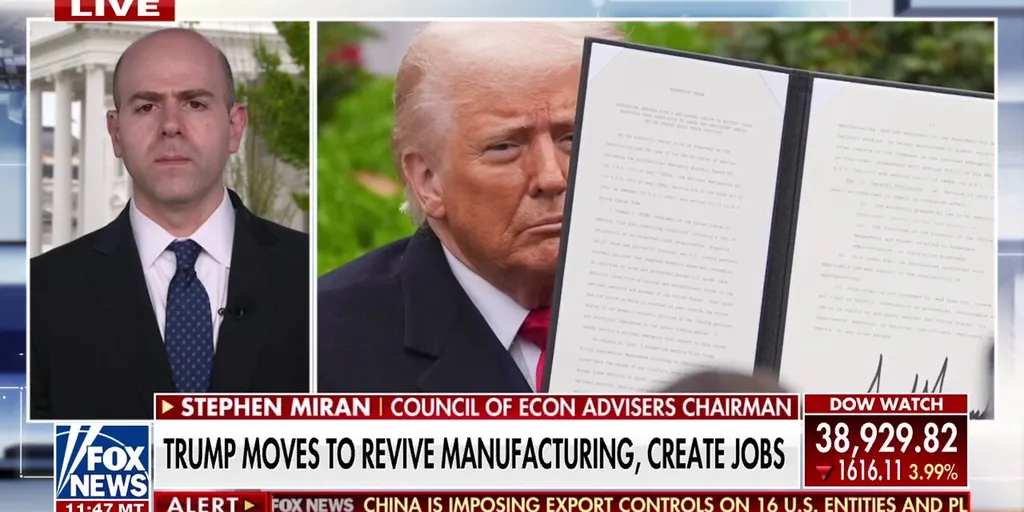
There are also fears that if tariffs fail to reorder the global trading system, Mr. Trump might impose a fee on Treasury debt as chief White House economist Stephen Miran has proposed.  This would amount to a partial U.S. default since it would cut the rate of return.  Think Treasury yields are rising now?  Watch what happens if a Miran fee is imposed. 

All of this is tempting economic fate and contributing to a global “sell America” narrative in financial markets.  That’s why the dollar is under pressure.  Smart Presidents pay attention to market signals and adapt.  The adaptation now would be to negotiate a quick end to the tariff barrage.  Claim some trade-deal victories, and call it a day. 

But markets are spooked because they don’t know if Mr. Trump listens to anyone but his own impulses. 

~ The Editorial Board, "The Fire Jerome Powell Market Rout: Investors render a verdict on tariffs and politicizing the Fed.," The Wall Street Journal, April 21, 2025

President Trump meeting in the Oval Office with Japanese Minister of
State for Economic and Fiscal Policy Ryosei Akazawa on April 16, 2025


Apr 5, 2025

Stephen Miran: "In the long run, the tariff rate will make the United States more competitive"

The wrongs of excessive trade imbalances and the wrongs of excessive globalization didn't happen overnight and they also won't be fixed overnight...  In the long run, the tariff rate will make the United States more competitive, vis a vis our trading partners.

~ Stephen Miran, Fox News interview, April 4, 2025


Mar 27, 2025

Stephen Miran: "I think that a lot of folks have got the effects of tariffs wrong"

I think that a lot of folks have got the effects of tariffs wrong...  The number one point is a general point about economics, which is that when you think about any economic policy, a tariff, a tax, anything else, the economists believe that the party that bears the burden or the benefit of that policy is the party that's more inflexible, because if you're flexible, you can change your behavior to avoid the costs...  

U.S. consumers are flexible.  We have options.  We can produce stuff at home, we have a variety of countries we can import stuff, we can substitute into home production, whereas countries that sell to the United States are inflexible.  They've only got the United States to sell to.  There's no alternative.  So they're the ones who will bear the burden of these tariffs, which means that there's going to be very limited pass through into downside economic risk or into higher prices.

~ Stephen Miran, "Trump's Economic Adviser Rejects Short-Term Pain From Tariffs," Bloomberg Podcasts, 0:30 mark, March 24, 2025


Mar 9, 2025

Leigh Goehring and Adam Rozencwajg on the new global monetary order

We have long maintained that the current period of commodity undervaluation would ultimately conclude with a fundamental shift in the global monetary order. Until recently, we expected this shift to originate from the BRIC nations. China, in particular, has spearheaded efforts to move away from the dollar in bilateral trade settlement, gradually reducing its reliance on the U.S. currency. By last year, nearly 10% of all international trade had already moved outside the dollar-based system—a quiet but unmistakable sign of change. 

More recently, however, our thinking has evolved. Rather than de-dollarization being driven externally, we now believe the catalyst may emerge from within the United States itself. Instead of retreating from the dollar’s role as the global reserve currency, policymakers appear poised to double down on it, introducing a series of sweeping reforms that the media has begun referring to as the “Mar-a-Lago Accords.” Though details remain scarce, both Treasury Secretary Bessent and proposed Council of Economic Advisors Chairman Miran have offered hints as to their likely structure. In short, the reforms are expected to include revaluing the Federal Reserve’s gold holdings, restructuring portions of the national debt, and implementing a tariff regime designed to define what Miran describes as a “global commonwealth” of allied nations. Whether these measures will succeed remains an open question, but there is no doubt they represent a fundamental break from the existing global monetary framework.

~ Leigh Goehring and Adam Rozencwajg, "On Commodities, Carry Regimes & Changes in Global Monetary Regimes," Goehring & Rozencwajg, March 7, 2025


Feb 26, 2025

Josh Hendrickson on the Trump tariff strategy

If you favor smaller government and you believe his [Stephen Miran's] argument, then I think that you would be in favor of higher tariffs and lower income taxes... and to the extent we have debt, also potentially coupling that with reductions in government spending.

[...]

The U.S. effective tariff rate is so low relative to other countries that the U.S. is just in a better position to raise tariffs relative to those other countries.  So on some level, that makes it harder to retaliate.  The other issue... is that this currency offset seems to go in one direction.  It seems to go for the United States and not necessarily for these other countries, for them than the initial tariffs on the U.S.

~ Josh Hendrickson, economics professor, Ole Miss, "Unpacking the Document that Spells Out Trump’s Tariff Strategy," The Human Action Podcast, February 14, 2025

(Professor Hendrickson is referring to a paper written by Stephen Miran, President Trump's nominee to chair the Council of Economic Advisers, which lays out Trump's tariff strategy.)