Showing posts with label people - Clay; Henry. Show all posts

Feb 8, 2020

Tom DiLorenzo on Whig Party hatred towards John Tyler

John Tyler also became the first president to be subjected to Articles of Impeachment, which were filled with rather hilarious political bluster.  He was accused of “arbitrary and despotic abuse of the veto power”; “open hostility to the Legislative department of the Government,” as though that was a bad thing; and “vacillation, weakness, and folly,” among other absurdities.  The Articles of Impeachment were ultimately rejected.

You know John Tyler was a good man, and that Ivan Eland [author of Recarving Rushmore] is probably spot on in ranking him as America’s best president (he reduced the size of the army by one-third, among other things) since he elicited the hatred of such a cabal of political gangsters, rent seekers, idiots and tyrants led by Lincoln’s “beau ideal of a statesman” Henry Clay.

~ Tom DiLorenzo,  "The President Who Was Expelled from His Own Party," LewRockwell.com, February 8, 2020

Image result for john tyler

John Tyler on vetoing Henry Clay's bank bill

The power of Congress to create a national bank to operate over the Union has been a question of dispute from the origin of the Government.... [M]y own opinion has been uniformly proclaimed to be against the exercise of any such power by this Government.

~ John Tyler, 10th president, August 16, 1841

Image result for john tyler stamps
John Tyler (1841-1845)
1938

Jan 19, 2020

Tom DiLorenzo on how Henry Clay thought ending slavery could harm the cause of liberty

In the eulogy Lincoln claimed that [Henry] Clay, like himself, had a "deep devotion to the cause of human liberty," even though Clay was a slaveowner.  Clay was opposed to slavery "on principle"; however, he not only owned slaves but also was opposed to eliminating slavery.  In Lincoln's words, "[Clay] did not perceive, as I think no wise man has perceived, how [slavery] could be at once eradicated, without producing a greater evil, even to the cause of human liberty itself."

It's hard to imagine a clearer example of circular reasoning: Slavery is an affront to human liberty, but ending slavery would supposedly be even worse.

~ Tom DiLorenzo, The Real Lincoln, pp. 14-15

Henry Clay
1890-1893

Jan 5, 2020

Tom DiLorenzo on Henry Clay's time as general counsel of the Bank of the United States

Having incurred $40,000 in personal debt, [Henry] Clay left Congress for two years in 1822 to serve as general counsel of the Bank of the United States.  As Clay biographer Maurice Baxter explains,
His income from this business apparently amounted to what he needed [to pay off his personal debt]: three thousand dollars a year from the bank as chief counsel, more for appearing in specific cases; and a sizable amount of real estate in Ohio and Kentucky in addition to the cash... When he resigned to become Secretary of State in 1825, he was pleased with his compensation.
Who wouldn't be pleased?  In current dollars the amount of money Clay earned in just two years would be nearly a million dollars.

~ Tom DiLorenzo, The Real Lincoln, p. 65

Henry Clay
1894


Tom DiLorenzo; "Clay was a powerful proponent of a nationalized banking system"

[Henry] Clay was also a powerful proponent of a nationalized banking system.  He fought a pitched political battle with Andrew Jackson (which Jackson eventually won) over the rechartering of the Bank of the United States.

As speaker of the House of Representatives, Clay personally demonstrated the usefulness of the Bank of the United States to politicians as ambitious as he was.  He used his position to place his cronies from Kentucky on the bank's board of directors, enabling them to reward their political supporters with cheap credit.  This was precisely the kind of political corruption that opponents of nationalized banking, such as Andrew Jackson, feared.

~ Tom DiLorenzo, The Real Lincoln, p. 64

Image result for bank of the united states
First Bank of the United States

Tom DiLorenzo on the political agenda of Henry Clay

When Henry Clay entered national politics in 1811 as a member of Congress, on the eve of the War of 1812 one of his first acts was to try to convince his colleagues to invade Canada, which they did, three times.  He waged a thirty-year political battle with the likes of James Madison, James Monroe, John C. Calhoun, John Randolph, Andrew Jackson, and the other defenders of the Jeffersonian philosophy of limited, decentralized, constitutional government.  Clay was the political heir to Alexander Hamilton and so championed centralized government power driven by political patronage for the benefit of what U.S. Senator John Taylor of Virginia called the "monied aristocracy."

~ Tom DiLorenzo, The Real Lincoln, p. 62

Henry Clay
1873

Jan 4, 2020

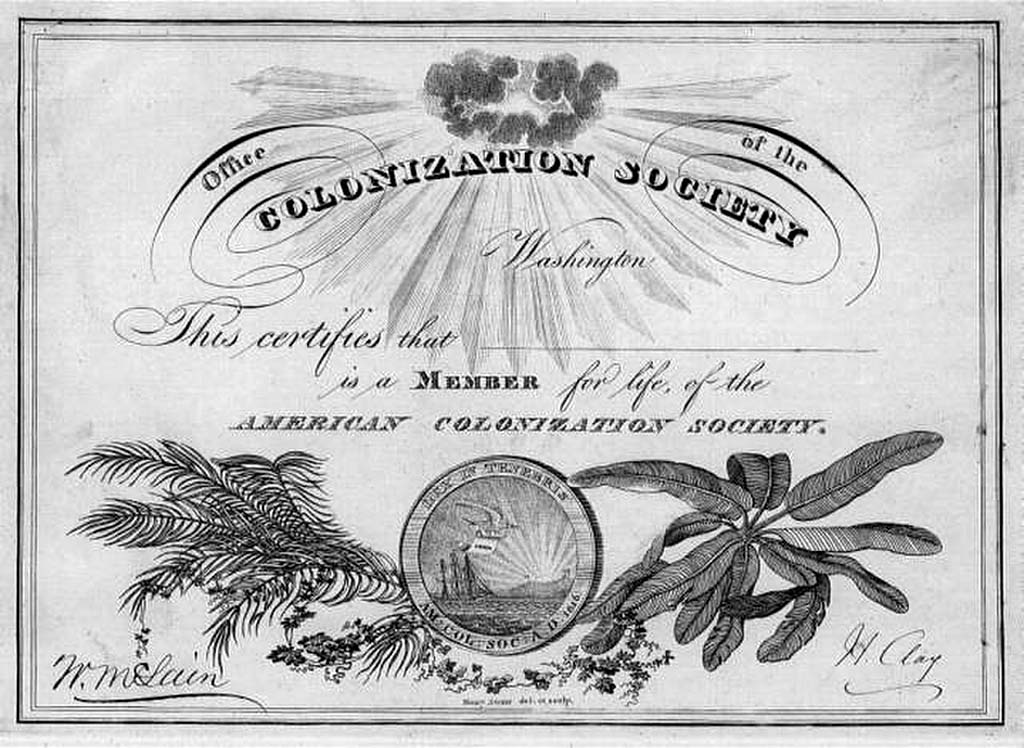
Robert Morgan on the forming of the American Colonization Society in 1816

In December 1816, a group of distinguished Americans met in Washington, DC, to establish an organization to promote the cause of black resettlement. The "American Colonization Society" soon won backing from some of the young nation's most prominent citizens. Henry Clay, Francis Scott Key, John Randolph, Thomas Jefferson, James Madison, James Monroe, Bushrod Washington, Charles Carroll, Millard Fillmore, John Marshall, Roger B. Taney, Andrew Jackson, Daniel Webster, Stephen A. Douglas, and Abraham Lincoln were members. Clay presided at the group's first meeting.

~ Robert Morgan, "Abraham Lincoln's Program of Black Resettlement," The Journal of Historical Review, Sept.-Oct. 1993 (Vol. 13, No. 5), pages 4-25

Image result for american colonization society

Jan 3, 2020

Edgar Lee Masters on the crony capitalism of Henry Clay

[Henry] Clay was the champion of that political system which doles favors to the strong in order to win and to keep their adherence to the government.  His system offered shelter to devious schemes and corrupt enterprises...  He was the beloved son of Alexander Hamilton with his corrupt funding schemes, his superstitions concerning the advantage of a public debt, and a people taxed to make profits for enterprise that cannot stand alone...  The Whigs adopted the tricks of the pickpocket who dresses himself like a farmer in order to move through a rural crowd unidentified while he gathers purses and watches.

~ Edgar Lee Masters, Lincoln the Man (1997), p. 27

(as quoted by Tom DiLorenzo in Hamilton's Curse, pp. 120-121 and The Real Lincoln, pp. 58-59)

Henry Clay
1873

Dec 31, 2019

Tom DiLorenzo on Henry Clay: "corrupt statist"

[Henry] Clay was a corrupt statist who spent his political career promoting mercantilism, protectionism, inflationary finance through central banking, and military adventurism in the quest for empire. Upon entering Congress in 1811 he helped persuade the government to attempt to conquer Canada, which it tried to do three times. He waged a thirty-year battle with James Madison, John C. Calhoun, Andrew Jackson, and other defenders of the Constitution over federally funded corporate welfare.

~ Tom DiLorenzo, "Henry Clay: National Socialist," The Free Market, March 1998

Related image
Henry Clay
1902-1903