Showing posts with label ESG. Show all posts

May 8, 2024

Cactus Schroeder on the failure of oil companies who shifted to green energy

Cactus Schroeder: There was so much money thrown at green energy - and it's all flopping - so these people are not going to continue putting money into things that aren't making money.  BlackRock was such a big deal with their [ESG].  And they're having to take a step back and say, "we're not making money" and, because they put all those regulations and they're on so many boards, the state of Texas has said, "bye, we're not doing business with you anymore."  They sold all their BlackRock stock and I think Louisiana's getting ready to do that as well or may have already.  And so some of those companies, they're going to have to change what they're doing or suffer the consequences.

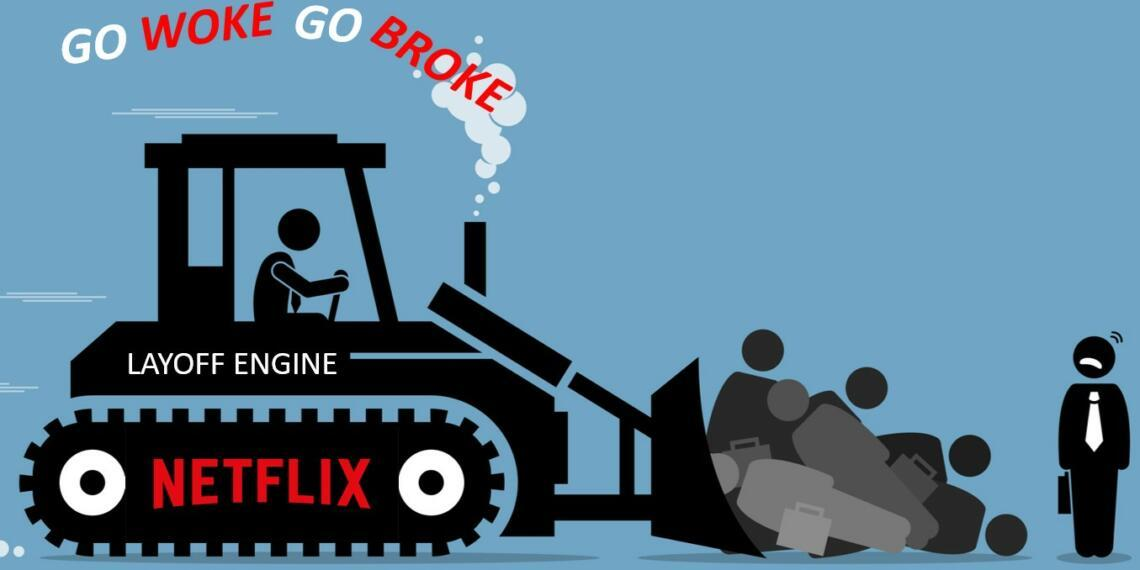
Dan Ferris: Yeah, it's just another version of go woke, go broke.  Anheuser Busch, Disney, now Porter [Stansberry] argues that Starbucks is because they started letting homeless people come in and use the bathroom and he said that it turned it from a business into a charity.  And now their results are sucking wind.  They're doing terribly.  At some point reality does kick in.  Reality kicks in and we all want our standard of living so we all know it's based on oil and gas and it's not based on a whole lot else.

~ Cactus Schroeder, interview with Dan Ferris, Stansberry Investor Hour, 32:30 mark, May 6, 2024


Jan 16, 2024

Russ Greene on Unilever's ESG rollercoaster

Unilever's history is a microcosm both of the rise of ESG and of the challenges the ESG agenda is now facing.  The British consumer packaged goods corporation owns several successful brands, including Ben & Jerry's, Dove, and Magnum.  It has prided itself on its ESG credentials, particularly under Paul Polman, Unilever's CEO from 2009 to 2019. 

Under Polman's leadership, the company made a series of corporate commitments to environmental and social causes.  It supported sustainable agriculture at the World Economic Forum.  It helped create the United Nations' "sustainable development goals."  It "made a stand to #unstereotype the way men and women are portrayed in marketing."  Again and again, it filtered its corporate purpose through a progressive worldview. 

While it is now common for brands to advertise their commitments to such causes, Unilever took the lead in incorporating "purpose" into virtually everything it did.  Polman often called for CEOs to focus on creating value for a wider group of "stakeholders," as opposed to narrowly focusing on shareholders; he also campaigned for government efforts to fight climate change. 

At first, Polman's play worked.  In his decade atop the company, Unilever's stock price rose by about 150 percent—"well ahead of the FTSE [Financial Times Stock Exchange] 100 average," The Guardian notes—and it reported decreasing emissions from its factories by 47 percent from 2008 to 2018.  Perhaps it indeed was possible to achieve both purpose and profits, to serve both "stakeholders" and shareholders at once. 

Toward the end of his term, though, signs of trouble appeared.  Kraft Heinz, a firm closely associated with Warren Buffett and his holding company Berkshire Hathaway, made a bid for control of Unilever in 2017.  The company rejected the offer.  This event carried symbolic meaning, as Buffett has a long history of favoring profits over "purpose."  In the fallout, investors increasingly put pressure on Unilever to cut bureaucratic overhead. 

After Polman left the company in 2019, his replacement Alan Jope eagerly picked up the ESG mantle.  A 2021 Unilever blog post declared that there was "No trade-off between purpose and performance."  In 2022, after a backlash against ESG had begun, Jope declared at a Clinton Global Initiative event that Unilever "will not back down on this agenda despite these populist accusations."

Indeed, the populists did not prompt Unilever to back down from ESG.  After all, Unilever is a British company, and in Britain, even conservative politicians have embraced aspects of the ESG agenda.  Market forces, on the other hand, have had an impact.  Investor Terry Smith repeatedly ridiculed Unilever's "virtue-signaling," calling on the company to focus on fundamentals.  Why did Hellmann's mayonnaise need a purpose?  Didn't it already have one, as a salad and sandwich condiment?  Nor was Smith the only investor concerned with Unilever's flagging performance.

Within months of his promise not to back down, Jope announced that he was stepping down as CEO. His replacement, Schumacher, is the one who called the focus on ESG goals a "distraction."


Dec 15, 2022

Joe Lonsdale on ESG

]I]n practice, what happens like anything else is ESG is a form of power, and the power becomes captured politically and used towards different ends.  And so a huge part of our corporate world, a huge part of the Fortune 500, is virtue-signaling to try to get free resources, to try to get basically rewarded based on the fact that a lot of institutions are now captured by these ESG frameworks.

~ Joe Lonsdale, venture capitalist and Palantir co-founder, "FTX founder manipulated ESG to earn virtue-signaling glow': Palantir co-founder," Fox Business, November 29, 2022


WSJ on the virtue signaling of Sam Bankman-Fried

Mr. Bankman-Fried virtue-signaled by committing to make FTX “carbon neutral” and donating generously to fashionable progressive causes such as a foundation working to provide solar energy in the Amazon River basin.  “We’re giving millions each year to launch sustainability related initiatives,” he said in an April Forbes magazine interview with—you can’t make this up—Brazilian super-model Gisele Bündchen.

~ WSJ Editorial Board, "Sam Bankman-Fried Becomes an ESG Truth-Teller," The Wall Street Journal, November 17, 2022


Oct 5, 2022

Sean Corrigan on what ails employers

After 25 years of green ideology, 10 years of ESG indulgence peddling, 3 years of biohazard totalitarianism, 8 months of totally avoidable warfare and increasingly self-destructive sanctions, who thinks the Fed’s rate rises are the main cause of the travails of employers?

~ Sean Corrigan, tweet, October 5, 2022


Sep 28, 2022

James Freeman on poor performance at Calpers due to political activism

There is no such thing as a free lunch.  Activists who think they can use public companies to pursue political agendas without endangering shareholder returns are indulging in a fantasy.  Disappointing results at a giant government pension fund cannot all be tied to political agendas, but the retired workers who rely on Calpers have every right to demand that fund managers adopt a singular focus on maximizing returns. 

[...]

Let’s hope Calpers finally gets it, and a good fresh start would include a determination to urge portfolio companies to simply pursue profits, not politics.  For years, the big fund has been fairly active in pursuing the latter, despite early red flags.

~ James Freeman, "An ESG Champion Stumbles," WSJ, September 28, 2022


Jun 26, 2022

Chris Wright on ESG-driven underinvestment in energy

I hope we've hit peak fantasy land.  I suspect the energy dialogue starts to get more sober going forward in this country.

~ Chris Wright, CEO of Liberty Oilfield Services (as quoted in "Drill, Baby, Drill Is Not an Option," Barron's, March 12, 2022)


Jun 21, 2022

Doug Casey on the impact of DIE and ESG on corporate cultures

The concepts of DIE (diversity, inclusion, and equity) and ESG (environmental, social, and governance) have inundated corporate culture like a tidal wave of sewage.  They’re viewed as being good, positive, and something that everybody should observe when they should be thrown out with the garbage.  They’re purely destructive. 

One of the causes for this, other than our corrupt education system, is that corporations today are usually not run by entrepreneurs.  Entrepreneurs, the founders, generally have one way of thinking.  Later, managers take over.  The company is then run by suits, heavy with lawyers and accountants. They’re what the French call “petit fonctionnaires.”  These are people with bureaucratic mindsets, better at backslapping and backstabbing than creating value, who come to consider themselves as masters of the universe.  It’s not good.

~ Doug Casey, "Doug Casey on Why Woke Corporations Will Go Broke," International Man, June 14, 2022


Apr 28, 2022

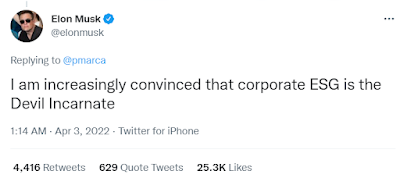
Elon Musk on ESG

I am increasingly convinced that ESG is the Devil Incarnate.

~ Elon Musk, tweet, April 3, 2022


Mar 18, 2022

Doug Casey on green energy

Wind and solar make no sense for mass power generation. They’re completely unsuitable for a complex industrial civilization. The Greens aren’t trying to solve a technological problem but make an ideological statement. Which is fine, except they’re doing it at the public’s expense. Meanwhile, the public has been so propagandized that they now feel it’s morally righteous to be hornswoggled. 

No problem if someone feels that covering his rooftop with solar panels can cut his electricity bill and pay back the cost in 7 or 10 years—which is roughly the case today. It’s something else entirely if a government puts a society’s electrical grid at risk in order to virtue signal.

~ Doug Casey, "Doug Casey Debunks the So-called 'Green Economy'," International Man, March 11, 2022


Feb 2, 2022

Carla Harris on venture capital funds going to women and minorities

There was about $3.8 billion that were allocated to black and hispanic founders last year [2020].  That number was $11 billion this year [2021].  Now the amount of VC dollars distributed also skyrocketed, and with respect to women, while the percentage was down, the absolute amount went up.  It was $3.8 billion and change that was allocated to female founders last year [2020].  That number was over $6 billion this year [2021]: only 2%, but the absolute dollars is something we need to pay attention to.  Slowly but surely, it's starting to penetrate.

~ Carla Harris, Morgan Stanley senior client advisor, Bloomberg TV interview, February 1, 2022


Jan 18, 2022

Larry Fink on stakeholder capitalism

Stakeholder capitalism is not about politics.  It is not a social or ideological agenda.  It is not ‘woke.’  It is capitalism, driven by mutually beneficial relationships between you and the employees, customers, suppliers, and communities your company relies on to prosper.

~ Larry Fink, 2021 BlackRock shareholder letter, "No need to be ‘woke,’ but BlackRock’s Fink says CEOs need to address societal issues," MarketWatch.com, January 18, 2022


Sep 8, 2021

John Chirico on the growth of stakeholder capitalism

Thirty years ago, the goal of a company was to serve shareholders.  That’s evolved.

Everyone is trying to be mission-driven these days.  Some companies are founded on that mission.  Others have come around to it, and others are not as authentic.

~ John Chirico, co-head of North American banking, capital markets and advisory at Citigroup Inc. "For Chobani, Allbirds, Other Coming IPOs, Greed Is Out. Do-Gooding Is In.," The Wall Street Journal, September 7, 2021


Aug 7, 2021

ETF.com on new BlackRock climate ETF

On Thursday BlackRock issued the BlackRock Future Climate and Sustainable Economy ETF (BECO), an actively managed fund that invests in stocks of companies that seek to reduce carbon emissions in the broader economy. 

Notably, the fund is seeking to produce a net lower environmental impact than the MSCI ACWI Multiple Industries Select Index as measured through an assessment, rather than seeking to specifically beat that index’s returns. BECO has an expense ratio of 0.70%, and trades on the NYSE Arca.

~ Dan Mika, "ETF Odds & Ends: 2 Active ESG Funds Debut," ETF.com, August 6, 2021


May 6, 2021

Morningstar on strong ESG fund flows and launches

Assets in U.S. sustainable funds have stayed on a steady growth trajectory.  As of March 2021, assets totaled nearly $266 billion.  That’s a 12% increase over the previous quarter and a 123% increase year over year.  Active funds retained the majority (60%) of assets, but their market share is shrinking.  Three years ago, active funds held 82% of all U.S. sustainable assets. 

As U.S. flows into sustainable funds have gained traction, asset managers have responded by growing their sustainable fund lineups.  In the first quarter of 2021, 11 funds were launched in the U.S. with sustainability mandates.  Of those 11, 10 were equity funds, and eight were exchange-traded funds.  Once again, most of the new sustainable funds available in the U.S. are actively managed offerings.  Two of the new funds target hydrogen power, an emerging focus for renewable energy investors: Direxion Hydrogen ETF (HJEN) and Defiance New Gen H2 ETF (HDRO).

~ Allyssa Stankiewicz, "Sustainable Fund Flows Reach New Heights in 2021’s First Quarter Green funds are blossoming this spring," Morningstar, April 30, 2021


Mar 23, 2021

Lauren Kashmanian on social bonds

Green bonds, which are bond issues with an underlying environmental or sustainable purpose, have been issued in the municipal bond market since 2013, when Massachusetts issued the first green-labeled municipal bond. Social bonds, which are newer to the municipal bond market, are defined as “bonds with a use of proceeds for new and existing projects with positive social outcomes.” Some of the issue types within the municipal market that are eligible for this label include bonds for affordable basic infrastructure, such as clean drinking water, clean transportation, and clean energy projects; bonds for essential service access, such as health care and education; bonds for socioeconomic advancement and empowerment; and bonds for affordable housing projects. 

Social bonds have also allowed nonprofit foundations to access the public bond market and continue their philanthropic work during a time when charitable donations from corporations and individuals might be less reliable. The Ford Foundation issued the first social bond by a nonprofit foundation earlier this year, and the issue was designated as such by Sustainalytics, a second-party verifier, under the category of socioeconomic advancement and empowerment. The net proceeds will be used toward “building resilience in the nonprofit sector and stabilizing and strengthening key nonprofit organizations essential to reducing inequality, so that they are in a position to advance just, inclusive, and equitable recovery efforts following the COVID-19 pandemic.”

~  Lauren Kashmanian, Senior Portfolio Manager, Parametric, "Muni Investors Can Prioritize the 'S' in ESG with Social Bonds: Municipal bond investors have a new way to support positive social change.," WealthManagement.com, March 10, 2021


Mar 19, 2021

Jason Hsu on China, competitiveness and ESG

To outcompete globally, to generate profits - this animal spirit of responding to monetary incentives is stronger in China than any other country I ever visited. Whereas, if you look at the U.S. and Europe and Japan today: ESG investing, purpose investing, impact investing, where investors are saying, "Hey, I'm willing to make less money, lower return for other reasons," right? "My investing, my work isn't merely profit-driven." And that ethos almost points to anti-capitalism. Capitalism requires you to be entirely selfish and profit-motivated. So that's the dichotomy in China. On the one hand you have extreme profit-motivated behaviors that's led to phenomenal growth. That's led to everyone acquiring a tremendous amount of education and working tremendously hard and producing prosperity and growth, but with a backdrop of a society that's also very distrustful of a market mechanism. 

~ Jason Hsu, "Quantamental Investing Lessons with Jason Hsu," 27:30 mark, Stansberry Investor Hour, March 18, 2021


Dec 25, 2020

Jim Grant on ESG

ESG is a bull-market luxury.  In a bear market, people I think are much more concerned about survival than they are about making a political statement.

~ Jim Grant, "Living Economic History: Q&A with Jim Grant," The Coffee Can Portfolio, December 10, 2020


Oct 25, 2020

Bloomberg on the popularity of ESG funds in 2020

Issuers have realized the benefits of ESG branding. At least eight funds have relaunched this year to switch to the strategy, versus a maximum of two in previous years, according to data compiled by Bloomberg Intelligence. 

There have been 17 ESG ETFs launched so far in 2020, compared with 10 in all of 2019. And the inflows keep coming. ESG funds have already taken in almost $4.1 billion in October, on track for their best month since at least 2013.

~ Bloomberg, "Record Flows Pour Into ESG Funds as Their ‘Wokeness’ Is Debated," by Casey Wagner and Claire Ballentine, October 25, 2020


Bloomberg: SEC considering rules for funds to label themselves "ESG"

Complicating socially conscious investing is the fact the Securities and Exchange Commission doesn’t regulate how the ESG label is applied, though it’s considering adding rules for funds that call themselves ESG or sustainable.

~ Bloomberg, "Record Flows Pour Into ESG Funds as Their ‘Wokeness’ Is Debated," by Casey Wagner and Claire Ballentine, October 25, 2020