~ Phil Duffy, "The British Agricultural Revolution Gets No Respect," Mises Wire, July 22, 2022
Showing posts with label agriculture. Show all posts
Jul 22, 2022
Phil Duffy on Adam Smith vs. Richard Cantillon
[Adam] Smith’s Wealth of Nations had the advantage of a half century more of observation over Cantillon’s Essay, and yet it was the latter’s insights into the agricultural revolution and the guiding role of the entrepreneur in achieving economic progress that separated the two economists. It is high time Richard Cantillon and the British Agricultural Revolution got their due respect.
Apr 20, 2008
Agrium VP on the future of agriculture
I think the next 15 to 25 years are going to be the most exciting in agriculture history. There's an opportunity to help with the energy crisis as well as with increasing human consumption of food.
~ Tom Warner, vice president of Agrium, a Calgary, Alberta-based agricultural products retailer, "Facing Big Changes Down on the Farm," IBD, March 3, 2008
Nov 11, 2007
Cyd Malone on the Back to the Land movement of the 1930s
During the 1930s, the wish of the world's politicians to "plan" other men's lives was strong and, by unhappy coincidence, so was their power to do so. The urge to "educate and uplift" their fellow (if lesser) man into a state more agreeable to their theories beat brightly in every progressive heart from Moscow and Berlin to London and Washington D.C.
The Communist Manifesto had vastly more influence on the intellectual mind than it does today, and its exhortation for "combination(s) of agriculture with manufacturing industries; gradual abolition of the distinction between town and country, by a more equitable distribution of the population over the country" was taken seriously as a workable idea and, more important, as a morally correct idea. Writings such as the Manifesto undoubtedly contributed to the birth of the Back to the Land movement, an intellectual fad that swept through the brains of many 1930s Western politicians.
As a result, the city of Magadan in Russia's Siberia was built from nothing, by and for Stalin's slave army. It still exists today. In Germany, the town of Ramersdorf was built from scratch on the magnanimous whim of Adolph Hitler; it too still exists today. And America's very own example of the fad was the West Virginia town of Arthurdale, constructed during 1933 on the magnanimous whim of Eleanor Roosevelt.
~ Cyd Malone, "The Peculiar History of Arthurdale," Mises.org, August 8, 2007
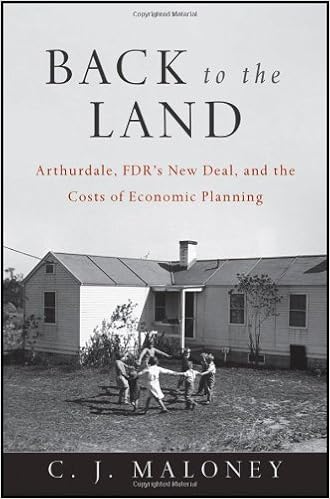
The Communist Manifesto had vastly more influence on the intellectual mind than it does today, and its exhortation for "combination(s) of agriculture with manufacturing industries; gradual abolition of the distinction between town and country, by a more equitable distribution of the population over the country" was taken seriously as a workable idea and, more important, as a morally correct idea. Writings such as the Manifesto undoubtedly contributed to the birth of the Back to the Land movement, an intellectual fad that swept through the brains of many 1930s Western politicians.
As a result, the city of Magadan in Russia's Siberia was built from nothing, by and for Stalin's slave army. It still exists today. In Germany, the town of Ramersdorf was built from scratch on the magnanimous whim of Adolph Hitler; it too still exists today. And America's very own example of the fad was the West Virginia town of Arthurdale, constructed during 1933 on the magnanimous whim of Eleanor Roosevelt.
~ Cyd Malone, "The Peculiar History of Arthurdale," Mises.org, August 8, 2007

Subscribe to:
Posts (Atom)

