Showing posts with label human rights abuses. Show all posts

Dec 28, 2023

Amnesty International on the killing of Palestinian demonstrators in the Great March of Return (2018)

According to the Al Mezan Center for Human Rights, since the start of the protests, over 150 Palestinians have been killed in the demonstrations.  At least 10,000 others have been injured, including 1,849 children, 424 women, 115 paramedics and 115 journalists.  Of those injured, 5,814 were hit by live ammunition.  According to Israeli media, one soldier was moderately injured due to shrapnel from a grenade thrown by a Palestinian from inside Gaza and one Israeli soldier was killed by Palestinian sniper fire near the fence that separates Gaza and Israel outside of the context of the protests. 

Why are Palestinians demonstrating? 

This year has marked 11 years since Israel imposed a land, air and sea blockade on the Gaza Strip.  The United Nations and the International Committee of the Red Cross (ICRC), among others, have characterized Israel’s closure policy as “collective punishment” and called for Israel to lift its closure.  Under Israel’s illegal blockade, movement of people and goods is severely restricted and the majority of exports and imports of raw materials have been banned.  Travel through the Erez Crossing, Gaza’s passenger crossing to Israel, the West Bank, and the outside world, is limited to what the Israeli military calls “exceptional humanitarian cases”, meaning mainly those with significant health issues and their companions, and prominent businesspeople.  Meanwhile, since 2013, Egypt has imposed tight restrictions on the Rafah crossing, keeping it closed most of this time. 

Over the last 11 years, civilians in the Gaza Strip, 70% of whom are registered refugees from areas that now constitute Israel, have suffered the devastating consequences of Israel’s illegal blockade in addition to three wars that have also taken a heavy toll on essential infrastructure and further debilitated Gaza’s health system and economy.  As a result, Gaza’s economy has sharply declined, leaving its population almost entirely dependent on international aid.  Gaza now has one of the highest unemployment rates in the world at 44%.  Four years after the 2014 conflict, some 22,000 people remain internally displaced, and thousands suffer from significant health problems that require urgent medical treatment outside of the Gaza Strip.  However, Israel often denies or delays issuing permits to those seeking vital medical care outside Gaza, while hospitals inside the Strip lack adequate resources and face chronic shortages of fuel, electricity and medical supplies caused mainly by Israel’s illegal blockade. 

The protests were launched to demand the right of return for millions of Palestinian refugees to their villages and towns in what is now Israel, and to call for an end to Israel’s blockade.  They culminated on 14 May, on the day of the US embassy’s move from Tel Aviv to Jerusalem and the eve of the 70th anniversary of the Nakba, when Palestinians commemorate the displacement and dispossession of hundreds of thousands in 1948-9 during the conflict following the creation of the state of Israel.  On that day alone, Israeli forces killed 59 Palestinians, in a horrifying example of use of excessive force and live ammunition against protesters who did not pose an imminent threat to life.

The organizers of the “Great March of Return” have repeatedly stated that the protests are intended to be peaceful, and they have largely involved demonstrators protesting near the fence that separates the Gaza Strip from Israel. Despite this, the Israeli army reinforced its forces – deploying tanks, military vehicles and soldiers, including snipers, along the Gaza/Israel fence – and gave orders to shoot anyone within several hundred metres of the fence.

~ "Six Months On: Gaza's Great March of Return," Amnesty International, October 19, 2018


Luke Tress on the United Nations criticizing Israel

Since 2015, the [UN] General Assembly has adopted 140 resolutions criticizing Israel, mainly over its treatment of the Palestinians, its relationships with neighboring countries and other alleged wrongdoings.  Over the same period, it has passed 68 resolutions against all other countries, UN Watch said.

In the 193-nation assembly’s most recent anti-Israel resolution Friday, it approved a call for the International Court of Justice to weigh in on the Israeli-Palestinian conflict. 

The resolution promoted by the Palestinians passed by a vote of 87 in favor, 26 against, with 53 abstentions.

The resolution, titled “Israeli practices and settlement activities affecting the rights of the Palestinian people and other Arabs of the occupied territories,” calls on the Hague-based ICJ to “render urgently an advisory opinion” on Israel’s “prolonged occupation, settlement and annexation of Palestinian territory.”

[...] 

In a strongly worded statement, Prime Minister Benjamin Netanyahu said Israel would not be bound by the “despicable decision.”

Netanyahu’s new hardline government, sworn in on Thursday, is likely to further stoke tensions with the UN and the international community.

Of Netanyahu’s coalition partners, none are on record supporting a two-state solution with the Palestinians, some support annexing the West Bank without granting equal rights to Palestinians in those areas, and many also vehemently oppose coordination or strengthening the PA [Palestinian Authority].

~ Luke Tress, "UN condemned Israel more than all other countries in 2022 - monitor," The Times of Israel, January 3, 2023


Dec 19, 2023

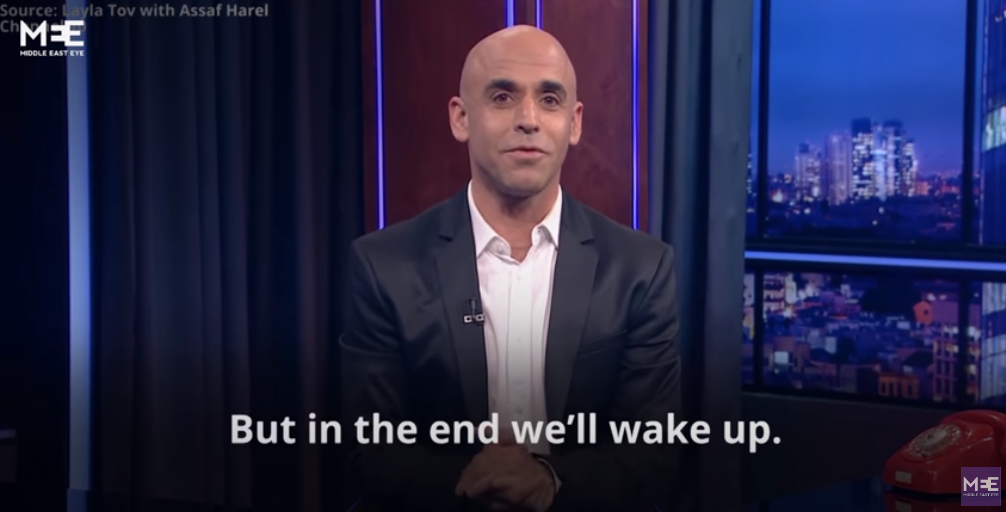
Assaf Harel on the importance of human rights organizations in Israel

The human rights organizations are the most legitimate and healthy thing today in Israeli society.  They are trying to wake a dormant society, a blocked society...  And the reason [prime ministers Naftali] Bennett and Bibi [Netanyahu] are spending so much time saying they're illegitimate is because they're saying the truth about the occupation and of what's happening.  And Bibi and Bennett know that on the day Israeli citizens wake up and discover what's happening beyong the Green Line, what it does to our solidiers, to the children who are raised there, to the elderly, to the families, to the millions of innocent people, what it does to our budget, our society, our economy?  On that day, the people will ask themselves if the occupied territories are really worth it.

[...]

If for once we could wake up before the war.  Because before now we only wake up after.  We had to have the Yom Kippur War to have peace with Egypt.  We had to have the intifada to have the Oslo Accords.  If only for once we could be smart enough to reach a peace agreement before the war.  Worse case, after it or another one after that, but in the end we'll wake up.

~ Assaf Harel, "Israeli comedian slams Israel for apartheid," Middle East Eye, 3:45 mark, March 2, 2017


Oct 15, 2023

Omar Baddar on Israeli human right abuses towards Palestinians

There's all these announcements about they're [Israeli Defense Forces] going to do everything they can to avoid civilian casualties.  It is really worth emphasizing here that Israel has bombed Gaza many, many times before and Human Rights Watch and Amnesty International and even Israeli human rights organizations like B'Tselem say that this is not at all what Israel's conduct is.  There isn't an effort to minimize civilian casualties.  There is mass indiscriminate bombing of civilian areas and frankly, we're watching that unfold right now as well.  The policy is essentially to punish the entire Palestinian population, cutting off electricity to all of Gaza, preventing anyone in Gaza from coming in and out.  This is an act of collective punishment and this is exactly the trajectory that we unfortunately are on.  I think we are going to see much greater death that's going to cover the entire Gaza strip and at the end of it, Palestinians are going to remain a population that is captive and under an illegal seige, as recognized by the U.N.  And we're only setting ourselves up towards another round of this in the future.  

What we need right now is the world community to come together and start dealing with this issue seriously, understanding that this policy of giving Israel carte blanche to behave however it wants towards Palestinians is not a way to actually achieve long-lasting peace.  You can't keep doing the same thing over and over againd and expecting a different result.  The one thing that has not been tried so far is allowing Palestinians to be free of Israeli occupation and military dictatorship.  Until we start taking Palestinian grievances seriously, until Israel starts seeing Palestinians as equal human beings who are deserving of the same human rights and decency and dignity that Israelis enjoy, I'm afraid we're going to be stuck in this situation for a very, very long time.

~ Omar Baddar, Palestinian-American Middle East analyst, CNN interview, 3:25 mark, October 9, 2023