Showing posts with label World Economic Forum in Davos. Show all posts

Feb 16, 2025

Bradley Greer: Bill Gates, George Soros and WEF recipients of USAID

USAID has long been a key player in U.S. foreign policy, providing aid to countries worldwide under the banner of so-called “humanitarian assistance and development.” 

The agency has also faced scrutiny for its role in funding programs that critics argue align with broader geopolitical strategies rather than purely philanthropic goals. 

Historically, USAID has been involved in funding initiatives such as international vaccine programs and “democracy promotion efforts.” 

Bill Gates

One of the major recipients of USAID funding has been the GAVI Alliance, an international vaccine initiative supported by Bill Gates. 

In 2020, USAID committed $1.16 billion to GAVI for fiscal years 2020 to 2023, with an additional $1.58 billion pledged for the following five years. Reports indicate that total contributions to GAVI could exceed $2 billion. 

George Soros

Additionally, USAID has been linked to funding non-governmental organizations (NGOs) involved in political and economic programs worldwide.

A 2017 report from the Heritage Foundation suggested that George Soros’ Open Society Foundations (OSF) had played a significant role in implementing USAID-funded initiatives since at least 2009.

Historical documents indicate that USAID and OSF collaborated as early as 1993 to train professionals in Eastern Europe. 

By the late 1990s and early 2000s, OSF-affiliated NGOs were involved in political movements across Eastern Europe, including Ukraine’s Orange Revolution in 2004.

[...] 

World Economic Forum

Beyond individual programs, USAID has also been involved with international organizations such as the World Economic Forum (WEF). Between 2013 and 2022, USAID invested approximately $26 million in multi-year agreements connected to WEF initiatives. 

In response, House Republicans introduced the ‘Defund Davos Act’ in January 2024, seeking to prohibit U.S. government agencies, including USAID, from funding the WEF. 

Legislators supporting the bill argued against the use of taxpayer dollars to support the Forum’s initiatives. 


Feb 15, 2025

Marko Papic investing in 2025: bet against the Davos consensus

Davos is great and you learn a lot, but it is a little bit like living in The Economist cover.  It is what it is.  It's in the price, it's consensus.  And I think that this year there might be three things that happen that will actually go against that consensus.  

First, referring to my point about Donald Trump, we may not want to go swing fully against globalization as a new paradigm.  President Trump has a nuanced position on trade and he will use those tariffs to negotiate new deals...  Maybe we've overstated how much trade wars are going to matter in '25.  

The second thing is that I think people are overstating is just how woefully inadequate Europe is as an investment opportunity.  There are things happening here that very few people brought up at Davos.  One is that there's an important German election coming up.  Second is that there is an energy revolution, both in alternatives but also in terms of LNG supply that will help Europe solve its energy problems.

And so what I would say is that 2025 may actually be a year where the dollar peaks and when some of these consensus trades, which is to be in Magnificent 7, in the U.S., particularly tech, actually... move against that consensus.

~ Marko Papic, "Thoughts From the Apex of Globalization," 1:40 mark, January 26, 2025


Jan 20, 2023

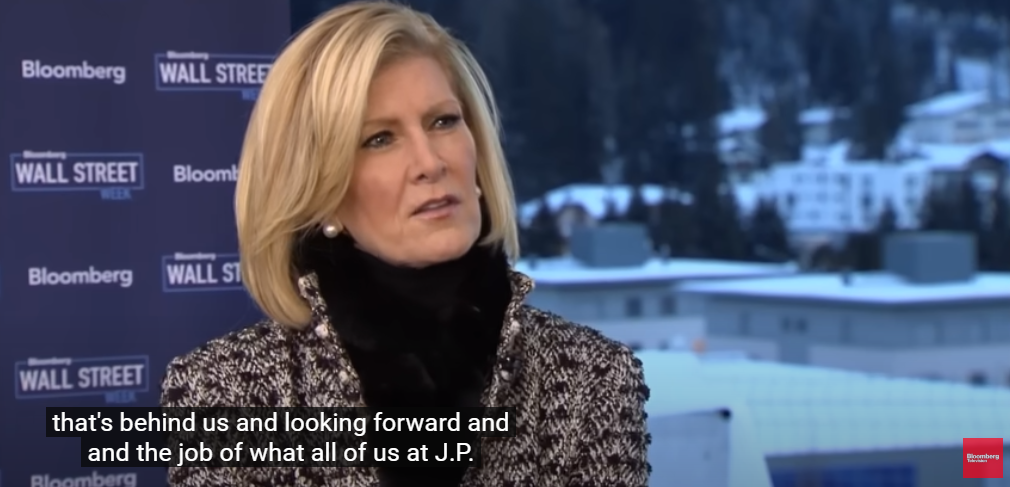
Mary Callahan Erdoes on the mood in Davos

I would say the tone here, having come here for the past decade, is less depressed than it often is, which is a good sign of hope of what's happening out there in the world, having come off of the most difficult year for a balanced portfolio, 60/40, whether you were in stocks or bonds or anything in between.  It was pretty rough sledding and so I think everyone's happy that that's behind us and looking forward.

~ Mary Callahan Erdoes, JPMorgan Chase, Bloomberg TV interview in Davos, 0:20 mark, January 18, 2023


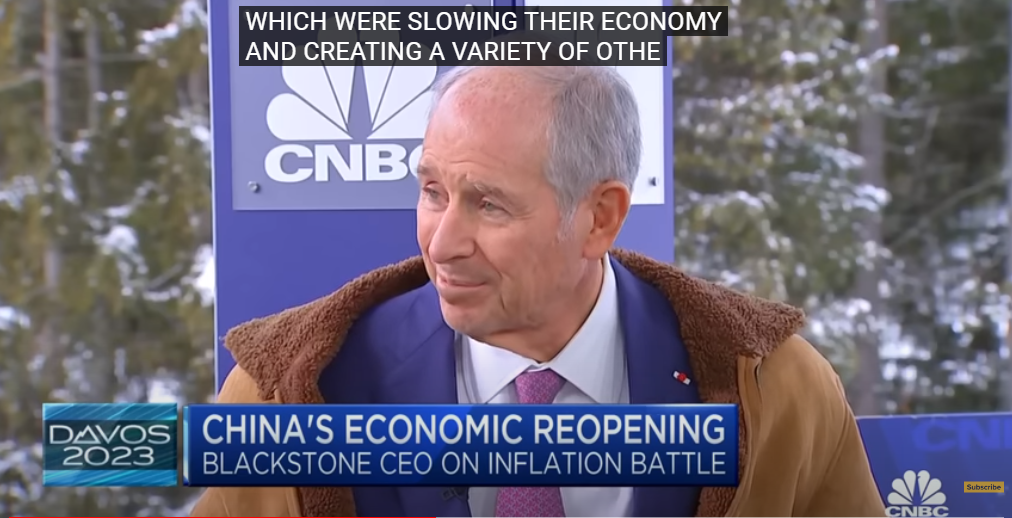
Stephen Schwarzman on China reversing harmful policies of past 2 to 3 years

What you're seeing, which some of us expected, is after the Party Congress in October, China has reversed most of the policies that it put in over the previous two to three years which were really slowing their economy and creating a variety of other issues.  The Chinese are infinitely practical.  This wasn't working out well and so they're changing it.

~ Stephen Schwarzman, Blackstone CEO, CNBC interview in Davos, 1:00 mark, January 17, 2023


Jan 19, 2023

Jamie Dimon: "this whole notion of decoupling is crazy"

Trade's not going away.  This whole notion of decoupling is crazy.

~ Jamie Dimon, JPMorgan Chase CEO, CNBC interview in Davos, 3:40 mark, January 19, 2023


David Solomon expects a soft landing

The macro psyche is evolving or breaking a little bit more to the positive...  I think the sentiment is softening a little bit and the view that the chance of a softer landing, both in the U.S. and Europe, is actually increasing.  Our economics team has been pretty "soft landing" over the last 6 months...  Our economics team, even last weekend, went and said that they are now not calling for recession in Europe.  The improvement in the energy situation, the reopening in China, they actually see as a little bit more positive. 

~ David Solomon, Goldman Sachs CEO, CNBC interview in Davos, 6:40 mark, January 18, 2023


Larry Summers: "soft landings are the triumph of hope over experience"

I'm still cautious, David, but with a little more hope than I had before.  Soft landings are the triumph of hope over experience, but sometimes hope does triumph over experience.  We have seen some slowing of inflation indicators  at the same time we've seen continued strength [in the economy].  That's gotta be what we all want to see.  I still think it's gonna be hard because we need a substantial amount of disinflation that goes beyond volatile components receding, but you have to recognize that the figures are better than somebody like me would've expected three months ago.  So it’s still a very, very difficult job for the Fed, but the situation does look a bit better.  

~ Larry Summers, interview with David Westin in Davos, Bloomberg Television, January 18, 2023


Jan 18, 2023

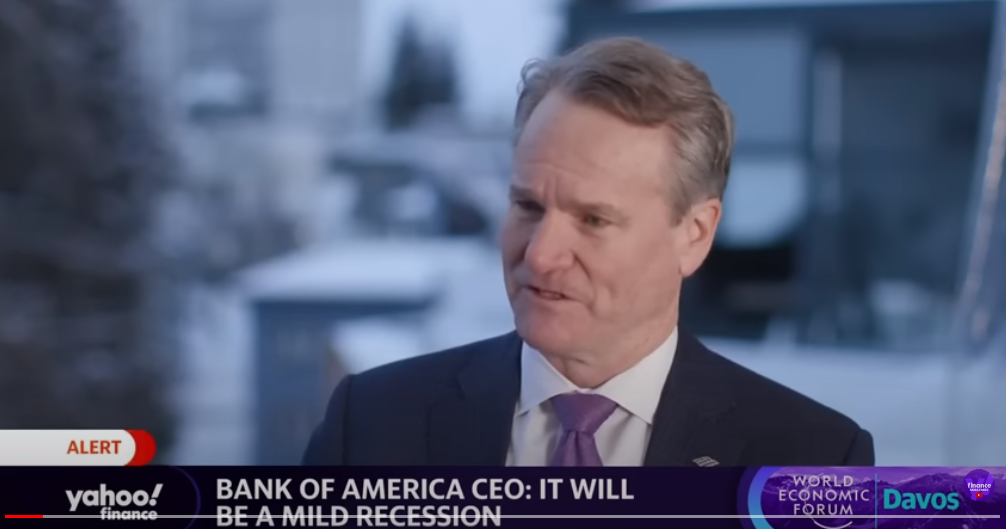
Brian Moynihan: "It'll be a mild recession"

It'll be a mild recession, largely because the stimulus and other things, even though the Fed's raised rates, you see the capacity of the American consumer to keep going.  So basically a mild recession early next year.  But over the last year that's been constantly pushed out so we'll see what happens, but mild recession, slightly down for a couple of quarters and then back to slightly up and then more normal in '24 and into '25.

~ Brian Moynihan, CEO if Bank of America, Yahoo!Finance interview from Davos World Economic Forum, 0:15 mark, January 17, 2023


Jun 2, 2022

Michael Rectenwald on the Davos confab

The annual meeting of the World Economic Forum (WEF) in Davos is perhaps the world’s most unpopular conference, and the WEF’s founder and chairman, Klaus Schwab, one of the world’s most despised figures. Often compared to “Dr. Evil,” the character Mike Meyers played in the Austin Powers series, and routinely likened to a James Bond supervillain on the internet, Schwab is seen as a messianic megalomaniac leading a nefarious cabal of world leaders and corporate heads into a future dominated by a globalist elite. 

A Twitter poll by TruthBoost asks, “Does the World Economic Forum make the world a better place?” As of this writing, 98.4 percent of respondents said no.

What is it about this confab and its leaders that makes the WEF and its meetings so despised? After all, the WEF is “committed to improving the state of the world,” or so says its slogan. As it turns out, most people don’t like having a group of unelected, self-appointed dictators issuing top-down decrees and recommending policies that restrict their freedom and infringe their rights.


Jan 23, 2022

Doug Casey on the political elites

The people who frequent forums, such as the WEF, see themselves as a special class―the elite.  They all know each other, go to the same schools, and socialize at the same clubs.  They have high incomes, a lot of power and influence, and groom their kids to join the party. 

They’ve jelled into an informal ruling class.  Even while they mouth hypocritical platitudes about democracy, diversity, equity, and other PC nonsense, they, in fact, despise the common man.  I wouldn’t be surprised if they would really like to see―as people such as Ted Turner and Bill Gates have intimated―80% of the world’s population to just disappear.  That way, when they visit places such as Machu Picchu, St. Mark’s Square in Venice, and other fashionable places, they won’t be annoyed by the hoi polloi wandering around as if they were equals.  Enough money and power can get the elite to start thinking that way.  Not to mention that these people are mostly sociopaths, with a heavy admixture of real psychos.

~ Doug Casey, "Doug Casey on Implications of the “Great Reset” Agenda and What it Means for You," Doug Casey's International Man, January 14, 2022


Jan 25, 2020

Donald Trump: "we must reject the perennial prophets of doom and their predictions of the apocalypse"

But to embrace the possibilities of tomorrow, we must reject the perennial prophets of doom and their predictions of the apocalypse.  They are the heirs of yesterday’s foolish fortune-tellers… They predicted an overpopulation crisis in the 1960s, mass starvation in the ’70s, and an end of oil in the 1990s.  These alarmists always demand the same thing: absolute power to dominate, transform, and control every aspect of our lives.

~ Donald Trump, World Economic Forum, January 21, 2020

Image result for donald trump davos prophets of doom

Jan 23, 2020

Bloomberg Businessweek: "About 18% of sessions at Davos this year are devoted to climate change"

The first-listed of six priorities for this year’s conference is “Ecology: How to mobilize business to respond to the risks of climate change and ensure that measures to protect biodiversity reach forest floors and ocean beds.” There are sessions with titles such as The Big Picture on Climate Risk, Solving the Green Growth Equation, Calling for Climate Justice, and Responsible Tourism in the Age of Climate Change.

About 18% of the sessions at Davos this year are devoted to climate change, along with other environmental topics and sustainability, vs. about 13% in 2010, when recovery from the financial crisis was more top of mind.

Bloomberg Businessweek, "A Sense of Climate Urgency in The Alps," January 17, 2020


Bloomberg Businessweek: "Davos is cloaked in white, but its agenda is green"

Davos is cloaked in white, but its agenda is green.  Environmentalism - fighting climate change in particular - has emerged as one of the biggest priorities of the World Economic Forum annual meeting, which is held every January in the Swiss ski village.

~ Bloomberg Businessweek, "A Sense of Climate Urgency in The Alps," January 17, 2020

0520_SOL_GREEN_02_CMS

Jan 22, 2020

Glenn Youngkin: We don't see excess in the economy"

I don't think that economic expansions die of old age; they die of excess.  And we don't see excess to any major material degree in the economy so we think that it can continue to grow.  It's not going to grow as fast as people would like, but steady slow growth is just fine.

Glenn Youngkin, co-CEO, Carlyle Group, interview with CNBC's Sara Eisen, World Economic Forum in Davos, January 21, 2020


Andrew Ross Sorkin on Elon Musk

I would say betting against Elon Musk is betting against humanity.  It's real.

~ Andrew Ross Sorkin, CNBC discussion with Becky Quick and Joe Kernan, World Economic Forum in Davos, January 22, 2020

(Tesla's market capitalization reached $100 billion for the first time later in trading.  At the time of the comment, TSLA was trading at roughly $580/share in pre-market trading.)


Jan 21, 2020

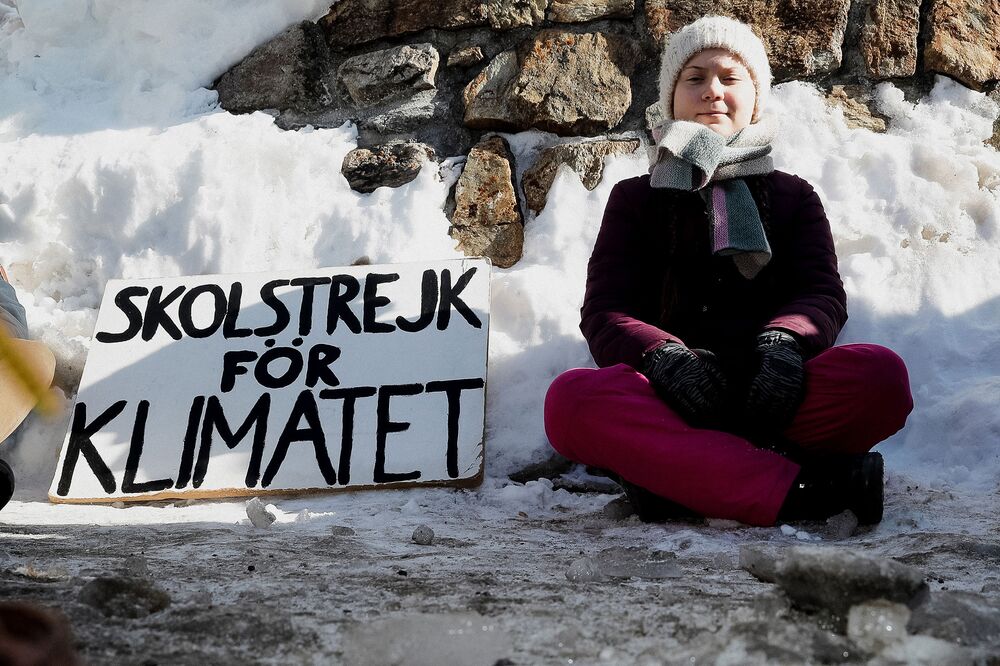
Greta Thunberg: "We are still telling you to panic"

Let's be clear: we don't need a low carbon economy; we don't need to lower emissions. Our emissions have to stop if we are to have a chance to stay below the 1.5 degree target. Our house is still on fire. Your inaction is fueling the flames by the hour. We are still telling you to panic, and to act as if you loved your children above all else.

~ Greta Thunberg, World Economic Forum, January 21, 2020

Image result for greta thunberg world economic forum 2020

Greta Thunberg on climate change: "I want you to panic"

Adults keep saying, "We owe it to the young people to give them hope."  But I don't want your hope.  I don't want you to be hopeful.  I want you to panic.  I want you to feel the fear I feel every day.  And then I want you to act.  I want you to act as you would in a crisis.  I want you to act as if the house was on fire, because it is.

~ Greta Thunberg, "'I want you to panic': 16-year old issues climate warning at Davos," 2:14 mark, January 25, 2019, World Economic Forum

Image result for greta thunberg world economic forum


Jan 18, 2020

Mark Hulbert on the Davos elites: asset bubble low on list of concerns

Among the top 10 global risks to business right now, “asset bubble” ranks 10th on the [Davos] elite’s list of concerns. That may or may not be an accurate assessment of where an asset bubble belongs in such a ranking. But what is noteworthy is a comparable ranking in the WEF’s Global Risks Report for 2009, published within weeks of the bottom of the 2007-09 bear market and global financial crisis. Back then, the No. 1 global risk was an “asset price collapse” — in terms of both likelihood and impact.

~ Mark Hulbert, "How the 1% at Davos make the same mistakes as we do about stocks and the economy," MarketWatch.com, January 10, 2020

Dec 18, 2019

World Economic Forum weighs in on gender inequality

Gender inequality is one of the biggest problems in modern societies. Holding back the potential of half the world’s population has huge consequences on our societies, economies, and businesses. The World Economic Forum has released its annual Global Gender Gap Report 2020, which ranks 153 countries based on their progress towards gender equality.

~ Vikas Shulka, "Top 10 most gender equal countries: Nordic nations lead," ValueWalk, December 17, 2019

(Economic basket cases Cuba, Zimbabwe and Bangladesh all get slightly higher scores than the U.S., and Singapore.)

Image result for world economic forum 2020 global gender gap report