Showing posts with label people - Bonner; Bill. Show all posts

Nov 9, 2021

Bill Bonner on Greta Thunberg and the climate change agenda

Which brings us back to Saint Greta, the climate change activist, subject of yesterday’s Diary. 

She wants action.  Not “blah, blah.”  She’s angry… frustrated. 

And the kind of action she wants is Big Time public policy action. 

That is, she is not satisfied with reducing her own carbon footprint and persuading others to do the same.  She wants to force other people to do things they don’t want to do – on a scale not seen since World War II. 

As America’s special presidential envoy to the United Nations Climate Change Conference (COP26), John Kerry, put it last week, the price tag will be trillions, not billions. 

[...]

Saint Greta proposes more aggressive government action.  But on this rudimentary evidence, the human race might be better off limiting public policies, rather than limiting the use of fossil fuel.

~ Bill Bonner, "Public Policy is an Elaborate Fraud," Rogue Economics, November 9, 2021


Oct 27, 2021

Bill Bonner on complacency about inflation

Bonner: I do think though that this period of, let's say, still calm inflation, this period where prices are going up (and some places they're going up a lot), but they're not going up as we might expect for money printing the way it's going on.  I think that that's a fake out on the part of the whole system.  It leads the Democratic Party - not just the Democrats, but Republicans, too - to think that they can raise that debt ceiling one more time and keep spending, spending, spending.  That is their plan and nobody ever questions it.  Nobody ever really questions, "How does this work?  Where does this money come from?"

Ferris: Where are all the loud voices of dissent about all of this spending?  They're gone.

Bonner: They're gone.  It's all become a political issue, not an economic issue.  Nobody doubts that you can do this from an economic standpoint, but the question is whether you can get away with it politically, which is a whole other issue.

~ Bill Bonner, "Preparing for the 'Zombie Apocalypse' with Bill Bonner," Stansberry Investor Hour, 25:35 mark, September 23, 2021


Mar 26, 2021

Bill Bonner on GDP and government spending

Included in GDP is government spending. But the services offered by the government are not the kind that you are usually looking for. 

Few people wake up in the morning and say, “Today, I’m going shopping for an F-35 Joint Strike Fighter.” Instead, they want the things the government doesn’t make. 

Government spending is almost completely focused on the consumption of wealth, not the creation of it. In other words, it doesn’t add to the supply side of the supply/demand teeter totter. It subtracts from it. 

So, when government spending increases as a percentage of GDP, that too should be cause for higher consumer prices. 

After WWII, total government spending – state, local, and federal – shrank to a bit more than 25% of GDP. Last year, it was over 40%.

~ Bill Bonner, "The Federal Reserve is Wasting Tons of Money," Rogue Economics, March 22, 2021


Feb 16, 2021

Bill Bonner on George Gilder as pied piper of the 2000 dot-com bubble

Of all those who "got it," few got it as good as George Gilder.  Gilder's role in the Information Revolution was to justify the dreams of the masses.  Like Marx, Engels, or Lenin, he helped convince the lumpeninvestoriat that they could get rich without working by buying into technology they did not understand and stock in companies they did not know with money they did not have.  What was talk of gigabits of photons flying over glass fiber and multiplexing, pulsating transits other than the information revolution's answer to Marxist claptrap about dialectical materialism?  To the average investor, it was all weird and unfathomable.  But if it made him rich, why ask questions?

~ Bill Bonner, Financial Reckoning Day (2003), p. 17


Feb 15, 2021

Bill Bonner: takeaways from the GameStop frenzy

So what was that all about, we wonder?  All the sturm and drang?  All the huffing and puffing on the part of bystanders?  Everybody seemed to get worked up about it. 

The shorts thought they were doing God’s work – helping Mr. Market find the appropriate price for GameStop shares.  The longs all wore white, too, confident that they were on a crusade to stop the rich from taking over the world. 

The only “takeaways” for us from the whole saga were that the Fed’s bubble must be getting ready to pop (the madness of the gaming crowd is reaching a fever pitch)… and that hatred towards “the rich” is running high – and growing.

~ Bill Bonner, "The Aftermath of the GameStop Short Squeeze," Rogue Economics, February 3, 2021


Jun 22, 2020

Bill Bonner on the progress of black Americans since the Civil War

For a hundred years following the Emancipation Proclamation in 1862, Blacks continued to make progress – more or less like every other immigrant group – learning skills, entering the professions, setting up their own businesses, and closing the gap between themselves and Whites. 

But then, do-gooders and world-improvers began to use Blacks in a novel way – with disastrous consequences.

In 1964, came the War on Poverty, which gave money to Blacks – but only if they didn’t marry and didn’t work. It also created a new, cronyfied Black elite – who figured out how to game the $21 trillion poverty/racism industry, getting jobs, grants, and special privileges for “minority” enterprises.

Then, in 1971, the War on Drugs brought a whole new level of violence, as gangs fought for market share. Drug laws put millions of Blacks behind bars… nurturing a criminal culture and making it harder than ever for many to get jobs in the normal economy.

And then came the funny money.

Over decades, it shifted manufacturing jobs overseas (it was easier and cheaper to buy things from overseas with fake money than it was to make them here). This, along with minimum wages, kicked the bottom rung out from under the laboring classes – Black and White.

And in 2009, the Federal Reserve kicked its program of money-printing into high gear… with a massive transfer of wealth from the middle and lower classes to the top 10%.

And if that weren’t enough, as mentioned above… the Fed has now gone all out… with huge bailouts to Wall Street, in which very few Blacks participate. Overall, by our estimate, in the last 90 days, the typical Black got only 1/33rd as much fake money as the top 10%.

~ Bill Bonner, "On Juneteenth, a Conversation on Reparations," Rogue Economics, June 19, 2020

May 26, 2020

Bill Bonner on the rise and fall of Amazon.com (2003)

[Jeff Bezos] was 35 when Time magazine awarded him its "Person of the Year" title in January 2001.  When the going was good, Time gushed, "Jeffrey Preston Bezos... peered into the maze of connected computers called the World Wide Web and realized that the future of retailing was glowing back at him... Every time a seismic shift takes place in our economy, there are people who feel the vibrations long before the rest of us do," rattled Time, "vibrations so strong they demand action - actions that can seem rash, even stupid."  Well, yes.  Very stupid.

[...]

Some people get rich in a revolution.  Some people get killed.  By October 2001, it was becoming clear who would be the victims - those who believed in Amazon.com and the Information Revolution.

Bezos was of course one of the victims.  In 2001, he was awarded the "Fame is Fleeting Award," by Gretchen Morgenson in the New York Times, "for one of the fastest falls from grace in recent history."  She considered it sadly ironic that he was facing irate shareholders only a year after being honored as Time's Person of the Year.

For at the end of 2000, Amazon's stock prices showed a decline of 89 percent to the $7 to $10 range (from its December 1999 high of $113).  Thus, a pin had pierced the bubble in high technology, and those who "got it" were getting it good and hard.  Their day of reckoning had come.

~ Bill Bonner, Financial Reckoning Day, pp. 23-24

TIME Magazine Cover: Jeff Bezos - Person of the Year - Dec. 27 ...

Mar 23, 2020

Bill Bonner on the crowd and the Big Lie

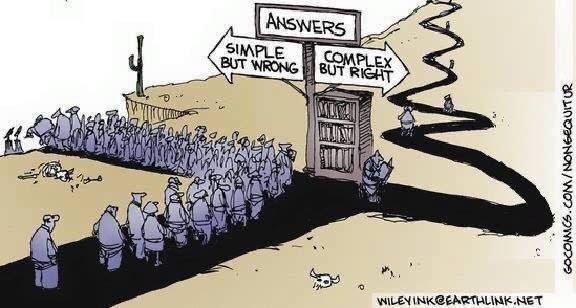
Crowds need lies, not truths; they are incapable of living with the infinite complexity, paradoxes, nuances, and gray areas of the truth.  Mobs belittle the truth to the point that it no longer resembles itself.

From the truth that stocks can rise for long periods of time came the lie that they will always do so.

From the truth that consumer spending can boost an economy became the lie that consumer spending is all an economy needs.

From the truth that consumer credit can boost consumer spending became the lie that credit can replace actual savings.

From the truth that the Fed can manipulate the economy in the short run became the truth that the Fed could control it over the long run.

From the truth that foreigners are generally willing to accept U.S. dollars in exchange for valuable goods and services came the lie that they must always do so.

And from the observation that the American economy - with its emphasis on debt, consumer spending, and stock market investing by the lumeninvestoriat - was a great success in the 1990s, came the fantasy that it represented the end of history.

Taken together, blended and simplified, these notions came to produce a sentiment that was completely at odds with the wisdom of previous generations and contrary to economic reality.

~ Bill Bonner, Financial Reckoning Day (2003), pp. 240-241

Image result for bill bonner

Mar 21, 2020

Bill Bonner on how baby boomers transformed the economy

A healthy economy needs forbearance, thrift, savings, patience, discipline - the very characteristics the boomers never had.  Soon, the economy began to reflect the boomer personality: cocksure, short-sighted, in need of immediate gratification, reckless, and self-indulgent.

~ Bill Bonner, Financial Reckoning Day (2003)

Image result for baby boomers

Mar 16, 2020

Bill Bonner on central planning

Central planning doesn't work.  A little bit is a drag.  A lot is fatal.

~ Bill Bonner

Bill Bonner on war propaganda and the power of simple narratives

Masses of people do not go to war because it will make their private lives richer, longer, or better... but for abstract principles that few can explain or justify.  Lebensraum... Preserving the Union... Driving the Infidel from the Holy Land... Making the World Safe for Democracy... the Domino Theory... the jingo hardly matters.   But it must be simple if the masses are to understand it, and bright enough to lure them to their own destruction.

~ Bill Bonner, Financial Reckoning Day, p. 170

Bill Bonner on groupthink

Group-think is popular because it is easier than private thinking and the stakes are lower.  A man's public attitudes are buttressed by others, held up by the media, and reinforced by constant repetition.  His private thoughts, on the other hand, are fragile, lonely and often desolate.  He cannot even get his own children to clean up their rooms or his wife to agree to his family budget; who can blame him for wanting to tell others what to do?

~ Bill Bonner, Financial Reckoning Day, p. 170

Image result for child's messy bedroom cartoon

Mar 10, 2020

Bill Bonner on crowd behavior and simple narratives

The world never works the way people think it does.  That is not to say that every idea about how the world works is wrong, but that often particular ideas about how it works will prove to be wrong if they are held in common.  For only simple ideas can be held by large groups of people.  Commonly held ideas are almost always dumbed down until they are practically lies... and often dangerous ones.  Once vast numbers of people have come to believe the lie, they adjust their own behavior to bring themselves in sync with it, and thereby change the world itself.  The world, then, no longer resembles the one that gave rise to the original insight.  Soon, a person's situation is so at odds with the world as it really is that a crisis develops, and he or she must seek a new metaphor for explanation and guidance.

~ Bill Bonner, Financial Reckoning Day, p. 3

Image

Feb 6, 2017

Bill Bonner: "investment markets reward virtue and punish sin"

We are, frankly, in far too much awe of the world, and too deeply entertained by it, to think that we can understand it today or foretell tomorrow.  Life's most attractive components - love and money - are far too complex for reliable soothsaying.  Still, we can't resist taking a guess.

We may not know how the world works, but we are immodest enough to think we can know how it does not work.  The stock market is not, for example, a simple mechanism like an ATM machine, where you merely tap in the right numbers to get cash out when you need it.  Instead, the investment markets - like life itself - are always complicated, often perverse, and occasionally absurd.  But that does not mean that they are completely random; though unexpected, life's surprises may not always be undeserved.  Delusions have consequences.  And, sooner or later, the reckoning day comes and the bills must be paid.

In this sense, the investment markets are not mechanistic at all, but judgmental.  As we will see, they reward virtue and punish sin.

~ Bill Bonner, Financial Reckoning Day (2006), p. 2

Image result for bill bonner financial reckoning day

Feb 5, 2017

Bill Bonner on the upward (bumpy) slope of human progress

When it comes to science and technology, man learns.  When it comes to love, war, and finance, he makes the same mistakes over and over again.

~ Bill Bonner

Image result for bill bonner

Oct 21, 2009

Bill Bonner on debt

For much of history, failing to repay debt was regarded as not merely a breach of contract, but a crime. People who failed to repay their debts in timely fashion were thought to have stolen from their lenders; they were put in prison. In the Middle Ages even a dead debtor's children could be sent to prison.

Now, bankruptcy laws allow individuals and businesses to go to rehab. Then, they can stiff creditors again. Neither sin nor crime, debt is now just a cost of doing business.

~ Bill Bonner, "Paying Off Debt Is Like Dying…," LewRockwell.com, October 21, 2009

Jul 17, 2009

Bill Bonner on inflation

Governments are seldom good at anything, but one thing they are undeniably good at is destroying their own currencies. The dollar has lost 95% or so of its value since 1913. That’s a pretty darn good job. Other countries have been even more thorough.

~ Bill Bonner, "Preparing for the New Economy," LewRockwell.com, July 16, 2009

Mar 26, 2009

Bill Bonner on modern day depressions

We repeat: there were only two examples of major depressions in the last century. Both came after a huge run-up in debt. And both were met with programs that economists should be ashamed of – bailouts, stimulus, loans, props, safety nets and hooks. In both cases – the ’30s in the United States and the ’90s in Japan – the depressions continued, on and off, for many years. WWII brought an end to the first one – 12 years after it began. The second one continues – nearly 20 years after the crash of the Tokyo stock market.

And now we have a third one…and this time the feds are determined to beat it. What’s their strategy? More firepower! What’s their secret weapon? QE, or quantitative easing, which is actual monetary inflation caused by buying debt directly from the government.

Will it work? Will Geithner/Bernanke succeed where others failed? Will economists finally master depressions…and find a way to get “creative” without the destruction?

Ah…we think we know the answer. But in the meantime, we’re enjoying the show.

~ Bill Bonner, "Get Set for a 15-Year Depression," LewRockwell.com, March 26, 2009

Feb 26, 2009

Bill Bonner on capitalism

What is capitalism, after all? It is not a system…not a plan…not a program. It was not decreed by any half-wit tyrant…nor written into law by any earnest assembly. It has no constitution…and no boundaries. It is merely a recognition of basic principles. “Thou shalt not steal,” it says in the Bible. Capitalism recognizes other peoples’ property. The baker has a right to his oven. The farmer has a right to his land. The capitalist has a right to his money. What they do with these things is up to them.

Will they make mistakes? Of course they will. Will they do evil and obnoxious things? No doubt about it. Will they occasionally lose their heads and overprice their assets…or run the whole economy into too much debt…or blow themselves up in a bubble? You bet.

As Adam Smith described, they will also bumble along to create the wealth of nations.

But larceny wasn’t invented in the 21st century either. Naturally, people want what the capitalists have. Everywhere and always, the thieves will find reasons why they should be able to take it from them. They will respect the environment better, they say. They will invest in “socially responsible” projects, they claim. They will heal the lame and make the blind see. If only they get their hands on your money!

We don’t particularly like capitalism or capitalists. We just don’t like anyone telling us what to do. So, doing unto others as we would have them do unto us, we make no effort to tell others what to do with their money. If they want to give it to Bernie Madoff or to Barack Obama, so be it – just count us out. If they want to invest in CDOs and MBDs…well, good luck to them; but don’t look to us to bail them out.

~ Bill Bonner, "A Broken Down Stock Market," LewRockwell.com, February 26, 2008

Feb 23, 2009

Bill Bonner on evolution

There are two parts to Darwinism as it is popularly understood. One part is based on observation – at which Darwin was a master. The other is extrapolation – not so much on Darwin’s part, but his followers. The problem is that the part that is probably correct is child-like and obvious. And the part that is more grown up is nothing more than empty guesswork. He notes that some animals are better suited to their environments than others. If a polar bear were suddenly born to a hog here in Nicaragua, it probably wouldn’t last long. On the other hand, if a mutation produced a naked polar bear at the North Pole, it wouldn’t stand much of a chance either. Both would probably perish, leaving no heirs or assigns…and thus removing from the gene pool whatever crazy aberration that created them. Some things survive and reproduce; some don’t. The essence of Darwinism is nothing more than that simple-minded observation, as near as we can tell.

But the application of this notion far and wide is a threat to the intellectual eco-system. Because of it, people think they know a lot more than they actually know. To the question, why is the polar bear white, rather than black, they have a ready answer: because evolution made him white. But this is no answer at all…it just postpones thinking until the next question: why did evolution make him that way?

Then, the guesses begin: because he can blend into the snowy background and sneak up on seals. Oh. They tell us, for example, that he covers his nose – which is black – with his paw, so he can get closer without being spotted.

Smart bear. But you’d think if evolution could turn his whole body black it could whitewash his nose too. And what about the seals? Are they morons? You’d think those that couldn’t tell the difference between a bear with his paw over his nose and an iceberg would have been weeded out by now. Besides, why aren’t seals white?

Of course, the biologists and know-it-alls have their answers, but they are just putting 2 and 2 together in the clumsiest way. They really don’t know why polar bears are white. All they know is that nature hasn’t exterminated the white polar bears – yet.

Many of these deep thinkers also believe that Darwin proved that God didn’t create man. Instead, man arose by the process of evolution, they say, one accidental step at a time. Man is the product of pure chance, they claim. As if God couldn’t make it look like an accident, if He wanted!

~ Bill Bonner, "A Broken Down Stock Market," LewRockwell.com, February 26, 2008