Showing posts with label people - Bernanke; Ben. Show all posts

Oct 10, 2022

Phil Grant on Ben Bernanke being awarded the 2022 Nobel Prize in economics

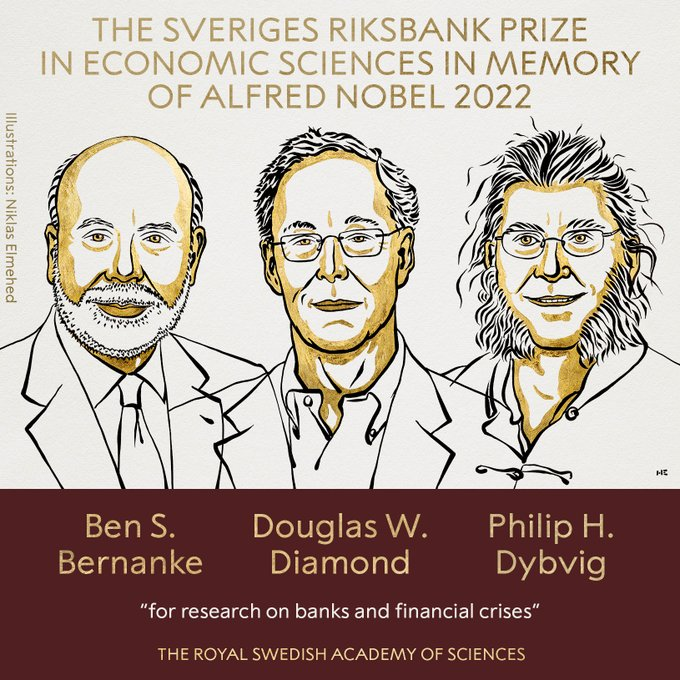
This morning, the Royal Swedish Academy of Sciences announced it will award the 2022 Nobel Prize in economics to a trio of economists including Ben Bernanke, Fed chair from 2006 to 2015 and author of the central bank’s zero rate-cum-asset purchase response to the global financial crisis.  Recall that, in response to a query from 60 Minutes in 2010, Bernanke expressed “100 percent” faith in the Fed’s ability to keep a lid on inflation, adding that: "We could raise interest rates in 15 minutes if we have to." 

More broadly, Bernanke’s longstanding advocacy for the discretionary, “Ph.D. standard” of monetary management remains a stance worth scrutinizing.  In a February 2004 speech, the then-Fed governor extolled the virtues of the “great moderation,” i.e., a decline in volatility across both inflation and economic growth metrics that prevailed since Paul Volcker tamed inflation in the early 1980’s.  Among his conclusions: 
The historical pattern of changes in the volatilities of output growth and inflation gives some credence to the idea that better monetary policy may have been a major contributor to increased economic stability. 

Few disagree that monetary policy has played a large part in stabilizing inflation, and so the fact that output volatility has declined in parallel with inflation volatility, both in the United States and abroad, suggests that monetary policy may have helped moderate the variability of output as well. 
Everything in moderation, even moderation.

~ Philip Grant, "Crowd Control," Almost Daily Grant's, October 10, 2022


Feb 21, 2022

Peter Boockvar on monetary stimulus

Bernanke, it's coming from someone who put the house on fire and then ran to the fire station and jumped into a truck then put the fire out and then wrote a book saying "I'm a hero."  So it's dangerous that we've been led by people like him down this very dark alley proving that they have no real understanding of capitalism and the regenerative power of economic growth.  And the constant need to put us on opioids to recover has been a tragic mistake.

~ Peter Boockvar, interview with Dan Ferris, Stansberry Investor Hour, 29:00 mark, February 21, 2022


Aug 18, 2020

Kevin Duffy on government "experts"

Imagine an expert who advocates a laissez faire approach to any problem.  He or she wouldn’t advance very far in “the expert model.”  For example, Alan Greenspan, a social climber above all, realized this at an early age and changed his worldview (which originally favored a gold standard).  Others, like Henry Kissinger, are plucked out of obscurity and promoted because their views are in perfect alignment with those of the political establishment.  Milton Friedman was a clever, but unusual choice for respectability.  Known for his free market views, Friedman was a monetarist who argued for greater intervention by the Federal Reserve in the 1930s to prevent the Great Depression.  He would later influence a man named Ben Bernanke, champion of “helicopter money.”

In order to rise through the ranks, economists, geopolitical consultants, regulators, and health experts must conform to the interventionist script.

~ Kevin Duffy, "The Expert Model," LewRockwell.com, May 27, 2020

Helicopter Ben: Arsonist Turned into Firefighter

Mar 31, 2020

Ben Bernanke: "Easier financial conditions will promote economic growth"

Easier financial conditions will promote economic growth.  For example, lower mortgage rates will make housing more affordable and allow more homeowners to refinance.  Lower corporate bond rates will encourage investment and higher stock prices will boost consumer wealth and help increase confidence, which can also spur spending.

~ Ben Bernanke, Washington Post op-ed, November 4, 2010

Ben Bernanke - The 2010 TIME 100 Poll - TIME

Mar 15, 2020

Jim Cramer: "They know nothing!"

Jim Cramer: Bernanke is being an academic.  It is no time to be an academic.  It is time to get on the Bear Stearns call.  Listen, open the darn Fed window.  He has no idea how bad it is out there!  He has no idea!  He has no idea! 

Erin Burnett: Cramer.

Cramer: I have talked to the heads of almost every single one of these firms over the last 72 hours and he has no idea what it's like out there.  None!  And Bill Poole?  Has no idea what it's like out there.  My people have been in this game for 25 years!  And they are losing their jobs and these firms are gonna go out of business and he's nuts!  They're nuts!!  They know nothing!!

~ Jim Cramer, CNBC discussion with Erin Burnett, 2:00 mark, August 3, 2007

Image result for jim cramer they know nothing

Oct 4, 2018

Kevin Duffy on the legacy of the 2008 financial bailouts


In his recent interview in Barron's (“Hank Paulson Says the Financial Crisis Could Have Been 'Much Worse’,” September 17, 2018), former Treasury Secretary Henry Paulson claimed, “The timing, cause, and severity of the next financial crisis are impossible to predict.  Of course someone will get it right and will be credited with doing so, but he or she won’t spot the next one.”  Having warned about the late ‘80s Japan bubble, late ’90s tech bubble and mid ‘00s credit bubble (“For Whom Do the Bells Toll?,” June 18, 2007), I’ll take that as a challenge.  The root cause is always artificially low rates set by central banks.  Since this period of low rates was longer (7 years vs. 2 ½ from 2002-04), deeper and more global, the next crisis will be more widespread and prolonged.  As for timing, it’s anyone’s guess but with rising rates, narrowing leadership (just 5 of 35 country stock markets up on the year), investor euphoria (record low cash levels at Schwab), and wild speculation (first cryptocurrencies, now cannabis stocks), the lights are flashing red.

There are plenty of areas of fragility.  Within the U.S., since the end of 2008 student loan debt is up 127%, auto loan debt 57%, corporate debt 76%, public debt 98%.  Margin debt has more than tripled.  Outside the U.S., Canada and Australia are experiencing housing bubbles while emerging market debt has gone from 110% of GDP to 194% according to the Bank for International Settlements.  Other potential landmines: Chinese corporate debt has increased by 64% of GDP, Italian government debt by 40% of GDP, and Japanese government debt by 61% of GDP.

Unlike the tech and credit bubbles, which were sector-specific, the bubble today is in “everything.”  This is the true legacy of Paulson, Geithner, Bernanke, Frank & Co.

~ Kevin Duffy, September 21, 2018

May 9, 2014

Value manager Bob Goldfarb does not see a repeat of the 1930s thanks to Bernanke

I do not believe we are going to revisit the 1930s. Bernanke is a student of the '30s and his policy responses are a reflection of his deep knowledge of the '30s.  So I do not think we are going to see a replay of the 1930s.

~ Bob Goldfarb, Lead Manager of Sequoia Fund, Ruane, Cunniff & Goldfarb Investor Day, St. Regis Hotel, New York City, May 17, 2013

Jan 25, 2014

Ben Bernanke: stock market is fairly valued

[T]he markets currently seem to be broadly within the metrics of market valuation- valuation seems to be broadly within historical ranges. The financial system is strong. The key financial istitutions are well-capitalized.

~ Federal Reserve Board Chairman Ben S. Bernanke, Brookings Institute speech, January 16, 2014

Jan 16, 2014

Bernanke says QE effect, poses no risk of financial instability

We don’t think that financial stability concerns should at this point detract from the need for monetary policy accommodation which we are continuing to provide. Of all the concerns raised about bond buying by the Fed, the risk it could prompt financial instability is the only one I find personally credible. Currently, asset prices are broadly in line with historical norms. Those who have been saying for the last five years that we’re just on the brink of hyperinflation, I think I would just point them to this morning’s CPI number and suggest that inflation is not really a significant risk of this policy. The Fed is extraordinarily sensitive to risks of financial market instability. (Referring to bond purchases by the Fed), It was at least somewhat effective, and given that we were at the limits of what conventional monetary policy could do, we felt that we needed to take additional steps. I’m not yet ready to conclude that very low interest rates are going to be a permanent condition.

~ Ben Bernanke, "Bernanke Says QE Effective While Posing No Immediate Bubble Risk", Bloomberg, January 16, 2014

Nov 10, 2013

Ben Bernanke on housing bubble talk (2005)

Well, unquestionably housing prices are going up quite a bit, but I would note that the fundamentals are very strong – a growing economy, jobs, incomes . . . much of what has happened [with home prices] was supported by the strength of the economy.

~ Ben Bernanke, CNBC, July 2005

Sep 24, 2013

Carl Icahn: "It's sad to see Bernanke go"

Our country owes Bernanke a great deal for pulling us out of the mess several of the largest investment banks go us into in ‘08.

Our country has been lucky over its history that it has had the right people to call on in a crisis. It’s sad to see Bernanke go.

~ Carl Icahn, September 24, 2013, Twitter

Image result for carl icahn bernanke

Mar 25, 2013

Bernanke says easy money policy benefits world

Because stronger growth in each economy confers beneficial spillovers to trading partners, these policies are not ‘beggar-thy-neighbor' but rather are positive-sum, ‘enrich-thy-neighbor' actions.

~ Fed Chairman Ben Bernanke, Reuters, March 25, 2013

Feb 26, 2013

Bernanke on being labeled a dove

Well maybe in some respects I am, but on the other hand my inflation record is the best of any Federal Reserve chairman in the postwar period -- at least one of the best, about 2 percent average inflation.

~ Fed Chairman Ben Bernanke Senate testimony, Bloomberg, February 26, 2013

Bernanke defends Fed balance sheet expansion, QE

We do not see the potential costs of the increased risk- taking in some financial markets as outweighing the benefits of promoting a stronger economic recovery.  Inflation is currently subdued, and inflation expectations appear well anchored.

~ Fed Chairman Ben Bernanke before the Senate, Bloomberg, February 26, 2013

May 21, 2012

Ben Bernanke on QE3

Going forward, we’ll have to continue to make judgments about whether additional steps are warranted, but as we do so, we have to keep in mind that we do have a dual mandate, that we do have to worry about both the rate of growth but also the inflation rate.

The trade-offs are getting — are getting less attractive at this point. Inflation has gotten higher. Inflation expectations are a bit higher. It’s not clear that we can get substantial improvements in payrolls without some additional inflation risk. And in my view, if we’re going to have success in creating a long-run, sustainable recovery with lots of job growth, we’ve got to keep inflation under control. So we’ve got to look at both of those — both parts of the mandate as we — as we choose policy.

~ Federal Reserve Chairman Ben Bernanke, Bloomberg press conference, April 4/28/2011

Nov 2, 2011

Bernanke on MF Global failure

It appears to be an idiosyncratic case. We are monitering the possible impacts on funding markets and elsewhere, and so far we have not seen any significant impact on financial stability.

Ben Bernanke, Federal Reserve Press Conference, 11/2/2011

Jul 15, 2011

Ben Bernanke on the consequences of a US debt default

It would be a calamitous outcome. It would create a very severe financial shock that would have effects not only on the U.S. economy, but the global economy.

~Ben S. Bernanke, chairman, Federal Reserve, Congressional testimony to the Senate Banking Committee, July 14, 2011

Bernanke on the effect of budget cuts on the US recovery

I only ask ... as Congress looks at the timing and composition of its changes to the budget, that it does take into account that in the very near term the recovery is still rather fragile, and that sharp and excessive cuts in the very short term would be potentially damaging to that recovery.

~Ben S. Bernanke, chairman, Federal Reserve, Congressional testimony to the Senate Banking Committee, July 14, 2011

Jul 14, 2011

Ben Bernanke on the possibility of QE3 in 2011

We are uncertain about the near-term developments in the economy. We’d like to see if, in fact, the economy does pick up, as we are projecting.

~Ben S. Bernanke, chairman, Federal Reserve, Congressional testimony, July 14, 2011

Ben Bernanke on possible US debt default

I think that there is not really any solution other than to find a way to solve these problems, to address the fiscal issues and to raise the debt limit at the appropriate time.

Ben S. Bernanke, chairman, Federal Reserve, July 14, 2011