Showing posts with label wealth creation. Show all posts

Feb 3, 2025

Kevin Duffy on who pays for tariffs

All taxes are taxes on production.  Ultimately the consumer pays the tariffs, but that doesn't measure the true costs.  If there were 100% tariffs on Chinese EVs (there are, they were quadrupled under the Biden administration), no Chinese EVs will be sold in the U.S.  This harms American consumers without raising a penny for the government.  

Poverty requires no explanation.  Just go live on a desert island and try to make everything yourself.  Wealth creation requires specialization (getting the highest value for your time) and trading the fruits of your labor with others.  Trade, as long as it's peaceful and voluntary, is win-win.  Both sides benefit, otherwise the exchange wouldn't take place.  The more people we can trade with and the more they produce, the wealthier we become. 

In other words, tariffs are a tax on wealth creation. 

Economists disagree on a lot of things, but the case for free trade is not one of them.

~ Kevin Duffy, Facebook post, February 2, 2025



Apr 20, 2024

Kevin Duffy on economics and investing

Our ideal economy would safeguard the property of its people, limit the meddling of its government, appreciate the efforts of its entrepreneurs and refrain from watering down its currency.  Sadly, no such state of nirvana exists.  We are all grading on a curve.

~ Kevin Duffy, "Western Media Hates China: For contrarians, what's not to love?," The Coffee Can Portfolio, April 15, 2024


Apr 3, 2024

Kevin Duffy on Phil Duffy's new book 'A Tale of Four Cities'

To economic historians, the “hockey stick of human prosperity” is that irresistible bright shiny object. Up until 1800, the human population and living standards grew at a snail’s pace, but then a strange thing happened: both took off.


[...] 

In A Tale of Four Cities, Phil Duffy asks an intriguing question: “What if the real inflection point took place 100 years or so earlier?”  Have economic archeologists been unearthing evidence in all the wrong places?  Have they drawn false conclusions?

Challenging simple narratives often leads to valuable, contrarian insights.  By shifting the timeline of the starting gun on human progress back a century, Duffy unlocks a treasure trove.  First, he asserts that the actual dawning was the Agricultural Revolution, which laid the foundation for the Industrial Revolution.  Second, he discovers Richard Cantillon, the first economist to recognize the critical role of the entrepreneur in creating wealth.  Cantillon’s Essay on the Nature of Trade in General was written in 1730, long before Adam Smith’s seminal work, The Wealth of Nations.  Third, he makes a compelling case that Smith suppressed Cantillon’s work and removed the role of the entrepreneur, paving the way for misguided theories which treated entrepreneurship as vulgar and exploitative.

This would largely explain why many people in America, far from appreciating their good fortune, are openly hostile towards ultra-rich entrepreneurs like Amazon’s Jeff Bezos.  It also explains why those same billionaires give openly to anti-capitalistic charities.  It explains why so many countries have destroyed themselves by ingesting toxic theories on wealth creation, from sub-Saharan Africa, to the former Soviet Union, to Cuba and Venezuela.  It explains why governments in the West have grown to oppressive levels, threatening to strangle their productive hosts. 

If Duffy is correct, much of the world today enjoys a level of wealth unimagined by our ancestors despite worshipping false idols like Adam Smith, paper money and democracy.  Future economic progress is not a guarantee.  In fact, the human experiment appears to be at a crossroads.  Choosing the right path may just require getting the timeline right on that bright shiny object.

~ Kevin Duffy, Forward to A Tale of Four Cities, April 8, 2023


Mar 24, 2022

Kevin Duffy on how the socialist sees inequality and wealth creation

Inequality is a blessing, not a problem.  Without it, specialization and trade (the division of labor) would not take place.  Trade, as long as it’s peaceful and voluntary, is mutually beneficial, win-win.  In other words, the more the merrier.  When the division of labor expands, good things happen, i.e. wealth increases. 

Of course, the distribution of this wealth will be uneven, depending on how adept individuals are at serving others.  But there’s nothing nefarious going on here.  In fact, entrepreneurs should be celebrated as they are the key drivers of human progress. 

Sadly, this is not how the socialist sees the world.  Instead, he sees a zero sum game, win-lose.  He assumes that those who accumulate great wealth must have stolen it from those who ended up with far less.  How, precisely, this theft takes place (when all transactions are voluntary), he can’t explain. 

Instead of forming a theory that models reality, the socialist bends reality to fit his theory. This is a fatal error, wreaking havoc on mankind, justifying government theft (win-lose) to correct an injustice that never existed.

~ Kevin Duffy, Quora answer, March 24, 2022


Sep 17, 2021

Simon Hallett on wealth creation today vs. the past

Modern capitalism differs from wealth creation in the old days.  In the olden days, if you wanted to get rich you had to knock somebody on the head and steal their stuff.  Today if you want to get rich you have to provide goods and services at prices that people want to pay.

~ Simon Hallett, interview, 19:40 mark, Stansberry Investor Hour, September 16, 2021


Jun 29, 2021

John Templeton on poverty and wealth creation

The conditions in the world today and throughout history show that many nations and their people remain impoverished because they neglect the principles of wealth accumulation - or because of the flight of capital into safer places.  There are many examples of great poverty in otherwise rich lands, poverty arising because government alone owns almost all the wealth and neglects to stimulate entrepreneurship.  I have observed that encouraging individuals to accumulate wealth brings both prosperity to nations and happiness to workers.  That, I believe, is the major lesson in economics of the past.

~ John Templeton, Looking Forward: The Next Forty Years, 1993, pp 90-91


Jun 14, 2019

Karl Marx on wealth creation

Accumulation of wealth at one pole is at the same time accumulation of misery, agony of toil, slavery, ignorance, brutality, mental degradation, at the opposite pole.

~ Karl Marx

Image result for rich vs. poor according to marx

Feb 18, 2019

Simon Mikhailovich: "Wealth is created in spurts"

[Gold] is a means to an end.  Wealth is created in spurts.  Everybody thinks that you can invest and you can generate a certain return every year in the stock market over and over and over again.  And the last 35 years have taught people potentially this kind of lesson. But in reality if you look throughout history, wealth is usually created in bursts of time.

 ~ Simon Mikhailovich, lead manager of the Tocqueville Bullion Reserve, Grant's podcast, February 3, 2019

Nov 6, 2018

Adam Smith on the ingredients needed for prosperity

Little else is requisite to carry a state to the highest degree of opulence from the lowest barbarism, but peace, easy taxes and a tolerable administration of justice.

~ Adam Smith

Dec 3, 2017

Anthony Deden on confusing money printing with wealth creation

Frankly, we now have two generations of economic agents who are entirely ignorant about the nature of money. We welcome rising prices and see them as wealth even as they are merely the result of inflation. We demand more cash to save the system, instead of allowing those who fail to go bankrupt, so that more efficient competitors can emerge. We have tolerated the Swiss National Bank sale of our gold reserves in exchange for American paper money and promises.

We demand cheaper currency to stay competitive because we do not know the true nature of competitiveness. If cheaper currency is the source of wealth, where has Bangladesh gone wrong? If cheaper money means economic prosperity, why not just print as much as we can and give it out to everyone? We have become fools. The customers know nothing and the advisers know even less. And then we have the idiot economists—the neo-classical, Keynesian variety with solutions to problems they did not even anticipate; solutions that have, in fact, long been discredited. And so we lurch from crisis to crisis—eating our meager capital in the hopes of becoming rich in money. It’s a pity.

~ Anthony Deden, "Reflections on the Role of Gold in Investment Practice," November 19, 2009

Feb 22, 2015

Guido Hülsmann on how money printing is not the source of wealth

The classical economists had rejected the notion that overall monetary spending — in current jargon: aggregate demand — is a driving force of economic growth. The true causes of the wealth of nations are non-monetary factors such as the division of labor and the accumulation of capital through savings. Money comes into play as an intermediary of exchange and as a store of value. Money prices are also fundamental for business accounting and economic calculation. But money delivers all these benefits irrespective of its quantity. A small money stock provides them just as well as a bigger one. It is therefore not possible to pull a society out of poverty, or to make it more affluent, by increasing the money stock. By contrast, such objectives can be achieved through technological progress, through increased frugality, and through a greater division of labor. They can be achieved through the liberalization of trade and the encouragement of savings.

~ Jörg Guido Hülsmann, "Why the Austrian Understanding of Money and Banks Is So Important," Mises.org, February 18, 2015

Jun 26, 2008

Thomas Donlan on democracy and the 80-20 Rule

Democratic government has this fundamental problem: In broad terms, 20 percent of the people do most of the productive work and create most of the nation's wealth, but the other 80 percent command a heavy majority of votes. It's a pleasant surprise that democracies foster much investment and productivity growth at all.

~ Thomas G. Donlan, A World of Wealth (2008), p. xxi

Jan 29, 2008

Bill Bonner on what does and does not create wealth

A word to the wise: you can’t really make people wealthy by resorting to "Zimbabwe economics."  A society grows rich by producing things...and saving money.  There is no other way.  Cheaper credit won’t do it.  More consumption won’t help.  Printing money – and dumping it from helicopters – is a losing proposition.

~ Bill Bonner, "Zimbabwe Economics," LewRockwell.com, January 29, 2008


Jan 18, 2008

Kevin Duffy on the creators and destroyers of wealth

The interplay of wealth creation (entrepreneurship) and destruction (government intervention) is constantly at work; it is the focus and mood swings of investors that change. During the late 1920s investors turned their attention to the positive – the wonders of new technology such as autos, electrification, radio, and the telephone. Meanwhile, the negative – government goosing of the money supply in the name of maintaining a stable price level – went either largely unnoticed or celebrated by mainstream economists as a powerful force to prevent any serious downturn, both for the economy and the growing crowd of stock investors. The "New Economics" of 1929 was followed over time by similar flights of fancy regarding government’s ability to manage an economy: the U.S. "New Era" (late 1960s), "Japan Inc." (1989), and a global "New Economy" (2000).

In contrast, major stock market lows are often set when the failures of the state are exposed and become engrained in the public psyche. Depression (1932), world war (1941), expected return to depression (1949), inflation (late 1970s), and deficits (late 1980s) created the best buying opportunities for investors of the past 75 years.

~ Kevin Duffy, Bearing Asset Management, "Investing as an Entrepreneurial Endeavor," July 13, 2004

Nov 18, 2007

Nathaniel Branden on compassion

We do not hear the term "compassionate" applied to business executives or entrepreneurs, certainly not when they are engaged in their normal work. Yet in terms of results in the measurable form of jobs created, lives enriched, communities built, living standards raised, and poverty healed, a handful of capitalists has done infinitely more for mankind than all the self-serving politicians, academics, social workers, and religionists who march under the banner of "compassion."

~ Nathaniel Branden

Nov 17, 2007

Lew Rockwell on wealth creation

Wealth is created by people - free people. Under what system? Not force. Not taxes and regulations. It is free-market capitalism that is the very foundation of material civilization.

~ Lew Rockwell, president, Ludwig von Mises Institute, June 28, 2007

Nov 16, 2007

Leonard Read's famous essay "I, Pencil"

There is a fact still more astounding: the absence of a master mind, of anyone dictating or forcibly directing these countless actions which bring me into being.  No trace of such a person can be found. Instead, we find the Invisible Hand at work.

Since only God can make a tree, I insist that only God could make me.  Man can no more direct these millions of know-hows to bring me into being than he can put molecules together to create a tree.

The lesson I have to teach is this: Leave all creative energies uninhibited.  Merely organize society to act in harmony with this lesson.  Let society's legal apparatus remove all obstacles the best it can.  Permit these creative know-hows freely to flow.  Have faith that free men and women will respond to the Invisible Hand.  This faith will be confirmed.

~ Leonard E. Read, founder, Foundation for Economic Education, "I, Pencil: My Family Tree as Told to Leonard E. Read," The Freeman, December 1958


Oct 26, 2007

Sheldon Richman on explaining poverty

Had [foreign aid advocate Mickey Leland] given the issue some thought, he might have discovered that the proper question is not “Why are these people poor?” but rather “Why is anyone rich?” Man was born in poverty; it needs no explanation because it is simply the absence of wealth. What needs to be explained is how anyone ever beat poverty and became prosperous. A certain logic is missing from the simple-minded argument that the rich got that way by robbing the poor.

We needn’t have expected Leland and his colleagues in Congress to discover the truth for themselves. It was readily available to the most casual investigator and has been available for many years.

In the 1830s two Englishmen understood it: standing grief stricken at the grave of a child who had died of starvation, one of them, Richard Cobden, turned to his friend, John Bright, and said, “Come with me. There are in England women and children dying with hunger – hunger made by the laws. Come with me, and we will not rest until we repeal those laws.” In the next decade Cobden and Bright united the efforts of industrialists and laborers in a crusade to repeal the causes of starvation in England: the Corn Laws, which made grain imports artificially expensive. Their success brought a period of unprecedented prosperity to England.

Cobden and Bright understood the source of prosperity. Men begin with only their labor and nature-given materials. They have to apply their labor to rearrange the materials in order to produce things of value. That requires ingenuity. And ingenuity is clearly the more important of the two. In fact, it is ingenuity that turns nature-given materials into resources. It was ingenuity that turned worthless underground black gunk into valuable oil. It was ingenuity that turned sand into silicon. Nature, strictly speaking, does not provide resources; it provides materials. A resource is a product of man’s mind; a material stamped with man’s purpose.

As important as ingenuity is to the creation of wealth, it does not exist unconditionally. To think, to discover what they need and how to produce it, men must be free. They can’t create at the point of a gun.

~ Sheldon L. Richman, "Phony Benevolence," The Free Market, October 1989

Sheldon Richman on wealth creation

Let’s dispose of an economic point; the government cannot “redistribute” wealth. The word in quotations marks implies that wealth is initially distributed. It is not. In the market there is no common pot from which someone ladles wealth. The incomes we observe result from a long series of voluntary exchanges. In each transaction, two parties decide that what they will get is more valuable than what they will give up. If each did not believe that, no transaction would occur. (The exception, of course, is income derived from government sources.)

Since there is no distribution, it cannot be judged fair or unfair. No one decided how much each person would get. Rather, everyone had opportunities to enter or not enter into transactions, depending on their values and what contribution they could make to the productive process. It makes no sense to call the “distribution” of income unfair if each step in the series of exchanges that brought that outcome was fair, that is, voluntary.

~ Sheldon L. Richman, "Egalitarianism," The Free Market, July 1990


Oct 21, 2007

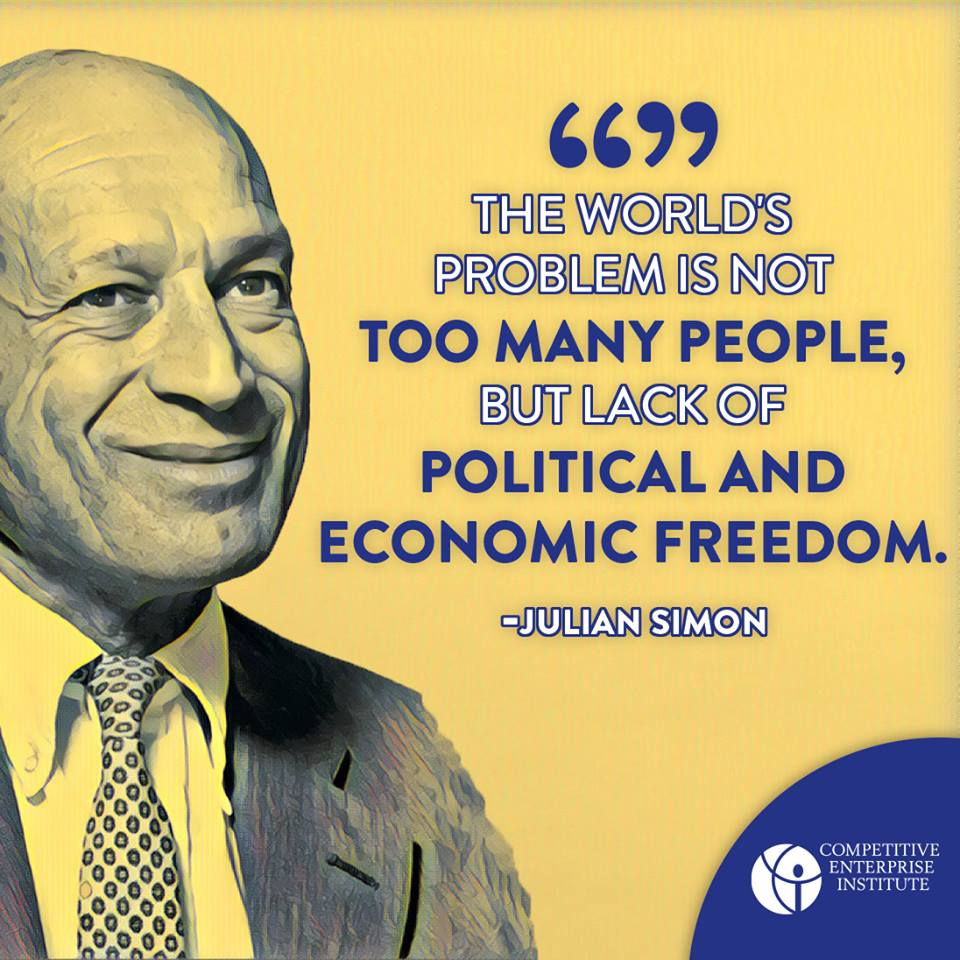
Julian Simon on wealth creation

Not understanding the process of a spontaneously-ordered economy goes hand-in-hand with not understanding the creation of resources and wealth.  And when a person does not understand the creation of resources and wealth, the only intellectual alternative is to believe that increasing wealth must be at the cost of someone else.  This belief that our good fortune must be an exploitation of others may be the taproot of false prophecy about doom that our evil ways must bring upon us.

~ Julian Simon