Showing posts with label Soviet containment. Show all posts

Jul 13, 2025

Stephen Kinzer on John Foster Dulles

If ever a man was born to international privilege, it was John Foster Dulles.  His family traced its ancestry to Charlemagne.  As a boy he thrived under the special encouragement of his grandfather and namesake, the lawyer-diplomat John Watson Foster, who had been a treaty negotiator, minister to Russia and Spain, and secretary of state under President Benjamin Harrison...

Dulles was hired as a clerk at the firm Sullivan & Cromwell, with a monthly salary of $50.  Unlike other clerks, he was able to live well, since his grandfather allowed him to draw on the $20,000 that had been set aside as the young man's inheritance.  He needed that help only for a short time.  Propelled by his sharp legal mind and network of connections, Dulles rose through the firm more quickly than anyone ever had.  By 1927, sixteen years after being hired, he was its sole managing partner and one of the highest-paid lawyers in the world...

By the time he reached his mid-thirties, Dulles was on easy terms with some of the world's richest and most powerful men... 

The list of Dulles's clients at Sullivan & Cromwell is nothing less than a guide to the biggest multinational corporations of early-twentieth century America...  Dulles arranged loans to governments across Latin America, Europe, and the Middle East; sued the Soviet Union on behalf of American insurance companies; organized a worldwide takeover campaign for the American Bank Note Company, which had printed the fateful Nicaraguan stamp showing a volcano in fictitious eruption; and negotiated concessions in Mexico and Panama for the American & Foreign Power Company.  His clients built ports in Brazil, dug mines in Peru, and drilled for oil in Columbia...

Dulles was especially interested in Germany, which he visited regularly during the 1920s and 1930s.  According to the most exhaustive book about Sullivan & Cromwell, the firm "thrived on its cartels and collusion with the new Nazi regime," and Dulles spent much of 1934 "publicly supporting Hitler," leaving his partners "shocked that he could so easily disregard law and international treaties to justify Nazi repression."  When asked during this period how he dealt with German clients who were Jewish, he replied that he simply decided "to keep away from them."  Finally, facing a revolt by his partners, he agreed in 1935 to close the firm's Berlin office, later backdating the decision to a year earlier.

Soon after World War II ended, Dulles found in Communism the evil he had been so slow to find in Nazism.  His epiphany came when he read Stalin's Problems of Leninism, which he found gripping.  Several times he compared it to Hitler's Mein Kampf as a blueprint for world domination...

Law and politics were not Dulles's only passions.  Throughout his life, he was also moved by deep Christian faith.  It was an integral part of his character, and from it grew the intensity of his anti-Communist zeal.  He cannot be understood apart from it...

Dulles believed the heritage of the United States, which he described as "in its essentials a religious heritage," placed Americans under a special obligation.  He felt what he called "a deep sense of mission," a conviction that "those who found a good way of life had a duty to help others to find the same way."  Like his father, he was a born preacher; like his grandfather, a missionary.  When the 1950s dawned, he was looking for a way to channel his "Christian insight and Christian inspiration" into the fight against "the evil methods and designs of Soviet Communism."

The best way to do that, Dulles quite reasonably concluded, was to become secretary of state.

~ Stephen Kinzer, Overthrow, pp. 112-115

John Foster Dulles dies at 71, May 24 ...

John Foster Dulles on the Soviet threat

The Soviets sought not a place in the sun, but the sun itself.  Their objective was the world.  They would not tolerate compromise on goals, only on tactics.

~ John Foster Dulles

Anti soviet propaganda, USA [1938] : r ... 

Mar 30, 2025

Kishore Mahbubani on how China learned from the collapse of the Soviet Union

I think out of necessity they [the Chinese] have to have a strategy.  And they do have one.  So for example, they ask themselves the obvious question: "Why did the United States successfully defeat the Soviet Union?  Why?"  And I must say, the one country that has studied the collapse of the Soviet Union more carefully than any country in the world is China because China knows that the dream of the United States is to make China the second Soviet Union that collapses.

So how does China prevent a collapse?  First point, the Soviet Union didn't collapse because of external pressures; it collapsed because of internal weaknesses.  And so China realizes, "To make sure I survive, I must have a very strong dynamic economy and strong dynamic society."  [...]

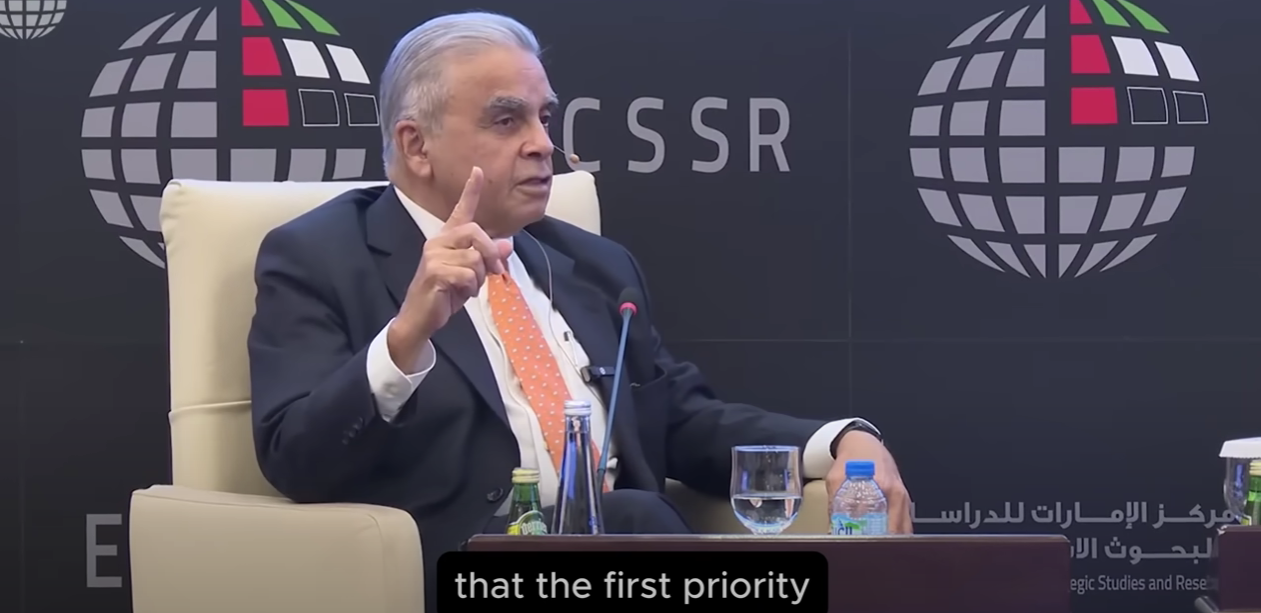
So the Chinese know that the first priority is to make sure your economy is strong and your society is strong, which is why they're massively educating their people and growing their economy, so that they don't become a second Soviet Union.  

The second thing that the Chinese learned from the collapse of the Soviet Union was that the United States succeeded because it managed to get a lot of the neighbors of the Soviet Union to join the containment policy everywhere: Western Europe, Japan, South Korea, both ends of the Soviet Union.  So what did the Chinese do?  The Chinese launched a preemptive strike against a containment policy by making sure that its neighbors depended on the Chinese economy.

I'll give you a simple example.  Singapore is part of Southeast Asia and we are part of an organization called ASEAN and ASEAN started as a pro-American organization.  In fact, when ASEAN was created on August 8th, 1967, both the Soviet Union and China denounced the creation of ASEAN as a pro-American organization.  It's true, ASEAN was pro-American, pro-Western.  And what was stunning was that even though ASEAN was pro-American, pro-Western and we had longer dialogues with the United States, European Union, Australia, Japan, everybody, none of our Western friends proposed a free trade agreement to ASEAN.  The first country to propose a free trade agreement to ASEAN was China in 2001.

And the impact of that China-ASEAN agreement was phenomenal.  Because in the year 2000..., ASEAN's trade with the United States was $135 billion and our trade with China was only $40 billion.  So U.S. trade was more than 3 1/2 times what China's trade with ASEAN was.  But as a result of the free trade agreement, by 2022, even though ASEAN's trade with the United States has gone from $135 billion to $450-500 billion, an increase of over three times, China's trade with ASEAN went from $40 billion to $975 billion dollars, almost $1 trillion dollars, the world's largest trading relationship in 2022!  So there's no way ASEAN can join a containment policy against its largest trading partner, right?  It's crazy.

~ Professor Kishore Mahbubani, "Kishore Mahbubani REVEALS China's Strategy to Counter USA," Rise of China, 6:35 mark, March 25, 2025

(The Association of Southeast Asian Nations was established in 1967 by Singapore, Thailand, Malaysia, Indonesia and the Philippines.  It has since been joined by Brunei, Vietnam, Laos, Myanmar and Cambodia.)


May 1, 2022

George Kennan on NATO expansion after the Soviet Union collapse

I think it is the beginning of a new cold war.  I think the Russians will react adversely and it will affect their policies.  I think it was a tragic mistake.  There was no reason for this whatsoever.  No one was threatening anybody else.  This expansion would have the Founding Fathers rolling in their graves.  We have signed up to defend a whole series of countries even though we have neither the resources nor the intention to do so in any serious way.

~ George Kennan, historian who advocated a policy of Soviet containment during the Cold War, May 2, 1998