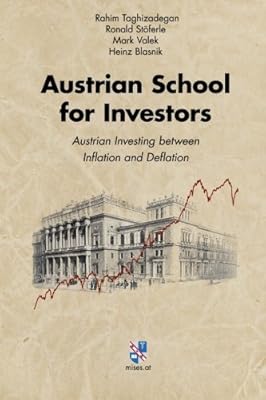
~ Rahim Taghnizadegan, Ronald Stöferle, Mark Valek and Heinz Blasnik, Austrian School for Investors (2015), p. 74
Showing posts with label books - Austrian School for Investors. Show all posts
Nov 1, 2020
Ronald Stöferle et al. on Nassim Taleb and why economists are prone to making poor forecasts
In [Nassim] Taleb's opinion, economists are susceptible to erroneous assessments, as soon as they ascribe excessive precision to statistical methods. He provides inter alia two major reasons for this. First of all, they often fall prey to the fallacious assumption that extensive amounts of historical observations permit conclusions about the future, and secondly, that future events are subject to a bell-shaped probability distribution. In other words: they do not assume that past correlations may be subject to randomness as well.
Ronald Stöferle et al. on intuition and investing
No amount of studies can make up for a lack of intution, including the study of the Austrian School. An artisan may gain a deeper understanding of his own work, gain self-confidence, and perhaps occasionally a good idea by the study of the history of art, but it can never replace talent and craftsmanship. Books as a medium stand in the great occidental tradition of theoria, but practical books about economic topics are as a rule of little value.
This is so because economy means change. Entrepreneurial success means doing something different than has been done hitherto. It is similar with investment success: it requires seeing things others do not see. This ability to see is primarily a talent, secondly down to practice, and only thirdly accessible to rational conception. Many banks prefer not to hire academics for their trading operations, as they think too much and do not have enough intuition.
~ Rahim Taghnizadegan, Ronald Stöferle, Mark Valek and Heinz Blasnik, Austrian School for Investors (2015), p. 71
Oct 31, 2020
Ronald Stöferle et al. on Austrian School adherents who predicated the collapse of the 1920s boom
The Great Depression was predicted by several economists of the Austrian School: in Austria, Ludwig von Mises recognized the problem when it was still in an early stage of its development, and told his colleagues in 1924 that the then largest Austrian bank, Creditanstalt, would ultimately become insolvent. Friedrich August von Hayek published several articles in early 1929, in which he predicted the collapse of the US economic expansion. Felix Somary uttered numerous warnings in the late 1920s. In the US, the economists Benjamin Anderson and E.C. Harwood warned that the monetary policy of the Federal Reserve would lead to a crisis. However, as was Somary, they were widely ignored.
~ Rahim Taghnizadegan, Ronald Stöferle, Mark Valek and Heinz Blasnik, Austrian School for Investors (2015), p. 62
Jul 17, 2019
Jim Grant on the value of Austrian theory when peering into the future
What we do is look for extremes in markets: very undervalued or very overvalued. Austrian theory has certainly given us an edge. When you have a theory to work from, you avoid the problem that comes with stumbling around in the dark over chairs and night stands. At least you can begin to visualize in the dark, which is where we all work. The future is always unlit. But with a body of theory, you can anticipate where the structures might lie. It allows you to step out of the way every once in a while.
~ Jim Grant, "The Trouble with Prosperity: An Interview with James Grant," Austrian Economics Newsletter, Winter 1996
(Cited by Austrian School for Investors, p. 75.)
~ Jim Grant, "The Trouble with Prosperity: An Interview with James Grant," Austrian Economics Newsletter, Winter 1996
(Cited by Austrian School for Investors, p. 75.)
Subscribe to:
Comments (Atom)