Showing posts with label quotes - classic words to the wise. Show all posts

Mar 8, 2025

Will Durant on the future of China (1935)

This nation, after three thousand years of grandeur and decay, of repeated deaths and resurrections, exhibits today all the physical and mental vitality that we find in its most creative periods; there is no people so adaptable to circumstance, so resistant to disease, so resilient after disaster and suffering, so trained by history to calm endurance and patient recovery.  Imagination cannot describe the possibilities of a civilization mingling the physical, labor and mental resources of such a people with the technological equipment of modern industry.  Very probably such wealth will be produced in China as even America has never known, and once again, as so often in the past, China will lead the world in luxury and the art of life.

No victory of arms, or tyranny of alien finance, can long suppress a nation so rich in resources and vitality.  The invader will lose funds or patience before the loins of China will lose virility; within a century China will have absorbed and civilized her conquerors, and will have learned all the technique of what transiently bears the name of modern industry; roads and communications will give her unity, economy and thrift will give her funds, and a strong government will give her order and peace.  Every chaos is a transition.  In the end disorder cures and balances itself with dictatorship; old obstacles are roughly cleared away, and fresh growth is free.  Revolution, like death and style, is the removal of rubbish, the surgery of the superfluous; it comes only when there are many things ready to die.  China has died many times before; and many times she has been reborn.

~ Will Durant, The Story of Civilization: Our Oriental Heritage, "Revolution and Renewal," pp. 822-823 (1935)


Nov 18, 2024

Marc Faber on China's rise as a manufacturing superpower (2002)

I'll start with emerging markets, where valuations are attractive and expectations are very low.  Since 1990 the markets in the developed countries of Western Europe and the U.S. are up, say, five times.  In emerging economies most markets are down 80% in dollar terms, and earnings are bottoming out.  Money has been flowing out of emerging-market funds for 2-3 years. 

One concern is that Chinese competition will continue to erode the market share of other Asian exporters to Western Europe and the U.S.  In the long run, very few emerging economies will be able to compete with China.  I wouldn't rule out, in 5-10 years' time, the possibility that China becomes the workshop of the world, the way Lancashire [England] did in 1830s.  But China will also become the customer of other emerging economies.  China has a population of 1.2 billion people.  Today less than 1% of the population is outbound, but 5%-10% could be traveling over the next 10-15 years.  That would mean a meaningful influx of tourists into the surrounding countries of Asia, and Australia, New Zealand, the United States and Western Europe.  Food and plantation companies will benefit from Chinese demand.  Companies that cater to domestic consumer demand -- cigarette companies, pharmaceutical companies, software companies -- will also be helped.

~ Marc Faber, "Past and Presents Four pros speak their minds on history, science and compelling stocks," interview by Laura Rublin, Barron's, January 21, 2002

(Emphasis mine.)


Jul 22, 2024

Tony Deden on the tech bubble (1999)

Let there be no doubt, that what we are witnessing is, indeed, history's greatest financial bubble.  The indescribable financial excesses, the massive increase in debt, the monstrous use of leverage upon leverage, the collapse in private savings, the incredulous current account deficits, and the ballooning central bank assets all describe the very severe financial imbalances which no amount of statistical revision nor hype from CNBC can erase. 

As it happened in 1929 - a boom and bust with which this bubble is often compared to but which pales into insignificance when compared with it - as it happened in 1972, in 1989 in Japan, or in 1998 in East Asia, booms are followed by busts - they are called recessions, depressions, etc. - because booms sow the seeds of every succeeding bust. 

Their cause is not the fault of capitalism as it has been suggested, but an excessive amount of money and credit created by central banks.  Yet, this seems to escape the understanding of those who will, in one day, convene congressional hearings to determine what caused this destruction.  The culprit is, as it always has been, the same organization, which professes interest in bringing about price stability and low inflation: The Federal Reserve Bank and its policies of money market intervention, credit creation and loose money.

~ Tony Deden, "Reflections on Prosperity," Safe Haven, December 29, 1999


Dec 4, 2023

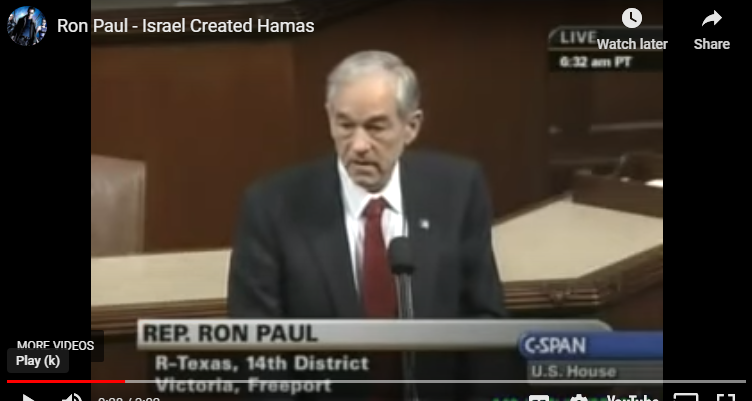
Ron Paul on Hamas and blowback (2009)

[Paul’s 2009 comments came as he rose in opposition to House Resolution 34, “Recognizing Israel’s right to defend itself against attacks from Gaza, reaffirming the United States’ strong support for Israel, and supporting the Israeli-Palestinian peace process.”]

I rise in opposition to this resolution, not because I am taking sides and picking who the bad guys are and who the good guys are, but I'm looking at this more from the angle of being a United States citizen, an American.  And I think resolutions like this really do us great harm.

In many ways, what’s happening in the Middle East, in particular with Gaza right now, we have some moral responsibility for both sides in a way because we provide help and funding for both Arab nations and Israel.  We have a moral responsibility, especially now today the weapons being used to kill so many Palestinians are American weapons and American funds are being used for this.

But there’s a political liability, which I think is something we fail to look at because too often there’s so much blowback from our intervention in areas that we shouldn’t be involved in.

You know Hamas, if you look at the history, you’ll find out that Hamas was encouraged and really started by Israel because they wanted Hamas to counteract Yasser Arafat.

You say, "Well, yeah, it was better then and served its purpose, but we didn’t want Hamas to do this." So then we, as Americans, say, "Well, we have such a good system; we’re going to impose this on the world.  We’re going to invade Iraq and teach people how to be democrats.  We want free elections."  So we encouraged the Palestinians to have a free election. They do, and they elect Hamas.

So we first, indirectly and directly through Israel, helped establish Hamas.  Then we have an election where Hamas becomes dominant, then we have to kill them.  It just doesn’t make sense.  During the 80s, we were allied with Osama bin Laden and we were contending with the Soviets.  It was at that time our CIA thought it was good if we radicalize the Muslim world.  So we finance the Madrassas school to radicalize the Muslims in order to compete with the Soviets.  There is too much blowback.

There are a lot of reasons why we should oppose this resolution.  It’s not in the interest of the United States, it is not in the interest of Israel either.

~ Rep. Ron Paul (R-TX), speech on House floor, 2009


Oct 11, 2023

Murray Rothbard on the Israel-Palestine conflict (1982)

Libertarians are opposed to every State.  But the State of Israel is uniquely pernicious, because its entire existence rests and continues to rest on a massive expropriation of property and expulsion from the land.  Libertarians in the United States often complain about the radical libertarian adherence to “land reform,” i.e. the giving back of stolen land to the victims.  In the case of expropriations centuries ago, who gets what is often fuzzy, and conservative libertarians can raise an important point.  But in the case of Palestine, the victims and their children—the true owners of the land—are right there, beyond the borders, in refugee camps, in hovels, dreaming about a return to their own.  There is nothing fuzzy here.  Justice will only be served, and true peace in the devastated area will only come, when a miracle happens and Israel allows the Palestinians to stream back in and repossess their rightful property.  Until then, so long as the Palestinians continue to live and no matter how far back they are pushed, they will always be there, and they will continue to press for their dream of justice.  No matter how many square miles and how many cities Israel conquers (shall it be Damascus next?), the Palestinians will be there, in addition to all the other Arab refugees newly created by the Israeli policy of blood and iron.  But allowing justice, allowing the return of the expropriated, would mean that Israel would have to give up its exclusivist Zionist ideal.  For recognizing Palestinians as human beings with full human rights is the negation of Zionism; it is the recognition that the land was never “empty.” 

A just Israeli state (insofar as any state can be just), then, would necessarily be a de-Zionized state, and this no Israeli political party in the foreseeable future would have the slightest desire to do. And so the slaughter and the horror will go on.

~ Murray Rothbard, "The Massacre," The Libertarian Forum, October 1982


Nov 20, 2022

Warren Buffett and Charlie Munger on cryptocurrencies (2018)

Warren Buffett: There's nothing being produced in the way of value from the asset.  You also have the problem that it draws in a lot of charlatans... who are trying to create various sorts of exchanges...  It's something where people who are of less-than-stellar character see an opportunity to clip people who are trying to get rich because their neighbor's getting rich buying this stuff that neither one understands.  It will come to a bad ending.  Charlie.

Charlie Munger: Well, I like cryptocurrencies a lot less than you do.  And so to me it's just dimentia.  And I think the people who are professional traders who go into cryptocurrencies, it's just disgusting.  It's like somebody else is trading turds and you decide "I can't be left out."


Oct 10, 2022

Tom Woods on sanctions on Iraq and inevitable reprisals "in the form of terrorist attacks" (2001)

In general, a policy of sanctions hurts only the civilian population, leaving the government more or less untouched.

If anything, sanctions may even tend to strengthen popular support for the government inasmuch as the leader can now portray himself and his nation as the besieged victims of a vindictive U.S.

Especially disconcerting about the Clinton-Albright policy [of sanctions on Iraq] was its blithe disregard of any long-term consequences for the U.S. essentially starving a helpless country to death.

Set aside the morality of the question for a moment, as Clinton and Albright did, and think only of U.S. interests.  The Gulf War has been over for 10 years, and American students still can't distinguish Baghdad from Wagga Wagga on a map.  But do you suppose the Iraqi people have forgotten, or ever will?

If the U.S. continues on its present course, it is next to impossible to imagine that we can forever avoid the terrible reprisals, in the form of terrorist attacks - nuclear, chemical or otherwise - that our policy makes almost inevitable.

~ Thomas E. Woods, Jr., "Lift U.S. Sanctions: They Choke The Tyrannized More Than The Tyrants," Investor's Business Daily, March 19, 2001


Jul 5, 2021

Andy Grove on the genomic revolution (2001)

This particular once-a-half-century change [the Internet] is due to the combination of the microprocessor and connectedness.  And the most interesting aspect is that the change hasn't nearly run its course yet.  We are likely to see layered on top of it a change of comparable significance in the area of genetics, molecular biology, and the like, which would absolutely be inconceivable without very powerful and highly connected and available computers.  The impact of that change on drug development, health care, and human life is difficult to imagine.  But is it part of the computing/connectedness change? Or should we think of it as a new change unto itself?  The reason I ask is that, if this change happens as extensively as some people think it might, the consequences could be far more important than the enabler.  Compared with directly altering life and death, computers and the Internet don't seem like such a big deal.  But without the computers and connectedness, the genetics/molecular biology stuff would never get off the ground.

~ Andy Grove, "Andy Grove's Rational Exuberance," Wired, June 1, 2001


Dec 10, 2020

Grant's Interest Rate Observer on the fragility of the CDO market (2007)

We are the first to admit our shortcomings in knowledge about structured mortage finance. But, then, we have found - colleague Dan Gertner, our man on the case, can attest to it - that ignorance about CDOs and ABS is far-reaching. In fact, it reaches far into the population of CDO investors. A subscriber who has made a study of the subprime market - he is a long-short equity investor by trade - e-mails to share his observation that "somewhere in the neighborhood of 70% of CDO buyers rely almost entirely on the ratings because they don't have the time or expertise to evaluate the underlying collateral and structure." It follows, our reader points out, that "once the rating agency integrity is gone, so is the CDO market, it would seem."

~ Grant's Interest Rate Observer, "Wheezing CDO machine," March 9, 2007


Mar 28, 2020

Bethany McLean on the shale boom and bust (2018)

These days, the rhetoric of “energy independence,” meaning an America that no longer depends on anyone else for its oil, not even Saudi Arabia or OPEC, is in perfect harmony with “Make America Great Again.” But rhetoric doesn’t produce profits, and most things that are economically unsustainable, from money-losing dot-coms to subprime mortgages, eventually come to a bitter end.

~ Bethany McLean, "The Next Financial Crisis Lurks Underground: Fueled by debt and years of easy credit, America’s energy boom is on shaky footing," The New York Times, September 1, 2018

Sep 24, 2019

Jim Grant: "Will central bankers continue to control events or will events start to control the central bankers?" (2019)

The question before the house is whether the central bankers can continue to control events or whether events will turn the tables and start to control the central bankers.  Our money's on events.

We reason that mighty interventions have unintended consequences.  Suppress the rate of interest, and you misdirect capital.  Cut short the corrective processes of a business-cycle downturn, and you store up trouble for the next recession.  Intervene over and over to save a bull market, and you must continue to intervene - you're in too far, you can't stop now, the downside is frightening.

Ultra-low interest rates, low volatility and stretched valuations soothe the spirit as they fatten the net worth.  Rising markers seed a belief that the world has arrived on a kind of permanently high plateau, not necessarily of price but of predictability.

~ Jim Grant, "The surprise factor," Grant's Interest Rate Observer, September 20, 2019

Image result for grant's interest rate observer

Jul 6, 2019

Michael Metz: negative sentiment is bullish (1990)

The market has held up remarkably well in the face of a barrage of bad news.  We've had the collapse of the savings and loans, the Campeau bankruptcy, the fall of Drexel Burnham Lambert Inc., the big write-downs of the New England banks, fear of poor earnings and the disaster in the Japanese market.  And yet the American market doesn't go down.  I think the market is telling us everyone has already assumed the worst and (that) the majority who want to sell stocks have done it.  It's an overconfident market that is vulnerable.  This is not an overconfident market.

I expect the Dow to make a new high soon.  And later this year I look for the Federal Reserve to easy monetary policy and a stampede of buying to set in , driving the Dow well over 3000 on expanding volume.

~ Michael Metz, "With Sentiment So Bearish, Stocks May Rise," Investor's Daily, April 9, 1990

(At the time, Investor's Intelligence survey showed 45% of investment advisors bearish and 43% bullish.  Equity mutual fund cash levels were at 11.5%.)

Jul 4, 2019

George Gilder on the new boom based on the Internet economy (2008)

From the pits of the crash of 2000, when the Internet and the dot.com siege were famously dismissed as a barren "bubble," came Google and MySpace to rise up and take all the chips and establish a new Internet economy.  If creativity was not expected, governments could plan it and socialism would work.  But creativity is intrinsically surprising and the source of all real profit and growth.

Because the U.S. remains the world's largest economy and still leads the world in business and technological creativity, the current crisis is mostly confined to boondoggles in finance.  It will pass rapidly and evolve into a new boom.  Emerging is a parallel unregulated financial system based on entrepreneurial creativity and invention.

At the heart of this multitrillion-dollar engine of growth are 741 venture capital firms that traffic in creativity as a business.  These firms command $257 billion under management and have launched companies generating $2 trillion in revenues.

~ George Gilder, "The Coming Creativity Boom," Forbes, November 10, 2008

Nov 27, 2018

Time magazine on the coming war in Europe (1939)

A generation ago western civilization had apparently outgrown the major evils of barbarism except for war between nations. The Russian Communist Revolution promoted the evil of class war. Hitler topped it by another, race war. Fascism and Communism both resurrected religious war. These multiple forms of barbarism gave shape in 1938 to an issue over which men may again, perhaps soon, shed blood: the issue of civilized liberty v. barbaric authoritarianism.

~ Time editors, "Adolph Hitler. Man of the Year, 1938," Time, January 2, 1939

Jun 13, 2017

Ken Fisher: tech bubble still in the middle of bursting (2001)

People keep asking if the technology drubbing is over - or will be soon.  As long as folks keep asking, you don't have to.  It isn't over until they stop asking.  The end is silent.  Make no mistake, this is the middle of the bursting of a classic sector bubble.

~ Ken Fisher, "Tech 2001," Forbes, January 22, 2001

Jan 31, 2017

Grant's: "sovereign debt is the biggest bubble since the Bronze Age" (2016)

If practice makes perfect, Grant's is unrivaled in calling the top in bond prices.  We have done so repeatedly over the course of many years, even if not lately; since 2014, our line has rather been "one last gasp" for the bulls.  We now say that the last gasp has been gulped.  With all the fluency that comes with study and repetition, we say that sovereign debt is the biggest bubble since the Bronze Age, or maybe since ancient Sumer.  The notion that negative-yielding bonds, denominated in a fiat currency, are a "safe" asset is a misconception that belongs in the next edition of Extraordinary Popular Delusions and the Madness of Crowds.  We are bearish on bonds, especially the ones that, like new cars on a dealer's lot, positively guarantee the owner a loss as soon as he takes possession of his property.

~ Jim Grant, Grant's Interesting Rate Observer, "Remember the Shell Oil 2 1/2s of 1971," July 15, 2016

Aug 5, 2015

Alexis de Tocqueville on the destiny of two great powers: America and Russia (1840)

Today, two great nations of the earth seem to be advancing toward the same destination from different starting points: the Russians and the Anglo-Americans.

Both have grown unobserved and, while men's attention has been preoccupied elsewhere, they have climbed up into the leading rank of nations and the world has learned of both their birth and their greatness at almost the same moment.

All other nations appear to have reached almost the upper limits of their natural development and have nothing left to do except preserve what they have, whereas these two nations are growing: all the others have either halted or are advancing by a great exertion of effort, whereas these two progress rapidly and comfortably on a seemingly unending course as far as we can see.

Americans struggle against obstacles placed there by nature; Russians are in conflict with men.  The former fight the wilderness and barbarity; the latter, civilization with all its weaponry: thus, American victories are achieved with the plowshare, Russia's with the soldier's sword.

To achieve their aim, the former rely upon self-interest and allow free scope to the unguided strength and common sense of individuals.

The latter focus the whole power of society upon a single man.

The former deploy freedom as their main mode of action; the latter, slavish obedience.

The point of departure is different, their paths are diverse, but each of them seems destined by some secret providential design to hold in their hands the fate of half the world at some date in the future.

~ Alexis de Tocqueville, Democracy in America, 1840

Jul 25, 2011

Kurt Richebacher on the expected soft landing (2000)

Adhering to the famous postulate of Austrian theory that the length and severity of recessions or depressions depend critically on the magnitude of the dislocations and imbalances that have accumulated in the economy during the preceding boom, we take it for granted that a hard, even a very hard, landing is absolutely inevitable for the U.S. economy.

~ Kurt Richebacher, The Richebacher Letter, July, 2000

(Source: Barron's, July 24, 2000, p. 33)

Dec 19, 2010

Mark Thornton on the tech bubble (2000)

Dear Investors Business Daily:

In "Are Boom- Bust Cycles Gone Forever?" (08-23-00, p. A10) a strong case is made that the business cycle is dying, if not dead. Once again the "new economy" mantra of technology, globalization and government management of the economy has raised its ugly head.

The same mantra was common in the U.S. during the 1960s when Keynesian "counter- cyclical fiscal policy" was in charge of the business cycle while American high tech companies expanded around the globe. Then came the stagflation of the 1970s. The Japanese boom of the 1980s was said to be due to its "managed economy" that allowed Japanese industry to dominate world markets. The Japanese bust of the 1990s followed. And who can forget the "Roaring 20s" when America's new technology (radios, cars, planes, refrigerators, motion pictures, etc.) had the world in awe. Economist Irving Fisher declared a "permanent prosperity" right before the stock market crash of 1929 and the Great Depression.

Technology cannot kill the business cycle. In fact, technology is the mechanism that traps capital in unsustainable and premature investment projects. Entrepreneurs are lured by artificially low or stable interest rates during the "boom" phase of the business cycle only to see their plans go bust as interest rates and inflation increase.

Clearly FED chief Alan Greenspan understands that monetary instability is the key to the cycle and he has recently stated his knowledge of the Austrian business cycle theory to Congress. But knowing the problem and solving it are two different things. Knowledge of economic theory does not allow bureaucrats to solve the problems of government inefficiency, taxation, business regulation and price controls.

The business cycle will not die until money and credit are purely market-based institutions, rather than government bureaucracies that supply, control, and regulate. While such a radical change of institutions is an unlikely event in the near future, requiems for the death of the business cycle might serve as a good forecast for what is.

~ Mark Thornton, letter-to-the-editor sent to IBD, never published, August, 2010

Image result for mark thornton 2010

Jul 22, 2010

Marc Faber cites the wisdom of Confucius

If a man gives no thought about what is distant, he will find sorrow near at hand.

~ Confucius

(cited by Marc Faber, editor, Gloom Boom & Doom Report, July 22nd, 2010)