~ Scott Minerd, Guggenheim Partners, "Markets are in ‘eye of the storm’ and mounting turmoil will drive stocks lower and 10-year bonds to negative 0.50%," MarketWatch.com, October 22, 2020
Showing posts with label negative interest rates. Show all posts
Oct 23, 2020
Scott Minerd predicts negative yields for U.S. Treasury bonds (2020)
We could ultimately see a ‘yield’ of negative 50 basis points on the 10-year note, and corporate yields in the neighborhood of 1 percent for investment grade corporate debt.
Sep 4, 2019
Alan Greenspan sees negative interest rates spreading to the U.S. (2019)
You’re seeing it pretty much throughout the world. It’s only a matter of time before it’s more in the United States.
~ Alan Greenspan, "Alan Greenspan says it’s ‘only a matter of time’ before negative rates spread to the US," CNBC interview, September 4, 2019
Jul 28, 2019
Jim Grant on negative interest rates and the ghost of Irving Fisher
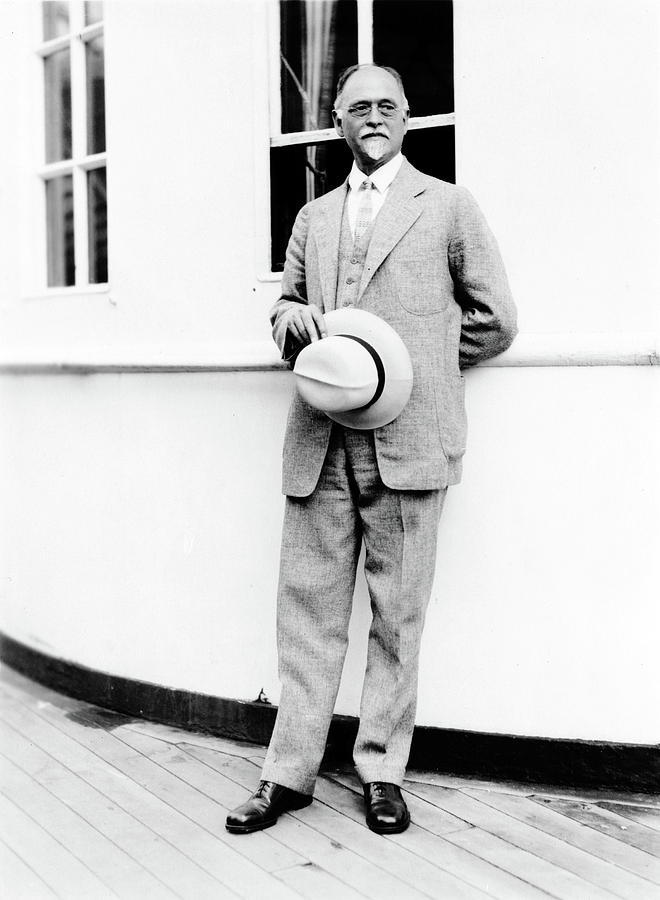
It's tempting to try to imagine how [Irving] Fisher would react to the negative interest rates of 2019. He certainly had nothing against innovation. One can imagine him falling in with the new thinking, or even, perhaps, leading it. He was an inveterate tinkerer and an ardent reflationist.
If his analysis was correct, Fisher wrote in 1933, "it is always economically possible to stop of prevent such a depression simply by reflating the price level up to the average level at which outstanding debts were contracted by existing debtors and assumed by existing creditors, and then maintaining that [price] level unchanged."
The mind - at least our mind - boggles at the otherworldliness of this casual prescription. "Simply by reflating?" The dubious record of so-called quantitative easing suggests there would be nothing simple about it. As to the unintended consequences of this prospective intervention, Fisher is silent.
~ Jim Grant, "The best economist on the lowest rates," Grant's Interest Rate Observer, July 26, 2019
If his analysis was correct, Fisher wrote in 1933, "it is always economically possible to stop of prevent such a depression simply by reflating the price level up to the average level at which outstanding debts were contracted by existing debtors and assumed by existing creditors, and then maintaining that [price] level unchanged."
The mind - at least our mind - boggles at the otherworldliness of this casual prescription. "Simply by reflating?" The dubious record of so-called quantitative easing suggests there would be nothing simple about it. As to the unintended consequences of this prospective intervention, Fisher is silent.
~ Jim Grant, "The best economist on the lowest rates," Grant's Interest Rate Observer, July 26, 2019
Jim Grant on the Hell that negative interest rates hath wrought
Dogmatism is foolish in this time of unprecedented wonders, but there's no law against opinions. Here is our first opinion. Because negative interest rates do not conform to human nature, as [Irving] Fisher demonstrated and common sense concurs, the market did not spontaneously produce them. The central banks finagled them.
We have more opinions:
- The evil fruit of artificially low interest rates (even slightly positive ones) is an eventual financial crisis.
- Crisis will lead to still more central bank activism and, finally, to a loss of confidence in money itself.
~ Jim Grant, "The best economist on the lowest rates," Grant's Interest Rate Observer, July 26, 2019
BlackRock strategist on negative yielding bonds
There's no chapter in your bond math book on this.
~ Scott Thiel, chief fixed-income strategist, BlackRock, as quoted in "The Bonds That Eat Your Money," Bloomberg Businessweek, July 29, 2019
Labels:
BlackRock,
bond bubble,
Hedgeye,
negative interest rates
Jul 27, 2019
Barron's on the bizarro world of negative yielding bonds
There’s a hot new investment trend sweeping global markets: losing money on purpose. Some $13 trillion in bonds worldwide had negative yields as of the end of June, up from $8 trillion at the end of last year.
That works out to $1,700 worth for each person on Earth, which you’d think would be enough to satisfy demand for turning savings into less savings. Nope. The European Central Bank just signaled that it wants to begin pushing yields lower. It recently passed Japan as the No. 1 player in subzero yields.
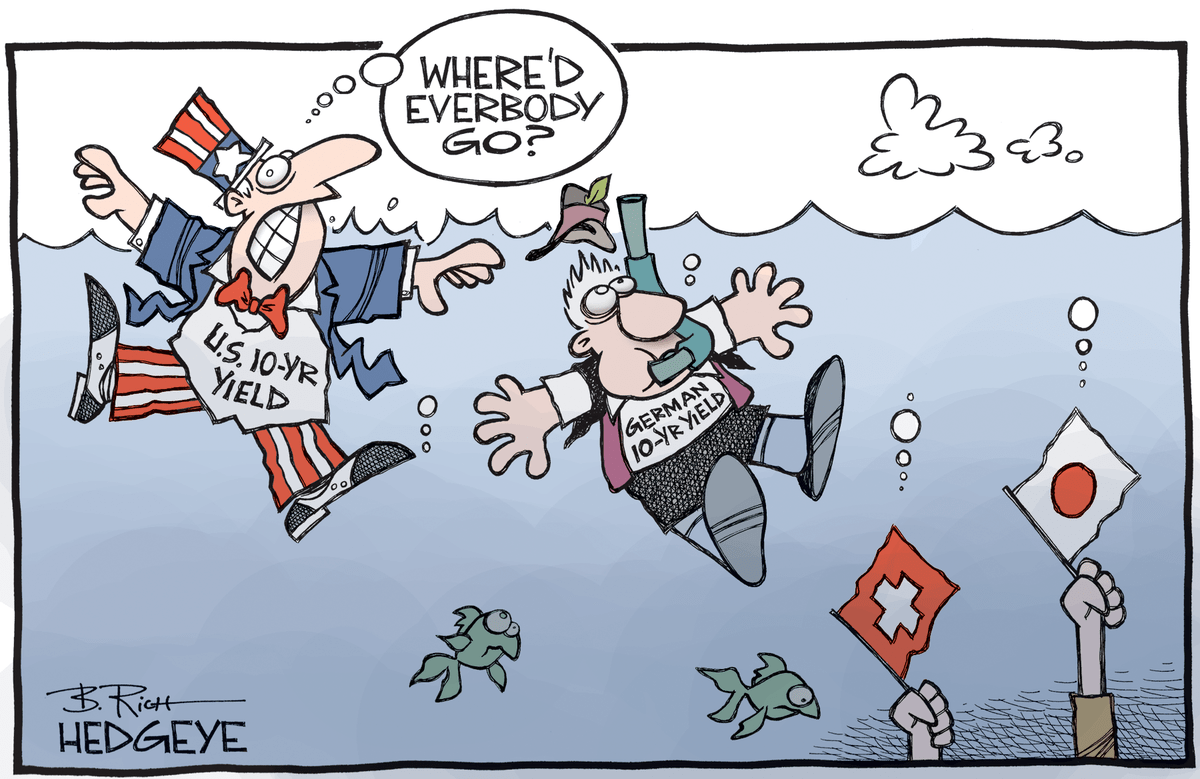
Things are getting weird for bonds in Europe. Even some junk-rated debt there pays less than nothing. Greece, which missed the deadline for a loan payment to the International Monetary Fund in 2015, a first for a developed country, now comes in below the U.S. on 10-year yields. Switzerland’s 50-year bonds just went negative. That makes it the second country, after Denmark, to have minus signs across all maturities.
If tight trousers have taught us anything, it’s that developments in Europe can eventually squeeze America. Euro-denominated bonds from companies like McDonald's, Apple, and AT&T are priced for negative yields...
~ Jack Hough, "Why Some Investors Are Buying Bonds That Lose Money," Barron's, July 27, 2019
That works out to $1,700 worth for each person on Earth, which you’d think would be enough to satisfy demand for turning savings into less savings. Nope. The European Central Bank just signaled that it wants to begin pushing yields lower. It recently passed Japan as the No. 1 player in subzero yields.
Things are getting weird for bonds in Europe. Even some junk-rated debt there pays less than nothing. Greece, which missed the deadline for a loan payment to the International Monetary Fund in 2015, a first for a developed country, now comes in below the U.S. on 10-year yields. Switzerland’s 50-year bonds just went negative. That makes it the second country, after Denmark, to have minus signs across all maturities.
If tight trousers have taught us anything, it’s that developments in Europe can eventually squeeze America. Euro-denominated bonds from companies like McDonald's, Apple, and AT&T are priced for negative yields...
~ Jack Hough, "Why Some Investors Are Buying Bonds That Lose Money," Barron's, July 27, 2019
Apr 5, 2017
Jim Grant on the sovereign debt bubble
We live in a time of actual novelty. Negatively yield sovereign debt is one such novelty and it is a doozy.
~ James Grant, Grant's podcast, January 27, 2017
Jan 31, 2017
Jim Grant reports on the bond bubble: "$13 trillion of bonds are priced with negative yields"
Arbor Quantitative Analytics reports that the 30-year Treasury bond delivered a 10% return in the 10 days ended last week, among the best such sprints on record (it was in the 99.5th percentile). Tuesday's Financial Times reported a drop in 10-year gilt yields to 0.71%, far below any yield recorded even when the pound was convertible into gold at a fixed price. "Across the world," the paper said, "government bond yields continue to collapse as economists forecast low global growth and greater stimulus from central banks in spite of years of monetary easing. Dutch benchmark 10-year rates are now negative, joining those of Japan, Germany and Switzerland." According to Bank of America Merrill Lynch, $13 trillion of bonds are priced with negative yields, up from just about none two years ago.
~ Jim Grant, Grant's Interesting Rate Observer, "Remember the Shell Oil 2 1/2s of 1971," July 15, 2016
Grant's: "sovereign debt is the biggest bubble since the Bronze Age" (2016)
If practice makes perfect, Grant's is unrivaled in calling the top in bond prices. We have done so repeatedly over the course of many years, even if not lately; since 2014, our line has rather been "one last gasp" for the bulls. We now say that the last gasp has been gulped. With all the fluency that comes with study and repetition, we say that sovereign debt is the biggest bubble since the Bronze Age, or maybe since ancient Sumer. The notion that negative-yielding bonds, denominated in a fiat currency, are a "safe" asset is a misconception that belongs in the next edition of Extraordinary Popular Delusions and the Madness of Crowds. We are bearish on bonds, especially the ones that, like new cars on a dealer's lot, positively guarantee the owner a loss as soon as he takes possession of his property.
~ Jim Grant, Grant's Interesting Rate Observer, "Remember the Shell Oil 2 1/2s of 1971," July 15, 2016
Aug 2, 2016
Jim Grant on negative interest rates
We are living in a unique time. Negative rates aren’t a naturally occurring phenomenon in finance but a creation of our ingenious central bankers. Furthermore, they seem to defy common sense. Interest rates exist because we want things now rather than later. That’s the nature of human desire. Negative interest rates turn that on its head. So they are a sign not of constructive policy making, but of trouble.
~ Jim Grant, "Jim Grant Is Bullish on Gold, Bearish on Kraft," Barron's, August 1, 2016
Feb 25, 2015
John Rubino on negative interest rates
Interest rates are the price of money, and as such they tell investors,
entrepreneurs and consumers what to do. Low interest rates generally say
“buy, build, consume, take risks” while high rates say “save, sell,
conserve, wait.” But zero or negative rates? Are they just an extreme
version of low rates or is there a qualitative difference? Everyone has a
theory about this but in the absence of historical precedent, we’ll
have to wait and see.
~ John Rubino, "Lowest Interest Rates EVER," DollarCollapse.com, February 24, 2015
Labels:
interest rates,
negative interest rates,
NIRP
Subscribe to:
Posts (Atom)