Showing posts with label Civil War. Show all posts

May 20, 2024

Lew Rockwell on how the good vs. evil paradigm has been applied to the Civil War

After the end of World War II, the good versus evil nations paradigm was applied to the War Between the States as well.  Before 1939, the dominant interpretation of the war stressed national reconciliation.  Historians such as Avery Craven saw the war as an unnecessary conflict brought about by errors and intransigence on both sides.  The foremost American historian of the time, Charles A, Beard, saw the war primarily in economic terms, as a conflict between the industrialized North and the agricultural South.  In the new view, by contrast. as expressed in a pioneering article, “The Causes of the Civil War” by the ardent New Dealer Arthur M. Schlesinger, Jr. in Partisan Review (1949), the war was seen as a Manichean struggle in which the heroic Abraham Lincoln battled the evil slave power. 

The neocons have continued the demonization of the South today, e.g., by campaigning to destroy all Confederate monuments and by rooting out any sympathy for the Confederate cause in history textbooks.  General Robert E. Lee, once a national icon, is now reviled, and Abraham Lincoln, who bears primary responsibility for a horrendous war and for the growth of the Leviathan state, is treated as a virtual demigod. 

As the great Tom DiLorenzo, the president of the Ludwig von Mises Institute has pointed out, Lincoln’s motive for war on the South was not the eradication of slavery—he urged the adoption of the Corwin Amendment, which would have guaranteed non-interference with slavery in place where it then existed—but the continued collection of tariffs, the principal source of the federal government’s tax revenues, Secession, he thought, must be forcibly suppressed to secure this vital source of revenue.  As DiLorenzo says, “Lincoln then threw down the gauntlet in his first inaugural: ‘The power confided in me,’ he said, ‘will be used to hold, occupy, and possess the property, and places belonging to the government, and to collect the duties and imposts; but beyond what may be necessary for these objects, there will be no invasion–no using force against, or among the people anywhere.’ 

‘We are going to make tax slaves out of you,’ Lincoln was effectively saying, ‘and if you resist, there will be an invasion.’  That was on March 4.  Five weeks later, on April 12, Fort Sumter, a tariff collection point in Charleston Harbor, was bombarded by the Confederates.  No one was hurt or killed, and Lincoln later revealed that he manipulated the Confederates into firing the first shot, which helped generate war fever in the North.”  See this. 

Mark Thornton and Robert B. Ekelund, Jr., in their excellent book Tariffs, Blockades, and Inflation have also made a strong case that tariffs were the primary cause of the war.

~ Lew Rockwell, "The Myth of Good and Bad Nations," LewRockwell.com, May 20, 2024


Sep 12, 2021

Tom DiLorenzo on precedents set by the Civil War

Americans are still fascinated by the war because many of us recognize it as the defining event in American history.  Lincoln’s war established myriad precedents that have shaped the course of American government and society ever since: the centralization of governmental power, central banking, income taxation, protectionism, military conscription, the suspension of constitutional liberties, the "rewriting" of the Constitution by federal judges, "total war," the quest for a worldwide empire, and the notion that government is one big "problem solver."

Perhaps the most hideous precedent established by Lincoln’s war, however, was the intentional targeting of defenseless civilians.  Human beings did not always engage in such barbaric acts as we have all watched in horror in recent days [9/11].  Targeting civilians has been a common practice ever since World War II, but its roots lie in Lincoln’s war.

~ Tom DiLorenzo, "Targeting Civilians," LewRockwell.com, September 17, 2001


Oct 19, 2020

Peggy Noonan on the Civil War

The civil war was, in short, a great moral struggle in which a nation went to war with itself to answer, for us, forever, a question: Does one human being have the right to own another? The answer, got after four years of carnage and grief, was: no. Another epochal moment in human history. And if we handn't remained one strong and unified nation, the triumphs that followed would not have been possible.

~ Peggy Noonan, "What Americans Need to Know," The Wall Street Journal, November 21, 1990


Jul 15, 2020

Samuel Mitcham on when "all about slavery" became the official narrative of the Civil War

From the 1870s to the late 1950s, there was an unofficial truce between the North and South.  Each side recognized and saluted the courage of the other; it was conceded that the North fought to preserve the Union and because Old Glory had been fired on, and the Southerner fought for liberty and to defend his home; the two great heroes of the war were Abraham Lincoln and Robert E. Lee; and the South admitted that slavery was wrong but never conceded that it was cruel.

Around 1960, the Democratic Party—led by Lyndon B. Johnson—advanced the modern incarnation of identity politics.  It worked very well for them.  In the election of 1956, 75% of African-Americans voted Republican.  By 1964, more than 90% of them voted Democrat, and they have been doing so until 2020.  As part of their effort to control and manipulate the black vote, the Leftists and their myrmidons advanced the myth that the Civil War was all about slavery.  It wasn’t.  It was, in my opinion, about money, more than anything else.

~ Samuel W. Mitcham, Jr., "Why the Civil War Wasn't About Slavery," LewRockwell.com, July 15, 2020

LBJ and MLK – Pieces of History

Feb 7, 2020

Kevin Peraino on Lincoln's foreign policy

Q: I know this is almost an impossible task, but if you had to describe it, what’s the Lincoln Doctrine?

A: Lincoln said it himself: “One war at a time.” And I think that’s the bumper sticker for Lincoln. He just didn’t want to do anything during the Civil War that was going to make his job at home more difficult.

That’s how he led the country, and set the stage for American power in the decades since.

~ Kevin Peraino, historian, "How Abraham Lincoln's foreign policy helped win the Civil War," Vox, February 18, 2019

Abraham Lincoln, the 16th president of the United States and arguably one of its best presidents on foreign policy.

Jan 25, 2020

Abby Cohen on the early history of Procter & Gamble

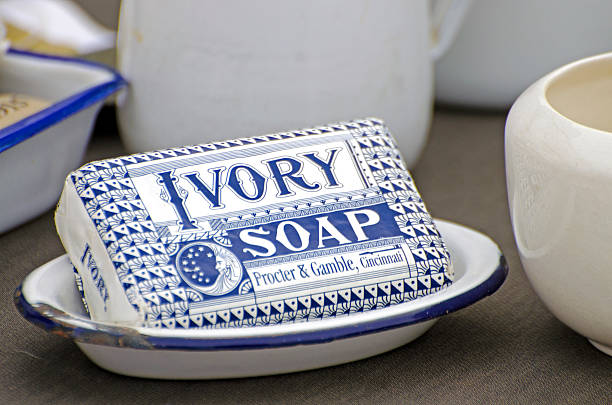
Procter & Gamble was founded 180 years ago. The company really grew during the Civil War, when they supplied the Union Army with soap and candles. What are some of their innovations? Ivory Soap, 1879, the soap that floats. My favorite product, Tide, which was introduced in 1946. Crest in 1955, the first toothpaste with fluoride.

~ Abby Cohen, Barron's Roundtable, January 6, 2020

Image result for procter & gamble original ivory soap 1879

Tom DiLorenzo on why the soldiers on both sides fought the Civil War

[A]ll of this editorializing about the war being waged over the “sacredness” of “the flag” is consistent with what Lincoln cultist James McPherson wrote in his book, What They Fought For: 1861-1865. After reading hundreds of letters home and diaries of “Civil War” soldiers on both sides of the conflict, McPherson concluded that the average Yankee soldier believe he was fighting for “the flag,” whereas the average Confederate grunt believed that he was fighting against a tyrannical government that had invaded his country, bombed his town, and threatened to harm his family.

~ Tom DiLorenzo, "The American Religion of Violence," LewRockwell.com, July 7, 2014

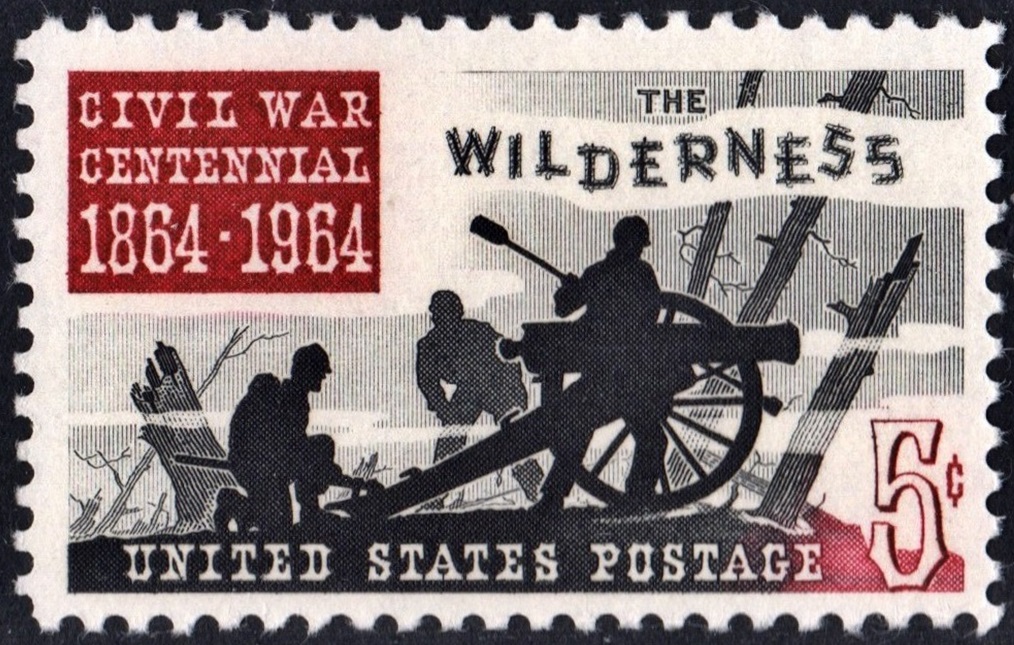
Civil War Centennial - The Wilderness
1864-1964

Tom DiLorenzo on the Lincoln myth

No respectable historian believes the Deep North/government school fantasy that enlightened and morally-superior Northerners elected Abe Lincoln so that they could go to war and die by the hundreds of thousands solely for the benefit of black strangers in the "deep South."

~ Tom DiLorenzo, "A Disease of the Public Mind," Abbeville Blog, March 29, 2017

Abraham Lincoln
Centennial of Birth - 1909

Jan 10, 2020

Q&A with Tom DiLorenzo about the Civil War

Q: Were Confederate soldiers fighting to defend slavery even though the vast majority were not slaveholders?

DiLorenzo: There was no need to go to war to "defend slavery." Lincoln guaranteed it in his first inaugural address by endorsing the Corwin Amendment.

Q: South Carolina gave 17 reasons after the 1860 election for seceding, including the protection of slavery. How big a factor was slavery?

A: Why states seceded and why there was a war are two totally different questions. There is no question that Lincoln invaded the South over tax collection, as he promised/threatened in his first inaugural address, his "slavery forever" speech. Tariffs were constitutional, so to justify secession on a constitutional basis some of the southern states cited non-enforcement of the fugitive slave clause of the constitution. In the words of Lincoln and the U.S.Congress (read the Crittenden Compromise), slavery had nothing whatsoever to do with why they invaded the southern states.

Q: How much did the prevalence of economic fallacies, especially the uncertainty of what freed blacks would have on the economy, contribute to the war on both sides?

A: Economic fallacy is the ideological bedrock of mercantilism, and mercantilism is what the Republican Party always stood for.

Q: You’ve written about how Lincoln trotted out practically every economic fallacy in the book. Did he actually believe in these fallacies or was he simply a selfish politician pushing a corrupt policy and using any means at his disposal?

A: Lincoln had a long career as a trial lawyer and as you know, most trial lawyers are in the business of throwing rhetorical mud against the wall to see if it sticks to promote their clients' interests, so I suspect he just adopted any economic fallacy that he could find to justify protectionism, corporate welfare, and a national bank run by politicians. He had spent a quarter of a century doing just that before becoming president.

Q: Did Lincoln’s attitude toward Southerners mellow at all during the war and after?  It seems he greatly underestimated the cost and time it would take.  Did he have any regrets?  Had he not been assassinated, would he have handled Reconstruction any differently than the Andrew Johnson administration?

A: Lincoln celebrated Sherman and Sheridan's war crimes up to the very end, he promoted them, and the Republican Party made national heroes out of them.  His speech writers like Seward made him sound magnanimous, but look at what he did-- orchestrating total war on Southern CIVILIANS to the very end. The party of Lincoln did what their namesake would have done during Reconstruction -- continue to plunder the South for the benefit of party hacks and the Northern plutocracy while doing next to nothing for the ex slaves.

Duffy: Thank you!

~ Tom DiLorenzo, author of The Real Lincoln and Lincoln Unmasked, answers to questions from Kevin Duffy, January 9, 2020

Image result for tom dilorenzo

Kevin Duffy on how libertarians should view the Civil War

To a libertarian, the Civil War is a classic case of both sides being wrong.  At the same time I am critical of the Northern invasion of the South, I can be critical of the institution of slavery. Libertarians naturally oppose conscription, which both sides resorted to in 1862.  Some counties in East Tennessee actually tried to secede from the Confederacy, but were checked by martial law, an action that libertarians would also oppose.  Some of the border states tried to remain neutral in the conflict.  According to Wikipedia, “Maryland's legislature voted overwhelmingly (53–13) to stay in the Union, but also rejected hostilities with its southern neighbors, voting to close Maryland's rail lines to prevent them from being used for war.  Lincoln responded by establishing martial law and unilaterally suspending habeas corpus in Maryland, along with sending in militia units from the North.”  Lincoln’s actions were not only anti-libertarian, they were unconstitutional.

~ Kevin Duffy

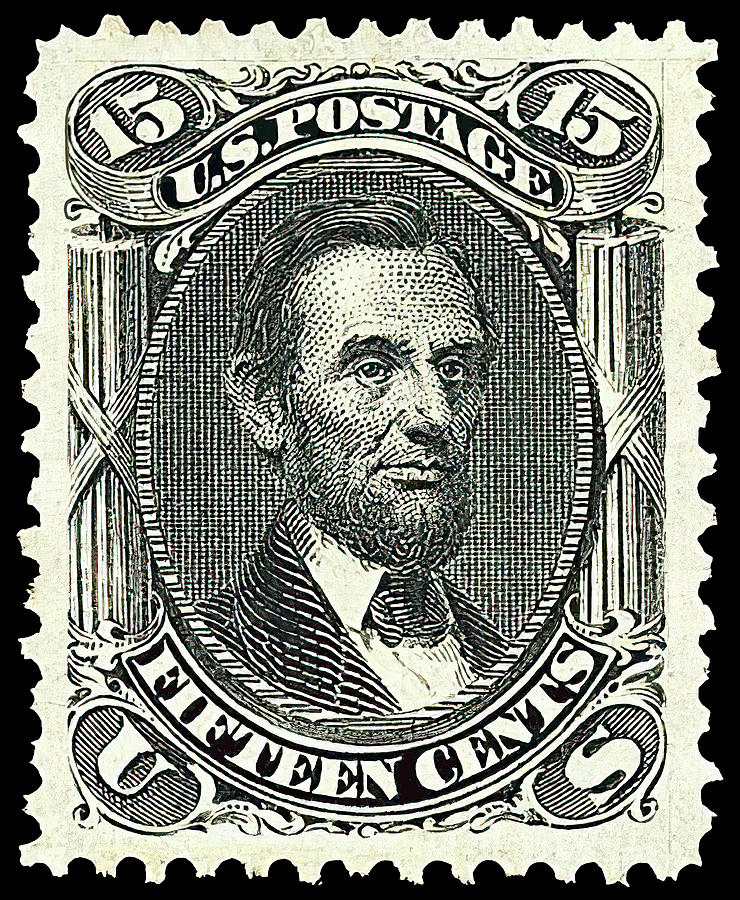
Image result for civil war stamps
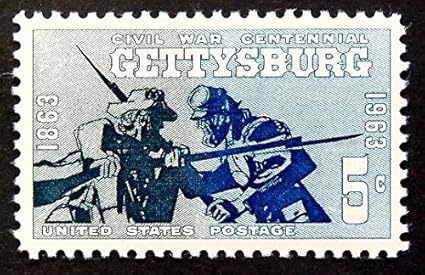
Civil War Centennial - Gettysburg
1863-1963

Jan 5, 2020

Abraham Lincoln on the reason for war against Southern secession

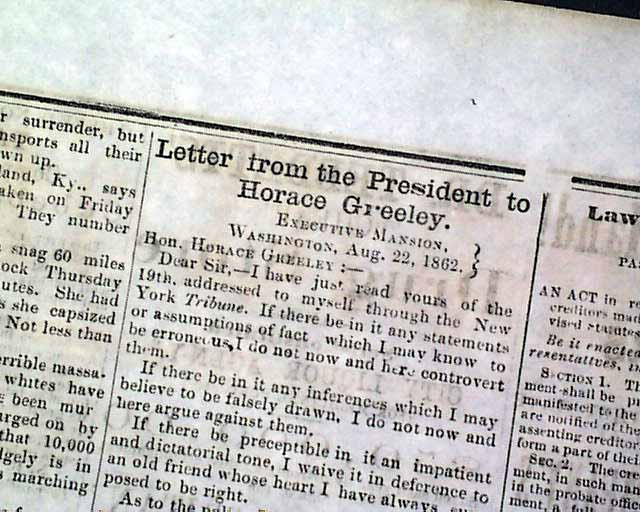
My paramount object in this struggle is to save the Union, and is not either to save or to destroy slavery.  If I could save the Union without freeing any slave I would do it;  and if I could save it by freeing some and leaving others alone I would also do that.  What I do about slavery, and the colored race, I do because I believe it helps save the Union...

~ Abraham Lincoln, public letter to New York Tribune editor Horace Greeley, August 22, 1862

Image result for lincoln letter to horace greeley

Jan 4, 2020

Robert Morgan on Lincoln's views on slavery and race adjustment

Many Americans think of Abraham Lincoln, above all, as the president who freed the slaves. Immortalized as the "Great Emancipator," he is widely regarded as a champion of black freedom who supported social equality of the races, and who fought the American Civil War (1861-1865) to free the slaves.

While it is true that Lincoln regarded slavery as an evil and harmful institution, it is also true, as this paper will show, that he shared the conviction of most Americans of his time, and of many prominent statesmen before and after him, that blacks could not be assimilated into white society. He rejected the notion of social equality of the races, and held to the view that blacks should be resettled abroad. As President, he supported projects to remove blacks from the United States.

~ Robert Morgan, "Abraham Lincoln's Program of Black Resettlement," The Journal of Historical Review, Sept.-Oct. 1993 (Vol. 13, No. 5), pages 4-25

Related image
Abraham Lincoln
1867

Jan 3, 2020

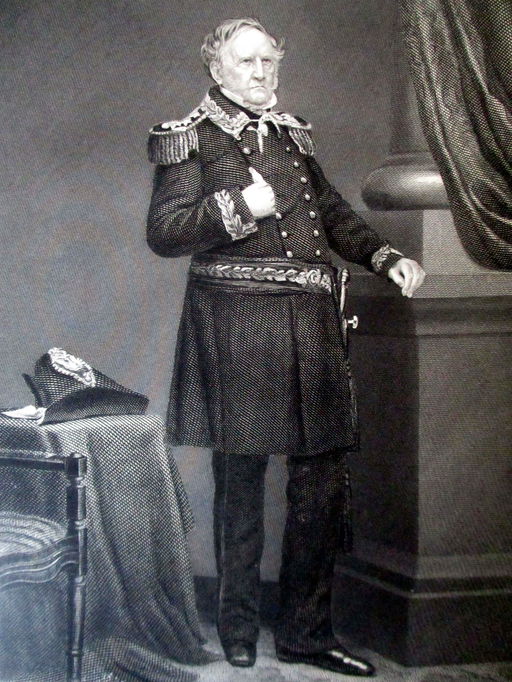
Winfield Scott on choices available to Lincoln to deal with Southern secession

Hoping that, in a day or two, the new President will have, happily, passed through all personal dangers, & find himself installed an honored successor of the great Washington — with you as chief of his cabinet — I beg leave to repeat, in writing, what I have before said to you, orally, this supplement to my printed “views,” (dated October last) on the highly disordered condition of our (so late) happy & glorious union. To meet the extraordinary exigencies of the times, it seems to me that I am guilty of no arrogance in limiting the President’s field of selection to one of the four plans of procedure, subjoined:

I. Throw off the old, & assume a new designation — the Union party; — adopt the conciliatory measures proposed by Mr. Crittenden, or the Peace convention, & my life upon it, we shall have no new case of secession, but, on the contrary, an early return of many, if not all the states which have already broken off from the Union, without some equally benign measure, the remaining slave holding states will, probably, join the Montgomery confederacy in less than sixty days, when this city — being included in a foreign country — would require permanent Garrison of at least 35,000 troops to protect the Government within it.

II. Collect the duties on foreign goods outside the ports of which this Government has lost the command, or close such ports by acts of congress, & blockade them.

III. Conquer the seceded States by invading Armies. No doubt this might be done in two or three years by a young able General — a Wolfe, a Desaix or a Hoche, with 300,000 disciplined men — estimating a third for Garrisons, & the loss of a yet greater number by skirmishes, sieges, battles & southern fevers. The destruction of life and property, on the other side, would be frightful — however perfect the moral discipline of the invaders. The conquest completed at that enormous waste of human life, to the north and north west — with at least $250[,]000,000, added thereto, and cui bono? — Fifteen devastated provinces — not to be brought into harmony with their conquerors; but to be held, for generations, by heavy garrisons — at an expense quadruple the net duties or taxes which it would be possible to extract from them — followed by a Protector or an emperor.

IV. Say to the seceded — States — wayward sisters, depart in peace!

~ Winfield Scott, letter to William H. Seward, March 3, 1861

Image result for winfield scott

Jefferson Davis on trying to avoid the Civil War

I tried all in my power to avert this war.  I saw it coming, for twelve years I worked night and day to prevent it, but I could not.  The North was mad and blind; it would not let us govern ourselves, and so the war came, and now it must go on unless you acknowledge our right to self government.  We are not fighting for slavery.  We are fighting for Independence.

~ Jefferson Davis, President of the Confederate States, 1862-1865

Image result for confederate states stamps

William Tecumseh Sherman on secessionists

To those who would submit to the rightful law and authority, all gentleness and forbearance; but to the petulant and persistent secessionists, why, death is mercy, and the quicker he or she is disposed of the better. Satan and the rebellious saints of Heaven were allowed a continuous existence in hell merely to swell their just punishment. To such as would rebel against a Government so mild and just as ours was in peace, a punishment equal would not be unjust.

~ General William Tecumseh Sherman

Related image
William Tecumseh Sherman
1890-1893

William T. Sherman on the Civil War

War is the remedy that our enemies have chosen, and I say let us give them all they want.

~ General William T. Sherman

Image result for william tecumseh sherman stamp
William T. Sherman
1995

Jan 2, 2020

Michael Fellman on the post-Civil War "final solution to the Indian problem"

Related image
Sherman, Grant and Sheridan
1937
[T]he great triumvirate of the Union Civil War effort [Grant, Sherman and Sheridan] formulated and enacted military Indian policy until reaching, by the 1880s, what Sherman sometimes referred to as "the final solution of the Indian problem," which he defined as killing hostile Indians and segregating their pauperized survivors in remote places . . . . These men applied their shared ruthlessness, born of their Civil War experiences, against a people all three despised, in the name of Civilization and Progress.

~ Michael Fellman, Citizen Sherman (1995)

(As quoted by Tom DiLorenzo, "How Lincoln's Army 'Liberated' the Indians," LewRockwell.com, February 12, 2003


Andrew Napolitano on Abraham Lincoln

In order to increase his federalist vision of centralized power, 'Honest’ Abe misled the nation into an unnecessary war... With very little regard for honesty, Lincoln increased federal power and assaulted the Constitution. His actions were unconstitutional, and he knew it... Lincoln’s view was a far departure from the approach of Thomas Jefferson, who recognized states’ rights above those of the Union... Lincoln increased the power of the federal government at the expense of the rights of the states and civil liberties. This opened the door to more unconstitutional acts by the government in the 1900s through to today...

~ Judge Andrew Napolitano, The Constitution in Exile, Chapter 4: "Dishonest Abe: The Lincoln You Didn't Know"

Image result for scott #555 stamp
Abraham Lincoln
1922-1925

Jul 17, 2019

Walter Williams on blacks fighting for the Confederacy

The flap over the Confederate flag is not quite so simple as the nation’s race “experts” make it. They want us to believe the flag is a symbol of racism. Yes, racists have used the Confederate flag as their symbol, but racists have also marched behind the U.S. flag and have used the Bible. Would anyone suggest banning the U.S. flag from state buildings and references to the Bible?

Black civil rights activists, their white liberal supporters and historically ignorant Americans who attack the Confederate flag have committed a deep, despicable dishonor to our patriotic Southern black ancestors who marched, fought and died not to protect slavery but to protect their homeland from Northern aggression.

~ Walter Williams, "Blacks and the Confederacy," LewRockwell.com, January 20, 2016

Image result for walter williams

May 29, 2017

Ulysses S. Grant on the Civil War and slavery

If I thought this war was to abolish slavery, I would resign my commission and offer my sword to the other side.

~ Ulysses S. Grant, Union general

(The veracity of this quote is in question.)

Outstanding Genuine Scott #303 F-Vf Mint OG NH 1902-03 Brown 4¢ Ulysses Grant
Ulysses S. Grant
1902-1903