~ Saifedean Ammous, The Bitcoin Standard, p. 68
Showing posts with label money supply. Show all posts
Mar 20, 2024
Saifedean Ammous on the appreciation of the Iraqi dinar in 2003
Should a currency credibly demonstrate its supply cannot be expanded, it would immediately gain value significantly. In 2003, when the United States invaded Iraq, aerial bombardment destroyed the Iraqi central bank and with it the capability of the Iraqi government to print new Iraqi dinars. This led to the dinar drastically appreciating overnight as Iraqis became more confident in the currency given that no central bank could print it anymore. A similar story happened to Somali shillings after their central bank was destroyed. Money is more desirable when demonstrably scarce than when liable to being debased.
Labels:
books - The Bitcoin Standard,
Iraq,
Iraq War,
Iraqi dinar,
money supply
May 12, 2023
Ryan McMaken on recent contraction in the money supply
The fact that the money supply is shrinking at all is so remarkable because the money supply almost never gets smaller. The money supply has now fallen by $2.2 trillion (or 10.2 percent) since the peak in April 2022. Proportionally, the drop in money supply since 2022 is the largest fall we've seen since the Depression. (Rothbard estimates that in the lead up to the Great Depression, the money supply fell by 12 percent from its peak of $73 billion in mid-1929 to $64 billion at the end of 1932.)
~ Ryan McMaken, "The Money Supply Has Plummeted in the Biggest Drop Since the Great Depression," Mises Wire, May 11, 2023
Aug 5, 2020
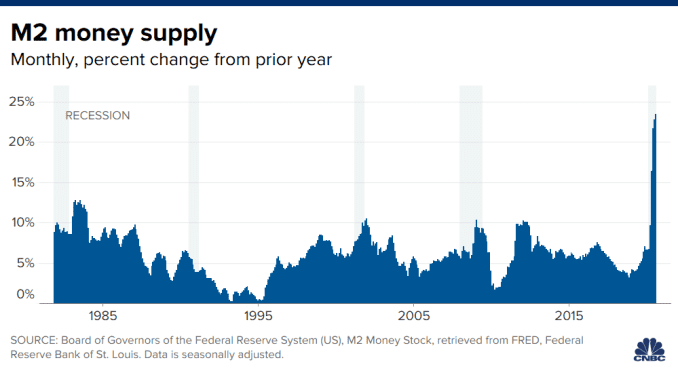
Mike Wilson on money supply growth on the risk of inflation
It’s fair to say we have never observed money supply growth as high as it is today. The Fed may not be in control of Money Supply growth which means they won’t have control of inflation either, if it gets going.
~ Mike Wilson, Morgan Stanley chief U.S. equity strategist, "The ballooning money supply may be the key to unlocking inflation in the U.S.," CNBC.com, August 5, 2020
Jan 1, 2020
James Garfield on money supply and the business cycle
Whoever controls the volume of money in our country is absolute master of all industry and commerce...when you realize that the entire system is very easily controlled, one way or another, by a few powerful men at the top, you will not have to be told how periods of inflation and depression originate.
~ James Garfield
~ James Garfield
| James Garfield 1902-1903 |
Jul 24, 2019
Ed Bugos: investors are "playing poker" and "calling the Fed's hand"
What that means my dear friends is that the bulls are playing poker. They have driven the stock averages to new heights and in doing so are calling the Fed's hand. If the Fed fails to cut rates and earnings don't come in particularly well, the market is likely to take a very big hit.
~ Edmond Bugos, July 24, 2019
Mar 17, 2017
Kevin Duffy on how Milton Friedman was guilty of data mining when studying the Great Depression
Milton Friedman studied the Great Depression and noticed that money supply
dropped by one-third from 1929-1933. He came
to the conclusion that this was the
cause of the depression and that the Fed hadn't acted strongly enough. He also influenced a guy by the name of Ben
Bernanke who, at Friedman’s 90th birthday party, vowed not to make
the same “mistake.”
Did the Fed really sit by idly as
Friedman claimed? Actually, no. The Fed acted aggressively, buying government
securities and expanding its balance sheet from 1929-1933. It also lowered the discount rate from 5% to
1 ½%. Friedman appears to be guilty of data
mining. Correlation doesn’t prove
causation. In fact, gold flows and loss
of confidence in banks were contributing factors to the contraction in money
supply. If anything, the monetary
inflation of the Fed probably made matters worse.
~ Kevin Duffy, "Mr. Market Flunks the Marshmallow Test," Grant's Spring Conference, March 15, 2017
Aug 17, 2013
Time magazine on the Fed doing "practically nothing" to stop the contraction of the money supply in the early 1930s
[Milton] Friedman blames unknowing monetary policy in large measure for the
magnitude of the Depression of the 1930s. Partly because so many banks
failed between 1929 and 1933, the U.S. supply of money shrank by 33%—and
that compounded a worldwide economic collapse. The Federal Reserve,
which took a narrow view of its responsibilities, felt itself almost
powerless to reverse the tide of events. Not really understanding what
should be done, it did practically nothing to offset the contraction of
the money supply.
~ Time, December 19, 1969
May 14, 2010
Philip Fisher on the inevitable bullishness of war for stocks
What do investors overlook that causes them to dump stocks both on the fear of war and on the arrival of war itself, even though by the end of the war stocks have always gone much higher than lower? They forget that stock prices are quotations expressed in money. Modern war always causes governments to spend far more than they can possibly collect from their taxpayers while the war is being waged. This causes a vast increase in the amount of money, so that each individual unit of money, such as a dollar, becomes worth less than it was before. It takes lots more dollars to buy the same number of shares of stock. This, of course, is the classic form of inflation.
~Philip Fisher, stock legend, "Five More Don'ts for Investors", Common Stocks and Uncommon Profits, 1958
Labels:
inflation,
money supply,
people - Fisher; Philip,
war
Feb 18, 2009
Bruce Bartlett on the root cause of the Great Depression: sharp contraction of the money supply
As economists Milton Friedman and Anna Schwartz proved to the satisfaction of most economists, the core economic problem in the early 1930s was a contraction of the money supply by a third. This caused the general price level to fall by about 25%.
Deflation caused real wages to rise, forcing employers to lay off workers to reduce labor costs; it forced businesses to go bankrupt because they had to sell goods for less than they cost to produce; it magnified the burden of debts as borrowers had to repay loans in dollars worth more than those they were lent; and it increased real interest rates and the real burden of taxation.
~ Bruce Bartlett, "The Real Lesson of the New Deal," Forbes.com, February 13, 2009
Deflation caused real wages to rise, forcing employers to lay off workers to reduce labor costs; it forced businesses to go bankrupt because they had to sell goods for less than they cost to produce; it magnified the burden of debts as borrowers had to repay loans in dollars worth more than those they were lent; and it increased real interest rates and the real burden of taxation.
~ Bruce Bartlett, "The Real Lesson of the New Deal," Forbes.com, February 13, 2009
Feb 27, 2008
Mayer Rothschild on the power of central banking
Give me control of a nation's money supply, and I care not who makes its laws.
~ Mayer Rothschild, private banker
Jan 31, 2008
Frank Shostak on Fed balance sheet expansion from 1931-1932
[T]he pace of the Fed's pumping in terms of the yearly rate of growth of its balance sheet (Fed Credit) jumped from 10.9% in August 1931 to 154% in July 1932. Yet bank lending had continued to decline — falling on average during this period by 22% (we suggest that this occurred on account of declining pool of real funding). As a result, the monetary measure AMS fell during this period on average by 11.3%.
~ Frank Shostak, "Why Is Bernanke Trying to Fight the Bear?," Mises.org, January 30, 2008
Subscribe to:
Posts (Atom)