Showing posts with label chapters - "War and Foreign Policy". Show all posts

Jun 7, 2025

Murray Rothbard on civilians and war

But "aggression" only makes sense on the individual Smith-Jones level, as does the very term "police action."  These terms make no sense whatever on an inter-State level.  First, we have seen that governments entering a war thereby become aggressors themselves against innocent civilians; indeed, become mass murderers.  The correct analogy to individual action would be: Smith beats up Jones, the police rush in to help Jones, and in the course of trying to apprehend Smith, the policy bomb a city block and murder thousands of people, or spray machine-gun fire into an innocent crowd.  This is a far more accurate analogy, for that is what a warring government does, and in the twentieth century it does on a monumental scale.  But any policy agency that behaves this way itself becomes a criminal aggressor, often far more so than the original Smith who began the affair.

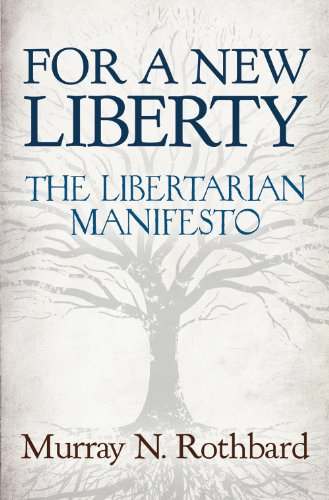
~ Murray Rothbard, For a New Liberty, "War and Foreign Policy," p. 335


Jun 6, 2025

Murray Rothbard on how libertarians view war

Libertarians favor liberty as a natural human right, and advocate it not only for Americans but for all peoples.  In a purely libertarian world, therefore, there would be no “foreign policy” because there would be no States, no governments with a monopoly of coercion over particular territorial areas.  But since we live in a world of nation-states.  And since this system is hardly likely to disappear in the near future, what is the attitude of libertarians toward foreign policy in the current State-ridden world? 

Pending the dissolution of States, libertarians desire to limit, to whittle down, the area of governmental power in all directions and as much as possible… 

Specifically, the entire land area of the world is now parcelled out among various States, and each land area is ruled by a central government with monopoly of violence over that area.  In relations between States, then, the libertarian goal is to keep each of those States from extending their violence to other countries, so that each State’s tyranny is at least confined to its own bailiwick.  For the libertarian is interested in reducing as much as possible the area of State aggression against all private individuals.  The only way to do this, in international affairs, is for the people of each country to pressure their own State to confine its activities to the area it monopolizes and not to attack other States or aggress against their subjects.  In short, the objective of the libertarian is to confine any existing State to as small a degree of invasion of person and property as possible.  And this means the total avoidance of war.  The people under each State should pressure “their respective States not to attack one another, or, if a conflict should break out, to withdraw from it as quickly as physically possible.

~ Murray Rothbard, For a New Liberty, "War and Foreign Policy," pp. 331-332

1919 (published posthumously)

Jun 5, 2025

Murray Rothbard on modern war vs. pre-modern war

It was not always thus.  During the Middle Ages, the scope of wars was far more limited.  Before the rise of modern weapons, armaments were so limited that governments could – and often did – strictly confine their violence to the armies of the rival governments.  It is true that tax coercion increased, but at least there was no mass murder of the innocents.  Not only was firepower low enough to confine violence to the armies of the contending sides, but in the pre-modern era there was no central nation-state that spoke inevitably in the name of all inhabitants of a given land area.  If one set of kings or barons fought another, it was not felt that everyone in the area must be a dedicated partisan.  Moreover, instead of mass conscript armies enslaved to their respective rulers, armies were small bands of hired mercenaries.  Often, a favorite sport for the populace was to observe a battle from the safety of the town ramparts, and war was regarded as something of a sporting match.  But with the rise of the centralizing State and of modern weapons of mass destruction, the slaughter of civilians, as well as conscript armies, have become a vital part of inter-State warfare. 

Suppose that despite possible libertarian opposition, war has broken out.  Clearly, the libertarian position should be that, so long as the war continues, the scope of assault upon innocent civilians must be diminished as much as possible.  Old-fashioned international law had two excellent devices to accomplish this goal: the “laws of war,” and the “laws of neutrality” or “neutral’s rights”…  In short, the libertarian tries to induce the warring States to observe fully the rights of neutral citizens.  The “laws of war,” for their part, were designed to limit as much as possible the invasion by warring States of the rights of civilians in their respective countries.  As the British jurist F.J.P. Veale put it: 
The fundamental principle of this code was that hostilities between civilized peoples must be limited to the armed forces…  It drew a distinction between combatants and non-combatants by laying down that the sole business of the combatants is to fight each other and, consequently, that non-combatants must be excluded from the scope of military operations.
In the modified form of prohibiting the bombardment of all cities not in the front line, this rule held in Western European wars in recent centuries until Britain launched the strategic bombing of civilians in World War II. Now, of course, the entire concept is scarcely remembered, since the very nature of modern nuclear warfare rests upon the annihilation of civilians.

~ Murray Rothbard, For a New Liberty, "War and Foreign Policy," pp. 332-334

1973


Murray Rothbard on the Indo-Pakistani war of 1971

Of all the recent wars, none has come closer – though not completely so – to satisfying these three criteria for a “just war” than the Indian war of late 1971 for the liberation of Bangla Desh.  The government of Pakistan had been created as a last terrible legacy of Imperial Britain to the Indian subcontinent.  In particular, the nation of Pakistan consisted of imperial rule by the Punjabis of West Pakistan over the more numerous and productive Bengalis of East Pakistan (and also over the Pathans of the North-West Frontier).  The Bengalis had long been yearning for independence from their imperial oppressors; in early 1971, parliament was suspended as a result of Bengali victory in the elections; from then on, Punjabi troops systematically slaughtered the civilian Bengal population.  Indian entry in the conflict aided the popular Bengali resistance forces of the Mukhti Bahini.  While taxes and conscription were, of course, involved, the Indian armies did not use their weapons against Bengali civilians; on the contrary, here was a genuine revolutionary war on the Bengali public against the Punjabi occupying state.  Only Punjabi soldiers were on the receiving end of Indian bullets.

~ Murray Rothbard, For a New Liberty, "War and Foreign Policy," p. 336


Nov 22, 2023

Murray Rothbard on why libertarians should oppose war

Many libertarians are uncomfortable with foreign policy and prefer to spend their energies either on fundamental questions of libertarian theory or on such "domestic" concerns as the free market or privatizing postal service or garbage disposal.  Yet an attack on war or a warlike foreign policy is of crucial importance to libertarians.  There are two important reasons.  One has become a cliché, but is all too true nevertheless: the overriding importance of preventing a nuclear holocaust.  To all the long-standing reasons, moral and economic, against an interventionist foreign policy has now been added the imminent, ever-present threat of world destruction...

The other reason is that, apart from the nuclear menace, war, in the words of the libertarian Randolph Bourne, "is the health of the State."  War has always been the occasion of a great - and usually permanent - acceleration and intensification of State power over society.  War is the great excuse for mobilizing all the energies and resources of the nation, in the name of patriotic rhetoric, under the aegis and dictation of the State apparatus.  It is in war that the State really comes into its own: swelling in power, in number, in pride, in absolute dominion over the economy and the society.  Society becomes a herd, seeking to kill its alleged enemies, rooting out and suppressing all dissent from the official war effort, happily betraying truth for the supposed public interest.  Society becomes an armed camp, with the values and the morals - as the libertarian Albert Jay Nock once phrased it - of an "army on the march."

~ Murry Rothbard, For A New Liberty, "War and Foreign Policy," pp. 347-348

1973


Nov 4, 2023

Murray Rothbard on the libertarian case against war

Let us assume for the moment, a world of two hypothetical countries: Graustark and Belgravia.  Each is ruled by its own State.  What happens if the government of Graustark invades the territory of Belgravia?  From the libertarian point of view two evils immediately occur.  First, the Graustark Army begins to slaughter innocent Belgravian civilians, persons who are not implicated in whatever crimes the Belgravian government might have committed.  War, then, is mass murder, and this massive invasion of the right to life, of self-ownership, of numbers of people is not only a crime but, for the libertarian, the ultimate crime.  Second, since all governments obtain their revenue from the thievery of coercive taxation, any mobilization and launching of troops inevitably involve an increase in tax-coercion in Graustark.  For both reasons - because inter-State wars inevitably involve both mass murder and an increase in tax-coercion, the libertarian opposes war.  Period.

~ Murray Rothbard, For a New Liberty, "War and Foreign Policy," p. 332