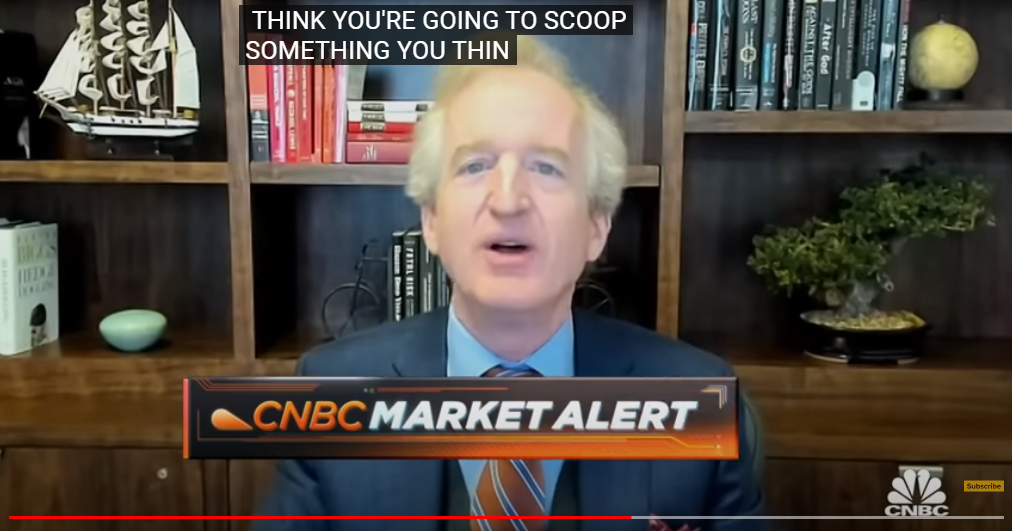
~ Chris Davis, Davis Fund Advisors, CNBC interview, 2:05 mark, May 2, 2023
Showing posts with label Wells Fargo. Show all posts
May 8, 2023
Chris Davis on recent bank failures: "it's not systemic"
The model of making a spread on money is about as old as human history. So the model is durable. We own banks that are in their second century, even their third century. So there's enormous resiliency to the model. And so when you get a panic, I think you have to look for where are the companies that are vulnerable - you have to avoid those because then you're trying to scoop them off the bottom which is risky. But if you own the companies that in a sense are beneficiaries? After all, where are those depositors going? When they leave these smaller regional banks they are fleeing to the big banks. That's where I think there is enormous safety and you can look at, for example, the balance sheet of Wells Fargo and you can see just how conservative they were in terms of not taking big interest rate risk and at the same time that they've had enormously resilient deposits. That's a wonderful combination with higher interest rates widening their profitability. So I think it's very different [from past banking crises] because it's not systemic. It's really a flight to quality and the fact the big banks are going down so much I think is creating that opportunity.
Apr 14, 2015
Jim Cramer: "The long national nightmare for banks is over"
We're beginning to get a sense that the long national nightmare for banks is over.
~ Jim Cramer, CNBC
(Comment made after Wells Fargo and JPMorgan Chase reported better than expected earnings.)
~ Jim Cramer, CNBC
(Comment made after Wells Fargo and JPMorgan Chase reported better than expected earnings.)
Labels:
banking,
JPMorgan Chase,
people - Cramer; Jim,
Wells Fargo
Oct 20, 2009
Bob Chapman on home equity loan exposure at four large banks
U.S. financial institutions hold almost $1.1 trillion in second liens, also known as home equity loans or "helocs." Some 42% of all helocs are held by four banks—Bank of America, J.P. Morgan Chase, Citibank and Wells Fargo. Since in a traditional mortgage foreclosure the second loan is usually wiped out, these big four banks have an exposure in the hundreds of billions of dollars.
Mortgage-finance consultant Edward Pinto points out that these same lenders have about $800 billion of first mortgage loans on their books, representing 8% of the total outstanding first mortgage loans in the U.S. But they also act as the servicers on almost 60% of total first mortgages, which means they handle negotiations on loan modifications. Thus when a home owner asks one of the big four banks to redo a loan, the banker may have a greater interest in saving the home-equity loan than in protecting the creditors of the first mortgage…
~ Bob Chapman, "US Treasury Controlled by Wall Street," LewRockwell.com, October 20, 2009
Mortgage-finance consultant Edward Pinto points out that these same lenders have about $800 billion of first mortgage loans on their books, representing 8% of the total outstanding first mortgage loans in the U.S. But they also act as the servicers on almost 60% of total first mortgages, which means they handle negotiations on loan modifications. Thus when a home owner asks one of the big four banks to redo a loan, the banker may have a greater interest in saving the home-equity loan than in protecting the creditors of the first mortgage…
~ Bob Chapman, "US Treasury Controlled by Wall Street," LewRockwell.com, October 20, 2009
Dec 9, 2008
Richard Kovacevich on bailouts and who should be first in line
Q: If the government is going to buy into banks, why not autos, why not airlines?
A: It's important to invest in the banks because banks are the grease that keeps the real economy moving. If there is no financing available for corporations, for consumers, for municipalities, if that does not exist, then no industry can be successful, right? You've got to have that backbone. And that's what you have to do first. Who else you do it with, or for, is for other people to decide. But I think almost everyone agrees, until you fix the financial system, helping others won't make a difference.
~ Richard Kovacevich, CEO, Wells Fargo, "Wells Fargo's Kovacevich: The Importance of Hitting Bottom," BusinessWeek, October 22, 2008 (Nov. 3 issue), interview with Maria Bartiromo
A: It's important to invest in the banks because banks are the grease that keeps the real economy moving. If there is no financing available for corporations, for consumers, for municipalities, if that does not exist, then no industry can be successful, right? You've got to have that backbone. And that's what you have to do first. Who else you do it with, or for, is for other people to decide. But I think almost everyone agrees, until you fix the financial system, helping others won't make a difference.
~ Richard Kovacevich, CEO, Wells Fargo, "Wells Fargo's Kovacevich: The Importance of Hitting Bottom," BusinessWeek, October 22, 2008 (Nov. 3 issue), interview with Maria Bartiromo
Richard Kovacevich on Wells Fargo's financial strength
Q: Well Fargo has stayed very strong relative to your competitors. Why?
A: We just didn't make some of the mistakes that others did. We still made some mistakes, and that's very unfortunate. In some cases, we should have known better. In general—and I don't know if I take much pride in this—we're probably the least ugly of the ugly ducks because we did not participate in some of the excesses, particularly related to subprime borrowers and [collateralized debt obligations] and highly leveraged loans.
~ Richard Kovacevich, CEO, Wells Fargo, "Wells Fargo's Kovacevich: The Importance of Hitting Bottom," BusinessWeek, October 22, 2008 (Nov. 3 issue), interview with Maria Bartiromo
A: We just didn't make some of the mistakes that others did. We still made some mistakes, and that's very unfortunate. In some cases, we should have known better. In general—and I don't know if I take much pride in this—we're probably the least ugly of the ugly ducks because we did not participate in some of the excesses, particularly related to subprime borrowers and [collateralized debt obligations] and highly leveraged loans.
~ Richard Kovacevich, CEO, Wells Fargo, "Wells Fargo's Kovacevich: The Importance of Hitting Bottom," BusinessWeek, October 22, 2008 (Nov. 3 issue), interview with Maria Bartiromo
Richard Kovacevich (Wells Fargo's CEO) on deleveraging
For those of us who are born capitalists, you know, it's an extraordinary time. However, what's happening is a deleveraging of the financial system. By putting in capital instead of just buying loans, for every dollar you put in, institutions get to lever that 10 to 20 times in terms of the loans they can make. So I think it's very wise to attempt to neutralize to some extent the deleveraging that has gone on and will continue to go on by putting capital in that can then be levered.
~ Richard Kovacevich, CEO, Wells Fargo, "Wells Fargo's Kovacevich: The Importance of Hitting Bottom," BusinessWeek, October 22, 2008 (Nov. 3 issue), interview with Maria Bartiromo
May 29, 2008
Short seller Doug Kass getting long financials
While the negatives of the credit cycle, the dilutive effect of the industry's refinancings and other factors cannot be dismissed, quite frankly, I can make the case that we are now at an unprecedented point of time to get long financials.
I have added Bank of America (BAC) to my banking basket of Citigroup (C) and Wells Fargo (WFC).
~ Doug Kass, "Kass: I'm Putting My Money in the Banks," TheStreet.com, May 29, 2008
I have added Bank of America (BAC) to my banking basket of Citigroup (C) and Wells Fargo (WFC).
~ Doug Kass, "Kass: I'm Putting My Money in the Banks," TheStreet.com, May 29, 2008
Jan 18, 2008
Jim Cramer on financials
Jamie Dimon's books are a thing of nonfiction. Thank heavens Jamie Dimon seems like a pretty realistic guy.
With Wells Fargo you're dealing with fact, not fiction. Goldman Sachs is deeply rooted in fact.
~ Jim Cramer, Mad Money Host, CNBC, January 17, 2008
With Wells Fargo you're dealing with fact, not fiction. Goldman Sachs is deeply rooted in fact.
~ Jim Cramer, Mad Money Host, CNBC, January 17, 2008
Dec 11, 2007
Richard Kovacevich on credit crunch
There's no credit crunch, not when you see people investing billions of dollars into financial institutions. The crunch is that there are buyers who don't think values are low enough yet and sellers who don't want to sell at these levels.
~ Richard Kovacevich, Chairman Wells Fargo, Bloomberg TV, December 11, 2007
Subscribe to:
Posts (Atom)
