This reluctance [to integrate themselves into the marketplace] helps further to explain the hostility intellectuals bear towards the market order, and something of their susceptibility to socialism. Perhaps this hostility and susceptibility would diminish if such persons understood better the role that abstract and spontaneous ordering patterns play in all of life, as they no doubt would do if better informed of evolution, biology, and economics. But when confronted by information in these fields, they are often reluctant to listen, or even to consider conceding the existence of complex entities of whose working our minds can have only abstract knowledge.
~ Friedrich Hayek, The Fatal Conceit, Chapter 5: "The Fatal Conceit"
Showing posts with label intellectual climate. Show all posts
Showing posts with label intellectual climate. Show all posts
Apr 20, 2020

Jul 18, 2008
Ludwig von Mises on war and idealogy
To defeat the aggressors is not enough to make peace durable. The main thing is to discard the ideology that generates war.
~ Ludwig von Mises, Human Action (1949)

~ Ludwig von Mises, Human Action (1949)
Nov 16, 2007
Lew Rockwell on academia embracing statism
In this world, there are some guaranteed failures - proven again and again. None is more persistent than government policy. I mean all government policy. Government's welfare programs don't work. Its wars are a calamity. Its regulations hobble prosperity. Its monetary policy is one long fiasco. Its trade policies hurt everyone but a few insiders. Its taxes throw good money after bad.
So it has always been; so it will always be.
Why does our country persist, then, in these failed policies? Well, politicians benefit from them. So do special interests. The bureaucratic class is always scheming for more money and power. And some people just enjoy getting something for nothing.
The major culprits are the universities. They teach what Mises called statism, which is an intellectual attachment to the bogus idea that the State can accomplish all wonderful things if only it has enough power and money. They teach this in sociology, in economics, in politics, in history, even in literature and the humanities. If there is a single doctrine that academia embraces, it is that the State is great.
~ Lew Rockwell, president, Ludwig von Mises Institute, June 28, 2007
So it has always been; so it will always be.
Why does our country persist, then, in these failed policies? Well, politicians benefit from them. So do special interests. The bureaucratic class is always scheming for more money and power. And some people just enjoy getting something for nothing.
The major culprits are the universities. They teach what Mises called statism, which is an intellectual attachment to the bogus idea that the State can accomplish all wonderful things if only it has enough power and money. They teach this in sociology, in economics, in politics, in history, even in literature and the humanities. If there is a single doctrine that academia embraces, it is that the State is great.
~ Lew Rockwell, president, Ludwig von Mises Institute, June 28, 2007
Nov 11, 2007
Cyd Malone on the Back to the Land movement of the 1930s
During the 1930s, the wish of the world's politicians to "plan" other men's lives was strong and, by unhappy coincidence, so was their power to do so. The urge to "educate and uplift" their fellow (if lesser) man into a state more agreeable to their theories beat brightly in every progressive heart from Moscow and Berlin to London and Washington D.C.
The Communist Manifesto had vastly more influence on the intellectual mind than it does today, and its exhortation for "combination(s) of agriculture with manufacturing industries; gradual abolition of the distinction between town and country, by a more equitable distribution of the population over the country" was taken seriously as a workable idea and, more important, as a morally correct idea. Writings such as the Manifesto undoubtedly contributed to the birth of the Back to the Land movement, an intellectual fad that swept through the brains of many 1930s Western politicians.
As a result, the city of Magadan in Russia's Siberia was built from nothing, by and for Stalin's slave army. It still exists today. In Germany, the town of Ramersdorf was built from scratch on the magnanimous whim of Adolph Hitler; it too still exists today. And America's very own example of the fad was the West Virginia town of Arthurdale, constructed during 1933 on the magnanimous whim of Eleanor Roosevelt.
~ Cyd Malone, "The Peculiar History of Arthurdale," Mises.org, August 8, 2007
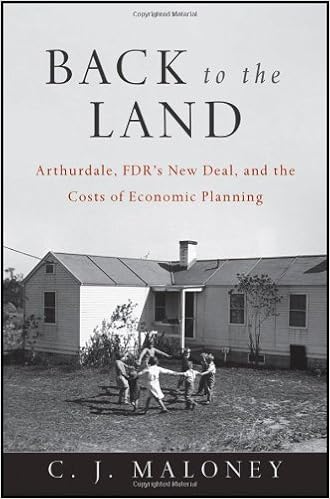
The Communist Manifesto had vastly more influence on the intellectual mind than it does today, and its exhortation for "combination(s) of agriculture with manufacturing industries; gradual abolition of the distinction between town and country, by a more equitable distribution of the population over the country" was taken seriously as a workable idea and, more important, as a morally correct idea. Writings such as the Manifesto undoubtedly contributed to the birth of the Back to the Land movement, an intellectual fad that swept through the brains of many 1930s Western politicians.
As a result, the city of Magadan in Russia's Siberia was built from nothing, by and for Stalin's slave army. It still exists today. In Germany, the town of Ramersdorf was built from scratch on the magnanimous whim of Adolph Hitler; it too still exists today. And America's very own example of the fad was the West Virginia town of Arthurdale, constructed during 1933 on the magnanimous whim of Eleanor Roosevelt.
~ Cyd Malone, "The Peculiar History of Arthurdale," Mises.org, August 8, 2007
Nov 3, 2007
Kevin Duffy on the intellectual climate and reasons for optimism
I am a long-term optimist. The failures of central planning are there for all to see. Russians, East Europeans, Chinese, Indians, and perhaps some Latin Americans who stared into the socialist abyss know best. Yet we are blindly traveling down the same road they’re coming from, and delude ourselves that we’re cruising along the free market highway. Fortunately, we’re just 290 million lost souls against billions. (though you should add in Western Europe going down the same path.) To me that’s what’s exciting – we’re no longer the only game in town. There are perhaps a hundred individual experiments taking place, all looking for the capitalistic key. Once they discover not to adopt ALL of the American system (esp. a central bank and “democracy”) the upward push of progress will be unfathomable and unstoppable. Even the U.S. will have no other choice but to follow this model.
The biggest reason for optimism, in my humble opinion, is the intellectual climate. The seeds of socialism/fascism/interventionism were sown in the mid to late 1800s. The battle of ideas took place and the bad guys won. Edward Bellamy wrote the best selling (I believe in 1887) socialist utopia novel Looking Forward. (His cousin, Francis Bellamy, also a socialist, wrote the Pledge of Allegiance in 1892.) A lot of these ideas came from German universities, considered the best in the late 1800s, early 1900s. (The first modern welfare state was Bismarck’s Germany.) An intellectual shift towards socialism preceded the disastrous/murderous 20th century, laying the groundwork for the U.S. Progressive Era (income tax, central bank, end of neutrality in foreign affairs), Soviet socialism, Nazi socialism, etc., etc.
Fast forward the tape to today. Intellectually, socialism is dead from the neck up. Free market principles are much more embraced (though there is still much work to do), especially around the world. The more failures of central planning are revealed (is mortgage market socialism next?) the more this intellectual shift will accelerate. When the current wretched system inevitably fails, the hope is that at least some sound thinking will fill the void. You’re already starting to see this with the failures of Katrina – calls for spending cuts, pork busting on CNBC, defense of gas price gouging by the Cato boys, and even some calls for private roads.
~ Kevin Duffy, Bearing Asset Management, October 10, 2005
The biggest reason for optimism, in my humble opinion, is the intellectual climate. The seeds of socialism/fascism/interventionism were sown in the mid to late 1800s. The battle of ideas took place and the bad guys won. Edward Bellamy wrote the best selling (I believe in 1887) socialist utopia novel Looking Forward. (His cousin, Francis Bellamy, also a socialist, wrote the Pledge of Allegiance in 1892.) A lot of these ideas came from German universities, considered the best in the late 1800s, early 1900s. (The first modern welfare state was Bismarck’s Germany.) An intellectual shift towards socialism preceded the disastrous/murderous 20th century, laying the groundwork for the U.S. Progressive Era (income tax, central bank, end of neutrality in foreign affairs), Soviet socialism, Nazi socialism, etc., etc.
Fast forward the tape to today. Intellectually, socialism is dead from the neck up. Free market principles are much more embraced (though there is still much work to do), especially around the world. The more failures of central planning are revealed (is mortgage market socialism next?) the more this intellectual shift will accelerate. When the current wretched system inevitably fails, the hope is that at least some sound thinking will fill the void. You’re already starting to see this with the failures of Katrina – calls for spending cuts, pork busting on CNBC, defense of gas price gouging by the Cato boys, and even some calls for private roads.
~ Kevin Duffy, Bearing Asset Management, October 10, 2005
Oct 21, 2007
Mises on responsibility and political involvement
Everyone carries a part of society on his shoulders; no one is relieved of his share of responsibility by others. And no one can find a safe way out for himself if society is sweeping towards destruction. Therefore everyone, in his own interests, must thrust himself vigorously into the intellectual battle. None can stand aside with unconcern; the interests of everyone hang on the result. Whether he chooses or not, every man is drawn into the great historical struggle, the decisive battle into which our epoch has plunged us.
~ Ludwig von Mises, Socialism, p. 515
~ Ludwig von Mises, Socialism, p. 515
Subscribe to:
Posts (Atom)
