Showing posts with label economic stimulus. Show all posts

Oct 15, 2024

Tianchen Xu on expected fiscal stimulus measures in China

Our overall take is quite positive in that MoF is willing to tackle China’s many economic challenges by leveraging its borrowing room.  The immediate benefits to the economy will be limited, as the MoF avoided large-scale direct cash handouts to households.  However, its commitment to restoring local public finances through fiscal transfer and debt replacement is highly commendable. 

In the medium term, it will put an end to the aggressive deleveraging by local governments and ease the resulting deflationary pressure.  And as their financial position stabilises, local governments will be better positioned to support the economy by providing public services and embark on public investments.

~ Tianchen Xu, Senior Economist, Economist Intelligence Unit, "China's briefing on stimulus gets lukewarm investor reception," Reuters, October 12, 2024

(Xu reacted to news conference with Finance Minister Lan Foan announcing more "counter-cyclical measures" this year without providing details on size of fiscal stimulus.)


Apr 4, 2024

Bloomberg Businessweek on muted impact of stimulus in China

The economy is besieged by deflation, a persistent housing market slump and a stock selloff.  And Beijing's piecemeal stimulus policies - such as lowering bank reserve requirements to encourage more lending and issuing more government bonds to fund construction projects - don't seem to be improving sentiment.

[...]

Chinese government advisers' calls for more stimulus reached a fever pitch last summer, and Beijing responded with an unusual midyear dose of deficit spending.  While the timing signaled a welcome flexibility, the scale of the effort, at 1 trillion yuan ($139 billion), paled compared with past interventions.

[...]

Stubbornly low confidence among households and businesses is blunting the impact of stimulus...  One sign Chinese families are feeling less secure: Rather than investing in housing or stocks, they're socking away money away in savings accounts at banks.  Companies are being showered with credit, but outside of growth sectors such as EVs and cleantech, business owners appear to be reluctant to expand amid weak demand and falling prices.

~ "China Limps Into the Year of the Dragon," Bloomberg Businessweek, February 12, 2024

Oct 27, 2022

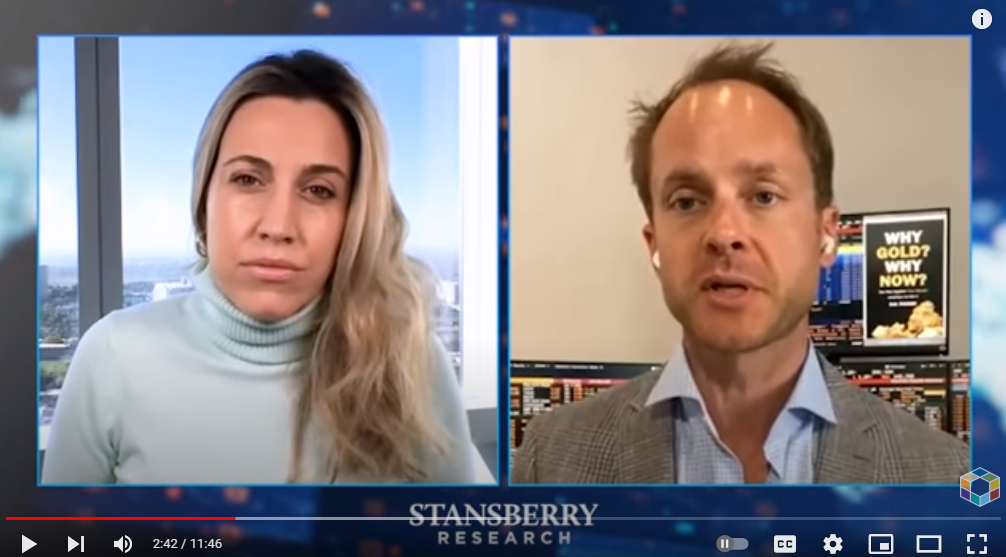
E.B Tucker on economic stimulus vs. gold

I want to give people something they can disrupt every dinner party they go to this weekend.  There's twelve trillion dollars worth of gold in the entire world, according to Pierre Lassonde's World Gold Council.  That's all the gold ever mined in history.  The U.S. spent over six trillion dollars this year and all we heard about was "We need more.  We're going to starve without the stimulus.  We need more."  And what did we spend all that money on?  Dental shields, plastic coverings, airline bailouts, checks to people so that they could put the money into Robinhood accounts.  Ok, that money's all gone.  Forget about it.  It's not coming back.

~ E.B. Tucker, interview with Daniela Cambone, Stansberry Research, 2:25 mark, November 5, 2020


Oct 20, 2022

The Wall Street Journal on the resignation of UK prime minister Liz Truss and the death of stimulus

The rapid rise and fall of Mr. Truss marks a stark lesson for global leaders over the risks of trying to boost their economies with stimulus packages during a period of rising inflation and interest rates. 

Ms. Truss’s advisers said balancing the books held back the government’s ability to juice the economy by funding tax cuts with debt, leaving Western nations that are already stuck in a cycle of low growth and ever-rising taxation to fund the U.K.’s public services. Ms. Truss’s team worked on the basis that markets would absorb the debt the U.K. government offered in return for the prospect of 2.5% annual growth.


Jul 24, 2022

Randall Forsyth on stimulus checks going into the stock market

While institutions reshuffle portfolios, it will be interesting to see what individuals do with their $1,400 stimulus payments.  Some $242 billion was deposited into Americans’ bank accounts on Wednesday, the biggest “helicopter drop” to date, write Jefferies economists in a research note.  At the same time, Bank of America strategists point out, a “staggering” record $68.3 billion flowed into equity funds in the past week.  It seems that at least some of the stimulus may be going for speculation, rather than spending. 

~ Randall Forsyth, "Bond Vigilantes' Return Won't Cause Another Black Monday," Barron's, March 20, 2021


Jan 9, 2022

Philip Duffy on three rounds of economic stimulus: "for every $1 received by individuals, $8 went to special interests"

Stimulus came in three waves: 
  1. Coronavirus Aid, Relief, and Economic Security Act, also known as the CARES Act, is a $2.2 trillion economic stimulus bill passed by the 116th U.S. Congress and signed into law by President Donald Trump on March 27, 2020. The spending includes $300 billion in one-time cash payments to individual people who submit a tax return in America (with most single adults receiving $1,200 and families with children receiving more. 
  2. Consolidated Appropriations Act, 2021 is a $2.3 trillion spending bill that combines $900 billion in stimulus relief for the COVID-19 pandemic in the United States with a $1.4 trillion omnibus spending bill for the 2021 federal fiscal year (combining 12 separate annual appropriations bills). The bill was passed by both houses of Congress on December 21, 2020, with large bipartisan majorities in support. The bill was the product of weeks of intense negotiations and compromise between Democrats and Republicans during the lame-duck session. After initially criticizing the bill, President Donald Trump signed it into law on December 27. Of the $900 billion in “stimulus rel;ief, the vast majority went to special interests while only $166 billion went for a $600 stimulus checks, for most Americans with an adjusted gross income lower than $75,000. 
  3. American Rescue Plan Act of 2021, Public Law No. 117-2 (March 11, 2021), was a $1.9 trillion bill passed by the 117th United States Congress and signed into law by President Joe Biden on March 11, 2021. $1,400 direct payments to individuals was a part of this legislation. Of the $1.9 trillion, “more than $242 billion” was allocated for individual payments. 
Critics of the above analysis are likely to claim that the Consolidated Appropriations Act allocated $900 billion to stimulus relief for individuals, but delving deeper into those numbers reveals that only $166 billion went into stimulus checks for individuals and the remainder was allocated to special interests. Thus by combining the figures from the three acts it is clear that only $708 billion of the $6.4 trillion funds allocated found its way into the pockets of individuals as opposed to $5.692 trillion into the pockets of special interests. Stated simply, for every dollar received by individuals, 8 dollars were expended for special interests.

~ Philip Duffy, January 9, 2022

President Trump signs CARES Act
March 27, 2020


Dec 20, 2021

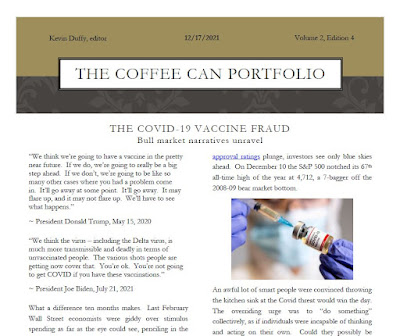
Kevin Duffy on the interventionist response to Covid

An awful lot of smart people were convinced throwing the kitchen sink at the Covid threat would win the day.  The overriding urge was to “do something” collectively, as if individuals were incapable of thinking and acting on their own.  Could they possibly be wrong?  Imagine admitting their error and reversing course…  Far more likely, the interventionists dig in their heels, refuse to admit defeat and double down.

~ Kevin Duffy, "The Covid-19 Vaccine Fraud," The Coffee Can Portfolio, December 17, 2021


Sep 21, 2021

WSJ: airline subsidies in the $900 billion Covid-19 relief bill

Tens of thousands of airline employees would get their jobs back, at least for a few months, under the new bill, which includes $15 billion to cover airline salaries and benefits through the end of March. The bill also includes $1 billion for airline contractor payrolls. 

Airlines received $25 billion under the Cares Act in the spring to cover workers’ pay and benefits, and in exchange agreed not to lay off or furlough employees until Oct. 1. As that date neared without much improvement in their outlook, carriers and labor unions warned that job cuts would be coming and pleaded for another round of aid. When it didn’t arrive in time, they furloughed tens of thousands of workers, including 19,000 at American Airlines Group Inc. and over 13,000 at United Airlines Holdings Inc. The bill also includes $2 billion for airports and airport-based businesses.

~ The Wall Street Journal, "What’s in the $900 Billion Covid-19 Relief Bill," December 27, 2020


Sep 4, 2021

Jim O'Sullivan on the stimulus drug wearing off

People will be surprised at how much the economy decelerates over the next year as the stimulus boost fades.

~ Jim O'Sullivan, chief U.S. macrostrategist, TD Securities

(As quoted in "Biden's Challenge: A Wobbly Economy," The New York Times, September 1, 2021)


Aug 15, 2021

Stephanie Pomboy on stimulus and inflation

It seems clear that, if there is a slowdown in demand and spending, they're just going to use it as a rationale to do another round of stimulus...  The inflation is going to be a rationale for more stimulus which will fuel more inflation. 

~ Stephanie Pomboy, conversation with John Hathaway and Bill Strong, 23:45 mark


Jul 17, 2021

Laura Rublin on economic stimulus

Ultralow interest rates and ultrahigh spending by the Federal Reserve and federal government helped the U.S. economy not only survive the devastating impact of the Covid-19 pandemic, but also thrive in its near aftermath.


Jun 15, 2021

Robert Blumen on the futility of economic stimulus

The US economy does have an excess of unemployed workers, empty storefronts, and idle resources of all kinds.  Why not give it a go?  A bit of stimulus could not hurt. 

Not. So. Fast. 

...The problem is not a pricing problem. The problem is that businesses have been prohibited from operating...  Resources are not priced out of the market.  People and businesses are instead banned from producing. This is a problem that pricing cannot solve because the transactions are not allowed.  Venues can legally operate only at a reduced capacity at which they are not profitable.  We have a “making it illegal to produce things” problem.  And stimulus can’t do anything about that even if you are stupid enough to be a Keynesian.

~ Robert Blumen, "Why Stimulus Does Not Stimulate," Mises.org, June 15, 2021


May 8, 2021

Lisa Beilfuss on the weak jobs report

There is a conundrum facing the U.S. economy: The very stimulus that has prompted a faster-than-expected recovery seems to be undermining it. 

That is one interpretation of the April jobs report released Friday, which showed employers added only a fraction of the jobs Wall Street expected and hired at the slowest pace since January.  Economists called the report puzzling; some said it should be ignored. 

~ Lisa Beilfuss, "Are We Overstimulated? April’s Weak Jobs Report Says Yes.," Barron's, May 8, 2021


Apr 7, 2021

Howard Marks on economic stimulus

We've never seen stimulus like we have at this time. I always say that if you've never seen something before you can't say how it's going to end.

~ Howard Marks, "Oaktree's Marks Says This Is the Time to Try to Be Resourceful," 8:10 mark, Bloomberg TV, April 5, 2021


Mar 22, 2021

Matt Gaetz on the $1.9 trillion Biden stimulus package

It is a Trojan horse for socialism, it is everything Democrats have wanted wrapped and branded in coronavirus so that people are scared into voting for it...  This is only the beginning.  And we are about to see massive inflation in this country as a consequence of no real pressure against the printing of money.

~ Matt Gaetz, Florida Representative, March 9, 2021


Bernie Sanders on the American Rescue Plan

As Chairman of the Senate Budget Committee, I am proud that we passed the American Rescue Plan, which, in my view, is the most significant piece of legislation to benefit working families in the modern history of this country.  This package, among many other things, increases direct payments by $1400, extends unemployment benefits, reduces child poverty by half, ensures we are vaccinating as many people as possible, and puts us on a path to safely reopen schools.

~ Bernie Sanders, Vermont senator, March 6, 2021


Jen Psaki on the $1.9 trillion Biden stimulus package

I will note that the plan that the Senate passed this weekend puts us one huge step closer to passing one of the most consequential and most progressive pieces of legislation in American history.

~ Jen Psaki, White House press secretary, March 8, 2021


Mar 15, 2021

Philip Grant on how Wall Street thinks the $1.9 stimulus bill is bullish for the economy and stocks

Owing to last week’s $1.9 trillion stimulus bill, economists at Goldman Sachs now pencil in a heady 8% year-over-year growth in fourth quarter GDP.  That would be the highest rate since 1951, when nominal annual output footed to about $350 billion, compared to about $21 trillion last year. 

Then, too, already-buoyant asset markets can expect another jolt, as suddenly flush retail hordes prepare to deploy their $1,400 check.  According to a late February survey from Deutsche Bank, respondents reported that they plan to allocate 37% of their stimulus payout into the market.  “Retail sentiment remains positive across the board, regardless of age, income or when the investor began trading,” wrote Deutsche Bank strategist Parag Thatte.  “Retail investors say they expect to maintain or add to their stock holdings even as the economy re-opens.”

~ Philip Grant, Almost Daily Grant's, March 15, 2021


Mar 8, 2021

Ed Hyman sees a 5 year expansion due to economic stimulus (2021)

Massive, unprecedented stimulus is already in place and increasing!  It’s firing on all cylinders, ie, QE, rates, and fiscal.  So even though inflation and bond yields are moving up, equities are supported.  We believe we’re at the start of a new expansion that will last five years or more.

~ Ed Hyman, Evercore ISI's Weekly Economic Report, March 7, 2021