Oct 12, 2026

Lew Rockwell on the aftermath of 9/11

The US government didn’t stop with wars.  It violated the civil liberties of Americans and established enormous new bureaucracies.  It trampled on the rights of states and localities.  It turned flying into a massive police operation.  It began a series of protectionist campaigns. 

The Bush administration busted the budget and saddled the country with the largest deficit in history.  Congress and the presidency engaged in a transparent logrolling whereby the warmongers gave the welfare statists what they want, in exchange for which the welfare statists gave the warmongers what they want.  The rest of us watched freedom melt.  We did what we could, in our writings and public advocacy, but the government tide was too high to hold back. 

 ~ Lew Rockwell, “Times Change, Principles Don’t,” Mises Wire, September 11, 2003


Lew Rockwell on Iraqi deaths before and after the 2003 invasion

What has been the result of our efforts to bring to Iraq the “benefits” of democracy?  There’s one thing Americans don’t talk about: the lives of Iraqis, or, rather, the deaths of Iraqis.  It’s interesting because we live in an age of extreme multiculturalism and global concern.  We adore international aid workers, go on mission trips abroad, weep for the plight of those suffering from hunger and disease, volunteer in efforts to bring plumbing to Ecuador, mosquito nets to Rwanda, clean water to Malawi, human rights to Togo, and medicine to Bangladesh. 

But when “we” cause the calamity, suddenly there is silence.  There is something odd, suspicious, even disloyal about a person who would harp on the deaths of Iraqis since the US invasion in 2003.  Maybe a person who would weep for Iraq is really a terrorist sympathizer.  After all, most of the deaths resulted from “sectarian violence,” and who can stop crazed Islamic sects from killing each other.  Better each other than us, right? 

Well, it’s about time that we think about the numbers, even though the US military has decided that body counts are not worth their time.  Here is the grisly bottom line: more than one million people have been murdered in Iraq since the US invasion, according to Opinion Research Business, a highly reputable polling firm in the UK.  Yes, other estimates are lower, but you have to be impressed by what they have found.  It seems very credible. 

In Baghdad, where the US presence is most pronounced, nearly half of households report having lost a family member to a killing of some sort.  Half the deaths are from gunshot wounds, one-fifth from car bombs, and one-tenth from aerial bombs.  The total number of dead exceeds the hugely well-publicized Rwandan genocide in 1994. 

Aside from the astonishing detail, what jumps out at me is the number of dead who are neither Sunni nor Shia.  It is also striking how the further geographically you move from US troop activity, the more peaceful the area is.  Americans think they are bringing freedom to Iraq, but the data indicate that we are only bringing suffering and death. 

If you have ever lost a family member, you know that life is never the same again.  It causes every manner of religious, social, and marital trauma.  It’s bad enough to lose a family member to some disease.  But to a cold-blooded killing or a car bomb or an airplane bomb?  That instills a sense of fury and motivation to retribution.

So we are speaking of some 1.2 million people who have been killed in this way, and that does not count the numbers that were killed during the invasion itself for the crime of having attempted to oppose invading foreign troops, or the 500,000 children and old people killed by the US-UN anti-civilian sanctions in the ten previous years. 

The US has unleashed bloodshed in Iraq that is rarely known even in countries we think of as violent and torn by civil strife.  It is amazing to think that this has occurred in what was only recently a liberal and civilized country by the region’s standards.  This was a country that had a problem with immigration, particularly among the well-educated and talented classes.  They went to Iraq because it was the closest Arab proxy to Western-style society that one could find in the area. 

It was the US that turned this country into a killing field.  Why won’t we face this?  Why won’t we take responsibility?  The reason has to do with this mysterious thing called nationalism, which makes an ideological religion of the nation’s wars.  We are god-like liberators.  They are devil-like terrorists.  No amount of data or contrary information seems to make a dent in this irreligious faith.  So it is in every country and in all times.  Here is the intellectual blindness that war generates.

Such blindness is always inexcusable, but perhaps more understandable in a time when information was severely restricted, when technological limits actually prohibited us from knowing the whole truth at the time.  What excuse do we have today?  Our blindness is not technological but ideological.  We are the good guys, right?  Every nation believes that about itself, but freedom is well served by the few who dare to think critically.

~ Lew Rockwell, "The War System," Against the State (2014)

Chart: The Death Toll Of Wars Since 9/11 | Statista 

Lew Rockwell why the neocons started the 2003 Iraq War

Why did the United States get involved? 

One of the key reasons was pressure from a group that has come to exercise more and more influence on American foreign policy — the neocons. Paul Wolfowitz, William Kristol, Robert Kagan, and a number of others were not satisfied with American foreign policy. They disclosed their plans in an important book by Kristol and Lawrence Kaplan, The War Over Iraq: Saddam’s Tyranny and America’s Mission, published in 2003. These neocon authors said that foreign policy must avoid “realism.” The realists favored working within the balance-of-power tradition of European diplomacy. “This in turn led to the realists’ key recommendation: A state must limit itself to the protection of its ‘vital interests,’ lest it disrupt the balance of power.” 

A foreign policy realist will not hesitate to ally, if conditions require it, with an undemocratic state, but this strikes at the heart of Kaplan and Kristol’s ideas.  The key to their approach is that America should embark on a worldwide crusade for democracy.  To do so, they claim, will result in a world at peace.

They contend that the “strategic value of democracy is reflected in a truth of international politics: Democracies rarely, if ever, wage war against one another.”  Given this premise, isn’t the conclusion obvious?  If only we establish democracy everywhere, the millennium is at hand. 

Democracy should be spread worldwide, but one area is the most important for the neocons — the Middle East. Kaplan and Kristol hate all of the political systems of the Arab world, and they propose to replace them: “There is today not a single Arab state that qualifies as a democracy. ...  But promoting democracy in the Middle East is not a matter of national egoism.  It has become a matter of national well-being, even survival.”

In particular, the royalist government of Saudi Arabia must go.  Why not replace it as an American ally with a democratic Iraq?  “Iraq’s experience of liberal democratic rule in turn could increase the pressure already being felt by Teheran’s mullahs. . . .  Iraq could even replace Saudi Arabia as the key American ally and source of oil in the region.” 

America should therefore strike at Saddam Hussein — remember, they wrote before the invasion began.  Incredibly, Kaplan and Kristol predicted that the Iraqis would welcome us with open arms.  Then we could start preventive wars against other dictatorships.

~ Lew Rockwell, "The War System," Against the State (2014)

Against the State: An Anarcho-Capitalist Manifesto - Kindle edition by  Rockwell, Llewellyn. Politics & Social Sciences Kindle eBooks @ Amazon.com.
2014


President George W. Bush on motivation for 9/11 attacks: "They hate our freedoms"

Americans are asking, why do they hate us?  They hate what they see right here in this chamber—a democratically elected government.  Their leaders are self-appointed.  They hate our freedoms—our freedom of religion, our freedom of speech, our freedom to vote and assemble and disagree with each other.

~ President George W. Bush, address to a joint session of Congress, September 20, 2001

2001 George W. Bush speech to a joint session of Congress - Wikipedia 

Steve Eisman on stress cracks at Oracle

Blue Owl [Capital] is developing an AI data center called Project Jupiter for Oracle.  Oracle sent a notice citing force majeure, a legal term, to Blue Owl.  The notice is an attempt to put off payments if the data center gets derailed and fails to come online on time.  Now the debt tied to Project Jupiter was already trading at stress levels at around 90 cents on the dollar.  I'm sure it's under more pressure today, Thursday.  Although this shows Oracle is becoming increasingly nervous about its lack of cash flow, its high debt levels and its weak credit ratings.

~ Steve Eisman, "The Enron-Era Tricks Are Back in AI: How These Companies Are Hiding Their Debt," The Real Eisman Playbook, 3:45 mark, September 25, 2026

Oracle Confirmed as Anchor Tenant for $165B Project Jupiter Data Center Campus in New Mexico | Oliver D. posted on the topic | LinkedIn 

Oct 9, 2026

Peggy Noonan on whether Sam Altman can be trusted

In a less friendly profile for the [New Yorker] published this April, titled “Sam Altman May Control Our Future—Can He Be Trusted?,” Ronan Farrow and Andrew Marantz wrote that Mr. Altman is “often described, either with reverence or with suspicion, as the greatest pitchman of his generation.” Many around him say he lacks extensive expertise in coding or machine learning. Messrs. Farrow and Marantz report “multiple engineers recalled him misusing or confusing basic technical terms.” 

Most of those interviewed shared the critics’ judgment that “Altman has a relentless will to power that, even among industrialists who put their names on spaceships, sets him apart.” A board member who had worked with Mr. Altman told the authors: “He’s unconstrained by truth.” 

Messrs. Farrow and Marantz report that in the fall of 2023, when the OpenAI board famously fired Mr. Altman as CEO, the company’s chief scientist told another board member: “I don’t think Sam is the guy who should have his finger on the button.” Board members believed he had “deceived them about internal safety protocols.” 

Mr. Altman famously fought back and was reinstated. Still, “the colleagues who facilitated his ouster accuse him of a degree of deception that is untenable for any executive and dangerous for a leader of such a transformative technology.”

~ Peggy Noonan, "Sam Altman Is No Oppenheimer: Neither a scholar nor a scientist, someone like him shouldn’t be in charge of the future of humanity," WSJ, October 9, 2026

OpenAI has become one of the most valuable companies in the world. It is reportedly preparing for an initial public offering at a potential valuation of a trillion dollars. The company’s C.E.O., Sam ... 

Oct 6, 2026

U.S. presidents on war and sacrifice

Civil War:

It is rather for us to be here dedicated to the great task remaining before us ― that from these honored dead we take increased devotion to that cause for which they gave the last full measure of devotion ― that we here highly resolve that these dead shall not have died in vain.

~ President Abraham Lincoln, Gettysburg Address, November 19, 1863

World War I: 

There are, it may be, many months of fiery trial and sacrifice ahead of us...  To such a task we can dedicate our lives and our fortunes, everything that we are and everything that we have, with the pride of those who know that the day has come when America is privileged to spend her blood and her might for the principles that gave her birth and happiness and the peace which she has treasured.

~ President Woodrow Wilson, war message to Congress, April 2, 1917

World War II:

“It is not a sacrifice for any man, old or young, to be in the Army or Navy of the United States.  Rather it is a privilege.  It is not a sacrifice for the industrialist or the wage-earner, the farmer or the shopkeeper, the trainman or the doctor, to pay more taxes, to buy more bonds, to forego extra profits, to work longer or harder at the task for which he is best fitted.  Rather it is a privilege.  It is not a sacrifice to do without many things to which we are accustomed if the national defense calls for doing without.” 

~ President Franklin D. Roosevelt, radio address after Pearl Harbor, December 9, 1941

This Day in History: FDR's D-Day Prayer 

Korean War:

To do this will require hard work and sacrifice by all of us. I know all of us are prepared to do whatever is necessary in the cause of peace and freedom.

~ President Harry Truman, radio and television report, September 1, 1950

Cold War:

Let every nation know, whether it wishes us well or ill, that we shall pay any price, bear any burden, meet any hardship, support any friend, oppose any foe to assure the survival and the success of liberty.

~ President John F. Kennedy, inaugural address, January 20, 1961

War on Terror:

Two years ago, I told the Congress and the country that the war on terror would be a lengthy war, a different kind of war fought on many fronts in many places. Iraq is now the central front… This will take time and require sacrifice. Yet we will do what is necessary, we will spend what is necessary to achieve this essential victory in the war on terror, to promote freedom and to make our own nation more secure.

~ President George W. Bush, address to the nation, September 7, 2003

Amid all this violence, I know Americans ask the question: Is the sacrifice worth it?  It is worth it, and it is vital to the future security of our country.

~ President George W. Bush, June 28, 2005, speech at Fort Bragg

President Bush Thanks Military on Independence Day at Fort Bragg, North Carolina 

Iran War:

As we celebrate this progress, we think especially of the 13 American warriors who have laid down their lives in this fight to prevent our children from ever having to face a nuclear Iran… And now we must honor them by completing the mission for which they gave their lives.

~ President Donald Trump, address to the nation, April 1, 202

The Economist: "America's attempts to impose its designs on the Middle East have run their course"

America seems to be stuck in the Middle East.  It has no easy way out of its war with Iran.  Yet the conflict, however it ends, will in fact mark something quite different: the moment when America pulls back from the region—in the sense that it finally relinquishes its hegemony there.  For the first time since the great powers dismembered the Ottoman empire a century ago, the Middle East’s overarching order will no longer be imposed from afar.  Will that herald an orgy of score-settling and violence, or a new beginning? 

After three wars, countless covert operations and seemingly endless rounds of diplomacy, America's attempts to impose its designs have run their course.  Like Britain, France and Russia, America will still be involved.  It will occasionally use military force to pursue its interests, including for counter-terrorism.   But it will abandon its role as architect.

The signs of America's looming retrenchment are unmistakable—even as President Donald Trump uses the annual meeting of the UN to threaten Iran with "annihilation" for the umpteenth time.  Two stand out.  Earlier this month America declined to join its ally Saudi Arabia in striking the Houthis in Yemen, who are endangering shipping in the Red Sea.  Instead it held talks behind the Saudis' backs to spare American vessels from attack.  That may seem like a detail, but when a superpower does deals with an insurgent militia, everyone understands it wants to cut its commitments.

The other sign is the expectation that America will limit its presence in the Middle East.  In peacetime it has 30,000-40,000 troops on 19 bases, eight of which are permanent.  However, the war has exposed how vulnerable they are to drones and cheap missiles.

~ "When America walks away: For decades America has enjoyed hegemony over the Middle East. That is about to end," The Economist, September 24, 2026


Sep 28, 2026

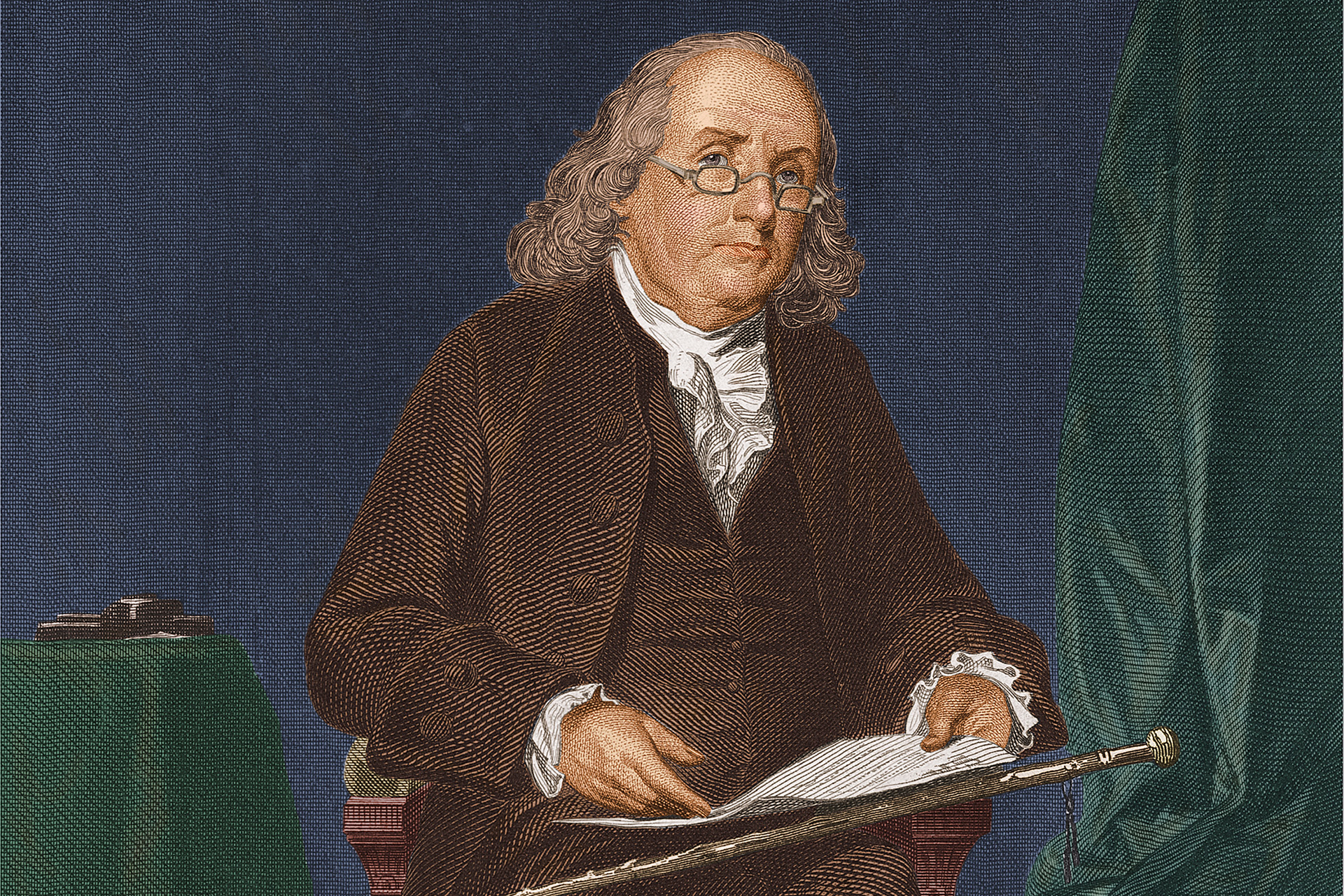
Ben Franklin on investing and compounding

Money makes money.  And the money that money makes, makes money. 

~ Benjamin Franklin

TIME for Kids | Benjamin Franklin | G3-4 

Sep 24, 2026

Lew Rockwell on how libertarians were right about 9/11

A libertarian must never tire of saying “I told you so.” Nor is there a dearth of opportunities to do so. Before 9-11, for example, it was the libertarians who said that 1990s sanctions against Iraq and broader intervention in the Middle East would inspire terrorism. The libertarians also warned that FAA regulations weren’t really making the airlines secure. The libertarians further saw that hundreds of billions spent on “defense” and “intelligence” weren’t really providing either. 

Thus was 9-11, two years ago, a big “I-told-you-so” moment for libertarians. The hijackers, seething in anger at US policy in the Gulf region and the Middle East, exploited a FAA-regulated system with plenty of loopholes for bad guys, to crash into a major financial center, and the US government, despite all its spending and promises, was powerless to stop it. 

And yet, in this upside-down world, the big message after 9-11 was not that the government and its ways had failed us. Quite the opposite. We were told that the government would save us. It was libertarianism that failed. 

Remember? Hillary Clinton, always exploiting the political moment, said of the efforts to cope on that awful day, “we saw government in action.… It was the elected officials who were leading and comforting.” That’s an odd way to describe running for their lives, prior to seizing power from their bureaucratic bunkers.

Vice President Dick Cheney said, “one of the things that’s changed so much since September 11th is the extent to which people do trust the government, big shift, and value it, and have higher expectations for what we can do.” The triumph of hope over experience! 

George Will wrote that “Sept. 11 forcefully reminded Americans that their nation-state…is the source of their security.… Events since Sept. 11 have underscored the limits of libertarianism.” He is speaking here of the same nation-state that stood by and did nothing as 19 guys with box cutters took down the twin towers.

Francis Fukuyama joined in to proclaim the “fall of the libertarians”: 

[9-11] was a reminder to Americans of why government exists, and why it has to tax citizens and spend money to promote collective interests. It was only the government, and not the market or individuals, that could be depended on to send firemen into buildings, or to fight terrorists, or to screen passengers at airports. 

Albert Hunt of the Wall Street Journal typified this genre of commentary. “It’s time to declare a moratorium on government-bashing,” he wrote. 

For a quarter-century, the dominant public culture has suggested government is more a problem than a solution.… But, as during previous catastrophes, America turns to government in crisis.… For the foreseeable future, the federal government is going to invest or spend more, regulate more and exercise more control over our lives… We will hear much less about the glories of privatization in areas like airport security.… Top Bush administration officials will have to dramatically alter their views on regulation.… Moreover, more muscular authority must be given to the new Office of Homeland Security…Tougher security measures at home are unavoidable.… But there is no real debate over expansion in general. Sept. 11 has underscored the centrality of government in our lives. 

So it went, across the political spectrum. The idea was that the events of that day had somehow refuted all our slogans about cutting government, privatization, personal liberty, markets, and peace. Clearly, they said, it was excessive liberty that had led to this disaster. It was cuts in government, and too little foreign belligerence, that brought it on, while the public sector, from the New York firemen to the military bosses who exacted vengeance abroad, saved us.

~ Lew Rockwell, "Times Change, Principles Don't," Mises Wire, September 11, 2003

Lew Rockwell - Wikipedija 

James Bovard on warnings prior to 9/11

I think if the American people had known how [many] warnings, how many signals the U.S. had ahead of time of this potential hijack conspiracy, there would’ve been far less of a reaction to rally around the flag and more criticism of the president.  Commentators thought it was great in the weeks after 9/11 that trust in government skyrocketed…  People need to keep their minds open.  People need to keep skeptical and critical.

~ James Bovard, C-SPAN Booknotes, September 25, 2003 (aired November 2, 2003)

2003


Sep 23, 2026

Nassim Taleb on the need for individual business failure

For the economy to be antifragile and undergo what is called evolution, every single individual business must necessarily be fragile, exposed to breaking - evolution needs organisms (or their genes) to die when supplanted by others, in order to achieve improvement, or to avoid reproduction when they are not as fit as someone else.  Accordingly, the antifragility of the higher level may require the fragility - and sacrifice - of the lower one.

[...]

Now, by disrupting the model, as we will see, with bailouts, governments typically favor a certain class of firms that are large enough to require being saved in order to avoid contagion to other business.  This is the opposite of healthy risk-taking; it is transferring fragility from the unfit to the collective.

~ Nassim Taleb, Antifragile: Things that gain from disorder, pp. 74-75


Steve Eisman on the AI ecosystem

I think about it like a chain.  So you've got Nvidia selling the chips.  Nothing wrong with selling chips.  You've got the hyperscalers buying the chips.  Nothing wrong if somebody buys the chips.  Where it starts to get squishy is something like 70% of AI revenue of the hyperscalers is just from OpenAI and Anthropic, and that's about 25% to 35% of their entire cloud revenue.  So basically, if you follow the entire chain down, the entire ecosystem is dependent on two companies - to say that they lose billions is a euphemism - and one of them I think is in trouble, which is OpenAI.

~ Steve Eisman, "Stock Picking in Difficult Times with George Noble," The Real Eisman Playbook, 16:40 mark, September 21, 2026 


Sep 22, 2026

Jacob Hornberger on how FDR provoked the Japanese attack on Pearl Harbor

By now, the evidence overwhelmingly establishes that President Franklin Roosevelt wanted the Japanese attack on Pearl Harbor to take place.  He desperately wanted to intervene in the war against Nazi Germany, but he faced a virtually insurmountable obstacle — the American people, most of whom firmly opposed U.S. entry into a second world war. 

Of course, this was during a time when presidents were still abiding by the U.S. Constitution’s requirement of a congressional declaration of war before a president could wage war against another nation-state.  FDR knew that he had virtually no chance whatsoever of securing such a declaration from Congress.

FDR knew that his only chance for getting the U.S. embroiled in World War II was to provoke Germany or Japan into attacking the United States.  In that case, he would be able to exclaim, “We’ve been attacked!  We’re innocent!  We were just minding our own business!  We have no choice but to defend ourselves!  Now, give me my declaration of war.” 

That’s what FDR’s oil embargo on Japan was intended to do — to provoke Japan into attacking the United States.  By preventing Japan from securing enough oil to fuel its war machine in China, FDR aimed to have Japan attack the U.S. Pacific Fleet so that Japan would have a free hand in securing oil in the Dutch East Indies without U.S. interference. 

When Japan attacked military ships at Pearl Harbor, FDR got what he wanted … and more.  Not only did he get his declaration of war against both Japan and Germany, he also got an aroused populace that immediately dropped its opposition to entry into World War II, rallied ’round the flag, and became enthusiastic supporters of the war. 

~ Jacob Hornberger, "Was 9/11 a New Pearl Harbor?," Power & Market, September 15, 2026

 Pearl Harbor attack | Date, History ...

Aug 12, 2026

Dan Wang on the U.S. vs. China

I start my book, my very first paragraph, to say that Chinese and Americans are more alike than any other people...  They're the two great founts of entrepreneurial dynamism in the world.  It is Shenzhen and Silicon Valley that are inventing the future and not so much Europe and Japan any longer.  There's kind of a hustle energy, there's a hastiness... [25:30]

That's another similarity between the U.S. and China: They're often very future-oriented.  They have a sense of optimism, much more so than the Europeans who have a sense of optimism only about the past. [27:45]

[...]

Maybe we can say that China right now has some of the control paranoia of the Soviet Union, some of the manufacturing excellence of Japan and some of the American entrepreneurial hustle.  You combine all of that and that is part of the reason that I think that China is going to be a pretty formidable power going forward.  [1:05:50]

[...] 

I think that China will not become anything like a cultural superpower in part because the engineers are so censorious.  They're so thin-skinned, they censor everything they can't understand, which is a lot.  If you take a look at a lot of aspects of cultural prediction, whether that is books, novels, films, China really has become much more constricted over the past 12 years of Xi's rule.  I think that China will not become anything like a big financial superpower in part because the control tendencies of the engineers is to impose a lot of capital controls and that makes it much more difficult for foreigners to want to hold RMB.  [1:10:20]

[...]

I want the U.S. to be 20% more engineering and I want China to be 50% more lawerly.  I think that it would be amazing if the Chinese state actually respected the creative impulses of its own people... if individual rights would actually be respected.  [1:30:00]

[...]

We can and should recognize both of these things, that repression can grow worse while technological dynamism grows richer.  I always feel myself that I have to fight this two-front war against people who think that China will collapse because of all the repression or that, because China's economic growth has been so impressive at lifting so many millions of people out of poverty, that gives the Communist Party a free pass on all of the sorts of violations that it has inflicted upon the people.  I think we can acknowledge both things are true, that the Communist Party has grown oppressive in more novel ways over the past 10 to 30 years; at the same time, it has grown richer and more technologically capable.  [1:37:20]

~ Dan Wang, "Dan Wang - The US vs China in the 21st Century," Invest Like the Best with Patrick O'Shaughnessy, October 16, 2025

Dan Wang | Technology Analyst | Chartwell Speakers


Aug 5, 2026

The Wall Street Journal on Leopold Aschenbrenner’s meteoric rise

Leopold Aschenbrenner’s forecasts about the future of artificial intelligence earned him a cult following on the internet, where his investment firm’s routine regulatory filings are studied like scripture. 

The parabolic performance of his hedge fund has given the 24-year-old Aschenbrenner a fan club on Wall Street, too. 

Aschenbrenner had no professional investing experience when he launched his AI-focused firm, Situational Awareness, less than two years ago, with a few hundred million dollars. 

Prescient stock picks and whooshes of inflows have vaulted its assets under management to more than $20 billion, according to people familiar with the matter, approaching the size of Bill Ackman’s Pershing Square and Dan Loeb’s Third Point.

~ "The 24-Year-Old AI Wiz Who Counts Jane Street as an Investor," The Wall Street Journal, June 8, 2026

Leopold Aschenbrenner, founder of Situational Awareness 


Jul 24, 2026

Dwight D. Eisenhower on the costs of the arms race with the Soviet Union

Every gun that is made, every warship launched, every rocket fired signifies, in the final sense, a theft from those who hunger and are not fed, those who are cold and are not clothed.  This world in arms is not spending money alone.  It is spending the sweat of its laborers, the genius of its scientists, the hopes of its children.  The cost of one modern heavy bomber is this: a modern brick school in more than 30 cities.  It is two electric power plants, each serving a town of 60,000 population.  It is two fine, fully equipped hospitals.  It is some fifty miles of concrete pavement.  We pay for a single fighter with a half-million bushels of wheat.  We pay for a single destroyer with new homes that could have housed more than 8,000 people...  This is not a way of life at all, in any true sense.  Under the cloud of threatening war, it is humanity hanging from a cross of iron.

~ President Dwight D. Eisenhower, "Chance for Peace" speech, April 16, 1953 

(Eisenhower delivered the address to the American Society of Newspaper Editors in Washington, D.C. - broadcast nationwide - shortly after Joseph Stalin’s death and early in his presidency.  The passage highlights the human and economic costs of the arms race, comparing military spending to resources that could instead fund schools, power plants, hospitals, housing, and food.)

Eisenhower's "Cross of Iron" Speech - Clio 

Jul 22, 2026

Kevin Duffy on the Austrian case for free trade

The Austrian (praxeological) method involves deductive reasoning, thought experiments, methodological individualism.  The only way to refute a logical argument is with better logic.  In trade, party A trades with B. Both do so because they benefit.  More accurately, because they expect to benefit.  Both expect to get more through the trade than they give up.  This doesn't mean in a week or a year neither will have regrets, but they do so because they expect to benefit. 

Now party C comes along and wants to interfere.  There are several problems: 

1. Knowledge - Does party C know something that A and B do not? 

2. Objectivity and altruism - Is party C above self-interest? 

3. Motive - By interfering, is party C benefiting at the expense of A and B?

4. Morality - What right does party C have to interfere?

Compounding this problem is that the state (a territorial monopolist on the use of force) acts as agent for party C.  It uses violence to interfere.  The state itself is not above self-interest; it has its own motives.  It benefits by being a broker in political favors.  Finally, there is the cost of maintaining the state, which is paid through violence (taxation). 

It's crystal clear who benefits from free trade (the people) and who benefits from attacking it (the state and special interests seeking protection and privileges).  This is where the intellectuals come in: They are needed in order to blind people to being fleeced.

~ Kevin Duffy

10 ways to Navigate Trade in the Food Industry 

Jul 17, 2026

Jim Chanos on bull and bear markets

Bull markets, you put a premium on promises and bear markets, you put a discount on reality.  And we're clearly in the former right now.

~ Jim Chanos,  "Jim Chanos: The AI Bubble Is 'Much Worse' Than Dot-Com," RiskReversal Media, 45:40 mark, July 17, 2026


Jun 18, 2026

Grant's on how CEOs of AI builders see massive demand swamping supply

Open before us is page 8 of the June 8 edition of The Transcript, a weekly roundup of earnings-call excerpts.  The first quotation, from Lip-Bu Tan, CEO of Intel Corp., sets the tone for what follows: "We see token usage exploding.  Agent now consumes 1,000x more tokens than single-event reasoning."

Sundar Pichai, CEO of Alphabet, Inc., is next: "[W]e are experiencing strong demand for our AI solutions from enterprises and consumers, at levels that are meaningfully exceeding our available supply."

He is followed by the CEO of Microsoft Corp., Satya Nadella: "[W]e are supply-constrained...  The thing that we do not want to do is to disappoint especially our enterprise consumers on Azure."

Then comes Jeffrey Clarke, COO of Dell Technologies: "Demand continues to exceed supply with memory as the primary constraint, and we expect to exit the year with meaningful backlog."

And not to forget Jensen Huang, CEO of Nvidia Corp.: "[W]e don't have enough supply.  The reason for that is because the world supply chain is supply-constrained.  We have the support of our ecosystem to have very robust growth, and well in support of whatever guidance we've provided."

Finally appears the CEO of Cerebras Systems, Inc., Andrew Feldman: "What is unusual about AI right now is the builders are so far behind the demand, it's absurd.  We have a backlog of more than $2 billion of demand...  [N]one of us, not us, not AMD, not Nvidia, can keep up with the demand that your employees are driving.  And that's sort of, in a lot of ways, the opposite of a bubble.  We are chasing, right?  Our customers and their customers are moving at the speed of software, and we're moving at the speed of real estate, data centers, right?  Um, and so we are behind."

~ Grant's Interest Rate Observer, "Hanging by a stock price," June 19, 2026

Pichai and Huang 

Jun 16, 2026

Evan Lorenz on DeepSeek's latest model, V4

Evan Lorenz: In January 2025, DeepSeek released its R1 model, which offered comparable performance to the best Western chatbots at a fraction of the price.  As Western investors digested the news of cut-rate, Chinese competition, the Nasdaq sold off.

Grant's: Mr. Market is turning a blind eye so far to the recent unveiling of DeepSeek's latest model, V4.  Like R1, V4 slightly underperforms the leading Western competition but sells at a fraction of the Western cost.  Bloomberg explains how: "DeepSeek's trillion-parameter system uses the Mixture-of-Experts technique, selectively triggering only a small subset of experts and activating only up to 37 billion parameters per task to keep inference costs far lower than for similar frontier models."

DeepSeek has put its model up for sale at 75% off until the end of the month, but once that discount ends, V4 will cost between just one-tenth to one-quarter of the leading American equivalents.

Lorenz: Price competition is what just might deflate the high-cost and capital-intensive AI boom.

~ Evan Lorenz, "The way the boom ends," Grant's Interest Rate Observer, May 8, 2026

🚀 🚨 Stop Everything — DeepSeek V4 Might Be the Smartest Coding AI of 2026  | by Greek Ai | GoPenAI 

OpenAI's CFO: "We are facing a vertical wall of demand"

Right now we are facing a vertical wall of demand.  If there are areas where we are not achieving certain goals, I would say it is often the lack of computational capacity that is slowing us down to some extent. 

~ Sarah Friar, OpenAI chief financial officer, Bloomberg interview, "OpenAI: We see a vertical wall of demand for our products," 24 ORE, May 1, 2026

Sarah Friar Bloomberg 

Jun 15, 2026

Karen Kwiatkowski on the Iran war: a tale of two empires

Our military footprint in the Gulf and the region has contracted; this will continue.  What we just watched over the past 100 days was an unusually vivid moment in the long slow collapse of the US military and financial empire. 

Conversely, tiny Israel saw its fluid borders expand in all four directions.  The cover of this war coincided with new bases in Somaliland, new gas fields through occupation of southern Lebanon and Gaza, massive Israeli expansion through land and political purchase in Greece, Cyprus, and Albania, and the exponential erasure of Gazans, Palestinians, Lebanese and Syrians. 

[...]

A truly defensive military and intelligence apparatus, at a fifth or even a tenth of what we spend today, as well as a structural jettisoning of special alliances that animate the current defense budget and focus, including but not limited to Israel, are now within reach for the US, in part because of what happened over the past 100 days.  The empire will oppose any changes in this direction, but our dry shell of an empire has few choices. 

In a strange way Trump will bring the troops home, and end US wars of choice, and like the captain of the Titanic, he will ride the ship, damaged by arrogance and overreach, into the deep. 

But before the empire fades, it retrenches, and global war-mongering becomes totalitarianism at home, national intelligence becomes domestic surveillance, AI looks inward to identify potential enemies of the state, and maps their communities for decimation or economic lockdown.

[...]

Today, we are in the midst of the collapse of two empires, one tiny and vicious, the other lumbering and lazy.  These two empires suffer different illusions, but Israel, under fascist Zionism, has dibs on discipline and seeks to rule.

[...]

US imperial retrenchment has been happening under our very noses, slowly at first with our devalued currency and never-ending wars, but the pace is quickening.  Notably in this 250th year after the Declaration of Independence, every American needs to be prepared for war at home.

~ Karen Kwiatkowski, "The US Empire is Retrenching, Bringing Imperialism Home," LewRockwell.com, June 15, 2026

Trump/Netanyahu: Israel, America and ... 

Jun 5, 2026

Ed Zitron on AI ROI

I think people are conflating a semiconductor rally with an underlying successful business, which doesn't really exist.  Anthropic's current revenue growth, which is deeply questionable and the fact that they "leaked" profitability - manipulated by Elon Musk, of course - their growth is coming because people cannot measure how much an AI task actually costs.  And a couple months ago, Anthpropic actually started charging their enterprise customers the actual token rates.  What this has led to is suddenly businesses are saying, "Oh, how much money are we spending?"  Uber's COO Andrew McDonald said that they are having trouble justifying the AI spend based on the actual return when one can actually measure it.  So you've got a thing where you can't measure the costs and you can't measure the return on investment.  What do you call that?  You call it a thing without an ROI.

~ Ed Zitron, EZ Primary Research CEO, interview on Bloomberg Businessweek Daily, June 4, 2026


Jun 2, 2026

Aristotle on knowledge

The purpose of knowledge is action, not knowledge. 

~ Aristotle

Image 

Dan Niles on the importance of OpenClaw

The one thing you have going on right now that you didn't have during the internet build out, on January 30th you had the formalization of this thing called OpenClaw [a free, open-source, self-hosted autonomous AI personal assistant/agent], which really kicked off the whole agentic [AI] move by corporations.  So Dan Nathan, instead of prior to that saying, "I'm going to ask ChatGPT a question, it's going to give me an answer" might go to ChatGPT and instead of asking, "Well, how did internet stocks perform in the late '90s?" you might go and ask ChatGPT, "Hey, go to Bloomberg, pull down data for all of these 20 internet companies, then go to the SEC website and go look at the 10-Ks and Qs, see if there were any writedowns, and then go and see what the news stories were at The Wall Street Journal, and then create a spreadsheet where I'm putting all of this data."

When you do that, that takes 10 to 100 times more tokens [basic units of text that the LLM reads, processes and generates; 100 tokens ≈ 75 words] and you can see that in the tokens being generated.  And so you have this step function change in compute demand caused by that that started on January 30th.  So I think you're going to see very strong demand for at least another year until you sort of anniversary that, and I think stocks continue to go higher because of that.  

Do I think we're in a bubble?  100%.  Do I think we're going to get a 30-50% drawdown at some point next year?  Yes.  But, do I think you can make a lot of money between now and then?  I think the answer to that is also, yes.

 ~ Dan Niles, "We're 100% in a Bubble and Dan Niles is Still Buying," RiskReversal Media, 6:00 mark, May 29, 2026


Dan Niles on agentic AI and the need for compute

With agentic [AI] you're doing multiple actions, multiple calls to APIs, opening up applications like an Excel or a Bloomberg or a CNBC website or SEC website, etc. and doing all of these things.  So you need an orchestration engine.  You need something that goes ahead and organizes all of that.  That's what CPUs do very well.  If you go back to training, you're just doing the same thing over and over again where you are training these AIs.  That's what a GPU does incredibly well, and that's why you saw an Nvidia absolutely explode higher because CPUs weren't really valuable in training.  You move to chat-based AI, again, that's pretty decent for a GPU, but now when you move to agentic, that's great for a CPU.  So you went originally from about 8 GPUs for 1 CPU.  When you move to agentic, that ratio gets closer to 1-to-1.

[...]

Agentic [AI] requires 10 to 100 times more tokens than chat-based AI.

~ Dan Niles, "Dan Niles: Be Nimble - 30-50% AI Crash By 2027," The Master Investor Podcast with Wilfred Frost, 11:40 mark, May 12, 2026


May 25, 2026

Dario Perkins on the AI capex debate

With U.S. tech stocks melting higher, the bulls are clearly “winning.” Two forces are driving this revival in sentiment. First, revenues across the AI ecosystem have surged, which seems to contradict the bears’ worries about data-center profitability. Second, we are seeing extremely strong demand for compute, which helps to alleviate investors’ worries about “overinvestment.” 

From our perspective, however, the debate about the sustainability of AI capex hasn’t been settled. Far from it. That’s because what we are seeing now is still largely just the result of revenue recycling, rather than the entry of new funds from outside the AI ecosystem. 

To illustrate: This year the hyperscalers are set to spend around $700 billion on data centers. That is a huge sum. Not only does it directly boost the revenues of the companies that provide the infrastructure, but the hyperscalers are also booking revenues from the recycling of those investments, either as order backlogs (“commitments” from the likes of OpenAI) or as “other revenues” (derived from the hyperscalers taking an equity stake in their customers and then recording large capital gains). 

Meanwhile, it is the model developers and the hyperscalers that are still driving much of the increase in demand for compute, as they put those massive AI investments to work. This whole ecosystem is massively circular; and while those circular dynamics clearly have a lot of momentum, that, in itself, isn’t enough for medium-term sustainability. For AI capex to be sustainable over the medium term, there needs to be a much larger share of revenue (and compute demand) from outside the ecosystem, particularly from business and consumer demand. Capex recycling isn’t enough. 

~ Dario Perkins, "The AI capex debate—who is right?," Macro Picture/TS Lombard, May 21, 2026

Fade Trump Chaos Until The Tipping ... 

May 18, 2026

Kevin Duffy on U.S. aggressions against Iran

The world doesn't trust Iran because it has memory-holed past U.S. aggressions: 

1953 - CIA-led coup overthrows democratically elected prime minister of Iran, Mohammad Mosaddegh; installs U.S.-friendly Shah, authoritarian monarch. 

1957 - SAVAK (secret police) is established with CIA and Israeli (Mossad) assistance; this becomes the Shah’s primary tool of repression. 

1979 - U.S. first imposes sanctions after the Shah is overthrown; these undergo a major expansion in 1995 under Clinton. 

1980-1988 - U.S. backs Saddam Hussein in Iran-Iraq War, costing hundreds of thousands of Iranian lives 

1988 - USS Vincennes “mistakenly” shoots down civilian Iran Air Flight 655 on July 3 over the Strait of Hormuz. All 290 aboard are killed, including 254 Iranians and 66 children. The US calls it a tragic error in a combat zone; Iran views it as deliberate. 

2025-2026 - US and Israeli strikes on Iran (starting late February 2025/early 2026) cause thousands of Iranian deaths, including a missile strike that hit the Shajareh Tayyebeh girls’ elementary school in southern Iran, costing 156 lives, 120 of them schoolchildren.

~ Kevin Duffy, tweet, April 28, 2026

Minab school bombing: how the worst mass casualty event of the Iran war  unfolded – a visual guide | US-Israel war on Iran | The Guardian 

Apr 29, 2026

Hans-Hermann Hoppe on democracy

What is true, just and beautiful is not determined by popular vote.  The masses everywhere are ignorant, short-sighted, motivated by envy, and easy to fool.  Democratic politicians must appeal to these masses in order to be elected.  Whoever is the best demagogue will win.  Almost by necessity, then, democracy will lead to the perversion of truth, justice and beauty.

~ Hans-Hermann Hoppe, Democracy: The God That Failed, 2001 

Hans-Hermann Hoppe - Wikiquote 

Kevin Duffy and Jeremy Hammond on participatory democracy, i.e. voting

Duffy: A key pillar of the statist belief system is participatory democracy.  Everyone gets a say (or vote), no matter how ignorant they are of the inner workings of the system.  This way critics like us are more easily dismissed.  Normally, 10,000 hours of study would qualify us as "experts," but not in this case.  There are no valued experts on the system itself.  It's simply assumed to be the greatest system of societal organization ever conceived by mankind.  To suggest otherwise is to be dismissed as a heretic. 

Hammond: Ah, yes, a huge part of the problem is the compulsion to vote—or as I prefer to describe it, to act to legitimize the criminal organization in Washington. I don't want to bicker over which head of the beast should devour us; I want to slay the beast.

~ Kevin Duffy and Jeremy Hammond, email exchange, April 29, 2026

Politics of Monarchy,... 9780765800886 ... 

Jeremy Hammond on statism

It is too discomforting for people who cling to a statist belief system to conceive of the possibility that their whole perception of society and government is mistaken, that the government is not some benevolent force for good but a criminal organization perpetually doing evil.  Their minds cannot handle it.  They choose self-delusion over love of truth.

~ Jeremy Hammond


Apr 21, 2026

Bob Dylan on war and religion

Oh, my name, it ain't nothin', my age, it means less 
The country I come from is called the Midwest
I's taught and brought up there, the laws to abide 
And that the land that I live in has God on its side
 
Oh, the history books tell it, they tell it so well 
The cavalries charged, the Indians fell 
The cavalries charged, the Indians died 
Oh, the country was young with God on its side 
 
The Spanish-American War had its day
And the Civil War too was soon laid away 
And the names of the heroes I was made to memorize 
With guns in their hands and God on their side
 
The First World War, boys, it came and it went 
The reason for fightin' I never did get 
But I learned to accept it, accept it with pride 
For you don't count the dead when God's on your side
 
The Second World War came to an end 
We forgave the Germans, and then we were friends 
Though they murdered six million, in the ovens they fried 
The Germans now too have God on their side 
 
I learned to hate the Russians all through my whole life 
If another war comes, it's them we must fight 
To hate them and fear them, to run and to hide 
And accept it all bravely with God on my side 
 
But now we've got weapons of chemical dust
If fire them we're forced to, then fire them we must 
One push of the button and they shot the world wide 
And you never ask questions when God's on your side 
 
Through many dark hour I been thinkin' about this 
That Jesus Christ was betrayed by a kiss 
But I can't think for you, you'll have to decide 
Whether Judas Iscariot had God on his side 
 
So now as I'm leavin', I'm weary as hell 
The confusion I'm feelin' ain't no tongue can tell 
The words fill my head, and they fall to the floor 
That if God's on our side, he'll stop the next war
 
~ Bob Dylan, "With God With God on Our Side," 1964
 
song and lyrics by Bob Dylan | Spotify