Showing posts with label people - Greenspan; Alan. Show all posts

Aug 18, 2020

Kevin Duffy on government "experts"

Imagine an expert who advocates a laissez faire approach to any problem.  He or she wouldn’t advance very far in “the expert model.”  For example, Alan Greenspan, a social climber above all, realized this at an early age and changed his worldview (which originally favored a gold standard).  Others, like Henry Kissinger, are plucked out of obscurity and promoted because their views are in perfect alignment with those of the political establishment.  Milton Friedman was a clever, but unusual choice for respectability.  Known for his free market views, Friedman was a monetarist who argued for greater intervention by the Federal Reserve in the 1930s to prevent the Great Depression.  He would later influence a man named Ben Bernanke, champion of “helicopter money.”

In order to rise through the ranks, economists, geopolitical consultants, regulators, and health experts must conform to the interventionist script.

~ Kevin Duffy, "The Expert Model," LewRockwell.com, May 27, 2020

Helicopter Ben: Arsonist Turned into Firefighter

May 29, 2020

Alan Greenspan on improvements in lending technology (2004)

Improvements in lending practices driven by information technology have enabled lenders to reach out to households with previously unrecognized borrowing capacities.

~ Alan Greenspan, remarks before America's Community Bankers in Washington, DC, October 19, 2004

President backs Greenspan | The Spokesman-Review

Sep 4, 2019

Alan Greenspan sees negative interest rates spreading to the U.S. (2019)

You’re seeing it pretty much throughout the world. It’s only a matter of time before it’s more in the United States.

~ Alan Greenspan, "Alan Greenspan says it’s ‘only a matter of time’ before negative rates spread to the US," CNBC interview, September 4, 2019

Oct 27, 2018

Kevin Duffy on Alan Greenspan, the enabler of all of the problems he sees today

To the editor,

This was quite a revealing interview; thank you for bringing it to us.  It is a good example of how politicians can become more honest the further removed they are from office and closer to meeting their maker.  Greenspan was quite frank about serious problems like entitlements, lack of savings, trade wars, budget deficits, price inflation and a bond bubble.  However, he was less honest (with himself) about his own role in enabling these: first, heading a commission to “fix” Social Security which expanded payroll taxes and second, presiding over a Federal Reserve that suppressed interest rates and created moral hazard (the “Greenspan put”), resulting in asset bubbles and a “Too Big to Fail” banking crisis.  Worse, his short-term success was endorsed by Milton Friedman in 2006 and central bankers all over the world copied his easy money policies, fomenting the “everything bubble” and enabling a global debt buildup unparalleled during peacetime.

While Reshma Kapadia admitted that the financial crisis “cast a more critical light on Greenspan’s tenure of low interest rates,” she unfortunately added the bromide, “and his faith in the market’s ability to self-regulate.”  Interest rates are the ultimate regulator of time preference, rewarding savers for their willingness to defer consumption and invest in greater production in the future.  By setting non-market rates below their natural level, Greenspan discouraged savings and sapped productivity, the very things he worries about.  Let’s be clear: central banking is at the root of our economic ills today, not free markets.

~ Kevin Duffy, letter-to-the-editor sent to Barron's, but never published, October 21, 2018

Feb 1, 2018

Alan Greenspan on bubbles in stocks and bonds

I think there are two bubbles.  We have a stock market bubble and we have a bond market bubble.  I think in the end of the day the bond market bubble will be the critical issue.  But for the short-term it's not too bad, but we're working obviously towards a major increase in long-term interest rates and that has a very important impact... on the whole structure of the economy.

~ Alan Greenspan, interview on Bloomberg TV, January 31, 2018

(He blamed the bond bubble on fiscal deficits.  No mention of the role of central banks.)

Dec 4, 2013

Greenspan spots bubble before the burst

It’s a bubble. It has to have intrinsic value. You have to really stretch your imagination to infer what the intrinsic value of Bitcoin is. I haven’t been able to do it. Maybe somebody else can.

I do not understand where the backing of Bitcoin is coming from. There is no fundamental issue of capabilities of repaying it in anything which is universally acceptable, which is either intrinsic value of the currency or the credit or trust of the individual who is issuing the money, whether it’s a government or an individual.

~ Greenspan says Bitcoin is a bubble with no intrinsic value, Bloomberg, December 4, 2013

Nov 26, 2013

Alan Greenspan sees no bubble... again (2013)

There are a lot of things that can go wrong, but to say that the market is bubbly and in a position where it could conceivably create a serious problem, I think is overstating it.

~ Alan Greenspan, FOX Business News, "Greenspan to FBN: Stocks Aren't in a Bubble," November 26, 2013

Jun 23, 2013

Alan Greenspan on the Fed's exit strategy

The sooner we come to grips with this excessive level of assets on the balance sheet of the Federal Reserve - that everybody agrees is excessive - the better.  There is a general presumption that we can wait indefinitely and make judgments on when we're going to move.  I'm not sure the market will allow us to do that.

~ Alan Greenspan, as appeared on CNBC, June 7, 2013

Mar 5, 2013

Alan Greenspan gives speech defending his bubble record

Fasciano asked whether laissez-faire capitalism inherently gives rise to tail risk, and if so, if this is an acceptable risk.

Greenspan replied that if you want to guarantee that that there will be no bubbles, you should have an economy like the Soviet Union’s. A regimented society does not have bubbles; it also doesn't have Standard Oil. We also wouldn't have bubbles if we didn't have human nature, he said. Bubbles come from euphoria, which is a deep-seated inbred characteristic that vies with fear. When we switch from fear to euphoria, bubbles can be the result. Behavioral economists refer to “herd behavior.” We’ve all observed this, when people run in in one direction in droves, like lemmings running over a cliff. And we do that. Yes, Greenspan said, it happens all the time and always will unless human nature changes, which it won’t. Don't question it.

If we wanted the monetary authorities to impose terrible inflation, we would not have stock market bubbles, “I guarantee it.” So the question is, do we live with these problems – and they are problems, but there’s no way around them – or do we live in a highly regimented society? We could impose enough regulations on the financial system, Greenspan said, that bubbles would not occur. But we can’t have it both ways.  [...]

Greenspan was accorded the moniker “The Maestro,” but he has also been accused of fomenting the housing bubble by keeping interest rates low in the early 2000s, following the collapse of the dot-com bubble.  He's also faced criticism for failing to recognize the existence of that bubble during his tenure as Fed chairman, arguing that "national price distortion" in housing prices was unlikely.  He responded to those claims.

In looking back on the crisis in residential housing, Greenspan said that it was clear at the time that housing was in a bubble. He pointed out, however, that we had just come out of the dot-com bubble, which had virtually no economic effect, and the “so-called” recession 2001 was barely visible. This suggested, he said, that we could probably get through the housing bubble. But he and others made the mistake of recognizing only too late that the dot-com bubble didn't amount to a big problem largely because the toxic assets of the time, which were equities, collapsed in institutions that were not leveraged. Therefore, although there was a very large capital loss, there weren’t the bankruptcies and sequential losses that occur when a leveraged institution holds toxic assets.

The mortgage-debt problem of the 2008 financial crisis was different, according to Greenspan. Mortgages were held in very large leveraged institutions. If we had somehow had the dot-com boom second, it would have been interesting to see how different history might have been, he said.

~ Adam Jared Apt, synopsis of Alan Greenspan speech given to Boston Security Analysts Society, February 12, 2013

Alan Greenspan gives speech on virtues of Fed-induced asset inflation

Another plus Greenspan cited was the state of the equity markets. In his words, equity premiums are now at almost the highest level in American history, which means that the market is pleased with the economic outlook and the downside risk is at a minimum. It was extraordinary, he said, to see how far the markets had gone down by March of 2009, when price-to-earnings ratios were at a level where “human beings don’t allow them to go any further.” Although we’re considerably up from there, there is still the possibility of a further rise, he said.  [...]

People don’t realize the significance of equity prices, and asset prices in general, for day-to-day economic activity, according to Greenspan. His research shows that equity markets are not only a leading economic indicator, but, much more important, they are fundamental creators of economic activity. Approximately 6% of the growth in GDP is funded by a rise in equity values, on average, though this varies considerably. As a result, increasing equity values can be even more important for economic growth than fiscal stimulus.

The problem with fiscal stimulus is that we measure it gross, by how much it puts into the economy, but we don’t put debits against it. The evidence is unambiguous, according to Greenspan, that rapid increases in deficits raise the expectation of taxes, engendering uncertainty in the business community and leading to significant declines in private capital investment. This lowers the impact of a fiscal stimulus by one-fourth to one-half and possibly significantly more, depending upon conditions. An equity stimulus doesn’t have this negative aspect. The data after March 2009 make clear that the equity stimulus drove the economy. Greenspan acknowledged that an equity stimulus brings with it an increase in private debt, “but not more than the system can handle.”  [...]

Although the housing market is recovering – foreclosures are clearly declining, and the market is beginning to clear – Greenspan said he was reminded of 2008. At that time, half of remediated mortgages went into default again after six months. As prices have gone up and people have built up equity in their homes, that proportion has now fallen to 10%. The key to recovery is having people build up equity in their homes. As that happens, it builds up a cushion; as prices go up 10% or 15%, the underwater homes are cleared out. Remediation made no sense. If we had let the markets adjust themselves, that is, allowed the kind of selling climaxes that clean out an illiquid market and caused prices to fall to a level where the market cleared, we would have been far better off, according to Greenspan.  [...]

~ Adam Jared Apt, synopsis of Alan Greenspan speech given to Boston Security Analysts Society, February 12, 2013
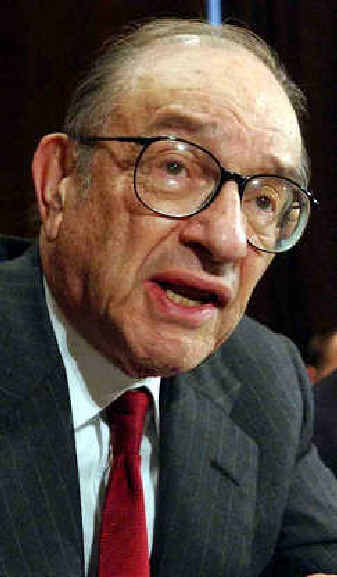
Aug 23, 2011

Alan Greenspan on how he used 'Fedspeak' in Congressional hearings

I would engage in some form of "syntax destruction", which sounded as though I were answering the question but in fact, had not.

~Alan Greenspan, former chairman, Federal Reserve, CBS "60 Minutes" interview, September 16, 2007

Aug 8, 2011

Alan Greenspan on why US Treasury Bonds are still safe

This is not an issue of credit rating. The United States can pay any debt it has because we can always print money to do that. So, there is zero probability of default.

~ Alan Greenspan, "the Maestro" and former chairman, Federal Reserve, MSNBC's Meet the Press, August 7, 2011

Jul 25, 2011

Joe Granville on the expected soft landing (2000)

I am pretty certain that Alan Greenspan would never have agreed to another four-year term if he feared a stock market collapse during his tenure. At least over the next nine months we can relax and expect a soft landing and no recession. Bad news will be out and good news will be in.

~ Joe Granville, The Granville Market Letter, July 13, 2000

(Source: Barron's, July 24, 2000, p. 33)

Jul 14, 2011

Alan Greenspan on the Bush tax cuts

I was in favor of the Bush tax cuts. on the grounds that it was the dissipation of a surplus. As soon as it became obvious that the surplus disappeared, I no longer supported that. My view about taxes is I would like them as low as possible but not with borrowed money.

~Alan Greenspan, former chairman, Federal Reserve, CNBC interview, June 30, 2011

Alan Greenspan on the return of the Greek drachma

A greek default is inevitable. If there is not fiscal consolidation, I cannot see any credible scenario where the Greek drachma does not come back.

~Alan Greenspan, former chairman, Federal Reserve, CNBC interview, June 30, 2011

Alan Greenspan on the inevitability of a Greek default

There's only two possible givens: there's a Greek default or there is a fiscal consolidation of the 17 countries of the Euro Zone.

I find that unlikely except for the fact that Germany is so key to that decision. Germany's caught up in a very critical political dilemma. If they were to stop and stop supporting Greece and Greece went under, what would very likely happen, we'd get some dismantling of the euro. What the Germans are resting on is a very strong export market, the result of the fact that the euro, relative to euro, relative to the eollar, is lower.

If, however, Germany goes back to the Deutschmark, which almost surely would be worth 20% more than the euro, they would have a huge capital gain. Remember, their liabilities would be much lower, but the very high Deutschmark would mean their exports would be under severe contraction. They have this short term problem of "how do we keep exports going, employment good?" Remember, they're doing very well, a very large part of that is they are supporting the transfer of a very large amounts of money.

That keeps the euro in place. It also keeps exports, as a critical variable.

~Alan Greenspan, former chairman, Federal Reserve, CNBC interview, June 30, 2011

Alan Greenspan says the motor of the US economy is Greece

It's very evident to anybody that looks at the data the major force driving our economy indirectly through the financial markets is Greece. As the Greek default goes up in probability, we run into all sorts of problems. largely, not because the United States has a lot of Greek debt. As you know, it doesn't. It's essentially that we have very large commitments in Europe and Europe is critical to not only holding the Greek debt, but I might add, also where I think approximately half the foreign affiliate earnings are generated.

So if Europe runs into trouble because of Greece, it's going hit us two ways. One, the basic commitment that we have to Europe and the usual financial flows, but in addition, it's going to affect the whole structure of profitability in the United States. Because we can't afford a [mumbled] and foreign affiliate earnings in Europe coming down significantly.

~Alan Greenspan, former chairman, Federal Reserve, CNBC interview, June 30, 2011

Alan Greenspan on the real reason the stock market has risen since 2009

There is an alternate explanation for the rise in the stock market, particularly since early 2009 and that is the  extraordinary increase in productivity in non-financial corporations. Not only labor productivity but productivity in energy, in the use of materials, and a number of other things. And if you construct that into a profit margin indicator, it directly causes a major rise in profit margins, a major rise in earnings, which we've seen. But, because of the so-called equity premium, the price people have to pay for stocks, or, I should say, that issuers have to pay for stocks, in order to get money relative to bonds, that is at the highest level in 50 years.

So, you have earnings pushing up against the structure of a very immobile equity premium and algebraically, the relationship of those two, is the stock price.

~Alan Greenspan, former chairman, Federal Reserve, CNBC interview, June 30, 2011

Feb 18, 2011

Alan Greenspan says "Not bad", gives his monetary policy credit following '08 Dow plunge

Greenspan brought up the fateful day in September 2008 when the Dow Jones industrial average plunged 6.98 percent. However, life picked up for him after the initial shock.

"The morning after we learned of the news," he said, "I was able to look myself in the mirror and say, 'Hey, not bad.'"

According to Paulson, the recovery process has been rather "tepid." Greenspan attributed the slow recovery to excessive government activism.

"What I'd suggest is that we calm down; let the economy heal by itself," he said. "But we are doing better now with the halting of more stimului and programs like 'Cash for Clunkers."

Greenspan also emphasized that the future health of the housing sector would depend on the phasing out of "contradictory" government-instilled institutions like Freddie Mac and Fannie Mae, whose objective of providing affordable housing conflicted with the necessity to "maximize profit for shareholders."

~Alan Greenspan, former Fed chairman, "Greenspan, Paulson discuss politics and economy", NYU Washington Square News, February 17, 2011

Aug 18, 2010

Alan Greenspan predicts a rosy future for the US economy and equities markets (1973)

It's very rare that you can be as unqualifiedly bullish as you can now.

~Alan Greenspan, then future-Federal Reserve Chairman, The New York Times "Economic Survey", January 7, 1973

(1973 and 1974 turned out to be the worst years for economic growth and the stock market since the Great Depression, as noted in Jason Zweig's commentary in "The Intelligent Investor")