Showing posts with label trade deficit. Show all posts

Apr 22, 2025

Bill Strong and Stephen Rahl on comparative advantage, trade deficits and reserve currency status

“The reality... is that the international trade system is designed to cheat us... every country around the world cheats us.” 

~ Peter Navarro, Counselor to the President of the United States 

“Navarro is dumber than a sack of bricks... Navarro is truly a moron.  What he says is demonstrably false.”

~ Elon Musk, Senior Advisor to the President of the United States

David Ricardo was not “dumber than a sack of bricks.”  Rather, the brilliant, early 19th-century British economist developed the theory of comparative advantage, in opposition to the then, widely accepted, mercantilism.  In his “Principles of Political Economy and Taxation” (1817) he proves that countries running trade surpluses are not “cheating” their trade partners and that free trade benefits both parties, regardless of which runs a surplus/deficit. 

Since Ricardo’s era, in the modern globalized trading world the country that has the world reserve currency must, by necessity, sustain a current account deficit.  This is because the extra demand for its “international” money must overvalue its currency.  This ensures that said country sustains more imports than exports, penalizing its net trade balance into long-term deficit.

Hence, the American dollar’s global trade dominance status provides the US with an “exorbitant privilege”—permitting only Americans to enjoy a permanent trade deficit and allowing us to live better than we otherwise would.  The idea that eliminating our current account deficit would “make America wealthy again” is exactly backwards. 

Rhetoric surrounding the radical “Liberation Day” tariff regime ignores Ricardo and harkens back to the good-old-days of tail fins and American manufacturing dominance.  We remember Dad’s made-in-Detroit 1957 Chrysler Windsor, and “good” as those days seemed at the time (real GDP per capita was about one quarter of today’s), they pale in comparison to the 21st century—partly because consumer goods were inferior and much more expensive then.  The idea that Trump’s (now paused) drastic tariff regime would improve Americans’ standard of living is a complete fantasy.

~ Bill Strong and Stephen Rahl, Eschaton Opportunities Fund Quarterly Letter Q1 2025

1957 Chrysler Windsor


Apr 7, 2025

Scott Bessent: "Our trading partners have taken advantage of us"

This has been years in the making, this unsustainable system.  Our trading partners have taken advantage of us.  We can see this through the large [trade] surpluses.  We can see this through the large budget deficit.

[...]

After 20, 30, 40, 50 years of bad behavior, you can't just wipe the slate clean.

~ Scott Bessent, Treasury Secretary, "Treasury Sec. Bessent says ‘there doesn’t have to be a recession’: Full interview," NBC News "Meet the Press," 2:50 mark and 9:30 mark, April 6, 2025


Apr 6, 2025

Kevin Duffy on trade deficit accounting

There is no "trade deficit" any more than your family runs a chronic trade deficit with the local grocery store.  Trade is mutually beneficial.  You value the food more than the money, the grocery store values your money more than the food it gives up. 

Outside of barter, there are all kinds of money exchanges in an economy.  Employees run a money surplus with their employers.  Businesses run money deficits with their suppliers and employees.  There are also exchanges that have nothing to do with goods and services, such as a depositor putting money in the bank (depositor runs a deficit, bank runs a surplus) or the government borrowing money (government runs a surplus, lender runs a deficit). 

So anytime someone claims Americans are getting ripped off by foreigners, consider perhaps the most successful company in the history of capitalism, Apple.  Apple does A LOT of business in China (16% of total revenue).  They run deficits with Chinese suppliers and surpluses with Chinese consumers.  Everyone is happy. 

But then Apple does something unforgivable: it imports iPhones to the U.S. for sale to its customers!  Again, everyone is happy.  In fact, because everyone Apple touches through money exchanges is happy - suppliers, employees, customers - the company is wildly profitable.  And that makes investors happy.  How happy?  Until Trump's trade war, Apple was valued at $3.6 trillion, the most of any company in the world.  Today, that's down to $2.8 trillion.  This makes total sense that shareholders have seen $800 billion of their wealth evaporate in 2 months: Apple is in the crosshairs of a trade war which mainly targets China.

A "trade deficit" is an accounting fiction, a contradiction in terms.  When Apple imports an iPhone and sells it in the U.S., it's counted by the U.S. Bureau of Economic Analysis, but when Apple sells an iPhone in China, it's not.  Using worthless trade statistics as an excuse to diminish trade is dangerous folly.

~ Kevin Duffy, Facebook post, April 6, 2025


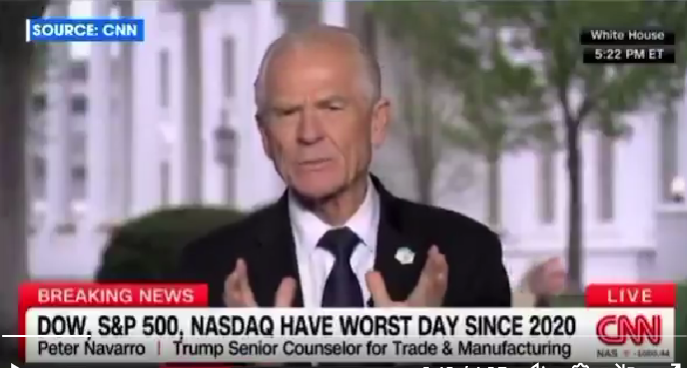
Peter Navarro on the trade deficit: "it's the sum of all cheating"

What the trade deficit does for any given country, it's the sum of all cheating.  It's the sum of all unfair trading practices.

~ Peter Navarro, senior counselor to the president for trade and manufacturing, CNN interview, April 3, 2025


Apr 5, 2025

Kush Desai: U.S. trade deficits are a "national emergency"

The only special interest guiding President Trump’s decisions is the interest of the American people.  The entire administration is aligned on addressing the national emergency that President Trump has rightfully identified is posed by our country running regular trade deficits.

~ White House spokesman Kush Desai, "Wall Street Gets Rude Shock as Bessent Plays Second Fiddle on Tariffs," Bloomberg, April 5, 2025


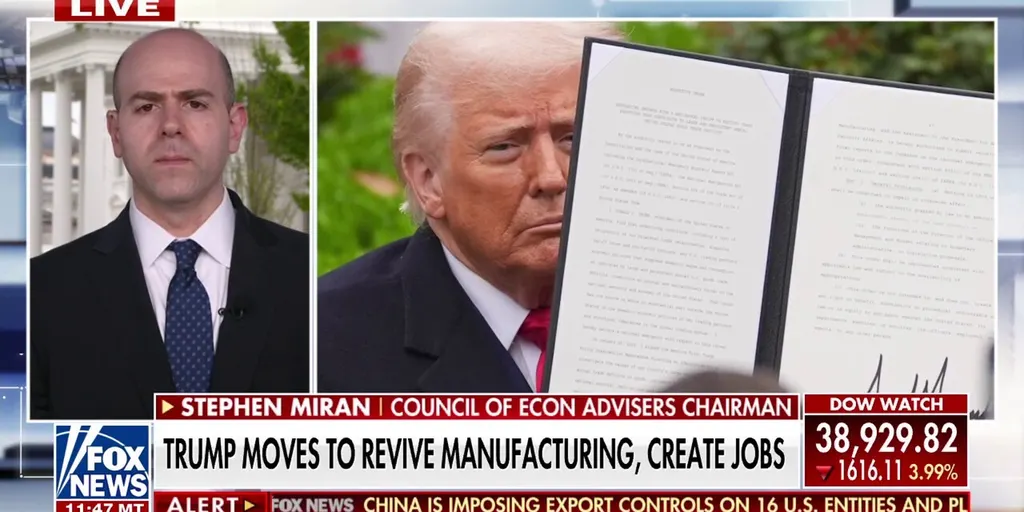
Stephen Miran: "In the long run, the tariff rate will make the United States more competitive"

The wrongs of excessive trade imbalances and the wrongs of excessive globalization didn't happen overnight and they also won't be fixed overnight...  In the long run, the tariff rate will make the United States more competitive, vis a vis our trading partners.

~ Stephen Miran, Fox News interview, April 4, 2025


Feb 9, 2020

Kevin Duffy on exploitation

Quora: How do libertarians address the issue of exploitation?

Duffy: Libertarians differ from most when addressing the issue of exploitation in two fundamental ways. First, they view exchange at the individual level vs. the abstract level. E.g., the “U.S.” doesn’t trade with “China.” Apple engages in various exchanges with Chinese employees, suppliers, consumers and shareholders. Second, they focus on the nature of the exchange. Is it coerced or voluntary? If coerced, exploitation exists; one party benefits at the expense of the other. If voluntary, both parties enter into the exchange because they expect to benefit. The operative word, of course, is “expect.” There are no guarantees and people often look back at decisions with regret. All part of the learning process. The future is uncertain and always will be.

Through the libertarian lens, what are some examples of exploitation? At the individual level, the answer is clear: rape, murder, robbery, fraud.

Greedy capitalists

What about at the abstract level? Do "greedy capitalists" exploit "helpless workers?" As long as no one is putting a gun to anyone’s head, no. If an employer and employee agree to an exchange, both parties expect to benefit. The employer prefers the labor services of the employee over the wage he’s willing to pay. The employee prefers the money he receives above the time spent doing the work. Win-win. If either party feels they are no longer benefiting, they are free to walk away (unless there is a contract that commits both to a certain amount of time).

Trade deficit with China

Is China exploiting the U.S. because they run a large trade surplus? Again, no. Since the exchanges involved are all voluntary, they must be mutually beneficial. Apple sells iPhones to Chinese consumers. Apple receives money (they have a money surplus and goods deficit) while the buyer receives an iPhone (they have a money deficit and goods surplus). Walmart buys products from Chinese suppliers. Even though they run a money deficit, they do so willingly… because they benefit. Walmart's Chinese suppliers run money deficits with their employees. Again, both parties benefit. Trade surpluses and deficits are an accounting fiction. Do you worry about running a chronic trade deficit with your local grocery store?

Sweatshops

Does a multinational firm setting up a factory in a poor country exploit its workers? If entered into freely and peacefully, the exchange only takes place if both parties benefit. E.g., if Nike builds a sneaker factory in Bangladesh, they must make the wages and work environment enticing enough to attract workers from their current jobs. They have to give them a better deal. They have to improve their lives. Some call this “unfair.” Libertarians call it heroic.

Taxation

How does a libertarian judge taxation? Is this a voluntary, mutually beneficial exchange or is it coercive and exploitative? The question answers itself.

~ Kevin Duffy, Quora answer, February 9, 2020

Image result for putting a gun to someone's head