Showing posts with label entrepreneurship. Show all posts

Apr 3, 2024

Kevin Duffy on Phil Duffy's new book 'A Tale of Four Cities'

To economic historians, the “hockey stick of human prosperity” is that irresistible bright shiny object. Up until 1800, the human population and living standards grew at a snail’s pace, but then a strange thing happened: both took off.


[...] 

In A Tale of Four Cities, Phil Duffy asks an intriguing question: “What if the real inflection point took place 100 years or so earlier?”  Have economic archeologists been unearthing evidence in all the wrong places?  Have they drawn false conclusions?

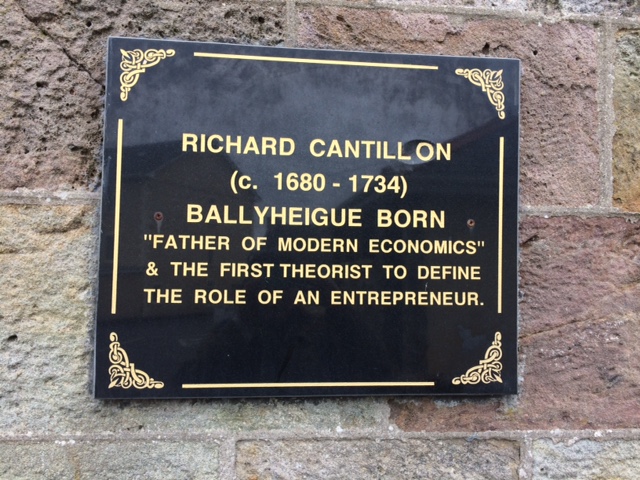
Challenging simple narratives often leads to valuable, contrarian insights.  By shifting the timeline of the starting gun on human progress back a century, Duffy unlocks a treasure trove.  First, he asserts that the actual dawning was the Agricultural Revolution, which laid the foundation for the Industrial Revolution.  Second, he discovers Richard Cantillon, the first economist to recognize the critical role of the entrepreneur in creating wealth.  Cantillon’s Essay on the Nature of Trade in General was written in 1730, long before Adam Smith’s seminal work, The Wealth of Nations.  Third, he makes a compelling case that Smith suppressed Cantillon’s work and removed the role of the entrepreneur, paving the way for misguided theories which treated entrepreneurship as vulgar and exploitative.

This would largely explain why many people in America, far from appreciating their good fortune, are openly hostile towards ultra-rich entrepreneurs like Amazon’s Jeff Bezos.  It also explains why those same billionaires give openly to anti-capitalistic charities.  It explains why so many countries have destroyed themselves by ingesting toxic theories on wealth creation, from sub-Saharan Africa, to the former Soviet Union, to Cuba and Venezuela.  It explains why governments in the West have grown to oppressive levels, threatening to strangle their productive hosts. 

If Duffy is correct, much of the world today enjoys a level of wealth unimagined by our ancestors despite worshipping false idols like Adam Smith, paper money and democracy.  Future economic progress is not a guarantee.  In fact, the human experiment appears to be at a crossroads.  Choosing the right path may just require getting the timeline right on that bright shiny object.

~ Kevin Duffy, Forward to A Tale of Four Cities, April 8, 2023


Jan 14, 2022

Ludwig von Mises on the importance of the entrepreneur

It is impossible to eliminate the entrepreneur from the picture of a market economy.  The various complementary factors of production cannot come together spontaneously.  They need to be combined by the purposive efforts of men aiming at certain ends and motivated by the urge to improve their state of satisfaction.  In eliminating the entrepreneur one eliminates the driving force of the whole market system.

~ Ludwig von Mises, Human Action, pp. 248-249


Sep 11, 2021

George Gilder on the role of the entrepreneur

An entrepreneur is the creative force in economics.  The entrepreneur is the person who comes and looks at a desert or a jungle or a wilderness and sees a garden, sees an opportunity to create new value.  Without the entrepreneur, economies are barren, they're dead.

~ George Gilder, The Call of the Entrepreneur (2007)


Aug 24, 2021

Tony Deden on the business owner

Instead of taking our cues from financial types, let’s consider the owner of a long-standing enterprise.  He wants to avoid going out of business (and so do I).  He is entirely uninterested in what others do (and so am I).  He wants to remain competitive, relevant and enduring (so do I).  Yes, he aims to be profitable but, he really knows that, in the long run, profit is the result of being successful at what you produce, not the result of chasing higher securities prices.  He, too, deploys irreplaceable capital.  He, too, considers the scarcity of his resources and the value they reflect in all his actions.  He knows the difference between something that has financial value and something that has true economic value (so do I), and he wishes to leave something meaningful to the next generation (so do I and so should all of us).

~ Tony Deden, "Arise, prudent man," Grant's Fall 2018 Conference, October 19, 2018


Aug 6, 2021

Brian Chesky on entrepreneurial ideas

If we tried to think of a good idea, we wouldn't have been able to think of a good idea.  You just have to find the solution for a problem in your own life.

~ Brian Chesky, co-founder of Airbnb


Jul 1, 2021

Steve Forbes on the role of profit (and the contrasting views of Adam Smith and Joseph Schumpeter)

Smith, Marx and Keynes all believed in various ways in what you might call an equilibrium, that the economy is a steady state and you get disruptions from time to time, whether wars, earthquakes or new inventions.  You get some turmoil and then things settle down and you have an equilibrium, which is why even John Stuart Mill became a socialist (not because of the influence of his young wife).  He couldn’t understand the role of profit. 

Even Adam Smith did not understand the role of profit.  If you have an economy where you are striving for a perfectly competition equilibrium, there is no role for profit, other than as a bribe for entrepreneurs to do things.  Schumpeter was an infidel, in the words of Peter Drucker.  That is, he saw profit as a cost of doing business, as a moral force.  Why?  Because in his mind the economy is always dynamic.  A free market is dynamic, always changing, what he called creative destruction.  You focus on the creative side.  But it’s also destroying, which means it’s destroying capital and you have to replace that destroyed capital with new capital. 

Also, how does an economy advance?  It advances with new knowledge.  Where does knowledge come from?  Through constant experimentation by entrepreneurs in the marketplace.  Look at Silicon Valley.  Look at Peter Thiel.  He says eight out of ten ventures, even with great brains like his, will fail.  Only two out of ten, maybe one out of ten, will really be successful. 

So, profit is essential if you’re going to have a growing economy.


Mar 4, 2020

Tom Woods on the difference between economics and entrepreneurship

"If you know so much about economics, how come you're not rich?" People really ask that sometimes.

Economics helps us understand how the world works, which policies will make us prosperous and which impoverished. It helps us understand the role of the entrepreneur, which according to Mises is to arrange resources so they add the most value for consumers.

It's easy to understand what the entrepreneur does. But:

It's not easy to understand how the entrepreneur does it. And that's pretty much the whole sack of potatoes, is it not?

~ Tom Woods, March 4, 2020

Image result for tom woods

Feb 10, 2020

Jeffrey Tucker on the discovery process

But what kind of society do we need in order to maximize the potential of this form of spontaneous development of individuals and societies? A society hobbled by preset agendas emanating from fixed regulations and laws presume the opposite of a trial-and-error society. They indulge the illusion of knowledge, the myth of certainty, the fantasy that a static order with known solutions can be forced on everyone.

~ Jeffrey Tucker, "Shakira’s Musical Disquisition on Uncertainty, Creativity, and Entrepreneurship," American Institute For Economic Research, February 4, 2020

Jul 28, 2019

Murray Rothbard on Adam Smith's omission of entrepreneurship

[T]he greatest of the many defects in [Adam] Smith's theory was his totally discarding Cantillon's and Turgot's brilliant analysis of the entrepreneur.  It was as if these great eighteenth century Frenchmen had never written.  Smith's analysis rested solely on the capitalist investing 'stock' and on his labour of management and inspection; the very idea of the entrepreneur as a risk-bearer and forecaster was thrown away and, again, classical economics was launched into another lengthy blind alley.  If, of course, one persists in fixing one's vision on the never-never land of long-run equilibrium, where all profits are low and equal and there are no losses, there is no point in talking about entrepreneurship at all.

The political implications of this omission were also not lost on nineteenth century socialists.  For if there is no role for entrepreneurial profits in a market economy, then any existing profits must be 'exploitative,' far more so than the low, uniform rate existing in long-run equilibrium.

~ Murray Rothbard, An Austrian Perspective on the History of Economic Thought, Vol. I, Chapter 16, "The celebrated Adam Smith," pp. 459-460, 1995

Image result for ballyheigue ireland richard cantillon plaque

Dec 28, 2016

Bono has a change of heart on the cure for poverty

Aid is just a stop-gap.  Commerce (and) entrepreneurial capitalism takes more people out of poverty than aid...  In dealing with poverty here and around the world, welfare and foreign aid are a Band-Aid.  Free enterprise is a cure...  Entrepreneurship is the most sure way of development.

~ Bono, speech at Georgetown University, 2013

Jul 17, 2011

Ludwig von Mises on how to tell an entrepreneur from a non-entrepreneur

There is a simple rule of thumb to tell entrepreneurs from non-entrepreneurs. The entrepreneurs are those on whom the incidence of losses on the capital employed falls.

~Ludwig von Mises, Austrian economist, 1951

Jun 18, 2010

David Ross on what it means to be an entrepreneur

An entrepreneur is someone who sleeps the same whether they've got a million dollars in profit or a million dollars in debt.

~David Ross, PhD (Professor of hot Dogs), former co-president of the Burger Boat Company, founder of Dr. Dawg restaurants, June 12th, 2010

May 15, 2010

Nancy Pelosi on the entrepreneurial spirit of the healthcare reform bill of 2010

We see it as an entrepreneurial bill, a bill that says to someone, if you want to be creative and be a musician or whatever, you can leave your work, focus on your talent, your skill, your passion, your aspirations because you will have health care.

~Nancy Pelosi, Speaker of the House, 110th US Congress, remarks from a speech given to the Asian American and Pacific Islanders Summit, May 14th, 2010

Nov 27, 2007

Friedrich von Hayek on the invisible hand

The aim for which the successful entrepreneur wants to use his profits may well be to provide a hospital or an art gallery for his home town. But quite apart from the question of what he wants to do with his profits after he has earned them, he is led to benefit more people by aiming at the largest gain than he could if he concentrated on the satisfaction of the needs of the known persons. He is led by the invisible hand of the market to bring the succour of modern conveniences to the poorest homes he does not even know.

~ Friedrich von Hayek, Law, Legislation and Liberty, Volume 2

Nov 18, 2007

Nathaniel Branden on compassion

We do not hear the term "compassionate" applied to business executives or entrepreneurs, certainly not when they are engaged in their normal work. Yet in terms of results in the measurable form of jobs created, lives enriched, communities built, living standards raised, and poverty healed, a handful of capitalists has done infinitely more for mankind than all the self-serving politicians, academics, social workers, and religionists who march under the banner of "compassion."

~ Nathaniel Branden

Nov 3, 2007

Burton Folsom on the rise of big business and deficiency of historians

One reason for studying history is to learn from it. If we can discover what worked and what didn't work, we can use this knowledge to create a better future. Studying the rise of big business, for example, is important because it is the story of how the United States prospered and became a world power. During the years in which this took place, roughly from 1840 to 1920, we had a variety of entrepreneurs who took risks and built very successful industries. We also had a state that created a stable marketplace in which these entrepreneurs could operate. However, this same state occasionally dabbled in economic development through subsidies, tariffs, regulating trade, and even running a steel plant to make armor. When the state played this kind of role, it often failed. This is the sort of information that is useful to know when we think about planning for the future.

The problem is that many historians have been teaching the opposite for years. They have been saying that entrepreneurs, not the state, created the problem. Entrepreneurs, according to these historians, were often "robber barons" who corrupted politics and made fortunes bilking the public. In this view, government intervention in the economy was needed to save the public from greedy businessmen. This view, with some modifications, still dominates in college textbooks in American history.

~ Burton W. Folsom, Jr., The Myth of the Robber Barons, pp. 121-122

Image result for the myth of the robber barons folsom

Oct 22, 2007

Sam Walton on who's boss

There is only one boss: the customer. And he can fire everybody in the company, from the chairman on down, simply by spending his money somewhere else.

~ Sam Walton, Wal-Mart founder

Oct 21, 2007

Reagan on entrepreneurship

Entrepreneurs are the forgotten heroes of America.

~ Ronald Reagan, 40th U.S. president

Mises on foresight and profit

Entrepreneurial judgment cannot be bought on the market.  The entrepreneurial idea that carries on and brings profit is precisely that idea which did not occur to the majority.  It is not correct foresight as such that yields profits, but foresight better than that of the rest.  The prize goes only to the dissenters, who do not let themselves be misled by the errors accepted by the multitude.  What makes profits emerge is the provision for future needs for which others have neglected to make adequate provision.

~ Ludwig von Mises, Human Action