Showing posts with label Google. Show all posts

Aug 23, 2022

John Doerr on his early investments in Amazon and Google

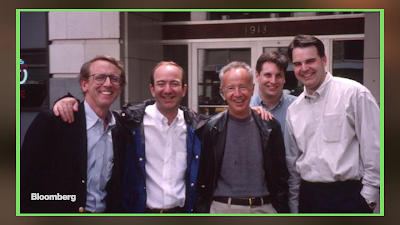
I met Jeff [Bezos] when he was thirty years old and he and I were both computer science kinds of geeks. And Amazon had a business plan: it was growing to be the best bookseller online. And so I invested - I think it was $8 million for 15% of Amazon - and Jeff and I set out to build an amazing, world-class team.  And he had a vision, which is true to this day, that if he had the broadest selection with the most affordable prices and the best customer experience, that flywheel he could get to grow by obsessing on the customer.  And yes, I believed he was successful.  No, I had no idea that it would be worth $1.2 trillion today.

But the same thing happened a few years later when I met two 21-year old Stanford University PhD dropouts, Larry Page and Sergey Brin.  And in that case I invested $11 million for 11% of the company, which was very controversial.  They had no business plan, no revenues.  And I asked Larry Page.  He sat across the table from me.  I said, "Larry, how big do you think this can be?"  Without batting an eyelash he said $10 billion.  I said, "Surely you mean market cap, right?"  He said, "No, I'm talking revenues."  He said to me, "John, you have no idea how much we're going to be able to improve search and how important search is for finding all the world's information and services.

~ John Doerr, Bloomberg Wealth inverview with David Rubenstein, August 23, 2022


Oct 11, 2021

The New York Times: YouTube suppressing "inaccurate claims about climate change"

Google said it would no longer display advertisements on YouTube videos and other content that promotes inaccurate claims about climate change.

[...]

The policy applies to content that refers to climate change as a hoax or scams that deny the long-term trend that the climate is warming, or denies that greenhouse gas emissions or human activity is contributing to climate change.

~ The New York Times, October 8, 2021


Aug 6, 2021

George Gilder on Google, Facebook and the limits of their free model

Q: In your book Life After Google, you discuss some of the tech giants' flawed business models today may not allow them to survive.  Can you elaborate on that?

A: I think companies like Google and Facebook that collect almost all their revenues from advertising and don't have any real liabilities to their customers - no real responsibilities to their customers - they aggregate viewers and sell advertisements, ads that we all know are minuses; people don't want to see their ads, particularily on their smartphones where pop-up ads of various kinds comprise 36% of bandwidth costs for your smartphone and you only intentionally click on the ads 0.03% of the time.  It's a failing model and it's worth recognizing that all the Chinese companies that are really competing with our companies (with three times the population) get 10% or something of their revenues from advertising.  They really have figured out how to collect money from customers.  That's their advantage and we better be alert to this.

Q: It sounds like these companies are starting to become dated...

A: Their free model is debauching them.  Free is not capitalism.  They really don't know how to deal with customers and whenever they have to make a decision, they decide in the end, "ah, it's easier just to give it away for free and collect more data and sell it to advertisers."  This model is reaching the end of the line and we're moving into life after Google!

~ George Gilder, Stansberry Research interview, 5:20 mark, October 11, 2019


Apr 28, 2021

Kevin Duffy on how the 2000 tech bubble led to internet 2.0

The dot-com bubble of 2000 was never the internet itself, but the notion of “first mover advantage.” There was a gold rush mentality to stake claims, and it was the internet pioneers who largely took the arrows in the back. If anything, the optimists underestimated the transformative nature of the new technology. The early 2000s shakeout cleared the way for a powerful second wave that drove the economy and made vast fortunes for the settlers. 

In March 2000, when the NASDAQ Composite peaked at just above 5,000, Amazon.com hadn’t recorded its first $1 billion in sales, Google was in diapers generating $19 million in revenue, and Mark Zuckerberg had yet to reach his 16th birthday. Today the founders of Amazon, Google and Facebook are worth a combined $440 billion and their companies valued at $4.22 trillion, not quite 10% of the total U.S. stock market capitalization.

~ Kevin Duffy, "Bubble Lessons," The Coffee Can Portfolio, April 26, 2021


Jan 18, 2021

Eric Schmidt on Big Tech and privacy

We know where you are.  We know where you've been.  We can more or less know what you're thinking about.

~ Eric Schmidt, Google CEO, 2001-2011


Dec 10, 2020

Evan Lorenz on competition heating up in Big Tech

On Oct. 20, the U.S. Department of Justice filed a suit against Alphabet [parent company of Google], alleging that the search giants payments to Apple, Inc. to make Google the default search engine contravenes U.S. law. To put the Department's suit in perspective, Alphabet pays Apple an estimated $8 billion to $12 billion per year, a sum equal to between 12% and 18% of Cupertino's operating income. Nearly half of all Google searches originate from Apple devices. This is not a parking ticket. However, there appear to be contigency plans. Two-and-a-half years ago, Apple hired John Giannandrea, Google's head of search.  An Oct. 28 report by the Financial Times found that iOS 14, the latest iPhone operating system, used Apple's home-grown search engine for certain user suggestions.

[...]

As we go to press, Apple trades at 35.6 times trailing earnings and Alphabet at 36.5 times.  The stocks seem priced for everything - except competition.

~ Evan Lorenz, "Comity in Washington," Grant's Interest Rate Observer, November 13, 2020


Aug 17, 2020

Dan Ferris on the mania for Big Tech

No one can imagine that Amazon isn't the greatest thing in the world.  No one can imagine that Facebook and Google and Apple... at a $2 trillion market cap.  People simply can't imagine that these aren't the greatest businesses now and forever.  I promise you, they will be disappointed.

~ Dan Ferris, "Kodak Crashes 85% from Recent Peak," Stansberry Investor Hour, 67:00 mark, August 13, 2020

Early Look (9/19/18): Why We Reiterate Our Short U.S. Growth Stocks Ca

Jul 27, 2019

Barron's: DOJ goes after Big Tech even though "none of the companies have traditional monopoly positions"

The Justice Department announced late Tuesday that it has opened a review of “the practices of market-leading online platforms.” The agency didn’t name specific companies, but the wording suggests that it will look into Google parent Alphabet for search, Facebook for social media, and Amazon.com for e-commerce.

[...]

[P]roving consumer harm is a tough task when Facebook’s and Google’s services are mostly free, and Amazon’s e-commerce platform has arguably lowered prices and increased convenience through faster delivery.

In fact, none of the companies have traditional monopoly positions in various markets. EMarketer estimates that Amazon represented 37% of U.S. e-commerce sales in 2018 and 3.5% of total retail sales. The firm also said Google accounted for 50% of U.S. digital-ad spending that year, while Facebook had 22%. Apple’s iPhone had 45% of the U.S. smartphone market, according to eMarketer’s latest data.

~ Tae Kim, "Why Investors Shouldn’t Overreact to the DOJ’s Antitrust Review of Big Tech," Barron's, July 27, 2019

Jul 4, 2019

George Gilder on the new boom based on the Internet economy (2008)

From the pits of the crash of 2000, when the Internet and the dot.com siege were famously dismissed as a barren "bubble," came Google and MySpace to rise up and take all the chips and establish a new Internet economy.  If creativity was not expected, governments could plan it and socialism would work.  But creativity is intrinsically surprising and the source of all real profit and growth.

Because the U.S. remains the world's largest economy and still leads the world in business and technological creativity, the current crisis is mostly confined to boondoggles in finance.  It will pass rapidly and evolve into a new boom.  Emerging is a parallel unregulated financial system based on entrepreneurial creativity and invention.

At the heart of this multitrillion-dollar engine of growth are 741 venture capital firms that traffic in creativity as a business.  These firms command $257 billion under management and have launched companies generating $2 trillion in revenues.

~ George Gilder, "The Coming Creativity Boom," Forbes, November 10, 2008

Jan 20, 2014

Bill Gates on "these Google guys" (2003)

These Google guys (co-founders Larry Page and Sergey Brin), they want to be billionaires and rock stars and go to conferences and all that. Let us see if they still want to run the business in two to three years.

~ Bill Gates, World Economic Forum in Davos, January 2003

(As recalled by DealBook's Andrew Ross Sorkin before the 2013 forum)


Mar 26, 2008

Georges Yared sees Google stock hitting 1,200 in 2009 (2007)

[Google's] 40%-50% growth rate gives it a category-killer status, so we think the stock will hit 1,200 in 2009. [His bold forecast is based on his 2009 earnings estimate of $29 a share on revenues of $29 billion, up from his 2008 estimate of $21 on $16.8 billion, and 2007's $15.60 on $15.6 billion.]

~ Georges Yared, Yared Investment Research, "After a Long Gallop, Is Google Winded?," BusinessWeek, December 3, 2007, by Gene Marcial

(Of 37 analysts who track Google, 33 tag it a buy. None rates the stock a sell.)