Showing posts with label interest rates. Show all posts

Jan 1, 2025

John Michaelson on the trouble with ultralow interest rates

Superlow rates function like Robin Hood in reverse.  They take from retirees and frugal working people who can’t get a decent, risk-free return on their savings and give to the rich, who own most of the appreciating assets.  Would-be home buyers might be clamoring for rate cuts, but low mortgage rates don’t make homes cheaper when we can’t (or won’t) increase supply.

Cheap money promotes unhealthy consolidation in the business world, sustains staid corporate incumbents at the expense of innovative newcomers, and promotes the financialization of the economy.

In short, bankers and private-equity firms love cheap money.  The rest of us get very little out of it.

And yet the Fed’s every instinct is to return to low interest rates.  Its decadelong adherence to low rates and quantitative easing wasn’t based on empirical evidence.  Rather it was based on theoretical models and untested academic dogma.  Unfortunately, the Fed is still dismissive of real-world evidence that ultralow real rates are associated with anemic growth.

~ John Michaelson, Michaelson Capital Partners, "The Era of Low Interest Rates Is Over. Good Riddance.," Barron's, December 7, 2024


Mar 29, 2024

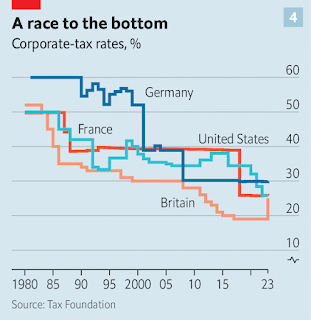
The Economist on the impact of lower interest rates and corporate tax rates on corporate profits (1989-2019)

If the boom has a home, it is America.  A hundred dollars invested in the S&P 500 on January 1st 2010 is now worth $600 (or $430 at 2010's prices).  However you measure them, American returns have outclassed those elsewhere.  Almost 60% of Americans now report owning stocks, the most since reliable data began to be collected in the late 1980s.

[...]

Yet much of this strong performance is, in a sense, a mirage.  Politicians have reduced the tax burden facing corporations.  From 1989 to 2019 the effective corporation-tax rate on American firms dropped by three-fifths.  Since corporations were giving less money to the state, corporate profits rose, leaving them with more money to pass over to shareholders.  Meanwhile, over the same period borrowing became cheaper.  From 1989 until 2019 the average interest rate facing American corporations fell by two-thirds...  We find that in America the difference in profit growth between the 1962-1989 period and the 1989-2019 period is entirely due to the decline in interest rates and corporate-tax rates.

~ "Problems on the horizon: Stockmarkets are booming. But the good times are unlikely to last," The Economist, March 2, 2024


Jan 6, 2024

Jim Grant on making interest rate forecasts

Q: A friend once said, “It’s okay to forecast the end of the world, just don't ever give a date.”  When people ask you about timing, what do you tell them? 

A: Oh, I’ve become very wily.  Years ago, someone asked me to forecast the 10-year yield one year hence, and I had the presence of mind to say no, thank you.  I count that as my journalistic coming of age.  Only rookies pick levels and dates.

~ Jim Grant, The Austrian, January-February 2021


Dec 20, 2018

Jim Grant is asked about Fed chairman Jerome Powell's press conference and stock market's negative reaction

Grant: I don't think it's a matter of communications policy.  I think it's a matter of substance.  To me, the clear and present risk is the consequences - unintended though they may be - of ten years of suppressed and distorted interest rates with the attendant distortions in both the so-called real economy and especially in the financial economy where leverage has been piled upon leverage.

CNBC: So this is inevitable, this kind of negative reaction.

Grant: Certainly after ten years of the lowest interest rates, literally in the 3,000 years of recorded history.

CNBC: We get that you didn't agree with the policy before, but right now are they making a mistake?

Grant: It's not a question of agreeing with it.  The consequences of ten years of distorted interest rates are things that we can't always see, but which are nonetheless there.  For example, the distortions of the leveraged loan market with fine print that's supposed to protect investors has been eviscerated or written down.  Green investments proliferate because there are no interest rates.  Interest rates are meant to measure risk, discount future cash flows and set investment hurdle rates.  When those things are absent or distorted, decisions in real time - real things - are not as they might be.  And exactly what is wrong is revealed in time.  Now, the stock market is a forward looking indicator.  The economy is not a forward looking indicator, right?

~ Jim Grant, interview on CNBC, December 19, 2018

Sep 24, 2017

Jim Grant on the great interest rate suppression experiment

An interest rate is a price.  Prices convey information.  Distorted prices convey misinformation.  Build a new factory?  Reckon the value of a future cash flow?  Deduce financial risk from a credit spread?  Manipulated rates give you the data you need to arrive at the wrong conclusion.

Like the flu, mispricing is communicable.  Like a sneeze, arbitrage transmits the disorder from one place, and one asset class, to the next.  Pygmy interest rates lead to tiny real-estate cap rates and towering equity P/E multiples.

~ Jim Grant, "Meet the Carrefour S.A. senior unsecured 1 3/4s of 2022," Grant's Interest Rate Observer, September 22, 2017

Image result for hedgeye cartoons

May 2, 2017

Donald Trump on Janet Yellen and her low interest rate policy

I like her, I respect her…I do like a low interest rate policy, I must be honest with you.

~ President Donald Trump, interview with The Wall Street Journal, April 12, 2017

Image result for hedgeye cartoons

Feb 25, 2015

John Rubino on negative interest rates

Interest rates are the price of money, and as such they tell investors, entrepreneurs and consumers what to do. Low interest rates generally say “buy, build, consume, take risks” while high rates say “save, sell, conserve, wait.” But zero or negative rates? Are they just an extreme version of low rates or is there a qualitative difference? Everyone has a theory about this but in the absence of historical precedent, we’ll have to wait and see.

~ John Rubino, "Lowest Interest Rates EVER," DollarCollapse.com, February 24, 2015