It is really remarkable how much where we are today looks like the bottom we've had in the last three cycles. Every time we've gone below a million starts, the market has cleared at that moment.
It's bottom-fishing time, I think. There's got to be bargains in Florida, Arizona and Nevada.
~ Prof. Karl E. Case, Wellesley College, "Is Housing Slump at a Bottom?," The Wall Street Journal, May 6, 2008, by Brett Arends

May 9, 2008
John Mackey on exploitation, entrepreneurship, and the profit motive
Politically, I drifted to the Left and embraced the ideology that business and corporations were essentially "evil" because they sought profits. I believed that government was "good" (if the "right" people had control of it) because it altruistically worked for the public interest.
[I'd been taught that] business and capitalism were based on exploitation: exploitation of consumers, workers, society and the environment. I believed that "profit" was a necessary evil at best and certainly not a desirable goal for society as a whole. However, becoming an entrepreneur completely changed my life. Everything I believed about business was proven to be wrong.
No one is forced to trade with a business; customers have competitive alternatives in the marketplace; employees have competitive alternatives for their labor; investors have different alternatives and places to invest their capital. Investors, labor, management, suppliers — they all need to cooperate to create value for their customers.
In other words, business is not a zero-sum game with a winner and a loser. It is a win, win, win, win game.
~ John Mackey, founder and CEO, Whole Foods Market, "The Transformation of John Mackey," Mises.org, June 13, 2008, by Ralph R. Reiland

[I'd been taught that] business and capitalism were based on exploitation: exploitation of consumers, workers, society and the environment. I believed that "profit" was a necessary evil at best and certainly not a desirable goal for society as a whole. However, becoming an entrepreneur completely changed my life. Everything I believed about business was proven to be wrong.
No one is forced to trade with a business; customers have competitive alternatives in the marketplace; employees have competitive alternatives for their labor; investors have different alternatives and places to invest their capital. Investors, labor, management, suppliers — they all need to cooperate to create value for their customers.
In other words, business is not a zero-sum game with a winner and a loser. It is a win, win, win, win game.
~ John Mackey, founder and CEO, Whole Foods Market, "The Transformation of John Mackey," Mises.org, June 13, 2008, by Ralph R. Reiland
May 8, 2008
Kevin Duffy on banks putting their names on major sports stadiums
Today 24 of 72 major sports stadiums have granted naming rights to financial firms, 14 of them banks. (Recall that 19% of the Stadium Class of 2000 -- including PSINet Stadium and Enron Field -- went bankrupt within five years.)
~ Kevin Duffy, Bearing Asset Management, "For Whom Do the Bells Toll", Barron’s, June 18, 2007
~ Kevin Duffy, Bearing Asset Management, "For Whom Do the Bells Toll", Barron’s, June 18, 2007
Charles Biderman on market sentiment
There is a still a huge wall of worry for this market to climb.
~ Charles Biderman, founder and CEO of TrimTabs, "Big Money Bearish But Insiders Bullish," Forbes.com, May 7, 2008
~ Charles Biderman, founder and CEO of TrimTabs, "Big Money Bearish But Insiders Bullish," Forbes.com, May 7, 2008
Ron Paul on truth
Truth is treason in the empire of lies.
~ Ron Paul in the preface to The Revolution: A Manifesto (2008)
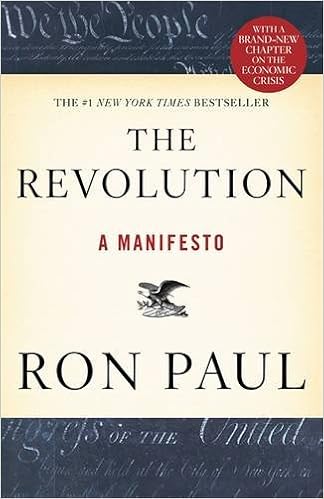
~ Ron Paul in the preface to The Revolution: A Manifesto (2008)
May 7, 2008
Jeff Tucker on the Old Right vs. the military industrial complex
The existence of such an industry scandalized Americans in the interwar period, and there was one treatise that led the way in helping to foment the ourage. In fact, it was a bestseller book in 1934 with the title Merchants of Death. (Here is the PDF and here it is in hard copy.)
We are justified in calling it the first mega-selling conservative book of the 20th century. Why conservative? The lead author was H.C. Engelbrecht, and, most importantly, its co-author was Frank C. Hanighen, who would later become the founder of Human Events, which was the most important weekly publication on the right in the 1940s and 1950s. In other words, the phrase Merchants of Death did not originate on the left but on the right, during the New Deal period when the people later called conservatives became alarmed about the union between big corporations and big government.
This book is not a typical left-wing style attacks on commerce as the essence of war. In fact, it argues the opposite. "The arms industry did not create the war system. On the contrary, the war system created the arms industry."
The blame, then, lies not with the private sector that makes the weapons. "All constitutions in the world vest the war-making power in the government or in the representatives of the people. The root of the trouble, therefore, goes far deeper than the arms industry. It lies in the prevailing temper of peoples toward nationalism, militarism, and war, in the civilization which forms this temper and prevents any drastic and radical change. Only when this underlying basis of the war system is altered, will war and its concomitant, the arms industry, pass out of existence."
The book holds up as a marvelous analysis of how the merchants of death profited from World War I, a fact that the public found riveting and help solidify a strong antiwar temperament in the electorate during those years. This raised consciousness led to a broader insight about the nature of the warfare state: namely, that they only way to restrain it was to keep centralized power of all sorts at bay. The leading spokesmen for the ideal here was later called the Old Right by Murray Rothbard.
How it came to be that the Old Right cause would later be taken up by the New Left, while the New Right came to embrace the warmongering creed of the Old Left – well, let's just say it was a complicated maneuver accomplished in a brief period of time in the late 1950s. Murray Rothbard was there and he chronicled the transition blow by blow. His book is called The Betrayal of the American Right. Sure enough, checking the book, on page 58, we find a nice discussion of Human Events, Frank Hanighen, and the problem of the Merchants of Death.
~ Jeffrey Tucker, "Iron Man and the Merchants of Death," LewRockwell.com, May 7, 2008
We are justified in calling it the first mega-selling conservative book of the 20th century. Why conservative? The lead author was H.C. Engelbrecht, and, most importantly, its co-author was Frank C. Hanighen, who would later become the founder of Human Events, which was the most important weekly publication on the right in the 1940s and 1950s. In other words, the phrase Merchants of Death did not originate on the left but on the right, during the New Deal period when the people later called conservatives became alarmed about the union between big corporations and big government.
This book is not a typical left-wing style attacks on commerce as the essence of war. In fact, it argues the opposite. "The arms industry did not create the war system. On the contrary, the war system created the arms industry."
The blame, then, lies not with the private sector that makes the weapons. "All constitutions in the world vest the war-making power in the government or in the representatives of the people. The root of the trouble, therefore, goes far deeper than the arms industry. It lies in the prevailing temper of peoples toward nationalism, militarism, and war, in the civilization which forms this temper and prevents any drastic and radical change. Only when this underlying basis of the war system is altered, will war and its concomitant, the arms industry, pass out of existence."
The book holds up as a marvelous analysis of how the merchants of death profited from World War I, a fact that the public found riveting and help solidify a strong antiwar temperament in the electorate during those years. This raised consciousness led to a broader insight about the nature of the warfare state: namely, that they only way to restrain it was to keep centralized power of all sorts at bay. The leading spokesmen for the ideal here was later called the Old Right by Murray Rothbard.
How it came to be that the Old Right cause would later be taken up by the New Left, while the New Right came to embrace the warmongering creed of the Old Left – well, let's just say it was a complicated maneuver accomplished in a brief period of time in the late 1950s. Murray Rothbard was there and he chronicled the transition blow by blow. His book is called The Betrayal of the American Right. Sure enough, checking the book, on page 58, we find a nice discussion of Human Events, Frank Hanighen, and the problem of the Merchants of Death.
~ Jeffrey Tucker, "Iron Man and the Merchants of Death," LewRockwell.com, May 7, 2008
Paul Volcker on the demerits of central banks buying mortgage bonds
A direct transfer of mortgage and mortgage-backed securities of questionable pedigree from an investment bank to the Federal Reserve seems to test the time-honored central bank mantra in times of crisis: lend freely at high rates against good collateral. It tests it to the point of no return.
~ Paul Volcker, speech before the Economic Club of New York, April 8, 2008
(Quote cited in "Trust in Central Banks Passes Point of No Return," Bloomberg, April 24, 2008, by Mark Gilbert)
~ Paul Volcker, speech before the Economic Club of New York, April 8, 2008
(Quote cited in "Trust in Central Banks Passes Point of No Return," Bloomberg, April 24, 2008, by Mark Gilbert)
Subscribe to:
Posts (Atom)
