~ "The Road to Serfdom," Chapter 11, “The End of Truth,” p. 161
Feb 20, 2014
Friedrich Hayek on the role of official myths in totalitarian systems
[I]n the disciplines dealing directly with human affairs and therefore most immediately affecting political views, such as history, law, or economics, the disinterested search for truth cannot be allowed In a totalitarian system, and the vindication of the official views becomes the sole object... These disciplines have, indeed, in all totalitarian countries become the most fertile factories of the official myths which the rulers use to guide the minds and wills of their subjects. It is not surprising that in these spheres even the pretense that they search for truth is abandoned...
~ "The Road to Serfdom," Chapter 11, “The End of Truth,” p. 161
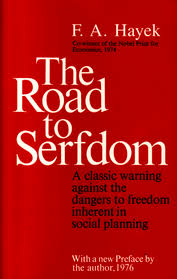
~ "The Road to Serfdom," Chapter 11, “The End of Truth,” p. 161

Feb 17, 2014
Paul Volcker on Harvard University and Great Society elitism
INTERVIEWER: You said Keynesianism was almost a religion at Harvard when you were there?
PAUL VOLCKER: They did have other people there, you know. John Williams was the other macroeconomist there, certainly financial-side, and he was a very skeptical practitioner. He didn't spend all his time professing, and he advised the Federal Reserve back in New York at great lengths. I can't say everybody was Keynesian, but the younger school certainly was. It was Paul Samuelson, Jim Tobin, and all of them had grown up in the Keynesian climate. I didn't know them all, but they were all circulating. They were the bright young stars of Harvard at the time.
INTERVIEWER: When did you begin to have doubts? How early did you begin to become skeptical about things?
PAUL VOLCKER: I was already skeptical. I guess I'm skeptical about everything. I've gotten worse in my old age, but I was a little bit turned off by the precision and certainty that these people attached to the doctrine. The analytic framework was very convincing, but this feeling they had, that they could press the right buttons and manage the economy pretty exactly, for some reason it turned me off. I was very skeptical that they were not overselling the precision of this theory and the precision [with] which they could run policy.
INTERVIEWER: Was that a gut instinct, or was that something you picked up?
PAUL VOLCKER: It must have been a gut instinct. I don't know why, but I was just a little bit turned off by the sense of certainty that they had.
INTERVIEWER: You actually talked about the administrations of Kennedy and Johnson, and you used the word "hubris" in that context. Would you say that that kind of attitude reached a peak?
PAUL VOLCKER: Yes,. There's no question in terms of its policy application that that approach reached its peak in the Kennedy-Johnson years, when in the Harvard years it was still intellectual concept. It really hadn't permeated fully the political decision-making [process]. It hadn't reached its apogee, which it certainly reached in the Kennedy-Johnson days, and they felt they'd solved the problem in the business cycle. They'd solved a problem with macroeconomics; it was time to turn to other microeconomic things, [and] it was time to turn to welfare questions, because they'd solved the problem. I'm not exaggerating very much when I say that. They had a very long period of economic advancement, and things were going pretty smoothly. Productivity was high, and unemployment was low.
~ Paul Volcker, Commanding Heights interview (PBS), September 26, 2000
PAUL VOLCKER: They did have other people there, you know. John Williams was the other macroeconomist there, certainly financial-side, and he was a very skeptical practitioner. He didn't spend all his time professing, and he advised the Federal Reserve back in New York at great lengths. I can't say everybody was Keynesian, but the younger school certainly was. It was Paul Samuelson, Jim Tobin, and all of them had grown up in the Keynesian climate. I didn't know them all, but they were all circulating. They were the bright young stars of Harvard at the time.
INTERVIEWER: When did you begin to have doubts? How early did you begin to become skeptical about things?
PAUL VOLCKER: I was already skeptical. I guess I'm skeptical about everything. I've gotten worse in my old age, but I was a little bit turned off by the precision and certainty that these people attached to the doctrine. The analytic framework was very convincing, but this feeling they had, that they could press the right buttons and manage the economy pretty exactly, for some reason it turned me off. I was very skeptical that they were not overselling the precision of this theory and the precision [with] which they could run policy.
INTERVIEWER: Was that a gut instinct, or was that something you picked up?
PAUL VOLCKER: It must have been a gut instinct. I don't know why, but I was just a little bit turned off by the sense of certainty that they had.
INTERVIEWER: You actually talked about the administrations of Kennedy and Johnson, and you used the word "hubris" in that context. Would you say that that kind of attitude reached a peak?
PAUL VOLCKER: Yes,. There's no question in terms of its policy application that that approach reached its peak in the Kennedy-Johnson years, when in the Harvard years it was still intellectual concept. It really hadn't permeated fully the political decision-making [process]. It hadn't reached its apogee, which it certainly reached in the Kennedy-Johnson days, and they felt they'd solved the problem in the business cycle. They'd solved a problem with macroeconomics; it was time to turn to other microeconomic things, [and] it was time to turn to welfare questions, because they'd solved the problem. I'm not exaggerating very much when I say that. They had a very long period of economic advancement, and things were going pretty smoothly. Productivity was high, and unemployment was low.
~ Paul Volcker, Commanding Heights interview (PBS), September 26, 2000
Paul Volcker on changing political winds on inflation
I was in the Federal Reserve, Treasury, a conservative guy who's always against inflation. The general tenor of the times was inflation was the least of evils, if it's an evil at all. What changed drastically in the 1980s and running through today is the presumption that inflation is bad [and that] the primary job of a central bank is to prevent inflation. That's taken for granted. The great ideology these days is that the central banks ought to be independent; they ought to have an inflation target, and an inflation target ought to be close to zero. That's a very different environment then the '50s and '60s and into the '70s.
~ Paul Volcker, Commanding Heights interview (PBS), September 26, 2000
~ Paul Volcker, Commanding Heights interview (PBS), September 26, 2000
Feb 3, 2014
Paul Richards: "Trust the Fed"
Yeah, the markets did not get off to the kind of start we wanted. But trust the Fed. They would not be tapering if the economy was weakening. They know how to run the economy. When we get to Fridays employment report, things will look a lot better.
~ Paul Richards, UBS Managing Director, as appeared on CNBC, February 3, 2014
(This quote is a paraphrase.)
~ Paul Richards, UBS Managing Director, as appeared on CNBC, February 3, 2014
(This quote is a paraphrase.)
Jan 30, 2014
Mark Zandi expects much stronger economic growth
The U.S. economy is set to experience much stronger growth as the middle of the decade approaches. Businesses are highly profitable and very competitive, households have reduced debt and are saving more, and the banking system is well-capitalized and liquid. The job market is headed in right direction. Broadly speaking the economy is performing steadily better.
~ Mark Zandi, chief economist, Moody's Analytics, "The economy is only going to get stronger: Mark Zandi," The Daily Ticker (Yahoo!Finance), January 30, 2014
(Zandi has a bullish outlook on the U.S. economy: he's forecasting 3% GDP growth this year and 4% growth in 2015. He says better economic growth will also lead to more jobs. He estimates that 3 million new workers will be hired in 2015, up from 2.25 million in 2013 and 2012. That would mean the economy returns to full employment (a federal jobless rate of 5.5% to 6%) by 2016.)
Jan 29, 2014
Jim Cramer on emerging market jitters
This is what happens and you have to ride it through.
~ Jim Cramer, CNBC, January 29, 2014, 8:54 AM ET
(S&P 500 futures 12 points below fair value as Turkish lira lost initial 3% gains from its central bank rate hike to 12% from 7 3/4%.)
~ Jim Cramer, CNBC, January 29, 2014, 8:54 AM ET
(S&P 500 futures 12 points below fair value as Turkish lira lost initial 3% gains from its central bank rate hike to 12% from 7 3/4%.)
Jeremy Siegel: "There is no bubble here" (2014)
Are we getting too pricey?
(He shows a chart showing the S&P 500”s median PE (for 1954 to 2014) is 16.5. The latest PE is 17.2.)
There is no bubble here. All these people that talk about bubbles believe an asset class is in a bubble, if the price is going up and they don’t own it.
(He shows a chart showing the S&P 500”s median PE (for 1954 to 2014) is 16.5. The latest PE is 17.2.)
There is no bubble here. All these people that talk about bubbles believe an asset class is in a bubble, if the price is going up and they don’t own it.
(That gets a laugh from the crowd.)
~ Jeremy Siegel, dubbed the “Wizard of Wharton,” delivered a keynote speech at ETF.com’s Inside ETFs conference in Hollywood, Fla., at about 5 p.m. Eastern on January 28, 2014
~ Jeremy Siegel, dubbed the “Wizard of Wharton,” delivered a keynote speech at ETF.com’s Inside ETFs conference in Hollywood, Fla., at about 5 p.m. Eastern on January 28, 2014
Subscribe to:
Posts (Atom)
